Catastrophic forgetting happens when a neural network loses previously learned capabilities while learning a new task. A model can become more accurate at its latest assignment while performing worse on tasks it handled successfully before training. Also known as catastrophic interference, this problem affects neural networks, continual learning systems, and large language models (LLMs).
The critical issue is not whether the model learned something new. It is whether that improvement came at the expense of capabilities the application still needs.
Catastrophic Forgetting Explained with a Practical Example
Imagine a language model that can summarize documents, translate text, and classify customer support requests. After fine-tuning it exclusively on support ticket classification, the model identifies customer issues more accurately. However, when asked to translate a paragraph, it begins returning classification labels instead of translated text.
The model has improved at one task while losing reliability on another. This is a practical example of the behavior associated with catastrophic forgetting, although the cause still needs to be verified through testing.
In AI Model Fine-Tuning, I consider the original model's performance just as important as its improvement on the new task. A fine-tuned model that performs one specialized job perfectly but loses essential general capabilities is not necessarily an improvement over the original.
The same problem appears in continual learning, where a neural network learns multiple tasks sequentially. A model trained to recognize one set of image categories can lose accuracy on those categories after training exclusively on a new set.
The defining characteristic is measurable deterioration on previously learned tasks following additional training. The model does not need to lose every previous capability for catastrophic forgetting to occur.
Causes of Catastrophic Forgetting in Neural Networks
Neural networks learn by adjusting internal parameters called weights. During training, an optimization algorithm changes these weights to reduce errors on the available training data.
The problem begins when weights supporting earlier tasks are also important for learning new ones.
When training moves to a new dataset, the optimization process prioritizes the current objective. If the training procedure does not preserve performance on earlier tasks, parameter updates can interfere with representations the model previously learned.
This conflict is known as the stability-plasticity dilemma.
Stability refers to preserving existing knowledge, while plasticity describes the model's ability to learn new information. A network with insufficient plasticity struggles to learn new tasks. Excessive changes to parameters that support previous tasks can damage established capabilities.
Three factors deserve particular attention.
Sequential Training on Different Tasks
When a model learns Task A followed by Task B, the training objective for Task B does not automatically protect its performance on Task A.
If both tasks rely on overlapping parameters, updates that improve the second task can reduce accuracy on the first.
Narrow Training Data
A fine-tuning dataset containing only one task gives the optimizer little direct incentive to preserve unrelated capabilities.
For example, training an assistant exclusively on rigid classification outputs can shift its responses toward that format, even when users request explanations or free-form answers.
This behavior must be evaluated against the original model to distinguish genuine forgetting from broader changes in response style.
Unrestricted Parameter Updates
Full-parameter fine-tuning allows updates throughout the model. Large or repeated updates increase the opportunity for interference with representations supporting earlier tasks.
Learning rate, training duration, dataset composition, and the selected optimization method all influence the outcome.
These factors should be evaluated together rather than assuming that adjusting a single training parameter will eliminate forgetting.
Catastrophic Forgetting in LLM Fine-Tuning
Catastrophic forgetting in LLMs is especially important because language models perform many different tasks using shared parameters.
A general-purpose model can support reasoning, multilingual communication, summarization, information extraction, and instruction following. Fine-tuning it for a specialized application changes how those capabilities are expressed.
Research on continual fine-tuning has documented declines in previously acquired knowledge and task performance after additional instruction training.
The effects extend beyond factual knowledge. A fine-tuned model can lose accuracy in reasoning benchmarks, follow instructions less consistently, or perform worse in languages that were absent from the new training data.
I would not evaluate such a model solely on its specialized task. For a customer support assistant, successful ticket resolution matters, but so do its ability to follow constraints, interpret unusual requests, and avoid unsupported claims.
LoRA and Parameter-Efficient Fine-Tuning
Low-Rank Adaptation (LoRA) updates a small set of trainable adapter parameters while keeping the original base weights frozen.
This reduces the number of trainable parameters, but LoRA does not guarantee protection against catastrophic forgetting.
The base model's original parameters remain unchanged, yet an active adapter alters the model's effective behavior. Those changes can reduce performance on previously supported tasks.
An important distinction is that retaining an unchanged base checkpoint allows the original model to be used again without the adapter. That does not mean the adapted model itself has preserved every original capability.
Detecting Catastrophic Forgetting After Training
I begin by comparing the fine-tuned model against its original checkpoint on tasks both models are expected to handle.
Testing only the new training objective can conceal deterioration elsewhere. A classification model might achieve excellent accuracy on its new dataset while losing the ability to process previously supported categories.
The comparison needs identical test inputs, evaluation criteria, model prompts, and inference settings. Otherwise, changes unrelated to training can influence the results.
I separate the evaluation into three areas.
Previously supported tasks: Test the capabilities the original model already performed successfully. These results establish whether earlier performance has declined.
Newly learned tasks: Evaluate the specialized behavior introduced during fine-tuning. This shows whether the additional training delivered its intended benefit.
General capabilities: Test instruction following, reasoning, output formatting, and other abilities essential to the application's broader operation.
A decline in these results is evidence of regression, but not automatic proof of catastrophic forgetting. Changes to prompts, tokenization, inference configuration, or evaluation data must also be ruled out.
Catastrophic Forgetting vs. Overfitting
These problems are related but not interchangeable.
Overfitting occurs when a model learns patterns in its training examples that do not generalize effectively to unseen examples.
Catastrophic forgetting concerns deterioration in previously learned performance after training on new information.
A model can overfit its new dataset without losing its original abilities. It can also experience catastrophic forgetting while achieving strong results on independent examples from the new task.
The distinction matters because improving generalization on the new task does not automatically restore capabilities lost from earlier training.
Measuring Catastrophic Forgetting
The most useful way to measure forgetting is to track performance on previously learned tasks across training stages.
Consider a hypothetical evaluation of a model trained sequentially on two tasks.
After learning Task A, the model achieves 90% accuracy on its held-out test set. Following training on Task B, its accuracy on the original Task A test set falls to 65%.
That represents a 25-percentage-point decline in previously measured performance.
If performance on Task B improved during the same period, the result demonstrates the trade-off between learning the new task and retaining the old one.
For multiple training stages, I track each task's performance after it is learned and compare that result with its performance after subsequent training.
A common forgetting measure compares a task's best previous evaluation score with its score after later training. This captures deterioration that a final average accuracy score can hide.
Backward Transfer (BWT) provides another perspective by measuring how learning later tasks affects performance on earlier ones. Negative backward transfer indicates that subsequent training has harmed earlier performance under the chosen evaluation definition.
For generative LLMs, the evaluation also needs task-specific measures. Exact-match accuracy is suitable for structured extraction, while instruction-following checks and consistent scoring criteria are needed for open-ended responses.
I keep the evaluation dataset independent of training data. Testing on memorized examples would make knowledge retention appear stronger than it is.
Methods to Prevent Catastrophic Forgetting
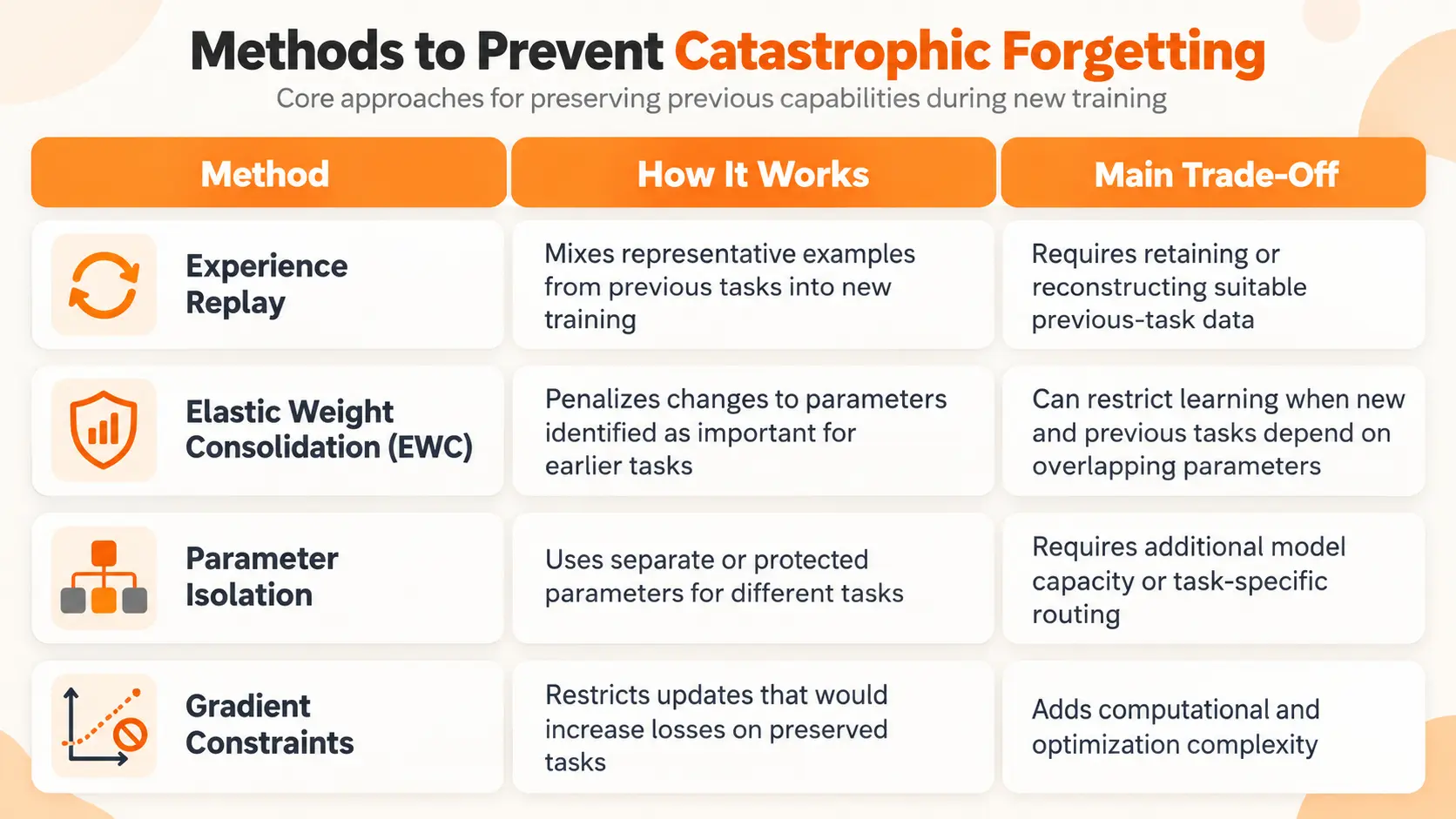
Preventing catastrophic forgetting requires protecting valuable previous capabilities while allowing the model to learn new information.
Several methods address this problem through different mechanisms.
Experience Replay and Knowledge Retention
Experience replay directly addresses the absence of earlier tasks from the new training objective.
Instead of training only on new examples, the model receives a mixture of new-task data and representative samples from previous tasks.
This allows optimization to account for both objectives during training.
For LLM fine-tuning, the preserved examples should represent capabilities that remain important to the application, including instruction following, formatting, and supported languages.
The ratio between old and new examples needs to be selected through evaluation. Excessive emphasis on previous tasks can restrict adaptation, while insufficient coverage leaves important capabilities unprotected.
Elastic Weight Consolidation
Elastic Weight Consolidation, introduced by Kirkpatrick and colleagues in 2017, protects previously learned tasks by limiting changes to parameters estimated to be important for those tasks.
EWC adds a regularization penalty to the training objective. Parameters assigned greater importance receive stronger resistance to change.
This helps preserve earlier knowledge without requiring every parameter to remain frozen.
The limitation is the balance between protection and adaptation. Strong constraints can prevent the model from learning necessary new representations, particularly when tasks depend on the same parameters.
Parameter Isolation and LoRA Adapters
Parameter isolation approaches protect earlier tasks by separating parts of the model used for different learning objectives.
Progressive Neural Networks, for example, preserve previously trained network components while adding capacity for new tasks.
For LLMs, maintaining separate task-specific adapters provides another way to isolate modifications while preserving an unchanged base checkpoint.
However, serving several tasks through one active adapter still requires evaluation for interference. Separate adapters also introduce decisions about which adapter should handle each request.
Training Controls and Early Stopping
Controlling learning rate, training duration, and checkpoint selection helps limit unnecessary parameter changes.
I would evaluate model performance at multiple checkpoints rather than selecting the final checkpoint solely because it achieved the lowest new-task training loss.
Early stopping can prevent additional deterioration after a suitable checkpoint is reached, but it cannot guarantee that forgetting has been avoided.
The deciding evidence remains performance on both the new task and the previously supported tasks.
Continual Learning and Knowledge Preservation
Continual learning aims to help models acquire new knowledge or skills over time without losing valuable previous capabilities.
Catastrophic forgetting is one of the central challenges in achieving that objective.
The choice of preservation method depends on what the system actually needs to retain.
If an application requires frequent factual updates but not changes to model behavior, keeping information in an external retrieval system can reduce the need for repeated fine-tuning. Retrieval-Augmented Generation (RAG) provides information at inference time without updating the model's weights.
This does not repair catastrophic forgetting inside a model that has already been modified. It changes how updated information is supplied to the application.
When the objective is to teach new behavior, improve a specialized skill, or adapt internal representations, model training remains relevant, and retention must be evaluated directly.
Preserving Model Performance During Deployment
Before deploying a newly trained model, I would establish acceptance criteria for both specialized performance and retained capabilities.
A model that improves the target task but fails essential existing requirements should not replace the previous production checkpoint.
The evaluation should also include requests that combine old and new capabilities. A specialized model may classify a customer issue correctly while failing to explain the result in the required language or format.
Testing each capability separately does not establish that the model can combine them effectively.
For systems updated through sequential training, retaining previous checkpoints, dataset versions, and evaluation results makes regressions traceable and allows controlled rollback when necessary.
The objective is not simply to prevent every change in model behavior. It is to preserve the capabilities the application depends on while demonstrating measurable improvement from new training.
Conclusion
Catastrophic forgetting is not simply a consequence of learning new information. It becomes a problem when that learning reduces capabilities a model still needs to perform reliably. For developers working with LLMs and neural networks, the real measure of successful training is improvement without unacceptable losses in previous performance.
I consider knowledge retention a core part of model evaluation, not something to address after deployment. By establishing reliable baselines, testing earlier capabilities, and selecting training methods that balance adaptation with retention, developers can build AI systems that learn new tasks while maintaining the performance their applications depend on.
FAQ
Can I recover a model's old skills after catastrophic forgetting?
Recovery depends on the available checkpoints and training data. Restoring an earlier checkpoint restores that checkpoint's original behavior. Additional training using representative previous-task data can recover lost performance, but full recovery is not guaranteed. Without an earlier checkpoint or suitable training data, recovery becomes more difficult to verify.
Does catastrophic forgetting affect image recognition models too?
Yes. Image classification networks can lose accuracy on previously learned categories after sequential training on new categories. This behavior is a central concern in class-incremental learning, where a model must recognize new classes while retaining its ability to classify earlier ones.
Can I measure forgetting without access to the original training dataset?
Yes, provided reliable evaluation data and earlier performance results are available. A held-out benchmark can measure changes in previously supported abilities without containing the original training examples. Without a recorded baseline, however, the exact amount of performance lost cannot be established reliably.
Will a larger model automatically forget less?
No. Increasing parameter count does not guarantee stronger knowledge retention. Forgetting depends on the model architecture, training procedure, task sequence, and evaluation setting. Research on continual fine-tuning has documented substantial forgetting in larger language models as well as smaller ones.
Can synthetic data help preserve old capabilities during fine-tuning?
Yes. Synthetic examples can be used to represent previous tasks when suitable original data is unavailable. Their labels, content quality, and task coverage must be validated before training. Synthetic data that misrepresents earlier tasks can reinforce incorrect behavior rather than preserve the intended capabilities.

Fatemeh Jahangard
Technology & AI Writer at PinerookFatemeh Jahangard covers AI, emerging technologies, and digital innovation for Pinerook, focusing on how technology shapes startups and industries.
 Seen first.


