AI agent orchestration is the process of coordinating AI agents, tools, and workflows to complete a shared objective. It determines which agent handles each task, how information moves between them, and what happens when a task fails or needs human approval.
The important part isn't getting several agents to work together. It's making sure their work produces a reliable result.
When I look at an orchestration system, I focus on three things: who controls the workflow, how agents share information, and whether the system can recover when something goes wrong. Those decisions matter far more than the number of agents involved.
How AI Agent Orchestration Works
An AI agent can interpret instructions, use tools, and complete tasks within its assigned capabilities. Orchestration manages the process surrounding those actions.
Consider a request to investigate a customer's billing problem. One agent retrieves payment records, another checks subscription access, and a third prepares a response. Without coordination, those agents are separate systems producing separate results.
The orchestration layer connects their work into one process.
Task Planning and Agent Selection
The process begins with a goal. The orchestrator identifies the required tasks, their dependencies, and which agents have the right capabilities.
For example, a request to prepare a competitive analysis involves collecting information, evaluating competitors, comparing findings, and preparing a report.
Some work can happen simultaneously. Other tasks depend on earlier results.
I prefer separating these dependencies before assigning tasks. It makes the execution path easier to control and prevents agents from working with information that isn't ready.
Execution and Communication
Once the tasks are assigned, the orchestrator starts the required agents and manages the flow between them.
An agent can return a completed result, request additional information, invoke an approved tool, or transfer responsibility to another agent.
The orchestration system decides how to handle each outcome. It can continue to the next task, start another agent, pause execution, or stop the workflow.
A crucial distinction is that this decision doesn't have to come from an AI model. Developers can define execution rules in code, allow a model to choose the next action, or combine both approaches.
State Management and Result Validation
As agents complete tasks, the system records what has happened and what remains unfinished.
This execution state includes task status, intermediate outputs, relevant identifiers, and the results of tool calls. It allows the workflow to resume from a saved checkpoint instead of restarting everything.
Before the process finishes, outputs must also pass the required checks. These can include structured-data validation, business rules, permission checks, and human approval.
An orchestrator doesn't guarantee that an agent's answer is correct. It provides the controls needed to verify results before they affect other systems.
Core Components of an AI Agent Orchestration System
An orchestration system is more than a collection of AI models. Its components need clearly defined responsibilities.
Orchestrator and Specialized Agents
The orchestrator manages execution, while specialized agents perform assigned tasks.
A research agent retrieves and evaluates information. A technical agent investigates system problems. A financial agent works with billing data within its permissions.
Their responsibilities should be narrow enough to test independently.
I don't see a reason to create a separate agent for every small action. Reading a database record or applying a fixed calculation can be handled by a regular software function. An AI agent adds value when the step requires interpretation, judgment, or adaptive tool use.
Memory and Shared State
Agents need access to information relevant to their work, but not every agent needs the same context.
Shared state keeps the current workflow consistent. Persistent memory stores information that must remain available beyond a single execution.
These are different requirements. A workflow checkpoint records progress, while long-term memory can preserve approved preferences, historical context, or previously retrieved knowledge.
A dedicated AI Agent Memory strategy becomes important when workflows span multiple sessions or depend on past interactions. It also raises questions about retention, access permissions, and keeping stored information accurate.
My preference is to give each agent only the context needed for its assigned task. Passing the entire conversation and every previous output to every agent increases processing costs and exposes unnecessary information.
Tools, Permissions, and Runtime Controls
Tools connect agents to databases, APIs, documents, and business applications.
The runtime controls which operations are available, how long execution can continue, and what happens when a tool returns an error.
Permissions must be enforced by the application and the external systems themselves. An instruction telling an agent not to delete records is not a replacement for restricting its credentials.
This separation is essential when AI agents move beyond generating text and begin modifying real business data.
AI Agent Orchestration Architecture
Before choosing an execution pattern, I look at where the authority to coordinate work sits.
Three architectural approaches define that relationship.
Centralized Orchestration
A central controller assigns tasks, tracks progress, and collects results from specialized agents.
This architecture gives developers a clear place to inspect the workflow, enforce policies, and manage failures.
It's a strong starting point for business processes with defined responsibilities, such as support operations, document processing, and internal reporting.
The trade-off is the dependence on the central controller. Its reliability, availability, and capacity become important as workload increases.
Decentralized Orchestration
In decentralized coordination, agents can transfer work directly to other agents without routing every decision through one central manager.
This allows an agent to identify when another specialist is better equipped to continue the task.
However, task ownership, communication rules, and shared-state consistency still need to be defined. Decentralization does not eliminate orchestration; it distributes coordination responsibilities.
Hierarchical Orchestration
Hierarchical systems introduce several levels of coordination.
A top-level orchestrator divides a complex objective into larger assignments. Lower-level coordinators then manage specialized groups of agents.
This makes sense when the system includes distinct operational domains, such as finance, customer operations, and product engineering.
I would not introduce this structure into a small application without a clear need. Every coordination layer adds dependencies, monitoring requirements, and additional failure points.
AI Agent Orchestration Patterns
Architecture defines where control lives. Orchestration patterns define how work moves between agents.
This distinction matters because a centralized architecture can support different execution patterns depending on the task.
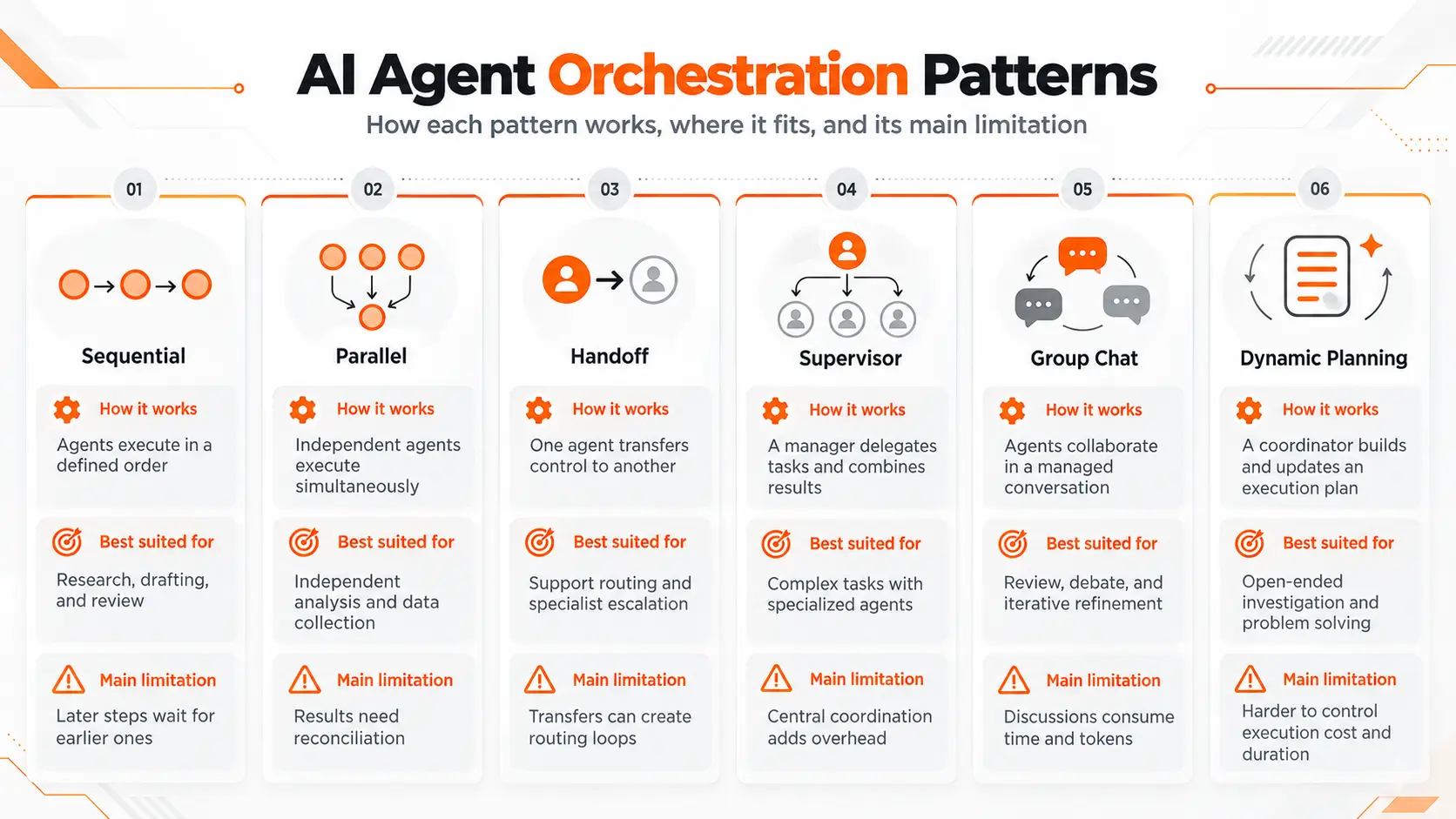
These patterns are not interchangeable.
For a fixed content review pipeline, sequential execution provides predictable dependencies. For independent evaluations of the same dataset, parallel execution can reduce elapsed time.
A handoff pattern fits requests where the required expertise becomes clear during the conversation. A supervisor pattern keeps one coordinating agent responsible for the broader objective.
For open-ended tasks, dynamic planning provides flexibility, but it also requires strict limits on iterations and resource consumption.
AI Agent Orchestration Example in Customer Support
To make the architecture more concrete, consider a hypothetical SaaS business managing subscription support.
A customer sends this message:
"I was charged twice for my subscription, and I still can't access my account."
The request contains two separate issues: a payment dispute and an account access problem.
A single support agent could investigate both, provided it has the right tools and permissions. But the company has separated financial operations from account administration for security reasons.
That creates a clear case for coordinating specialized agents.
Request Classification
The orchestration system receives the message and identifies two tasks.
The billing task requires access to payment records. The account task requires subscription and access information.
Each task receives the relevant customer identifier and a defined set of permitted operations.
Parallel Investigation
The billing agent checks the transaction records for duplicate charges.
At the same time, the account agent checks whether the customer's subscription is active and whether access permissions match the subscription status.
The two investigations are independent, so the orchestrator can run them in parallel.
Result Collection and Action Approval
Both agents return structured findings.
The orchestrator checks whether their results contain the required information and whether any proposed actions need authorization.
If a refund is justified, the system prepares the request for approval according to the company's financial policy. The agent cannot bypass that approval by generating a persuasive explanation.
The account issue can proceed through an independently authorized recovery process.
Final Customer Response
After the approved actions are completed, the system combines the verified results into one response.
The customer receives an explanation of the payment investigation, the account status, and the actions taken.
The value of orchestration here isn't that three agents are better than one. It's that financial and account operations remain separated while the customer experiences one coordinated support process.
Agent Communication and Integration Protocols
Multi-agent systems need a way to exchange information, but not every orchestration system requires a dedicated agent communication protocol.
Agents operating inside the same application can communicate through framework-managed state, function calls, or internal messaging.
The situation changes when independent agents operate across different services, organizations, or development frameworks.
Agent-to-Agent Communication
The A2A Protocol provides a standardized approach for communication between independent AI agent systems.
It supports discovering another agent's capabilities, exchanging messages, and managing tasks across service boundaries without requiring access to the remote agent's internal implementation.
This matters when a company wants its internal agent to collaborate with an external service operated by another provider.
A2A handles communication between agent systems. It does not replace the application logic responsible for deciding which tasks should be delegated or whether the returned results are acceptable.
Connections to External Tools
Model Context Protocol, or MCP, addresses a different integration requirement.
MCP provides a standardized interface through which AI applications can discover and use external tools, resources, and prompts.
A customer support agent, for example, can use an MCP-connected tool to retrieve account information from an approved system.
The distinction behind MCP vs A2A is straightforward: MCP connects AI applications to capabilities and context, while A2A enables collaboration between independent agent systems.
Both can operate within the same architecture. Neither eliminates the need for execution control, access policies, or result validation.
AI Agent Orchestration Tools and Frameworks
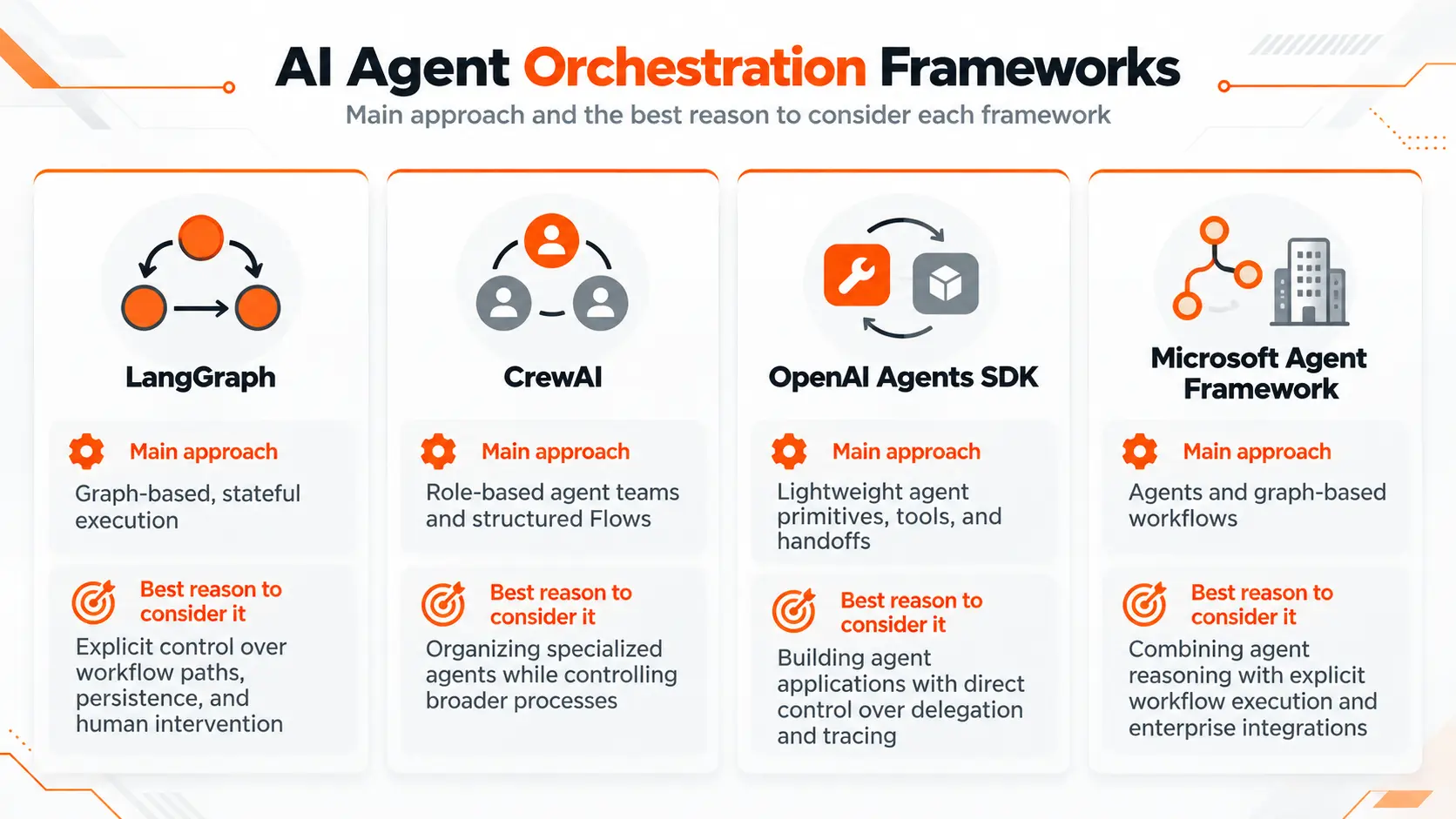
Several development frameworks support agent coordination, but they expose different levels of control over execution.
I wouldn't choose one based on the number of agents in a demonstration. The more useful comparison is how the framework handles state, workflow ownership, approvals, and debugging.
LangGraph
LangGraph centers orchestration around a graph of execution steps and shared state.
Developers define how tasks move between nodes, how progress is persisted, and where execution pauses for external input.
I find this approach most relevant when the workflow has complex branching, long-running tasks, or approval requirements that must survive interruptions.
CrewAI
CrewAI provides two complementary concepts: Crews and Flows.
Crews organize specialized agents around collaborative tasks. Flows provide structured control over execution paths, events, and state.
That distinction makes CrewAI relevant to teams that want recognizable agent roles without giving up control of the surrounding business process.
For developers who want to understand the implementation sequence, a dedicated CrewAI Tutorial can cover agent definitions, tasks, tools, and Flow configuration without turning this orchestration guide into a coding lesson.
OpenAI Agents SDK
The OpenAI Agents SDK supports orchestration through model-directed delegation and code-defined execution.
Two useful approaches are agents as tools and handoffs.
With agents as tools, a manager retains responsibility for the final result while calling specialists for bounded tasks. With handoffs, responsibility passes to another agent.
The SDK also provides tracing and guardrail mechanisms, giving developers ways to inspect and control execution.
Microsoft Agent Framework
Microsoft Agent Framework combines individual agents with explicitly defined workflows.
Its orchestration capabilities include sequential, concurrent, handoff, group-chat, and manager-directed patterns.
The framework is relevant when applications need a combination of AI reasoning, conventional code, execution checkpoints, and integration with existing enterprise systems.
Selecting the Right Framework
The framework decision should follow the architecture, not determine it.
If I need detailed control over a stateful execution graph, I would evaluate LangGraph first. If the central requirement is organizing collaborating specialists, CrewAI belongs on the shortlist.
For a fuller comparison of the two approaches, LangGraph vs CrewAI deserves its own analysis covering implementation complexity, persistence, debugging, and workflow control.
Framework capabilities also evolve. Before committing to a production system, I would test the required behavior against the current documentation and a working prototype.
Building an AI Agent Orchestration System
I would approach implementation as a controlled engineering process, not as an exercise in connecting as many agents as possible.
Define a Narrow Business Objective
Start with one measurable workflow.
For example, reducing the time required to investigate subscription access problems is a clearer objective than automating the entire customer support department.
Record how the process performs before introducing AI. This establishes a baseline for evaluating whether orchestration adds value.
Separate Reasoning From Fixed Rules
Identify which steps require AI reasoning and which belong in conventional software.
A model can interpret a customer's request or summarize evidence. A fixed rule should determine whether a refund exceeds the amount an automated system is allowed to authorize.
This division keeps critical business requirements outside the model's discretion.
Specify Agent Inputs and Outputs
Every agent needs an input contract, an output format, and a defined responsibility.
For a billing investigation, the output could contain a transaction identifier, verified charge status, supporting evidence, and an escalation flag.
Structured outputs make downstream validation easier than relying on unrestricted text.
Establish Execution Boundaries
Set limits for model calls, tool invocations, retries, running time, and total expenditure.
Define what happens after those limits are reached. The workflow must stop or escalate rather than continue indefinitely.
For actions with external effects, such as issuing refunds or sending messages, use unique operation identifiers so retries do not create duplicate transactions.
Test Complete Workflows
Testing agents individually is necessary, but it doesn't prove the combined workflow is reliable.
I would test complete scenarios involving missing information, unavailable tools, contradictory outputs, permission failures, and requests that require human approval.
The final test isn't whether each agent produced a plausible response. It's whether the entire system reached the correct outcome without violating its operational rules.
Reliability, Cost, and Security in Production
A working demonstration proves that an execution path is possible. Production readiness requires evidence that the system can handle repeated use, failures, and changing inputs.
Reliability and Recovery
Agents depend on models, databases, external APIs, and other services. Any of those dependencies can fail.
The workflow needs timeouts, retry policies, saved execution state, and defined escalation paths.
A failed step should not silently become a successful result. If a required billing lookup fails, the system must not invent a transaction status to finish the customer's request.
Latency and Operating Cost
Every additional model call contributes to resource consumption. Sequential calls increase total execution time, while parallel execution can increase concurrent usage and pressure on service quotas.
The useful cost measure is not simply the price of one model request.
For a customer support application, I would track cost per correctly resolved case, including retries, validation, infrastructure, and human review.
An orchestration system that uses cheaper models but requires excessive retries can cost more than a simpler design.
Security and Auditability
Each agent should operate with the minimum access required for its work.
External content must be treated as untrusted input. A document, website, or tool response should not be able to override the application's permissions or instructions.
Production logs also need enough detail to identify which agent requested an action, what data it accessed, whether approval was granted, and which external operation succeeded.
Those records are essential when investigating unexpected changes to business systems.
Measuring Workflow Quality
I would evaluate an orchestration system using four measurements:
Task success rate: The percentage of requests completed according to verified acceptance criteria.
End-to-end latency: The time between receiving a request and reaching its final state.
Cost per successful task: Total execution expenditure divided by successfully completed tasks.
Escalation and failure rate: The share of requests that require intervention or end without an accepted result.
These measurements reveal whether a more complex architecture is delivering measurable benefits.
Choosing Between a Single Agent and Multi-Agent Orchestration
More agents do not automatically produce better results.
A single agent with carefully selected tools can complete many workflows without requiring a network of specialists.
I would keep the system simple when one agent can understand the task, access the necessary tools, and complete it within acceptable limits.
Multi-agent orchestration becomes justified when work requires separate areas of expertise, distinct access boundaries, parallel investigation, or complex delegation that a single agent cannot handle reliably.
There is also a middle ground: a deterministic workflow that invokes AI only for selected steps.
For a startup, that approach can be more practical than building a fully autonomous team of agents.
The architectural question is not how much autonomy the technology supports. It is how much autonomy the process actually needs.
Final Thoughts
AI agent orchestration turns separate AI capabilities into a coordinated process with defined responsibilities, execution rules, and operational controls.
Its value comes from managing the connections between tasks: deciding what runs next, preserving the right information, validating results, and preventing failures from spreading through the system.
My approach is to begin with the simplest design that meets the business objective, then introduce specialized agents when their contribution can be measured.
A successful orchestration system isn't the one with the most sophisticated agent network. It's the one that delivers a correct result, respects its permissions, and remains understandable when something fails.
FAQ
Can I run all my AI agents on my own servers?
Yes. A self-hosted orchestration system can use locally deployed models, databases, and execution infrastructure. Full control also requires self-hosting the supporting services. Any external model API or managed integration introduces an external dependency.
Can two agents in the same workflow use different AI models?
Yes. Each agent can use a different model or provider when the framework and application integrations support them. The orchestration layer must normalize the data exchanged between agents so that provider-specific response formats do not break downstream tasks.
What happens if an external API hits its rate limit halfway through?
The workflow should respect the API's rate-limit response, delay further requests according to the configured retry policy, and preserve completed work. Once the retry limit is reached, execution must enter a defined failure or escalation state rather than continuing with incomplete data.
Can I disable one agent without shutting down everything?
Yes, provided the application supports runtime configuration or controlled deployment changes. Disable new task routing to that agent, then direct affected requests to an approved alternative or an escalation queue. In-progress tasks must follow an explicit cancellation or completion policy.
How do I stop an agent from sending the same email twice?
Assign the email operation a unique idempotency key and record its delivery status in durable storage. Before a retry, check whether the operation has already succeeded. The same approach applies to payments, refunds, order creation, and other actions that must not be repeated.
Can I update the workflow while older tasks are still running?
Yes, with workflow versioning. Store the version associated with each execution and preserve compatibility for existing tasks. New requests can use the updated workflow while unfinished requests complete under their original version or pass through an explicitly tested migration process.
How do I delete customer information from an agent system?
Identify every location where the information is stored, including persistent memory, conversation records, checkpoints, vector indexes, logs, and external integrations. Apply the relevant deletion and retention requirements across those systems, then verify completion. Deleting an agent's conversation history alone is insufficient.
Can these workflows run overnight without anyone monitoring them?
Yes, if the runtime supports unattended execution, durable task processing, and automated operational monitoring. Workflows requiring human approval must remain paused until an authorized person responds. Critical failures should generate alerts rather than leaving the system to continue without oversight.
How do I test agents without sending real emails or charging customers?
Use sandbox environments, mocked APIs, and test credentials. Replace production actions with controlled test implementations that record the requested operation without executing it. Validate the expected state transitions and approval rules before enabling live integrations.
What happens if my AI model provider goes offline?
The application can route eligible tasks to a configured backup provider, provided the models and tools are compatible with the required workflow. Tasks that cannot safely use the backup must pause or fail explicitly. Provider failover requires prior testing because different models can produce different outputs and tool-calling behavior.

Fatemeh Jahangard
Technology & AI Writer at PinerookFatemeh Jahangard covers AI, emerging technologies, and digital innovation for Pinerook, focusing on how technology shapes startups and industries.
 Seen first.


