
AI agent memory is the system that allows an AI agent to retain, retrieve, and reuse information from previous interactions and tasks. It helps agents maintain context, remember user preferences, and continue work without rebuilding the same information every time.
But storing information is only half the job. An agent also needs to know which memories are relevant, whether they're still accurate, and when they should be updated.
When I evaluate an AI agent's memory, I focus less on how much information it can store and more on whether it can retrieve the right information at the right moment. That distinction separates a useful memory system from an expensive collection of conversation histories.
Types of AI Agent Memory
AI agent memory falls into two broad categories: short-term and long-term memory. Long-term memory can then be organized into semantic, episodic, and procedural memory, depending on what information the agent needs to retain.
Understanding these differences is the starting point for choosing the right memory architecture.
Short-Term Memory
Short-term memory holds information an agent needs during an active conversation or task.
For example, a customer support agent investigating a billing problem needs the customer's current request, recent tool responses, and the progress of the investigation. Without this working context, it cannot reliably continue from one step to the next.
Short-term memory is maintained through conversation state, message history, and temporary execution data. A persistent checkpoint can also preserve this state when a workflow pauses or restarts.
Its purpose is continuity within an active task, not permanent knowledge retention.
Long-Term Memory
Long-term memory preserves information across separate conversations and execution sessions.
An agent can use it to remember a customer's communication preferences, a project's technical requirements, or the outcome of an earlier task.
Unlike working context, long-term memory requires durable storage and a mechanism for retrieving relevant records.
I would not store entire conversations as permanent memory by default. A long transcript contains repeated explanations, temporary requests, and information that becomes outdated. Extracting reusable information produces a more manageable memory system.
Semantic Memory
Semantic memory stores facts and knowledge that remain useful beyond the interaction in which they were discovered.
A software development agent could remember that a particular project uses PostgreSQL, follows specific naming conventions, and requires approval before production deployment.
Those facts help the agent make decisions without repeatedly inspecting the same project documentation.
Semantic memory works best when information has a defined source and can be corrected when the underlying facts change.
Episodic Memory
Episodic memory records specific events and their outcomes.
Consider an agent that attempted a software deployment, encountered a dependency conflict, and resolved it by updating a package version.
Retaining that event gives the agent a reference when it encounters a similar problem later.
I find the distinction between semantic and episodic memory particularly useful: semantic memory tells an agent what is true, while episodic memory tells it what happened.
Procedural Memory
Procedural memory preserves instructions, workflows, and established methods for completing tasks.
A reporting agent might retain an approved process for collecting data, validating figures, and preparing a final report.
Instead of rediscovering that process, it can follow the stored procedure on future assignments.
Procedural memory can be implemented through persistent instructions, reusable skills, or version-controlled workflow definitions. It does not require the model to update its own weights.
AI Agent Memory Types Compared
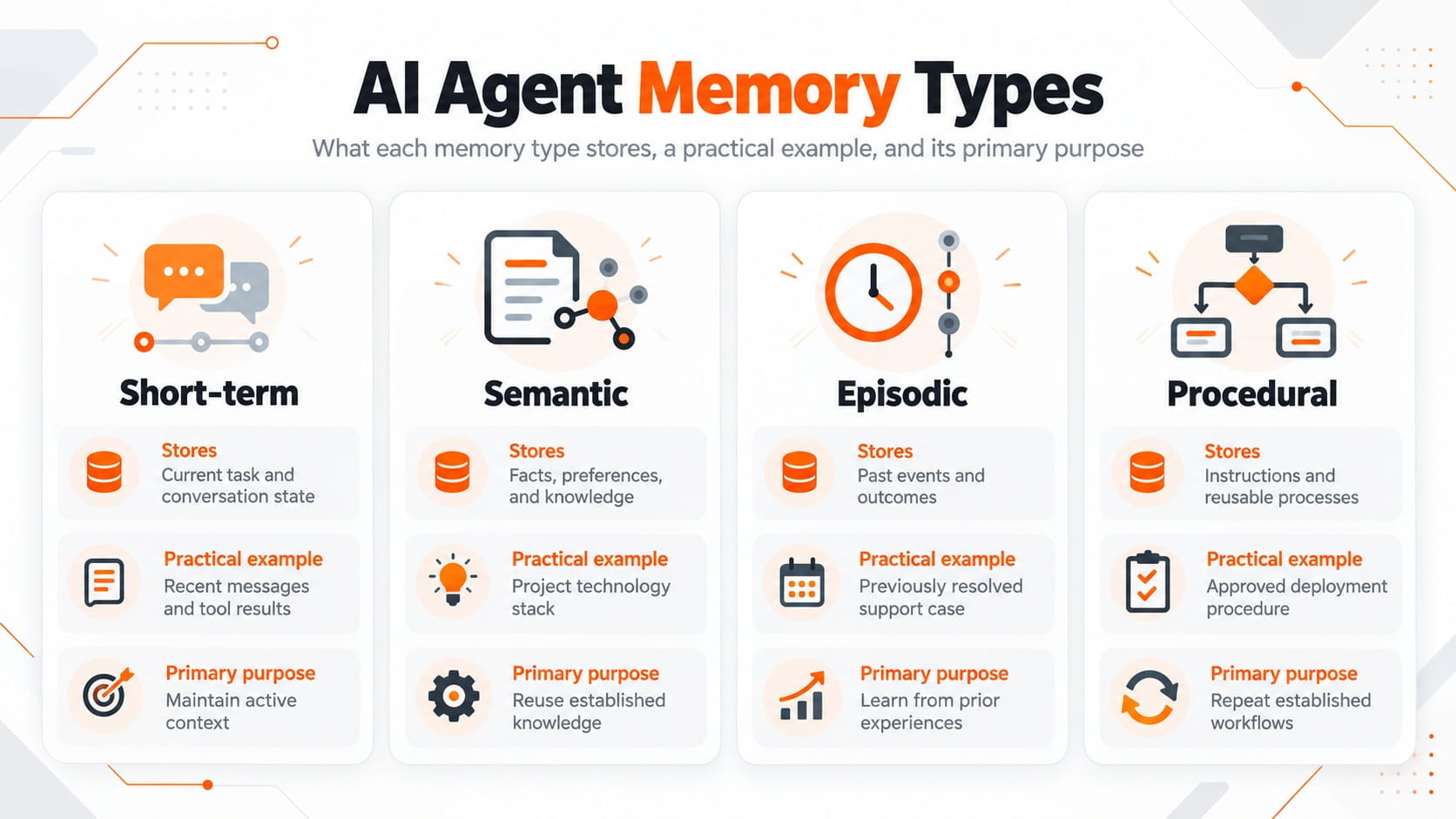
The right combination depends on the application's responsibilities. A straightforward conversational assistant can operate with session memory, while a long-running business agent needs durable knowledge and reliable state management.
How AI Agent Memory Works
An agent doesn't access its entire memory every time it receives a request. A memory system selects information, stores it, retrieves what matters, and makes that information available during execution.
I think of this as a continuous cycle rather than a single database operation.
Memory Creation
The process starts when the agent receives information worth retaining.
That information can come from user instructions, verified tool responses, completed tasks, or explicit feedback.
For example, a user tells a reporting assistant:
"Use British English for all future financial reports."
The memory system can extract the preference and associate it with the correct user.
The important decision is whether the information should remain available after the current conversation ends.
A temporary request for today's report belongs in working context. An explicit instruction for future reports belongs in long-term memory.
Memory Storage
After extraction, the information is converted into a format that supports retrieval.
A useful memory record contains more than a sentence. It also identifies the memory owner, source, creation time, and current validity.
For example:
Memory: Financial reports must use British English.
Scope: User preference
Source: Explicit user instruction
Status: Active
These fields give the application enough information to manage the memory instead of treating every stored statement as equally trustworthy.
Memory Retrieval
When the user requests another financial report, the application searches the user's stored memories.
The retrieval process identifies relevant records and supplies them to the agent alongside the new task.
The agent doesn't need the entire conversation in which the original preference appeared. It only needs the relevant instruction.
For larger memory collections, retrieval can combine semantic similarity, metadata filtering, timestamps, and relevance ranking.
The goal is to return the smallest set of accurate memories needed to complete the task.
Memory Updates
Memory must change when the underlying information changes.
Suppose the same user later requests American English for future reports. Keeping both preferences active would create conflicting instructions.
The memory system should verify the new instruction, update the active preference, and preserve historical information only when the application has a legitimate need for it.
A reliable memory layer distinguishes new facts from corrections and expired information.
Without that distinction, an agent can retrieve a perfectly relevant memory that is no longer correct.
AI Agent Memory in Multi-Agent Systems
Memory becomes more important when several agents contribute to the same task.
Imagine a research agent collecting market information, an analysis agent evaluating the results, and a reporting agent preparing the final document.
Each agent needs access to the findings produced before its own work begins.
This is where memory connects directly with AI Agent Orchestration. The orchestration system controls task execution and delegation, while the memory layer preserves the information required to complete those tasks.
Shared and Private Memory
Not every agent should have access to the same information.
A research agent can store verified source material in a shared project memory. The reporting agent can retrieve that material without repeating the research.
However, a financial agent's access to confidential billing information should remain restricted to authorized tasks.
I would separate memory into three scopes: task-specific state, agent-specific memory, and shared project knowledge.
That structure allows collaboration while keeping access permissions explicit.
Memory Consistency
Shared memory introduces another challenge: multiple agents can produce updates to the same information.
For instance, two agents might retrieve a project's status before either receives the latest update.
The application needs version control or transactional safeguards to prevent outdated writes from replacing newer information.
The same rule applies to retrieved memories. Before an agent performs an important action, the application must verify that the information is still valid.
Shared memory improves coordination only when its contents remain consistent.
AI Agent Memory vs Context Windows and RAG
AI agent memory, context windows, and retrieval-augmented generation are closely connected, but they solve different problems.
A context window is the information available to the model during an inference request. It includes instructions, messages, and retrieved content.
A larger context window allows more information to be processed in one request. It does not automatically preserve that information for future sessions.
Retrieval-augmented generation (RAG) is a technique for supplying relevant external information to a model. It retrieves information from documents or databases and includes it in the model's working context.
Agent memory determines which information should be retained, how it is maintained, and when it should be recalled.
An agent memory system can use RAG techniques for retrieval, but it also needs rules for writing, updating, and deleting records.
For example, a company knowledge base can tell a support agent what the current refund policy says. Memory can tell it that a specific customer's refund request was investigated previously.
The first provides reference knowledge. The second provides continuity across interactions.
Keeping these responsibilities separate makes the system easier to maintain.
AI Agent Memory Storage and Architecture
There is no requirement to build a dedicated vector database for every memory-enabled agent.
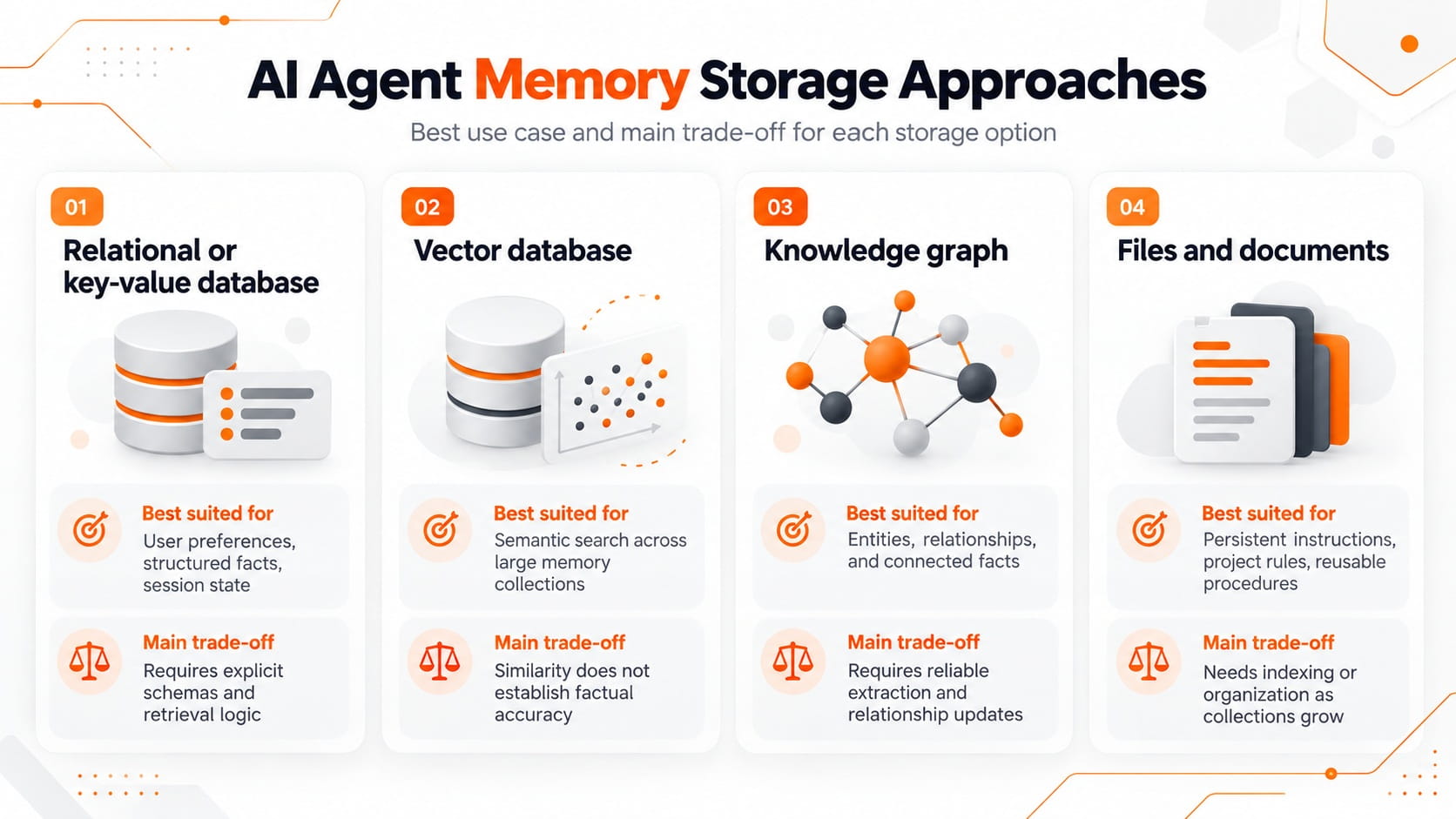
I would choose storage based on the information being retained and the queries the application must answer.
Structured Storage
A relational database is a practical starting point for information with predictable fields.
If an agent only needs to remember a user's language preference, project identifier, and approved notification channel, a structured database provides direct retrieval and straightforward updates.
Adding a vector database would introduce infrastructure without improving those exact lookups.
Vector-Based Memory
Vector storage becomes useful when agents need to retrieve information by meaning rather than exact identifiers.
A developer could ask an agent to find a previous incident involving a similar authentication problem, even when the stored description uses different terminology.
Embeddings allow the retrieval system to identify related information.
However, similarity is not proof of correctness. Results still need filtering and validation against their sources.
Graph-Based Memory
Knowledge graphs represent entities and the relationships between them.
For a business application, those entities could include customers, accounts, products, support cases, and employees.
A graph can help an agent answer connected questions, such as which customers use a service affected by a particular technical incident.
When those relationships change over time, temporal information can identify which facts are currently valid.
This architecture is valuable for relationship-heavy applications, but it also requires more complex data maintenance.
AI Agent Memory Example in Customer Support
Consider a SaaS company with a support agent handling recurring customer requests.
During the first interaction, a customer explains that all subscription invoices should be sent to a specific billing contact.
The agent verifies that the customer is authorized to change the billing preference. The application then saves the approved preference to the customer record.
Three weeks later, the customer contacts support about a missing invoice.
Instead of asking for the billing contact again, the agent retrieves the saved preference and checks the current invoice status through the billing system.
The memory provides continuity. The billing system provides the authoritative transaction information.
This separation matters.
If the agent stored a previous invoice status as permanent truth, it could incorrectly tell the customer that the latest invoice had already been paid.
For this application, I would preserve the customer's approved preferences in memory while retrieving current financial information directly from the billing platform.
That gives the agent useful historical context without turning memory into an unreliable replacement for business records.
Building AI Agent Memory
A practical implementation should begin with a narrow memory requirement rather than an elaborate architecture.
Define the Memory Scope
Start by identifying what the agent needs to remember across conversations.
For a project management agent, this could include project conventions, approved decisions, and unresolved dependencies.
Assign every memory a scope. A personal preference belongs to the relevant user, while an approved project procedure can belong to the project.
Access controls must enforce these boundaries at the storage and retrieval layers.
Establish Write Rules
Decide what qualifies for permanent storage.
I would prioritize explicit preferences, confirmed decisions, and verified outcomes.
Unverified claims, temporary instructions, and raw tool output should not automatically become durable facts.
Where memories influence sensitive decisions, require validation before committing changes.
Build Retrieval Into the Workflow
Retrieve relevant memory before the agent makes decisions that depend on historical context.
Apply scope filters before semantic ranking so that a relevant record from another customer cannot enter the current user's context.
Set a retrieval limit and a token budget. A memory system should improve the agent's context, not overwhelm it.
Add Lifecycle Controls
Define how memories are corrected, superseded, expired, and deleted.
Include timestamps, source references, and version information for records that can change.
For facts owned by external systems, store references when direct retrieval is safer than maintaining duplicate values.
Evaluate Memory Accuracy
Test the memory system with questions that depend on information from earlier sessions.
I would include cases where the user corrects a previous preference, where two memories contradict each other, and where no relevant memory exists.
A successful test requires the agent to retrieve the correct information without inventing missing facts or exposing another user's records.
AI Agent Memory Frameworks and Tools
Developers can implement memory directly or use frameworks that provide storage and retrieval capabilities.
The right option depends on whether the application needs conversation continuity, extracted knowledge, or a more complex persistent memory layer.
LangGraph
LangGraph provides short-term memory through persisted thread state and long-term memory through stores that support retrieval across threads.
Its architecture is useful for applications that need to maintain workflow state while retaining selected information between sessions.
Mem0
Mem0 focuses on extracting useful facts from interactions and retrieving them in later conversations.
It supports memory operations such as adding, searching, updating, and deleting records.
This approach fits applications that need persistent user preferences and personalized context without repeatedly sending complete conversation histories to the model.
Zep
Zep uses a graph-based approach to organize entities, facts, and their relationships over time.
Its temporal capabilities support tracking changes in information, making it relevant for applications where facts and relationships evolve.
Letta
Letta provides persistent agent memory with structured memory blocks and additional storage mechanisms.
Its approach gives agents a defined way to manage information available in their working context and preserve knowledge between interactions.
OpenAI Agents SDK
The OpenAI Agents SDK provides session mechanisms for maintaining conversation history across agent runs.
That is useful for conversational continuity. Applications requiring extracted, structured long-term knowledge need to implement or integrate the corresponding persistent memory mechanisms.
I would evaluate these tools through a small prototype before selecting one. The deciding factor should be whether it satisfies the application's memory requirements, not how many features appear in its documentation.
Memory Quality, Security, and Cost
A memory-enabled agent introduces additional storage, retrieval, and processing requirements.
That investment only makes sense when the retrieved information improves task performance.
Retrieval Quality
A successful memory lookup must return information that is relevant, accurate, and authorized for the current task.
I would measure recall accuracy, incorrect retrievals, outdated facts, and the rate at which user corrections are successfully reflected in later responses.
These measurements are more useful than the total number of memories stored.
Information Security
Stored memories can contain personal information, confidential project details, and sensitive operational context.
The storage system needs access controls, retention policies, and protection against unauthorized modification.
Retrieved memory must also be treated as data rather than a source of unrestricted instructions. An attacker should not be able to change an agent's behavior by placing malicious text into a document that later becomes memory.
Operating Cost
Memory introduces costs for extraction, storage, indexing, retrieval, and context processing.
At the same time, relevant memory can reduce repeated tool calls and unnecessary retrieval of previously established information.
I would measure total cost per successfully completed task, rather than evaluating memory storage expenses in isolation.
A simpler system that retrieves five accurate records is more useful than a sophisticated system that processes hundreds of irrelevant memories.
Final Thoughts
AI agent memory gives autonomous systems continuity beyond a single interaction. It allows agents to reuse verified knowledge, retain useful experiences, and follow established procedures without repeatedly starting from zero.
But effective memory is not measured by how much an agent remembers.
The more important questions are whether the stored information is still valid, whether the right agent can retrieve it, and whether outdated knowledge can be corrected.
I would start with a small, structured memory system and expand it only when the application's retrieval requirements justify additional complexity.
The goal is not to make an AI agent remember everything. It is to give the agent reliable access to the information that improves its next decision.
FAQ
Can my AI agent remember voice conversations too?
Yes. Voice interactions can be transcribed and processed through the same memory pipeline used for text conversations. The application must manage recording permissions, transcription accuracy, and data retention before extracting information for persistent memory.
Can I move my agent's memory to another AI model?
Yes, if the application stores memories independently of the model provider. Structured records and text-based memories can be exported and reused. Vector embeddings require compatibility checks, and changing embedding models can require rebuilding the search index.
Can I make my AI agent work with memory completely offline?
Yes. A local model, local storage, and locally hosted retrieval components can provide offline memory. The application must avoid dependencies on remote inference, embedding, authentication, or database services.
If I delete a chat, does the agent forget everything from it?
Not automatically. Conversation history and extracted long-term memories can exist in separate storage systems. A complete deletion process must identify and remove the relevant records according to the application's retention and deletion policies.
Can customers see what an AI agent remembers about them?
Yes, if the application provides a memory inspection interface. Developers can expose stored records through an authenticated dashboard or API, including options to request corrections and deletions.
Can I use the same memory with different AI agent frameworks?
Yes. A framework-independent memory service can expose storage and retrieval operations through an API. Each framework then needs an adapter that converts memory records into the context format expected by its agents.
Can an AI agent remember images and files instead of just text?
Yes. Memory systems can store file references, extracted metadata, image descriptions, or multimodal embeddings. The application must retain access to the original files when tasks require information that cannot be represented accurately through text alone.
What happens if my memory database stops responding?
The application must follow a defined failure policy. Tasks that depend on stored permissions, approvals, or critical historical information should stop or escalate. Tasks that do not require memory can continue in a restricted stateless mode if the workflow explicitly supports that behavior.
Can someone trick an agent into remembering false information?
Yes. Untrusted content can contaminate memory when applications allow unrestricted extraction and storage. Defenses include source verification, restricted write permissions, validation rules, and separating user-provided information from authoritative system records.
Can I share company knowledge between agents without exposing private user data?
Yes. Use separate storage namespaces and enforce authorization before retrieval. Organization-wide knowledge can be available to approved agents, while customer-specific and private records remain restricted to their authorized users and workflows.

Fatemeh Jahangard
Technology & AI Writer at PinerookFatemeh Jahangard covers AI, emerging technologies, and digital innovation for Pinerook, focusing on how technology shapes startups and industries.
 Seen first.


