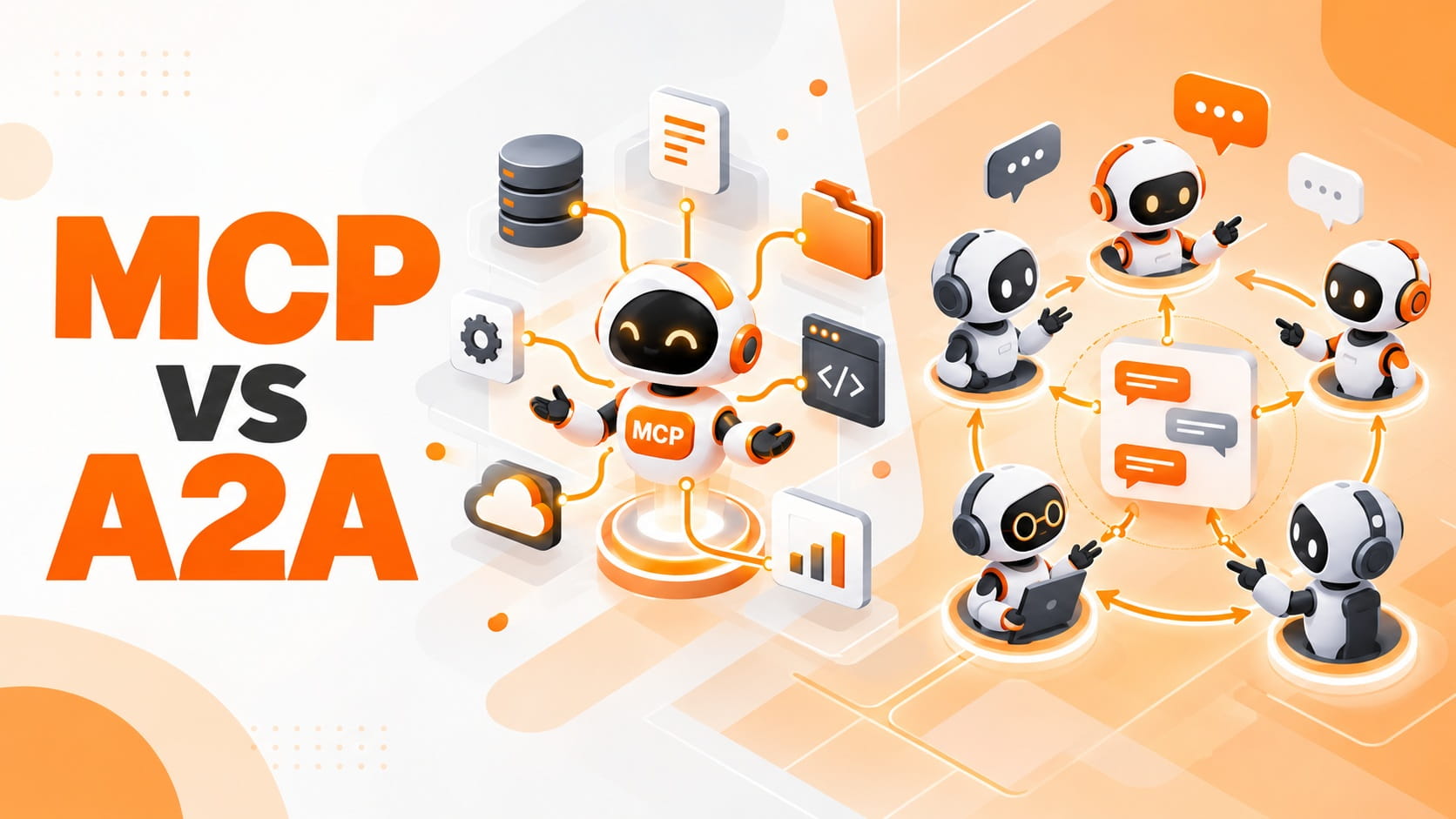
MCP and A2A solve two different problems in AI agent development. Model Context Protocol (MCP) connects AI applications to tools, APIs, and data sources. Agent2Agent (A2A) enables independent AI agents to communicate, delegate tasks, and exchange results.
The choice isn't about which protocol is more advanced. It's about what your AI system needs to connect.
If an agent needs to retrieve customer records from a database, MCP provides a standard integration method. If that agent needs to hand a billing investigation to another independently operated agent, A2A provides a communication protocol for that collaboration.
I'll compare their technical differences, explain where each fits in an AI architecture, and use a SaaS customer-support workflow to show when combining them makes sense.
MCP vs A2A: Key Differences
When evaluating these protocols, I start with the system boundary. Is the agent accessing a capability, or is it collaborating with another independent system that can plan and execute work?
That distinction shapes the architecture, communication model, and implementation requirements.
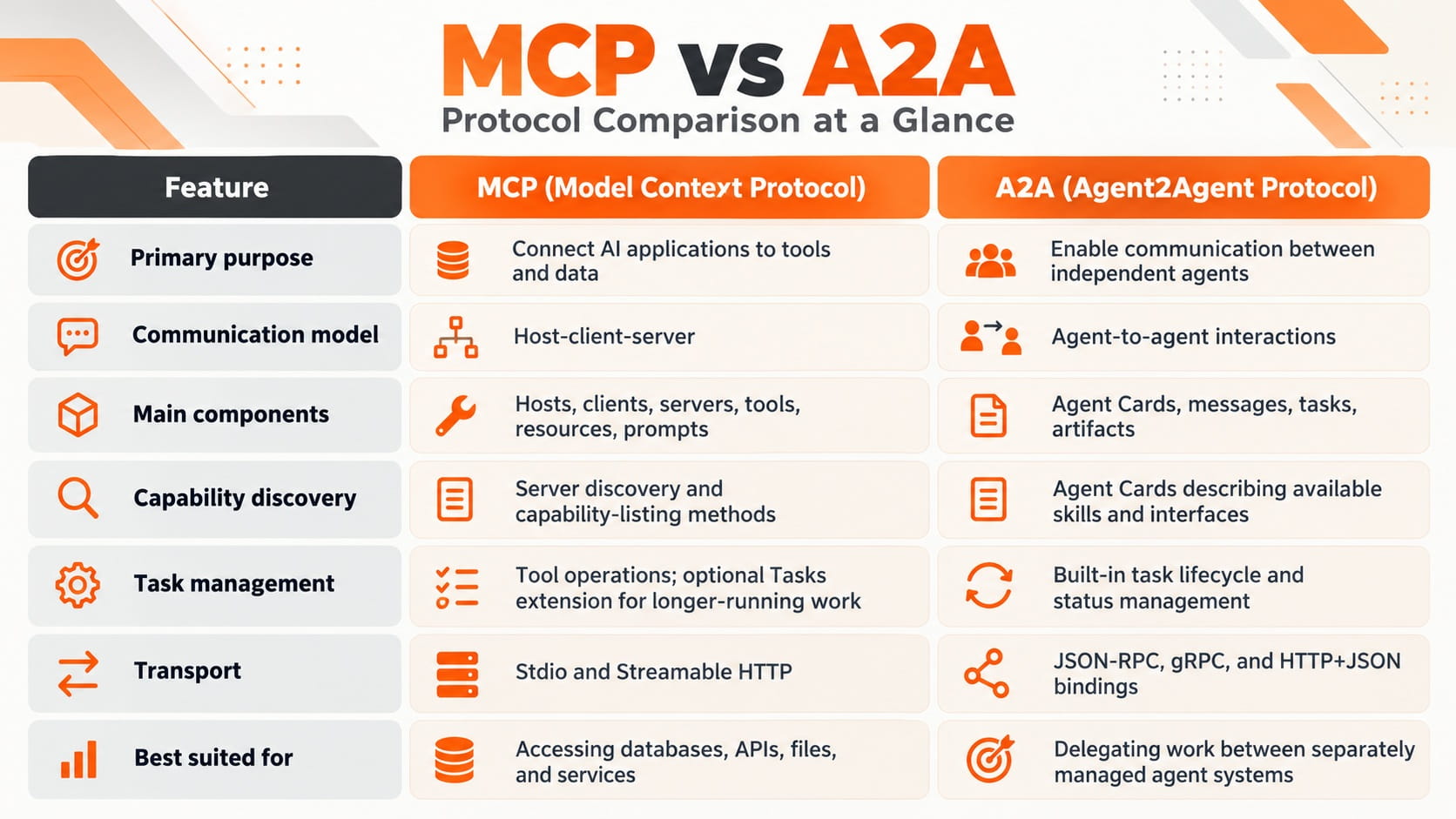
The most important difference is the responsibility of the system receiving the request.
An MCP server exposes capabilities through a defined interface. An A2A agent accepts work as an independent participant and determines how to complete it using its own implementation.
Both protocols support communication across systems, but they standardize different relationships.
MCP Architecture: Connecting Agents to Tools and Data
Model Context Protocol gives AI applications a consistent way to discover and use external capabilities.
Its architecture has three main participants:
MCP Host: The application running the AI experience and coordinating connections.
MCP Client: The component within the host that communicates with an MCP server.
MCP Server: The service exposing tools, resources, or reusable prompts.
For example, consider a startup building an AI assistant for its sales team.
The assistant needs access to customer information stored in a CRM. Without MCP, developers can integrate the CRM through its API and write the application-specific code needed to manage requests and responses.
With MCP, the CRM integration can expose its supported capabilities through a standardized interface that compatible AI applications understand.
The server can provide three types of capabilities:
Tools: Executable operations, such as retrieving an account or updating an approved record.
Resources: Information available to the application, including documents and database content.
Prompts: Reusable templates that structure interactions.
I find the separation useful when a product needs several integrations. Each MCP server can expose a defined set of capabilities, while the application controls which ones are available to its agents.
MCP doesn't decide which business action an agent should take. That responsibility remains with the application and its decision-making logic.
MCP Communication and Tool Execution
MCP uses JSON-RPC 2.0 for structured communication.
A compatible client can discover available server capabilities, retrieve tool definitions, and invoke a selected operation with defined arguments.
For local integrations, MCP supports standard input and output (stdio). Remote servers can communicate through Streamable HTTP.
The July 2026 specification also introduced a stateless core and optional extensions, including Tasks for asynchronous operations.
That matters when comparing MCP with A2A. Long-running work is not exclusive to A2A. The distinction is that MCP's Tasks extension expands capability execution, while A2A models collaboration between independent agents.
A2A Architecture: Communication Between Independent Agents
Agent2Agent Protocol addresses a different integration problem.
Imagine a startup developing an AI-powered business platform. Its customer-support agent needs help from a specialist billing agent operated by a separate service.
The billing agent has its own instructions, tools, permissions, and execution process. The support agent shouldn't need access to those internal components.
A2A provides a common interface for this interaction.
The requesting agent can discover the specialist's advertised capabilities, submit work, receive progress information, and collect the result.
Agent Cards and Capability Discovery
A2A uses Agent Cards to describe an agent's publicly advertised interface.
An Agent Card can identify the agent's skills, supported communication interfaces, and authentication requirements.
This allows a client to determine whether a remote agent provides the service it needs without inspecting that agent's internal implementation.
For a startup integrating external AI services, this is an important architectural advantage. The external provider can change its internal framework while maintaining a compatible A2A interface.
Tasks, Messages, and Artifacts
A2A separates communication from the work being performed.
A Message carries information between the client and the remote agent.
A Task represents a unit of work and tracks its execution state.
An Artifact contains an output produced during task execution, such as a report or structured result.
A task can move through states including submitted, working, completed, failed, and input-required.
This makes A2A suitable for interactions that involve multiple exchanges or require the requesting system to wait for additional work.
The remote agent doesn't need to expose its internal reasoning, private tools, or proprietary application logic to participate.
MCP and A2A in a SaaS Customer Support Workflow
To make the architectural difference more practical, consider a fictional SaaS company called SupportFlow.
SupportFlow uses an AI assistant to handle customer questions about subscriptions, invoices, and account access.
The company already maintains a customer database and operates a separate billing service.
Now it wants the assistant to resolve more requests without giving every component access to the entire system.
Retrieving Customer Information with MCP
A customer sends this message:
"I was charged twice for my subscription. Can you check my account?"
The support agent first needs to confirm the customer's subscription and recent payment information.
An MCP server exposes authorized operations for retrieving those records.
The support agent uses the relevant capability and receives the account details.
At this stage, there is no need to involve another autonomous agent. The system is retrieving structured information from an existing service.
MCP fits that responsibility.
Delegating a Billing Investigation with A2A
Suppose the account data confirms two payment records that require further investigation.
SupportFlow has a separate billing agent responsible for payment investigations.
The support agent can send an A2A request describing the issue and providing only the authorized information required for the investigation.
The billing agent then uses its own tools and business rules to examine the case.
It can return an investigation result or report that additional information is required.
The support agent receives the result and prepares a response for the customer.
The distinction is that the support agent retrieves data through MCP but delegates an independent investigation through A2A.
Combining Both Protocols
The billing agent can also use MCP internally.
It might connect to a payment service, retrieve transaction records, and inspect invoice details through approved MCP integrations.
The resulting architecture looks like this:
Customer → Support Agent → A2A → Billing Agent
Support Agent → MCP → Customer Database
Billing Agent → MCP → Payment and Invoice Services
Each protocol handles a separate part of the workflow.
I would also keep refund execution outside the agent's automatic permissions until the application has verified the customer, the transaction, and the required approval conditions.
A successful protocol exchange doesn't establish that a financial action is authorized.
MCP vs A2A for Multi-Agent Systems
One assumption worth examining is that every multi-agent system needs A2A.
It doesn't.
If I were building a research assistant with three agents inside a single application, I would first use the coordination features already provided by the chosen framework.
For example, CrewAI or LangGraph can manage responsibilities, pass results between agents, and control task execution within an application.
Adding A2A between those internal components introduces another communication layer without automatically improving their output.
The decision changes when agents need to interact across independently managed systems.
Multi-Agent Workflows Within One Application
Consider a startup with a research agent, an analysis agent, and a reporting agent.
All three belong to the same application, use the same deployment environment, and operate under one team's control.
A framework can coordinate their work directly.
MCP becomes useful if the agents need standardized access to external tools or data.
A2A isn't required simply because the application contains several agents.
Independent Agents Across Services
Now consider a startup that needs to collaborate with an external financial analysis agent.
The external service controls its own infrastructure, credentials, execution logic, and available capabilities.
The startup needs an interface for requesting work and receiving results without controlling the external implementation.
This is where A2A becomes valuable.
The number of agents is not the deciding factor. Their independence and communication requirements are.
Protocol Selection for Startup AI Systems
For a startup, I would choose between MCP and A2A by examining the boundaries of the product rather than adopting both from the beginning.
Use MCP when the main requirement is tool integration.
An AI assistant that reads internal documentation, queries a database, or accesses a CRM needs a way to interact with those services.
MCP provides a standardized interface when the application and available servers support it.
Use A2A when the requirement is agent interoperability.
An AI application that delegates tasks to independently operated agents benefits from A2A's capability discovery, communication model, and task lifecycle.
Use both when independent agents also need external tools.
A multi-service AI platform can use A2A for collaboration between specialist agents while using MCP to provide each agent with its own tools and resources.
Use neither when an existing integration is sufficient.
A simple application that calls a single API doesn't need another protocol solely because the request originates from an AI model.
Direct API calls and a framework's existing orchestration capabilities remain valid architectural choices.
The right approach is to introduce a protocol when it removes a specific integration problem.
Security and Operational Considerations
Protocol compatibility does not automatically create a secure or reliable AI system.
MCP and A2A provide communication mechanisms, but the application still needs appropriate authorization, data protection, monitoring, and execution controls.
Access Control and Agent Permissions
With MCP, I would limit each server to the operations the application actually needs.
A customer-support agent that retrieves order information should not automatically receive permission to delete customer records.
With A2A, the application must authenticate remote requests and enforce authorization for the requested work.
Agent Cards can advertise supported security schemes, but an advertised capability is not permission to use it.
For a multi-tenant SaaS application, customer data must also remain isolated between tenants.
Data Sharing Across Agent Boundaries
A2A allows independent agents to collaborate without exposing their internal implementations.
That doesn't mean every piece of information sent between them is safe to share.
Before delegating work, I would define which customer records, transaction details, and account identifiers the receiving agent is authorized to access.
The same principle applies to MCP tools. Tool responses are external data and should not be treated as trusted instructions.
Sensitive actions require explicit application-level checks, regardless of which protocol delivered the request.
Performance and Monitoring
Adding more services changes the operational behavior of an AI workflow.
Each remote request introduces network communication, authentication processing, and another potential point of failure.
For a startup, I would monitor request latency, failed operations, API consumption, and the time required to complete delegated tasks.
A2A task identifiers and MCP operation records should be connected to an application-level trace so the team can follow a customer request across services.
Neither protocol independently provides a complete monitoring or business-audit system.
These requirements belong in the application architecture.
Choosing a Protocol That Fits the Product
For a new AI product, I would start with the smallest architecture that meets the actual requirements.
If an agent needs external information, I would evaluate MCP or an existing API integration.
If multiple agents run within one application, I would use the framework's orchestration capabilities before introducing another communication protocol.
If work needs to move between independently operated agents, I would evaluate A2A and its task management model.
The two protocols are complementary, but using both is not a measure of architectural maturity.
The goal of AI Agent Orchestration is to coordinate the right capabilities and responsibilities within a system. Protocol selection should support that goal, not make the product harder to maintain.
For startup teams, the strongest decision is the one that delivers the required functionality with clear permissions, observable execution, and manageable operational costs.
FAQ
Do I have to pay to use MCP or A2A?
No licensing fee is required to use either open protocol. However, operating compatible servers, hosting remote agents, making model API requests, and accessing paid third-party services can create costs. The total expense depends on the infrastructure and services used by the application.
Can I use MCP with a local model like Ollama?
Yes. MCP is not restricted to a specific language model provider. A local model can participate in an MCP-enabled application if the host supports MCP and implements the necessary model-to-tool interaction. Local inference does not eliminate the security requirements of connected tools.
What happens if an A2A agent needs my approval halfway through a task?
The remote agent can report an input-required task state and request additional information or approval. The client application must provide a suitable user interaction and submit the response to continue the task. An approval interface is an application responsibility, not an automatically generated A2A feature.
Can an older MCP client connect to a server using the latest protocol version?
Compatibility depends on the versions supported by both implementations. MCP provides protocol-version discovery and compatibility mechanisms, but a client that only understands an older exchange format cannot assume full support for newer features. Developers should verify SDK compatibility and test the integration before upgrading production servers.
Can I keep an A2A agent private instead of making it publicly available?
Yes. An A2A agent can be deployed behind a private network or an authenticated service endpoint. Discovery and access can be restricted according to the application's security design. Supporting A2A does not require publishing internal source code, private prompts, or proprietary business logic.

Fatemeh Jahangard
Technology & AI Writer at PinerookFatemeh Jahangard covers AI, emerging technologies, and digital innovation for Pinerook, focusing on how technology shapes startups and industries.
 Seen first.