
A vesting schedule determines when an employee, founder, or adviser earns the right to keep an equity award or exercise stock options. It is one of the most important terms in a startup compensation agreement because receiving an equity grant does not necessarily mean the recipient can immediately retain or use all of it. The schedule establishes how ownership benefits develop over time and what may be lost if the recipient leaves before completing the required service period.
Within Cap Table and Startup Equity, vesting arrangements connect individual contributions to the company's long term ownership structure. They help businesses retain employees, protect remaining founders when a cofounder departs, and establish the conditions under which equity awards become available. However, vesting does not guarantee that the underlying shares will increase in value or that an employee will be able to sell them.
The practical challenge is understanding exactly how much equity becomes vested at each point in time. A four year schedule with a one year cliff can produce a very different result from annual vesting or a schedule without a cliff, particularly when someone leaves during the first year. This guide explains the main vesting structures, calculates a complete example, and examines what happens when employment ends or a company is acquired.
Understanding a Vesting Schedule in Startup Equity
A vesting schedule is a contractual timetable or set of conditions that determines when equity rights become earned. It may apply to stock options, restricted shares, restricted stock units, or other awards, although the legal meaning of vesting depends on the instrument involved.
For stock options, vesting normally determines when the recipient becomes entitled to exercise a particular portion of the grant, subject to its terms. The employee generally must still pay the exercise price to acquire the underlying shares. For restricted founder stock, shares may already have been issued, but the company can retain contractual rights to repurchase the unvested portion if the founder stops providing services.
This distinction matters because a vested option is not necessarily an owned share. Similarly, a founder who holds issued shares may still face restrictions that determine how many can be retained after departure.
The relevant agreement should specify the vesting start date, total duration, cliff conditions, frequency of vesting, and any provisions that accelerate or modify the schedule. Without these details, a stated grant size provides an incomplete picture of what the recipient has actually earned.
The Four Year Vesting Schedule With a One Year Cliff
A common arrangement at venture backed startups uses four years of vesting with a one year cliff. Under this structure, the recipient must generally complete the first twelve months of qualifying service before any portion becomes vested.
At the first anniversary, 25% of the original grant becomes vested. The remaining 75% then generally vests in equal monthly installments during the following 36 months. At the end of the fourth year, the entire grant has vested, assuming the service requirements and other applicable conditions have been satisfied.
For a grant of 4,800 options, the first anniversary would result in 1,200 vested options. Each subsequent monthly installment would add 100 options because the remaining 3,600 options are divided across 36 months.
The schedule is sometimes described as monthly vesting over 48 months with a twelve month cliff. That description refers to the same allocation of 100 options per month, except the first twelve installments become vested together at the cliff date rather than being available individually during the first year.
This arrangement is widely used, but it is not mandatory for every company. Founders and employees may negotiate other schedules, and different awards from the same company can carry different terms.
How a Vesting Cliff Changes the First Year
A vesting cliff is the initial period that must be completed before any equity becomes vested. Its primary purpose is to prevent a short period of service from immediately creating vested rights to a portion of a longer term award.
Consider an employee who receives 4,800 stock options under a four year schedule with a twelve month cliff. If the employee leaves after eleven completed months, none of the options would ordinarily be vested under the simplified arrangement. If the employee completes the first twelve months, 1,200 options become vested at once.
The difference between leaving shortly before and shortly after the cliff can therefore be substantial. That outcome follows the contractual schedule rather than the number of days the employee worked beyond the grant date.
Employees should not assume that completing most of the first year gives them a proportional entitlement before the cliff. They should review the precise service requirements, termination provisions, and definitions of qualifying service in their award documents.
A Practical Vesting Schedule Calculation
Consider HarborPoint, a fictional software startup that grants an employee 4,800 stock options. The award has a four year vesting period, a one year cliff, and monthly vesting after the cliff. The vesting commencement date is January 1, 2027.
Under these terms, no options become vested during the first eleven completed months. On January 1, 2028, the employee reaches the first anniversary and 1,200 options vest. After that date, another 100 options become vested each month until the grant is fully vested on January 1, 2031.
The following table shows selected milestones. It assumes uninterrupted qualifying service, no acceleration, and no adjustments to the grant.
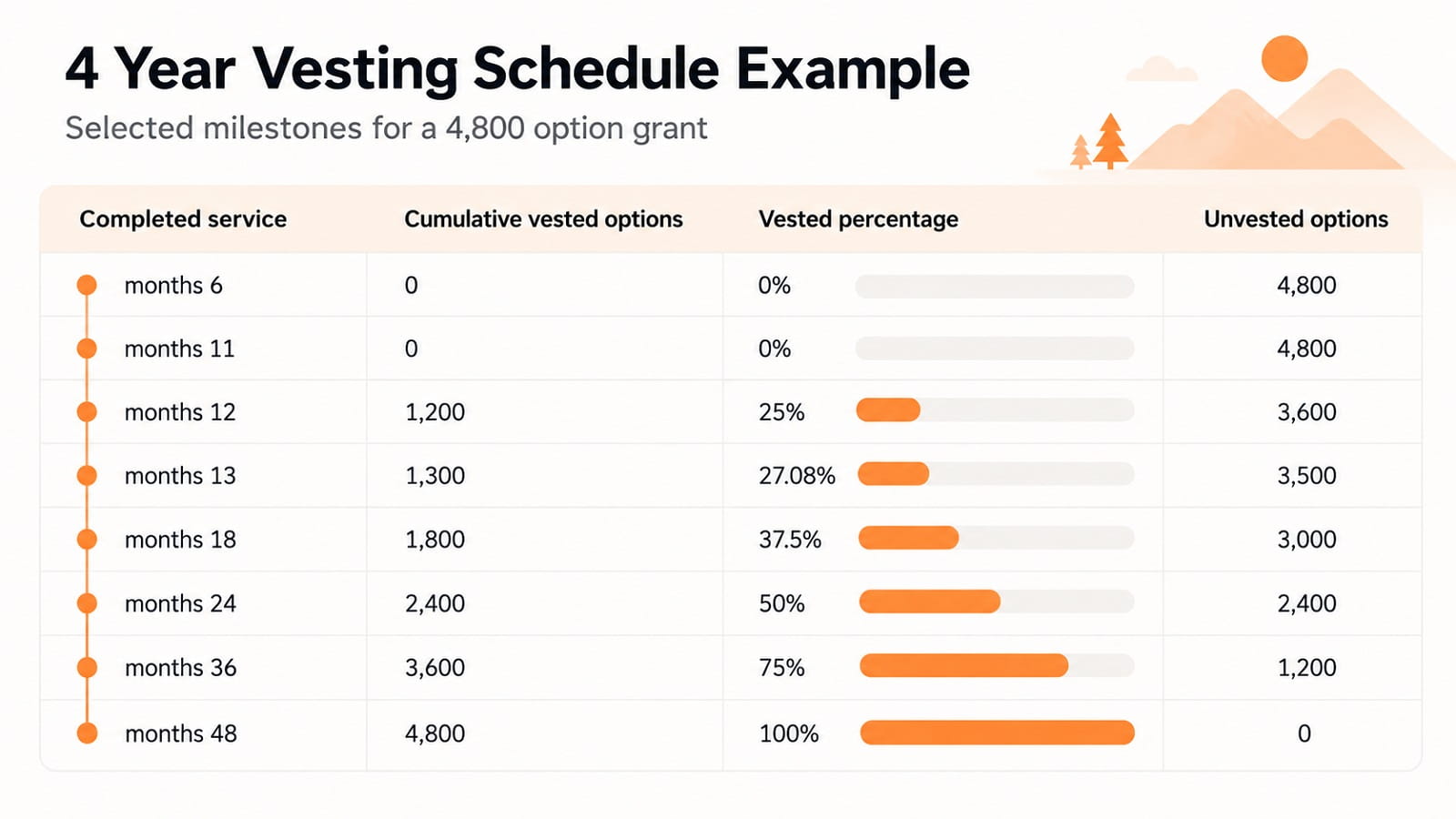
The calculation is straightforward once the cliff has been completed. For the first twelve months, cumulative vested options remain at zero. Starting at month twelve, the vested total equals 1,200 plus 100 options for each additional completed month, up to the maximum grant of 4,800.
At month eighteen, the employee has completed six monthly vesting installments after the cliff. The cumulative vested amount is therefore 1,200 plus 600, giving a total of 1,800 vested options. The remaining 3,000 options have not yet vested.
This is a count of contractual option rights, not a calculation of cash compensation. Exercising the vested options may require payment, and selling the resulting shares may be restricted while the business remains privately held.
The Difference Between Grant Date and Vesting Start Date
The grant date and vesting commencement date are related but should not automatically be treated as identical. The grant date generally identifies when the company formally approves or establishes an award under the applicable arrangements. The vesting commencement date determines when qualifying service begins counting toward the schedule.
A company may approve an award after an employee has already started working and specify an earlier vesting commencement date when permitted by the governing arrangements. This can recognize service performed before the administrative grant process was completed.
However, an earlier commencement date does not automatically change the grant date for every legal, tax, or accounting purpose. Companies should not treat these dates as interchangeable or assume that award documentation can be backdated without consequences.
Employees should verify both dates because even a difference of several months can affect the amount vested when they leave. Founders should ensure that agreements and capitalization records use the authorized dates consistently.
Monthly, Quarterly and Annual Vesting Structures
Not every equity award becomes vested monthly. Some companies use quarterly installments, annual installments, or schedules in which different percentages vest at specific milestones.
Monthly vesting distributes earned rights relatively evenly over time. Quarterly vesting creates larger increments every three months, while annual vesting may require the recipient to complete an entire year before earning the next portion.
The practical differences become most visible when service ends between scheduled vesting dates. Two employees may receive identical grants but retain different numbers of options after the same service period because the installment frequency differs.
The following comparison assumes four alternative schedules applied to the same 4,800 option grant. Each arrangement reaches full vesting at month 48, and the figures represent cumulative vested options at the end of the stated month.
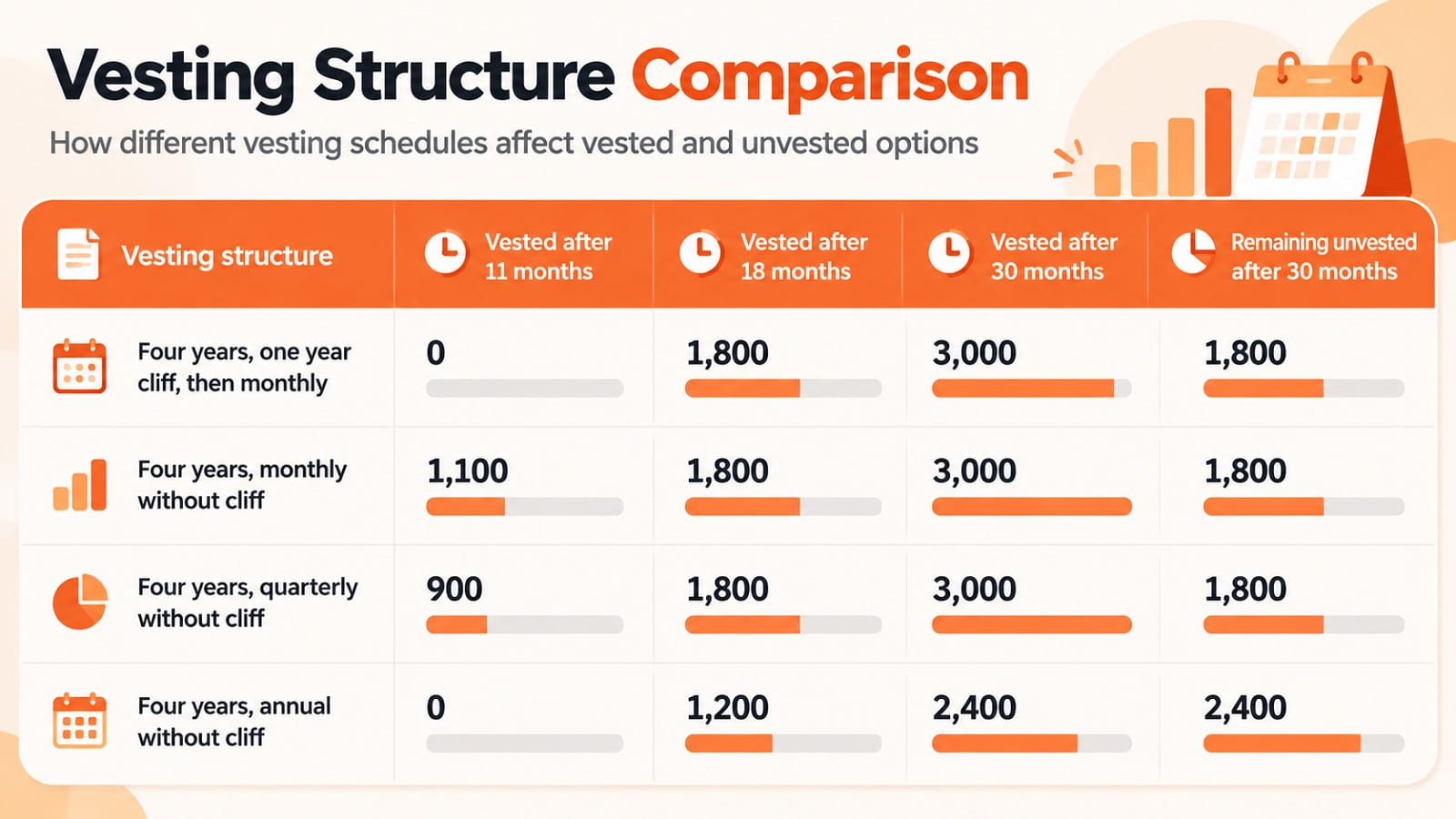
At eleven months, an employee with monthly vesting and no cliff would have earned 1,100 options. An employee with quarterly vesting would have earned 900 options because only three quarterly installments would have occurred. Under the annual schedule or the one year cliff, the employee would have no vested options at that point.
At eighteen months, the monthly and quarterly structures produce the same cumulative amount of 1,800 options. The annual structure produces only 1,200 because the next annual installment does not occur until month 24.
These differences show why the total vesting duration alone is insufficient for comparing equity offers. The cliff and installment frequency can have meaningful consequences even when the grant size and final vesting date are identical.
Time Based and Performance Based Vesting
Time based vesting depends primarily on completing a specified period of qualifying service. It is commonly used for employee stock options because it produces a predictable timetable for the company and recipient.
Performance based vesting depends on achieving defined business or individual milestones. An award might become vested after a specified revenue target, product development milestone, or other measurable objective has been achieved. These arrangements require particularly clear definitions so that the company and recipient can determine whether the conditions have been satisfied.
A company can also use hybrid arrangements combining service and performance requirements. Under such a structure, an employee may need to remain employed for a particular period and achieve a separate objective before receiving the relevant equity benefit.
Performance conditions can create uncertainty when circumstances change. A milestone that appeared attainable when the award was granted may become less relevant after a strategic shift. For this reason, the agreement should address how progress is measured and who has authority to determine whether the conditions have been satisfied.
Vesting Schedule Terms for Founders
Founder vesting is designed to address a different ownership risk from ordinary employee retention. When a company begins with multiple founders, each person may receive a substantial number of shares based on an expectation of continued participation.
If one founder leaves shortly after incorporation, the remaining team may face a difficult situation if the departing founder retains a large ownership interest without continuing to contribute. Vesting arrangements can help address this problem by allowing the company to repurchase certain unvested shares according to the agreed terms.
Unlike an employee receiving options that vest over time, a founder may acquire actual restricted shares at the beginning. The founder can already be a shareholder, while the company's contractual repurchase right over the unvested portion decreases as service milestones are completed.
A four year arrangement with a one year cliff is also frequently used for founders. However, the parties may agree to recognize work completed before incorporation, specify different conditions, or adopt particular protections for an unexpected departure.
The consequences should be documented before they become contentious. The agreement needs to identify what happens to unvested shares, how any repurchase price is determined, and which events can alter the original restrictions.
What Happens When an Employee Leaves Before Full Vesting
Leaving a startup before an equity award is fully vested can result in the loss of its unvested portion. For ordinary stock option grants, unvested options generally expire or are canceled in accordance with the award documents, while vested options may remain exercisable for a limited period.
Return to the HarborPoint employee with 4,800 options. If employment ends immediately after completing eighteen months of qualifying service, 1,800 options have vested and 3,000 remain unvested. Under the assumed agreement, the employee would ordinarily lose the unvested portion.
The 1,800 vested options are not automatically cash or shares. The employee must consider the terms governing exercise, including the exercise price, deadline, and any restrictions on the resulting shares.
Suppose the options have an exercise price of $1.50 per share. Exercising all 1,800 vested options would require $2,700 before taxes and other expenses. If the employee cannot afford that payment or does not wish to assume the associated financial risk, the options may expire without being exercised.
This example explains why the number of vested options cannot be evaluated independently from the costs and opportunities associated with acquiring and eventually selling shares.
Post Termination Exercise Deadlines
A post termination exercise period is the amount of time an option holder has to exercise eligible vested options after leaving the company. The period is governed by the applicable equity plan and individual award agreement.
Some startup agreements use a period of approximately ninety days, while others provide longer deadlines. Employees should not assume that every option grant follows the same rule.
US tax treatment introduces an additional distinction. Incentive stock options generally need to satisfy specific employment related requirements to retain their intended statutory treatment, including a rule concerning exercise within three months after employment ends, subject to applicable exceptions.
An option agreement might allow exercise for longer than three months, but that does not mean the option necessarily retains incentive stock option tax treatment throughout the extended period. The contractual right to exercise and the federal tax classification are separate questions.
Employees should review their documents before resigning or otherwise ending their service relationship. A decision made without understanding the deadline can result in the loss of valuable contractual rights or unexpected tax consequences.
Vesting Acceleration During an Acquisition
Vesting acceleration allows part or all of an unvested award to become vested earlier than the original schedule when specified conditions occur. The treatment depends entirely on the relevant agreements and the terms of a corporate transaction.
Single trigger acceleration generally requires one defined event, often a change of control. If the acquisition meets the contractual definition and the agreement provides full acceleration, the affected unvested equity may become vested at that point.
Double trigger acceleration generally requires two events. A common arrangement involves an acquisition followed by a qualifying termination of employment within a specified period. Depending on the agreement, a resignation for defined good reason may also qualify.
For example, suppose an executive has 4,800 options, of which 2,400 have vested when the company is acquired. A full single trigger provision might cause the remaining 2,400 options to vest when the acquisition occurs. Under a double trigger arrangement, acceleration might depend on both the acquisition and a subsequent qualifying employment event.
Neither outcome should be assumed without reviewing the applicable documents. Awards may be assumed, replaced, canceled, settled, or modified as part of an acquisition, and acceleration provisions may cover only a specified portion of the remaining grant.
Equity Vesting and Changes to Company Ownership
Vesting determines the conditions under which contractual equity rights become earned, but it does not always change the number of shares included in the company's fully diluted capitalization.
For example, a startup may reserve shares for employee equity awards and grant options from that existing reserve. As the options vest, the employee earns additional exercise rights, but the total fully diluted share count may remain unchanged because the options were already included in the capitalization model.
Actual share issuance can occur later when options are exercised. Restricted founder shares may already have been issued even though they remain subject to vesting related repurchase rights.
This distinction helps founders and investors avoid confusing vesting progress with new dilution. Dilution depends on changes to the relevant capitalization, while vesting describes the conditions governing existing awards or restrictions.
Accurate equity records should identify granted, vested, exercised, expired, and unallocated securities separately. Those records support employee communications, financing models, and the company's understanding of future ownership commitments.
Tax Considerations for Vesting and Restricted Shares
Vesting can affect tax timing, but the consequences differ across types of equity. Employees should not assume that becoming vested always creates taxable income or that no taxes arise until the underlying shares are sold.
For ordinary stock options, tax obligations may be associated with exercise rather than vesting. The outcome depends on whether the options are statutory or nonstatutory and on the applicable tax rules.
Restricted stock can produce different consequences because actual property may already have been transferred subject to restrictions. Under US rules, a recipient of eligible restricted property may consider a Section 83(b) election to recognize compensation income at the time of transfer rather than when the property becomes substantially vested.
An eligible Section 83(b) election generally must be filed with the IRS no later than thirty days after the relevant property transfer. The election does not apply merely because someone receives an ordinary unexercised stock option. Early exercise arrangements involving actual restricted shares can require additional analysis.
Restricted stock units may also involve settlement conditions that differ from the time at which service requirements are completed. In a private company, these differences can matter because employees may face taxable compensation before being able to sell the shares.
Because these rules can create financial consequences that are difficult to reverse, employees and founders should obtain qualified advice relevant to their awards and jurisdictions.
Designing Vesting Terms That Support Retention
A company should choose vesting terms based on the responsibilities of the recipient and the business purpose of the grant. An award intended to reward several years of service may reasonably follow a different schedule from one tied to completing a specific advisory project.
The agreement should make the expected timetable understandable. Recipients need to know when vesting begins, whether there is a cliff, how frequently additional portions vest, and what happens if the service relationship ends.
Founders should also consider whether existing employees will need additional awards after their original grants become fully vested. A new grant can create a separate vesting timetable rather than extending the original schedule automatically.
Consistent administration is equally important. Changes in employment status, approved leaves, grant amendments, and corporate transactions may affect vesting under the applicable documents. The company should maintain records that reflect these changes accurately.
Clear terms help recipients understand what they have earned and allow founders to manage future equity commitments without relying on informal explanations.
Final Thoughts
A vesting schedule is an essential part of startup equity because it defines when founders and employees earn rights associated with their awards. The total number of shares or options in a grant is only part of the agreement. The commencement date, cliff, installment frequency, and departure provisions determine how much of that grant may ultimately be retained or exercised.
The HarborPoint example demonstrates how a four year schedule with a one year cliff works in practice. It also shows why two employees receiving identical grants can have different vested amounts when the conditions or payment intervals differ.
Founders should design schedules that reflect their retention goals and document them accurately. Employees should evaluate the full terms before treating an equity grant as part of their financial compensation. A clear understanding of vesting helps both sides make better decisions about long term participation in the company.
FAQ
What Is a Vesting Schedule?
A vesting schedule determines when a person earns contractual rights connected to an equity award. It can depend on time, performance milestones, or a combination of conditions.
How Does a Four Year Vesting Schedule Work?
A common arrangement provides for vesting over 48 months, often with a one year cliff. Under that structure, 25% vests after twelve months and the remaining 75% generally vests monthly over the following three years.
What Does a One Year Cliff Mean?
A one year cliff means the recipient must generally complete the first twelve months of qualifying service before any equity becomes vested. If the person leaves before that point, the grant may produce no vested rights under the standard arrangement.
How Much Equity Vests After Eighteen Months?
Under a four year monthly schedule with a one year cliff, 37.5% of the original award has vested after eighteen completed months. For a grant of 4,800 options, that equals 1,800 vested options.
Can Equity Vest Without a Cliff?
Yes. A company can establish monthly, quarterly, annual, or other permitted schedules without an initial cliff. The applicable agreement determines when the first installment becomes vested.
Does Vested Equity Mean the Employee Owns Shares?
Not necessarily. Vesting stock options generally makes them exercisable, but the employee may still need to purchase the underlying shares. Restricted shares and other equity instruments can operate differently.
What Happens to Unvested Options When an Employee Leaves?
Unvested options generally expire or are canceled under the award terms. Vested options may remain exercisable for a specified period, but the employee should confirm the exact deadline.
Can a Startup Change an Existing Vesting Schedule?
Changes may be possible, but they depend on the governing documents, required approvals, the recipient's rights, and applicable law. A company should not assume it can unilaterally alter an approved award.
Does an Acquisition Automatically Accelerate Vesting?
No. Acceleration depends on the relevant contractual provisions and transaction terms. Some agreements provide acceleration after a change of control, while others require an additional qualifying employment event.
Is Vesting the Same as Receiving Cash From Startup Shares?
No. Vesting determines when equity rights become earned, while cash proceeds usually depend on exercising options where required and completing a permitted sale or other liquidity transaction.

Mobina Khanki
Venture & Funding Writer at PinerookMobina Khanki covers venture capital, startup funding, fundraising, and startup finance for Pinerook, focusing on founders and investors.
 Seen first.


