
Cap table and startup equity management may look straightforward when a company has only one or two founders. Each person receives an agreed number of shares, and their ownership percentages seem easy to understand. However, the picture becomes more complicated when the business raises investment, hires employees, grants stock options, or enters agreements that may convert into shares later. Without accurate ownership records, founders can misunderstand how much of the company they control and what they may retain after future financing.
A well maintained cap table provides the foundation for understanding these changes. It connects share ownership with investment agreements, employee incentives, and decisions about the company's future financing. The percentages shown in an early ownership record are not necessarily the percentages that will remain after new shares are issued. Founders, investors, and employees therefore need to understand both current ownership and the potential effects of future transactions.
This guide explains how startup capitalization works, how ownership percentages are calculated, and what changes when a business raises capital. It covers common and preferred shares, employee incentives, founder arrangements, convertible financing, dilution, and investor rights. Three practical tables illustrate how ownership is recorded and how different financing decisions affect the people who hold equity.
Understanding a Startup Capitalization Table
A capitalization table is a record of a company's ownership structure. It identifies the holders of shares and other relevant securities, the quantities associated with each holder, and the rights or potential ownership changes connected with those securities. The record may begin with two founders holding common shares and later expand to include investors, employee awards, warrants, and agreements that convert into equity.
When founders ask what is a cap table, the most useful answer is that it is both an ownership record and a financial planning tool. It allows management to determine who currently holds shares, what percentage each holder represents, and how proposed transactions could alter the ownership structure. It also helps investors examine the capitalization of a company before committing capital.
The document should reflect completed legal transactions rather than informal promises. A conversation about providing shares to an adviser is not equivalent to a properly authorized and documented issuance. Accurate records therefore require supporting agreements, corporate approvals, and reconciliation whenever ownership changes.
The Main Components of a Capitalization Table
Ownership records become more useful when each security is identified correctly. Common shares, preferred shares, options, and convertible instruments may have different economic rights and cannot always be treated as interchangeable. The capitalization record should also show whether a number represents issued shares or potential future shares.
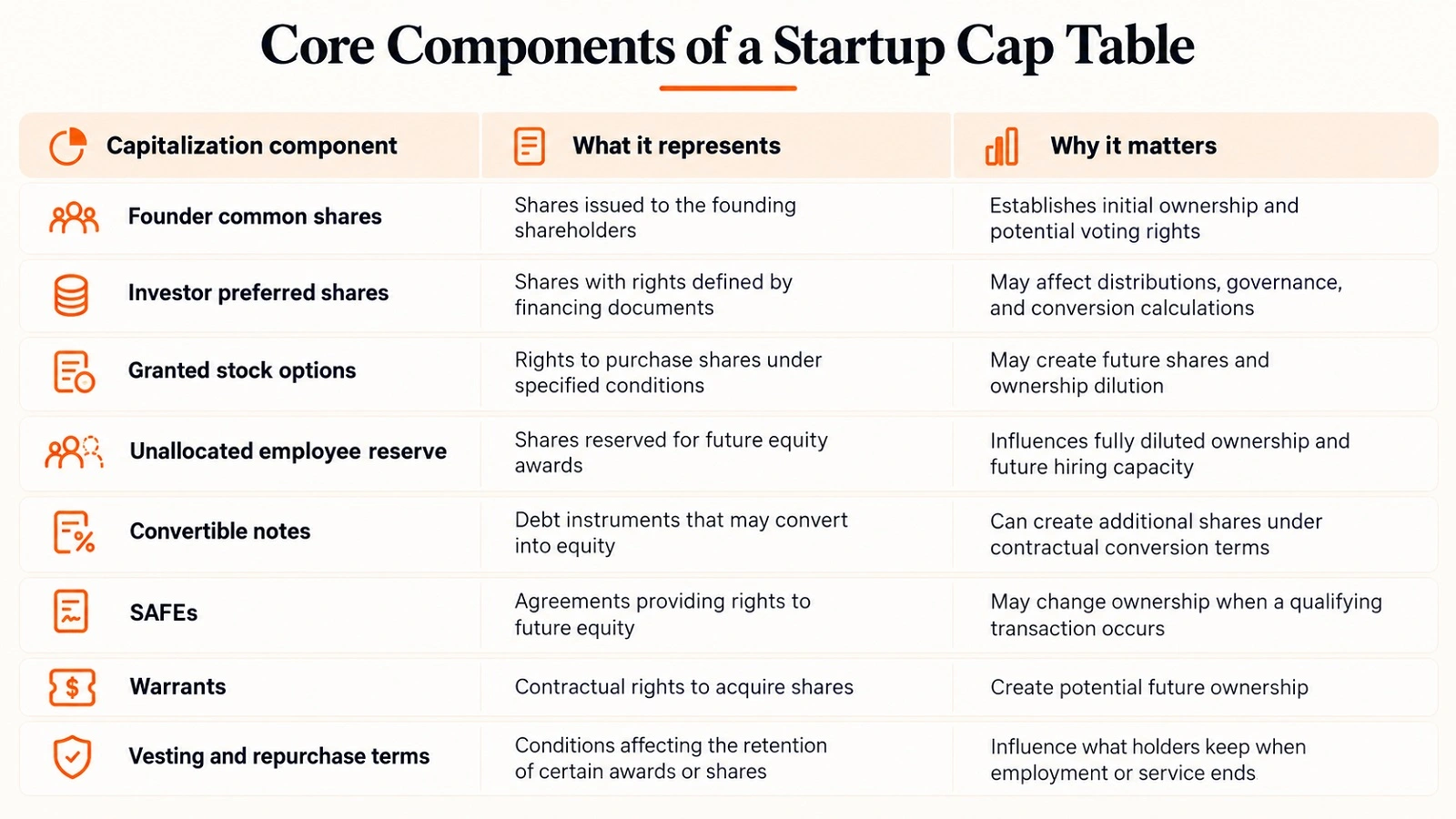
The table illustrates why share ownership cannot be understood through one percentage alone. Some securities already represent ownership, while others may become shares only after particular conditions are satisfied. The relevant treatment depends on the instrument, its contractual terms, and the calculation being performed.
An accurate company record should also maintain the dates of transactions, share classes, issue prices where relevant, and references to supporting documents. As the business grows, management may require additional schedules for financing history, securities conversions, employee awards, and ownership calculations.
Authorized, Outstanding, and Fully Diluted Shares
Before calculating ownership, founders need to distinguish three different share counts. Authorized shares represent the maximum number of shares a company is permitted to issue under its governing documents, subject to applicable corporate law. Issued and outstanding shares represent shares that have actually been issued and remain held by shareholders. The number authorized does not itself determine anyone's ownership percentage.
Fully diluted capitalization provides a broader view. It generally includes outstanding shares and additional shares that could result from specified options, warrants, and employee equity reserves. Convertible instruments may also be incorporated under explicit conversion assumptions. Because the definition can vary according to the financing documents, the company should state which securities are included in each calculation.
The basic formula for outstanding ownership is:
Ownership percentage = Shares held by the shareholder ÷ Total outstanding shares × 100
For fully diluted calculations, the denominator changes to include the additional securities or reserved shares specified in the model. This can produce a lower percentage even when the shareholder's actual share count has not changed.
These two percentages serve different purposes. Outstanding ownership helps describe existing shareholders, while fully diluted ownership helps evaluate potential future ownership and financing consequences. Neither should be quoted without identifying the calculation basis.
Understanding Ownership Rights in Startups
The term startup equity refers to ownership interests in a young company. Depending on its legal structure, that interest may be represented by shares, membership units, or another recognized ownership instrument. In corporations, investors and employees may hold different types of securities, each with rights defined by governing documents and applicable law.
Common shares are frequently associated with founders and may carry voting rights and participation in residual economic value. Preferred shares are commonly issued to investors in priced financing rounds and may include preferences concerning distributions, conversion, or particular corporate decisions. The precise rights depend on the securities and agreements involved.
A shareholder's percentage is therefore not the complete description of that person's economic position. Two investors may each hold 10% on an assumed conversion basis but have different rights if one holds preferred shares and the other holds common shares. Ownership analysis should examine the number of shares, the applicable class, and the rights attached to that class.
A Practical Ownership Example for a Growing Startup
Consider CedarWorks, a fictional software startup founded by two entrepreneurs. Founder A receives 6 million common shares, and Founder B receives 3 million common shares. The company also establishes a reserve of 1 million shares for potential employee awards. Initially, only 9 million shares have been issued, but its simplified fully diluted capitalization includes the additional 1 million reserved shares.
The following cap table example demonstrates how these figures change when CedarWorks raises outside investment. Assume the company agrees to a valuation of $10 million before financing on the 10 million share fully diluted basis. A new investor contributes $2.5 million at a share price of $1, receiving 2.5 million newly issued shares.
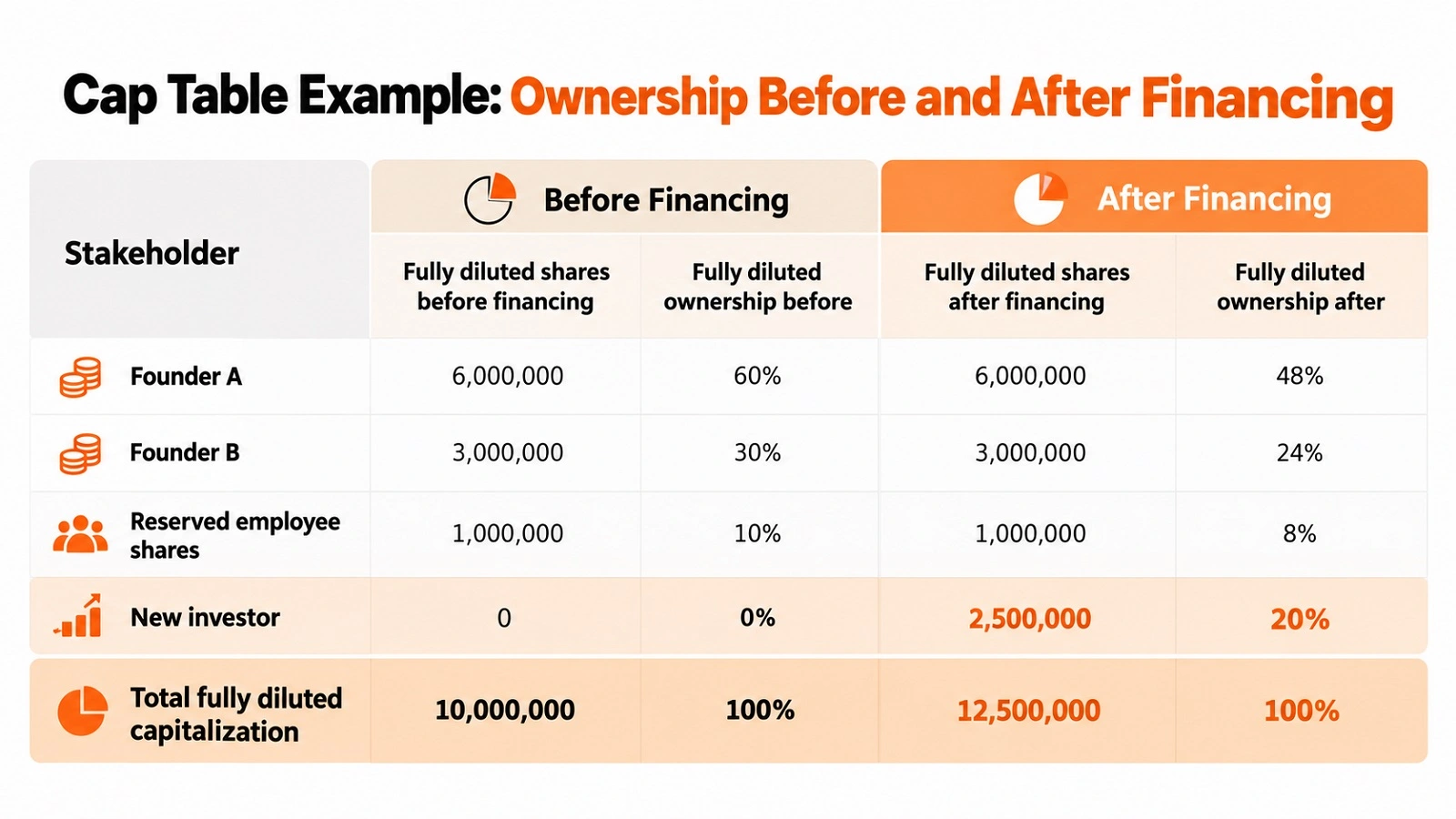
The investment increases the company's modeled fully diluted capitalization from 10 million to 12.5 million shares. Founder A still holds 6 million shares, but the ownership percentage decreases from 60% to 48%. Founder B experiences the same proportional reduction, moving from 30% to 24%. The new investor receives 20% of the company on the stated fully diluted basis.
The employee reserve represents potential future share issuance rather than an individual shareholder currently holding those unissued shares. Its inclusion in the fully diluted share count is a modeling convention and does not mean that the reserved shares have already been issued. The illustration assumes there are no outstanding SAFEs, convertible notes, warrants, or additional increases to the employee reserve. It also assumes a single equivalent share basis and does not attempt to represent differences in voting or distribution rights.
Before financing, the two founders hold 100% of the 9 million outstanding shares. Their outstanding ownership percentages are approximately 66.7% and 33.3%. The lower percentages in the table arise because the unallocated reserve is included in the fully diluted denominator.
This distinction is important when discussing ownership with investors or employees. A percentage based only on outstanding shares can look materially different from the percentage calculated after potential future issuances are considered.
How Ownership Changes During Fundraising
A priced investment round generally involves investors purchasing shares at an agreed price. The investment increases the company's cash resources and usually increases the total number of outstanding shares. Existing shareholders may retain the same number of shares while representing a smaller proportion of the expanded capitalization.
The financial valuation used for a round also matters. A company's pre investment valuation describes the agreed value before the new capital is contributed. Its post investment valuation is the pre investment valuation plus the new money, assuming a straightforward primary equity financing without other adjustments.
In the CedarWorks example:
Pre investment valuation = $10,000,000
New investment = $2,500,000
Post investment valuation = $12,500,000
New investor ownership = $2,500,000 ÷ $12,500,000 × 100 = 20%
These calculations provide a useful starting point, but actual financing agreements may introduce additional complexity. Preferred share rights, outstanding convertible securities, and changes to employee reserves can alter the economic consequences of the round. The company should calculate ownership using the definitions specified in the transaction documents.
Founder Ownership and the Initial Equity Split
The distribution of founder equity is one of the earliest decisions a startup makes. Founders may divide shares equally or agree on different allocations reflecting their contributions, responsibilities, commitments, and expectations about future participation. There is no universal percentage that produces the correct outcome for every team.
An initial ownership agreement should account for how the founders expect to work together. One person may contribute essential technology, while another manages commercial development and operations. The value of those roles can change as the business grows, so discussions should address future responsibilities rather than focusing exclusively on contributions made before incorporation.
Founders also need documentation covering intellectual property assignments, decision making, departures, and the treatment of shares when someone stops working for the company. These arrangements can be more important than small differences in the initial ownership split. A company may face serious difficulties when a departing founder retains substantial rights without clear contractual arrangements governing the consequences.
How New Share Issuance Affects Ownership
A central consequence of issuing additional shares is equity dilution. Dilution occurs when an existing shareholder's percentage decreases because the capitalization increases and the shareholder does not acquire a proportionate number of the new shares. The change is mathematical, but its economic significance depends on why the new shares are being issued and what value the company receives.
Dilution is not automatically harmful. A founder might own 80% of a company with limited financial resources or 50% of a substantially more valuable business after successful financing and expansion. The smaller percentage could represent greater financial value if the capital enables meaningful business growth.
However, a financing round can be unfavorable when a company gives up substantial ownership without obtaining resources sufficient to improve its prospects. The relevant questions concern the financing amount, agreed valuation, new investor rights, and milestones the company expects to achieve. Founders should understand the ownership consequences before committing to a transaction.
The Effect of Valuation on Founder Ownership
Consider the same CedarWorks capitalization immediately before investment. The founders collectively hold 90% on a fully diluted basis, and the employee reserve represents 10%. Management wishes to raise $2.5 million but wants to understand how different valuations would affect ownership.
The following scenarios assume that the amount raised remains constant, the existing employee reserve is unchanged, and there are no additional securities or financing adjustments.
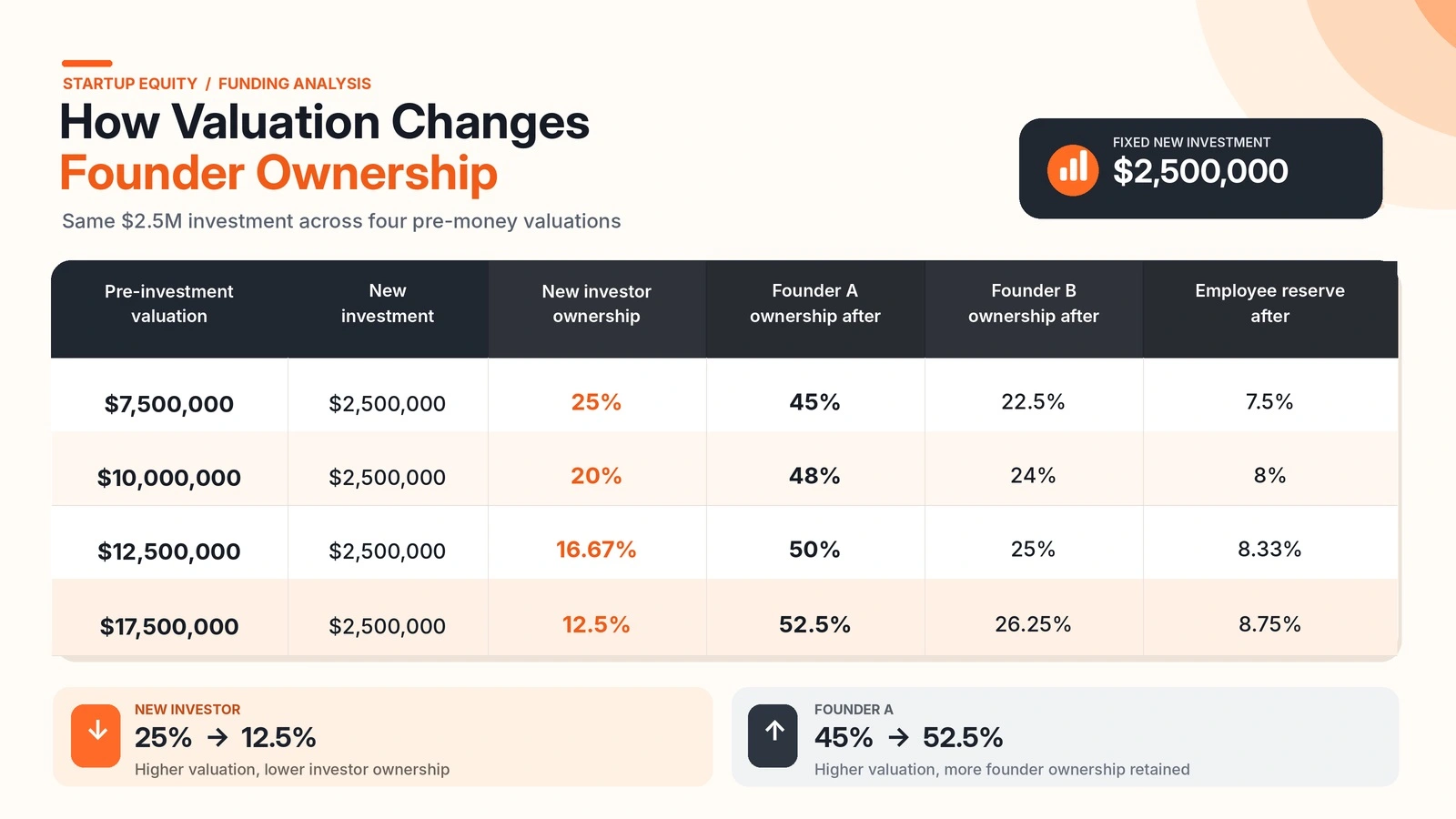
The valuation difference substantially changes the percentage acquired by the investor. At a $7.5 million pre investment valuation, the investor receives 25%. At a $17.5 million valuation, the same investment represents only 12.5%. Founder A consequently retains 45% in the lower valuation scenario compared with 52.5% in the highest valuation scenario.
This does not mean the highest valuation should always be accepted. A demanding valuation can create additional expectations for growth and make later financing more difficult if the company fails to demonstrate sufficient progress. Investor preferences and governance provisions must also be considered when comparing offers.
The figures assume that no additional employee shares are reserved before the round. If investors require a larger reserve as part of the financing agreement, the ownership percentages must be recalculated.
Employee Ownership Incentives
Startups may use employee stock options to help recruit and retain people when they cannot offer the same cash compensation as larger established businesses. A stock option generally gives its holder the right to purchase a specified number of company shares at an exercise price, subject to the terms of the award. Receiving an option does not necessarily make the employee a shareholder immediately.
The potential financial benefit depends on several factors. These include the number of options granted, the exercise price, the company's future value, the possibility of selling shares, and the costs and taxes associated with exercising or disposing of the resulting shares. A grant that appears valuable based on a private company valuation may not provide immediate liquidity.
Employees should also understand whether the company has different classes of shares with preferential rights. The value available to ordinary shareholders in an acquisition can differ from a simple calculation based on the company's headline sale price. Options should therefore be explained through actual award terms rather than presented as guaranteed future compensation.
Vesting and Employee Retention
A vesting schedule determines when a person earns the contractual right to retain or exercise specified equity awards, depending on the form of the security. Vesting is commonly used to encourage continued service and align the interests of founders or employees with the company's development. The terms should be recorded clearly in the relevant agreements.
A common arrangement in venture backed companies provides for vesting over four years with a one year cliff. Under a typical structure, no options vest during the first year, and 25% vest when the employee completes that year of service. The remaining portion may then vest in monthly installments, although actual arrangements vary.
Vesting can also apply to founder shares through repurchase rights or other contractual restrictions. When a founder leaves, the number of shares retained and any repurchase rights depend on the agreements already in place. The company should not assume that every vested or unvested equity instrument follows the same legal treatment.
Acceleration provisions may change vesting outcomes after certain events, such as an acquisition or qualifying employment termination. Because these terms affect both ownership and negotiation outcomes, they should be reviewed before financing or corporate transactions.
Understanding the Employee Equity Reserve
An option pool is a reserve of shares that a company sets aside for employee or other eligible equity awards. The company may grant awards from this reserve as it recruits additional staff, while the remaining shares stay available for future allocation. Maintaining a reserve helps founders plan equity incentives without negotiating an entirely new allocation for every hire.
The size of the reserve affects fully diluted ownership. In CedarWorks, 1 million of the original 10 million modeled shares were reserved for potential employee awards. The founders therefore represented 90% of the fully diluted capitalization before the financing even though they held all of the issued shares at that point.
Investors may request changes to the employee reserve during fundraising. A particularly important negotiation concerns whether an increase is included in the capitalization before the investment or effectively allocated after the new investor enters. That timing can affect how much dilution existing shareholders bear.
Founders should evaluate reserve size using a realistic hiring plan rather than selecting an arbitrary percentage. Expected roles, potential award sizes, current unallocated capacity, and future financing requirements can all influence the amount needed. A reserve that is unnecessarily large can reduce founders' modeled ownership without providing an immediate commercial benefit.
Employee Compensation Through Company Ownership
The broader concept of equity compensation includes several arrangements through which employees, executives, or other service providers may receive ownership interests or benefits linked to company value. Stock options are one example, but companies may also use restricted stock awards, restricted stock units, or other arrangements permitted by applicable law and the company's governing documents.
These instruments do not create identical rights. Restricted stock may involve issued shares subject to forfeiture or repurchase conditions, whereas restricted stock units typically involve contractual rights to receive shares or other settlement at a later time. Options generally require an exercise decision and may involve payment of the exercise price.
Tax rules differ across jurisdictions and security types. In the United States, an eligible Section 83(b) election generally must be filed within 30 days after the property is transferred. The election does not apply to an ordinary unexercised stock option, and founders should seek qualified tax advice before making it. Particular arrangements involving an early exercise of options may require separate analysis because actual shares can be transferred before vesting is complete.
A well designed compensation arrangement should explain the award clearly. Employees need to understand vesting, exercise or settlement conditions, potential liquidity restrictions, and the circumstances in which rights expire. This transparency can prevent misunderstandings that arise when equity awards are described only as a percentage of a company's estimated value.
SAFEs and Convertible Notes in Ownership Planning
Startup financing does not always involve immediate share issuance. Some investors provide capital through agreements intended to convert into equity during a later transaction. Two commonly encountered instruments are SAFEs and convertible notes, although their availability and legal treatment depend on the jurisdiction and contractual form.
A SAFE generally provides a contractual right to receive equity upon specified events. Under Y Combinator's standard post money SAFE structure, a valuation cap can help determine the ownership attributable to the investment before the next priced round. However, the actual conversion outcome depends on the agreement, the capitalization definition, and the terms of the subsequent financing.
Convertible notes are different because they are debt instruments. They may include interest, a maturity date, a conversion discount, and a valuation cap. When a financing event occurs, the outstanding amount and applicable contractual provisions can affect how many shares the investor receives.
Neither instrument should be omitted simply because no new shares have yet been issued. A company may appear to have a simple shareholder structure while carrying substantial potential dilution from outstanding conversion agreements. Founders should maintain a separate schedule for these securities and model their effects before completing additional financing.
Preferred Shares and the Distribution of Exit Proceeds
An ownership percentage does not necessarily determine how much money a shareholder receives when a company is sold. Preferred investors may hold liquidation preferences that influence how proceeds are distributed. These rights are established in the investment documents and can vary significantly between transactions.
Consider a simplified example in which an investor has contributed $2.5 million for preferred shares carrying a one times nonparticipating liquidation preference. Depending on the contractual terms, that investor may be entitled to receive the original investment amount before common shareholders receive residual proceeds, or may choose an economically preferable conversion into common shares.
If the company sells for an amount that does not provide sufficient value to every shareholder, the preference can materially affect the distribution. At higher exit values, conversion may produce a more favorable result for the investor. The actual calculation also depends on other preferred shares, senior claims, outstanding awards, transaction expenses, and the applicable legal terms.
Founders should therefore distinguish ownership percentages from distribution rights. A capitalization record explains the securities held, but a separate exit analysis may be necessary to determine what each stakeholder could receive under a proposed transaction.
Managing Ownership Records as the Company Grows
A startup should update its capitalization records whenever an event changes issued shares, equity awards, or relevant conversion rights. Common events include founder issuances, employee grants, option exercises, financing rounds, share transfers, repurchases, and the conversion of outstanding securities. Each transaction should be supported by approved documentation.
An early company may maintain its records through carefully controlled spreadsheets. As the number of shareholders and securities grows, specialized equity management software may become more practical. The important requirement is not the software itself but the accuracy of the underlying records and the ability to reconcile every transaction with supporting legal documents.
Management should also establish clear responsibility for maintaining the information. Investors, legal advisers, finance teams, and employees may all require different extracts, but they should not rely on conflicting ownership records. A single controlled record reduces confusion during fundraising and other corporate events.
Preparing Capitalization Records for Investor Due Diligence
Before an investment round, founders should confirm that the recorded ownership structure matches the company's legal documents. Investors may review historical share issuances, board approvals, employee grants, outstanding conversion agreements, and relevant shareholder rights. Discrepancies can delay a transaction or create uncertainty about the ownership being purchased.
A financing model should include the capitalization immediately before the proposed investment and the expected structure afterward. This allows management to test the influence of valuation, share issuance, option reserve adjustments, and the conversion of outstanding instruments. The analysis should identify assumptions rather than present estimated percentages as finalized legal outcomes.
Founders should pay particular attention to equity promises that have not been properly documented. An informal commitment to provide a percentage of ownership can create confusion when later financing calculations do not account for it. Resolving these issues early is generally easier than addressing them during the final stages of an investment transaction.
Final Thoughts
Understanding capitalization and ownership is essential for founders who intend to raise capital, recruit employees through ownership incentives, or build a business with multiple shareholders. Ownership records do more than identify who holds shares today. They reveal how financing agreements, potential share issuances, and contractual rights can affect the company's future structure.
The CedarWorks example demonstrates how a financing round changes percentage ownership even when the founders retain their original share counts. It also shows why fully diluted calculations, employee reserves, and valuation assumptions need to be understood before investment terms are agreed.
An accurate capitalization record, supported by proper documentation and realistic financing models, helps founders make more informed decisions. The objective is not to prevent every instance of dilution, but to understand what ownership the company is exchanging and what value it expects to receive in return.
FAQ
What Is the Purpose of a Startup Capitalization Record?
Its purpose is to document ownership and relevant securities in a structured format. It helps founders and investors understand current shareholdings, potential dilution, and the effects of financing or employee ownership arrangements.
Does Every Startup Need an Ownership Record?
A business issuing ownership interests should maintain accurate records of those interests. Even a company with one or two founders benefits from documenting the initial ownership structure before introducing additional shareholders or employee awards.
What Is the Difference Between Outstanding and Fully Diluted Ownership?
Outstanding ownership is calculated using shares that have already been issued and remain outstanding. Fully diluted ownership uses a broader denominator that includes specified potential shares, such as employee options or reserves, and may incorporate convertible securities under defined assumptions.
How Does Raising Investment Change Founder Ownership?
When a company issues new shares to investors, the total capitalization increases. Existing founders may retain the same number of shares while owning a smaller percentage of the expanded company.
Can Founders Lose Ownership Without Selling Their Shares?
Yes. Their percentage can decrease when new shares are issued to investors or other stakeholders. The reduction in percentage does not necessarily mean the founders have transferred any of their existing shares.
Is a Stock Option the Same as Owning a Share?
No. A stock option generally provides the right to acquire shares under defined conditions. The holder normally does not become a shareholder merely by receiving the option, although the precise treatment depends on the instrument and applicable law.
Why Do Investors Consider the Employee Equity Reserve?
The reserve represents potential future shares that can affect fully diluted ownership. Its size and treatment can influence the ownership percentages negotiated during a financing round.
What Happens to Ownership When a Founder Leaves?
The outcome depends on the founder's share ownership, vesting or repurchase arrangements, shareholder agreements, and applicable law. Some shares may remain with the departing founder while others may be subject to contractual repurchase rights.
Do SAFEs Immediately Give Investors Shares?
Generally, a SAFE is a contractual right to future equity rather than an immediate issuance of shares. The investor's eventual shareholding depends on the agreement and the relevant conversion event.
Does a Higher Company Valuation Always Benefit Founders?
A higher valuation may reduce the percentage issued for a fixed investment amount. However, the full economic outcome also depends on investment rights, later financing needs, business performance, and the possibility of achieving an exit at an attractive value.

Mobina Khanki
Venture & Funding Writer at PinerookMobina Khanki covers venture capital, startup funding, fundraising, and startup finance for Pinerook, focusing on founders and investors.
 Seen first.


