Venture debt is a form of borrowing designed primarily for startups that have raised venture capital but need additional financing to support growth. Unlike conventional business loans, which often depend heavily on historical profitability and collateral, venture debt lenders may place greater emphasis on investor backing, available cash, business performance, and the company's prospects for securing future capital. It can help founders finance strategic initiatives while avoiding an immediate equity round, but the obligation to repay remains even when growth falls short of expectations.
Within Startup Debt and Alternative Funding, venture debt occupies a distinct position because it typically complements existing equity investment rather than replacing it. A startup may use the additional liquidity to complete product development, expand sales, purchase equipment, or strengthen its financial position before another funding round. However, the benefits depend on the repayment schedule, loan conditions, and whether the financing helps the company reach a milestone that justifies the added financial risk.
This guide explains how venture debt financing works, which startups may qualify, how lenders structure agreements, and what founders should examine before accepting a loan. It also provides a practical financial example showing how borrowing affects cash balances, monthly spending, and the timing of future financing decisions.
What Is Venture Debt?
Venture debt is a specialized loan provided to growth companies, usually those backed by institutional venture capital investors. It is designed for businesses that may not yet generate consistent profits but have demonstrated commercial potential, raised equity funding, and established a credible plan for future development.
Traditional lenders often assess a borrower's repayment capacity through historical earnings, cash flow, and assets available as security. Venture lenders may instead consider the quality of existing investors, the company's cash reserves, recent financing activity, commercial progress, and the likelihood of raising additional capital.
The financing generally takes the form of a term loan or another negotiated credit facility. The borrower receives access to capital and agrees to repay it according to specified contractual conditions, typically including interest and fees.
Some venture lenders also receive warrants, which provide an opportunity to acquire equity under agreed terms. This means borrowing may involve limited potential dilution even when the principal financing is structured as debt.
The defining characteristic is not the absence of repayment obligations. It is the lender's willingness to finance a developing company whose growth prospects and investor support may be more significant than its historical profitability.
How Venture Debt Financing Works
A venture debt transaction begins when a company identifies a funding requirement and approaches a specialized lender. The lender evaluates the business, its financing history, expected operating performance, and the circumstances under which the loan could be repaid.
The parties then negotiate the facility amount, interest rate, repayment schedule, fees, security arrangements, and other contractual provisions. Depending on the structure, the company may receive the entire loan at closing or draw funds in installments after satisfying agreed conditions.
Loan Approval and Funding
A lender may review financial statements, cash forecasts, capitalization records, existing investor commitments, and the company's plans for the next funding round.
The assessment often considers how much equity the startup has already raised and whether that capital provides sufficient support for the proposed borrowing. A company with a recently completed institutional funding round may be better positioned than one approaching the end of its cash reserves.
Loan availability does not imply that the startup should borrow the maximum amount offered. The appropriate facility size should reflect the intended use of funds and the company's ability to meet its financial commitments.
Interest Payments and Principal Repayment
A venture loan may include an initial period during which the borrower pays interest but does not make scheduled principal payments. This can preserve cash during the early stages of an investment or growth initiative.
After that period, principal repayment may begin through installments. Other facilities can involve larger payments at maturity or different repayment arrangements.
The distinction matters because a loan that appears affordable during its initial interest payment period may become significantly more demanding once principal payments begin.
Founders should model the complete repayment schedule rather than evaluating affordability using only the first few monthly payments.
Security and Contractual Restrictions
Venture debt frequently includes security over specified company assets. The lender may also impose conditions concerning minimum liquidity, financial reporting, further borrowing, asset transfers, or other business activities.
These provisions are intended to manage lending risk, but they can restrict operational flexibility. A business that breaches an important contractual condition may face consequences even if it has not missed a scheduled payment.
The agreement should therefore be assessed as a complete financing arrangement, including the lender's remedies and the company's responsibilities throughout the loan term.
Who Qualifies for Venture Debt?
Eligibility depends on the lender, financing market, business stage, and available financial evidence. Venture debt is commonly associated with startups that have completed institutional funding rounds and demonstrated meaningful progress toward their commercial objectives.
Companies at Series A or later stages may be candidates, although some lenders consider earlier businesses with substantial funding or other strong financial characteristics.
The existence of venture capital backing does not guarantee approval. Lenders generally need evidence that the startup has adequate resources, credible commercial prospects, and a realistic strategy for meeting future repayment obligations.
Investor Support and Financing History
The quality and experience of existing investors can influence a lender's assessment. Investors with a record of supporting portfolio companies through additional rounds may strengthen confidence in the company's financing prospects.
However, a lender should not treat potential investor support as guaranteed repayment. Future investment decisions remain subject to commercial conditions, investor approval, and available capital.
Founders should distinguish between existing committed funds and capital that investors might provide under favorable circumstances.
Cash Runway and Business Performance
Lenders examine how much cash the company currently holds, how quickly it is consuming that cash, and what management expects to achieve before additional funding becomes necessary.
A startup with sufficient operating liquidity and measurable growth progress may have stronger borrowing prospects than one seeking emergency financing after experiencing substantial financial deterioration.
Revenue quality also matters. Predictable customer collections, retention, gross margins, and commercial contracts can help demonstrate that the business is developing toward a more sustainable financial position.
The appropriate indicators depend on the business model. A subscription software company will not necessarily be assessed using the same operating measures as a biotechnology business conducting long development programs.
When Should a Startup Raise Venture Debt?
Timing can materially influence both the availability and commercial terms of a venture loan. Companies often explore borrowing shortly after an equity financing, when their liquidity is stronger and their next business milestones are clearly defined.
At that stage, the company may have greater negotiating flexibility because it is not dependent on receiving immediate debt funding to continue operating.
Borrowing later can still be appropriate, particularly when revenue and cash generation have improved. However, seeking financing only after cash reserves become critically low may reduce lender interest and increase the risk of unfavorable terms.
The central question is whether the company can use the debt to improve its future financing or operating position. Borrowing solely to postpone an unavoidable financial problem can make that problem more expensive.
Financing Growth Between Equity Rounds
A startup may use debt to fund additional development or customer acquisition before its next equity round.
For example, management might expect a new enterprise product to generate meaningful commercial traction within the following year. Additional financing could allow the company to complete development and demonstrate results before negotiating with new equity investors.
The strategy works only if the company can reasonably support the loan during that period. Future fundraising should not be treated as certain until the capital is contractually committed and available.
Supporting Predictable Capital Expenditure
Venture debt may also finance equipment, infrastructure, or other investments with identifiable commercial benefits.
When expenditure supports customer contracts or capacity expansion, the company can evaluate whether expected cash receipts justify the financing obligations.
This is different from borrowing to support highly speculative activities whose financial outcome remains uncertain. The loan should match the company's capacity to manage risk, not merely the attractiveness of the proposed opportunity.
Venture Debt Terms and Costs Founders Should Review
Venture debt agreements contain several financial and legal provisions that determine the actual cost of borrowing. The interest rate is important, but it represents only one part of the overall financing arrangement.
Founders need to examine fees, repayment conditions, equity related rights, security, financial covenants, and the consequences of default.
The following table summarizes the principal contractual elements and the questions management should resolve before accepting an offer.
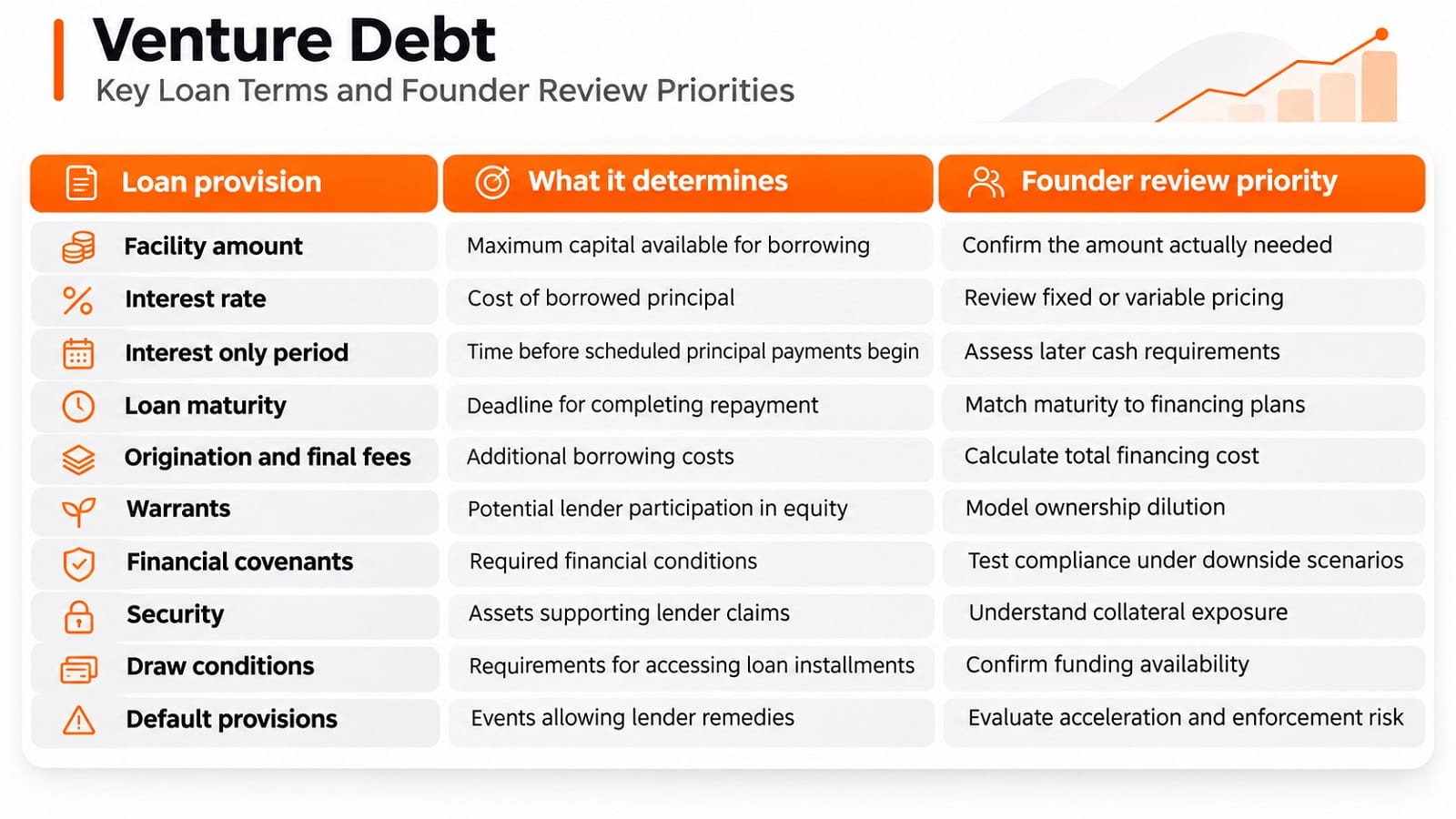
These provisions should be reviewed together because one favorable term can be offset by another restrictive condition. A longer interest only period may improve initial liquidity but leave substantial principal payments later, while a lower interest rate may be accompanied by additional fees or warrant obligations. The appropriate comparison is the total economic and operational effect of the agreement throughout its duration.
Understanding Warrants and Equity Dilution
A warrant gives the holder a contractual opportunity to purchase shares under specified conditions. Some venture lenders negotiate warrants as part of their compensation for providing capital to a growing company that may not yet have stable earnings.
The number of shares available, exercise price, expiration date, and treatment during corporate transactions affect their economic significance.
Warrants should not be confused with an immediate transfer of equity ownership. Their potential dilution depends on whether they are exercised and on the company's capitalization.
Founders should calculate the ownership consequences alongside interest and fees when comparing competing financing offers.
Financial Covenants and Default Risk
Financial covenants may require maintaining specified liquidity levels, delivering reports, or satisfying other financial conditions.
A company can encounter difficulties if its performance deteriorates or if an unexpected expenditure causes it to breach an agreed threshold. Depending on the loan terms, a breach may create an event of default or permit the lender to require corrective action.
Founders should negotiate covenant conditions using realistic financial forecasts. Requirements that appear manageable under an optimistic growth plan may become restrictive when revenue arrives later than expected.
The agreement should also explain any notice periods, opportunities to remedy breaches, and the lender's rights after default.
A Practical Venture Debt Financing Example
Consider Northstar Cloud, a fictional software startup that recently completed an equity financing. The company has $4 million in unrestricted cash and is investing heavily in product development and customer acquisition.
Its operating cash expenses exceed customer receipts by $250,000 per month. Management expects to achieve important commercial milestones over the following year and is considering a $1 million venture loan to provide additional liquidity.
For this example, assume the proposed loan carries 12% annual interest, a $20,000 upfront financing fee, and an initial 12 month period during which only interest is paid. Principal repayment would begin after that period under a subsequent schedule, which is not included in the initial cash projection.
The figures are illustrative and do not represent a market quotation or a recommendation to accept debt.
Comparing Cash Positions With and Without Debt
Before borrowing, Northstar has a simple cash runway of 16 months, calculated by dividing its $4 million cash balance by the existing $250,000 monthly operating shortfall.
If the company receives the loan, it gains $1 million in capital but pays the assumed $20,000 fee. Its initial available cash increases to $4.98 million.
During the first 12 months, annual interest of 12% on the outstanding $1 million principal produces a monthly interest payment of $10,000, assuming the rate remains unchanged and interest is calculated using a simplified monthly convention.
The company's monthly cash consumption during that period would therefore increase to $260,000 if its operating performance remained unchanged.
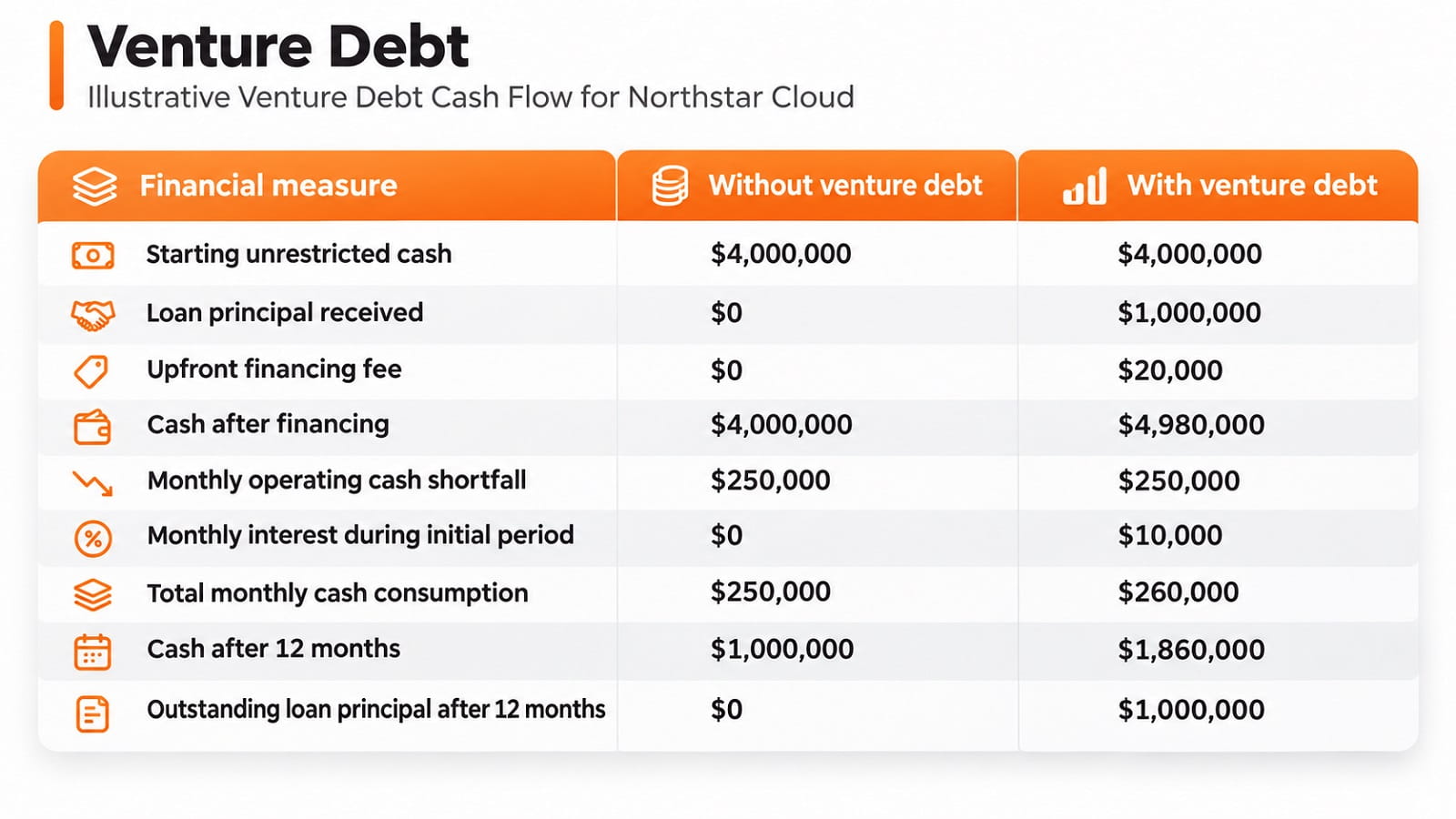
The debt financed scenario leaves Northstar with $860,000 more cash after 12 months, but it also has a $1 million outstanding liability. The additional liquidity is not equivalent to newly created economic value because the borrowed principal must eventually be repaid. This distinction is important when founders evaluate whether borrowing genuinely improves their financial position or simply shifts obligations into a later period.
Why a Higher Cash Balance Does Not Guarantee Longer Runway
Northstar's larger bank balance may provide flexibility while it develops new products or pursues additional customers. However, dividing that balance by its current operating shortfall would ignore future principal repayments.
Once the interest only period ends, the company's monthly debt service may increase significantly. The exact amount depends on the subsequent amortization schedule and contractual terms.
A reliable forecast should therefore include the remaining debt balance, scheduled principal payments, fees due at maturity, and possible changes in revenue and operating expenses.
If Northstar cannot generate sufficient additional cash or obtain new capital when principal repayment begins, the loan may intensify its financial difficulties.
Testing a Delayed Funding Round
Suppose Northstar expects to raise additional equity in 12 months, but weak market conditions delay the round by six months. The company would need to continue financing operations while meeting the loan obligations.
Management should examine whether projected cash remains sufficient throughout the delay, whether the lender can enforce additional requirements, and whether the company has realistic alternatives to an immediate fundraising round.
A useful stress test should include lower customer collections, delayed product milestones, and reduced investor appetite. If the company cannot withstand a plausible downside outcome, borrowing may create more risk than the additional liquidity justifies.
Venture Debt vs Traditional Business Loans
Venture loans and conventional business loans are both forms of debt, but lenders often evaluate them using different assumptions.
Traditional commercial lending commonly emphasizes established cash generation, collateral, financial history, and demonstrated repayment capacity. Venture lending places greater weight on a company's growth prospects, investor support, financial runway, and potential access to additional capital.
This does not mean venture lenders ignore repayment risk. They assess it through a different commercial framework suited to companies that may still be investing more cash than they generate.
The distinction also affects contract structure. Venture facilities may include warrants, specific liquidity covenants, and repayment arrangements designed around anticipated development milestones.
A profitable startup with stable cash flow may find conventional lending more appropriate. A venture backed company with strong growth prospects but negative operating cash flow may consider specialized borrowing, provided the repayment strategy remains credible.
Advantages and Disadvantages of Venture Debt
The primary advantage of venture debt is access to additional capital without necessarily completing an immediate equity financing. This can help founders preserve ownership while funding defined strategic initiatives.
Borrowing may also provide a financial buffer against temporary delays in customer growth or fundraising. In favorable circumstances, the company can use that additional time to achieve milestones that improve its commercial position.
However, the main disadvantage is the obligation to repay. Scheduled interest, principal payments, fees, and potential contractual restrictions apply regardless of whether management achieves the expected growth.
The existence of warrants can also reduce the ownership preservation benefit. Security interests and default provisions may expose the company to additional restrictions during financial distress.
Venture debt is therefore most useful when the capital has a defined purpose and the company can demonstrate a realistic strategy for satisfying its obligations.
Negotiating a Venture Debt Agreement
Founders should begin negotiations by identifying the financing amount actually required. Borrowing more than necessary increases interest expense and can create avoidable liabilities.
The next priority is repayment timing. The interest only period, principal schedule, and maturity should align as closely as possible with expected cash generation and financing milestones.
Fee structures also deserve attention. Origination charges, final payment fees, and early repayment provisions can alter the total cost of borrowing significantly.
Management should evaluate warrants through a capitalization model and test covenant compliance under downside assumptions. Negotiations should also address whether the company can raise additional capital, sell assets, or refinance existing obligations without unnecessary restrictions.
Finally, founders should assess the lender's experience with venture backed companies and its approach to borrowers experiencing temporary setbacks. Commercial flexibility is valuable, but it should be reflected in documented contractual rights rather than relying solely on informal assurances.
Common Venture Debt Mistakes
One mistake is treating borrowed money as equivalent to new equity investment. Debt temporarily increases cash resources while also creating liabilities. The financial benefits depend on what the company achieves with that capital.
Another mistake is evaluating only the initial interest payment. A relatively modest monthly cost can become substantially larger when principal repayment begins.
Founders may also underestimate covenant risk, particularly when agreements require minimum liquidity or other financial thresholds. A business can face contractual pressure before it has completely exhausted its cash.
A further problem is relying on an expected equity round as the only repayment strategy. Investors may delay decisions, reduce their commitments, or decline to participate. Funding plans should account for those possibilities.
Finally, comparing lender offers based solely on interest rates can conceal differences in fees, warrants, security, and operational restrictions. The entire agreement determines the real financing cost.
Final Thoughts
Venture debt can provide valuable financial flexibility for startups that have secured institutional backing and identified meaningful opportunities for growth. It may help management fund strategic initiatives without immediately issuing additional equity, but its commercial advantages depend on the company's capacity to manage repayment obligations.
Founders should evaluate the full borrowing arrangement, including interest, fees, warrants, covenants, security, and future principal payments. A larger cash balance should not be mistaken for improved financial health when significant debt obligations remain outstanding.
The strongest use of venture debt connects borrowed capital to measurable progress while preserving sufficient liquidity to withstand delays and weaker operating performance. When those conditions are not supported by credible forecasts, additional equity or another financing structure may be more appropriate.
FAQ
What Is Venture Debt in Startup Financing?
Venture debt is a specialized form of lending for growth companies, commonly those backed by venture capital. It provides borrowed capital that must be repaid under agreed terms and may include interest, fees, covenants, security, and warrants.
How Does Venture Debt Differ From Venture Capital?
Venture capital normally involves investment in exchange for equity ownership. Venture debt is borrowed capital that creates repayment obligations, although warrants may introduce some potential dilution.
Can a Startup Get Venture Debt Without Revenue?
Some companies without significant revenue may qualify when they have substantial investor backing, adequate liquidity, and credible development prospects. Eligibility depends on the lender and the company's financial circumstances.
Does Venture Debt Dilute Founders?
The loan principal does not ordinarily require issuing the same equity stake as a conventional investment round. However, some lenders receive warrants, which can cause dilution if exercised.
How Long Does Venture Debt Take to Repay?
Repayment periods vary by lender and loan structure. Agreements may include an initial interest only period followed by principal installments or other negotiated arrangements. Founders should examine the actual payment schedule.
Is Venture Debt Suitable for Every Startup?
No. It is generally more relevant to companies with established venture backing and credible repayment or refinancing prospects. Businesses without sufficient financial resources may face excessive risk from borrowing.
What Happens if a Startup Cannot Repay Venture Debt?
The consequences depend on the agreement and applicable law. Lenders may have rights relating to default, acceleration, collateral enforcement, or other remedies. A company facing repayment difficulties should obtain qualified legal and financial advice.

Mobina Khanki
Venture & Funding Writer at PinerookMobina Khanki covers venture capital, startup funding, fundraising, and startup finance for Pinerook, focusing on founders and investors.
 Seen first.


