
Venture capital investment has reached extraordinary levels in 2026, but the market is becoming increasingly divided. Artificial intelligence companies are attracting enormous amounts of funding, established startups are securing exceptionally large investment rounds, and investors are concentrating capital in businesses with significant growth potential. Meanwhile, many smaller startups continue to face a selective fundraising environment.
For founders, understanding venture capital trends requires looking beyond headline investment figures. A record year for funding does not necessarily mean that every startup can raise capital more easily. Investment opportunities vary according to industry, company stage, business performance, and the ability to demonstrate a credible path toward growth.
The latest developments in Venture Capital reveal an industry increasingly shaped by artificial intelligence, concentrated investment, changing financial expectations, and uneven exit opportunities. These trends influence how investors evaluate companies and how founders should prepare for fundraising.
Venture Capital Market Overview in 2026
Global venture funding has remained exceptionally strong during 2026. According to Crunchbase, startups worldwide raised approximately $159 billion during the third quarter, representing a 53% increase compared with the same period in 2025.
Funding during the first nine months of 2026 reached approximately $679 billion, the highest total for that period in Crunchbase's dataset. However, third quarter investment was also 25% lower than the preceding quarter, showing how strongly funding activity can fluctuate even during a year of substantial investment.
The United States remains a major center of venture financing. The PitchBook and NVCA Venture Monitor reported $515.8 billion in US venture investment through September 2026. Artificial intelligence accounted for 82.7% of that investment value, highlighting the concentration of capital in a particular technology category.
These figures are significant, but they need context. Large investments in a relatively small number of companies can increase total funding without creating equally favorable conditions for other startups. Founders should therefore distinguish between the overall amount of capital invested and the opportunities available to businesses at their specific development stage.
Venture Capital Market Statistics in 2026
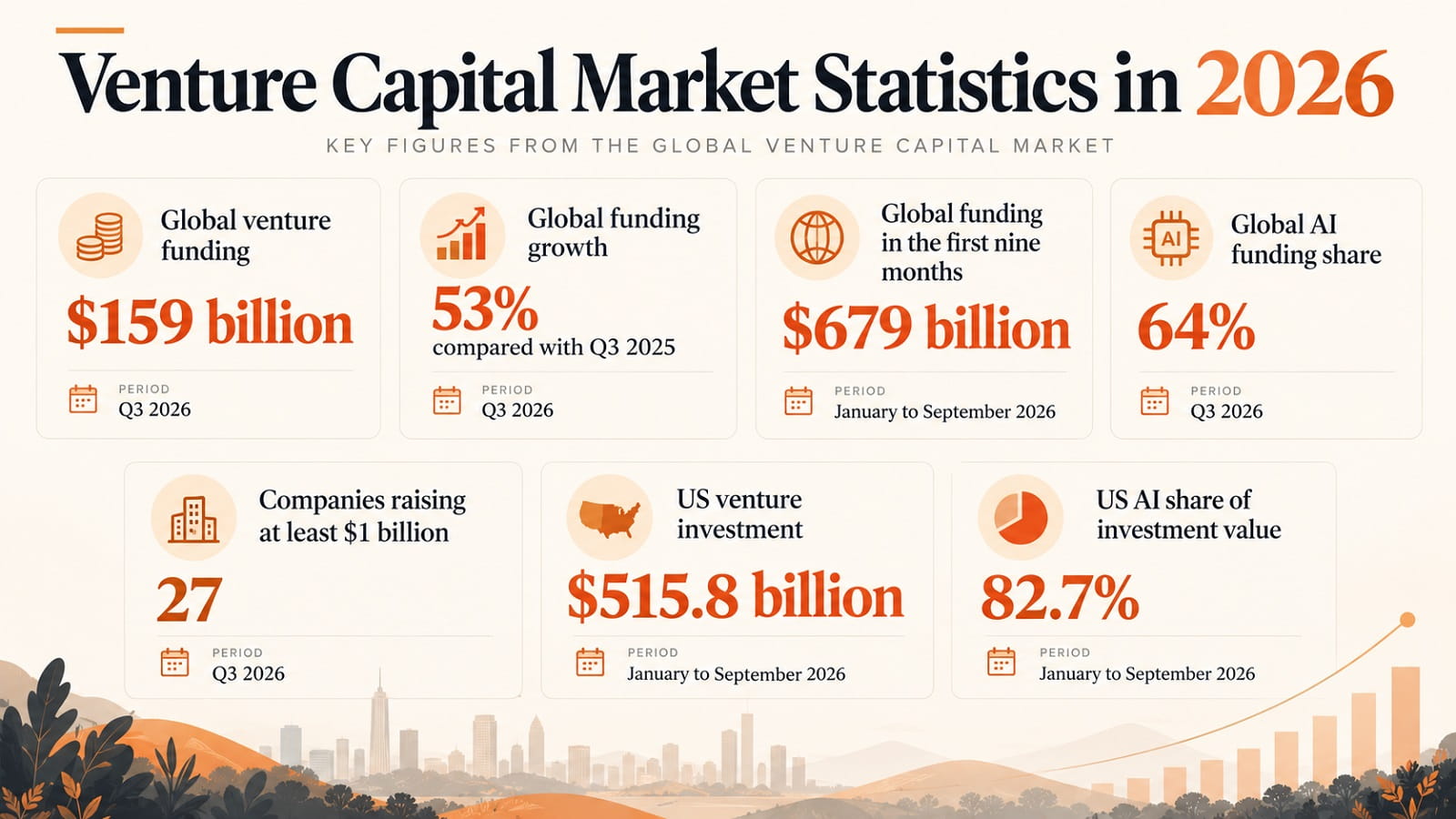
Global figures come from Crunchbase, while US investment figures come from PitchBook and NVCA. The reports use different geographic coverage and methodologies, so their totals should not be directly combined.
The broader pattern is clear: venture capital remains highly active, but funding is concentrated among selected industries, established companies, and unusually large transactions.
Artificial Intelligence Is Dominating Venture Capital Investment
Artificial intelligence has become the most influential investment theme of 2026. Companies developing foundation models, AI infrastructure, automation software, advanced computing systems, and specialized business applications are receiving substantial investor attention.
Crunchbase reported that AI related startups attracted approximately $102 billion during the third quarter of 2026, accounting for 64% of global venture funding. This concentration reflects investor expectations about the commercial potential of AI and the financial resources required to develop advanced systems.
However, growing investment does not mean that every company using AI has a strong fundraising advantage. As development tools become more accessible, many startups can introduce similar features into their products. Investors must determine which businesses possess competitive strengths that extend beyond access to existing AI models.
Proprietary technology, specialized industry knowledge, customer relationships, valuable data, and established distribution channels can help distinguish one company from another. More importantly, investors need evidence that customers receive meaningful value from the product.
For example, a startup using AI to improve financial reporting should demonstrate how its technology reduces costs, improves accuracy, or helps customers complete important tasks more effectively. Simply describing the software as AI powered does not explain why customers will continue paying for it.
Founders operating in AI should focus on solving important problems and developing advantages that remain relevant as the technology evolves. The strongest investment case connects technological capability with measurable commercial demand.
Mega Rounds Are Concentrating Capital in Fewer Startups
One of the defining venture capital trends of 2026 is the growing importance of exceptionally large financing rounds. During the third quarter, 27 companies raised at least $1 billion each, establishing a record for the number of startups completing rounds of that size in a single quarter.
These companies accounted for approximately one third of global venture funding during the period. The scale of these investments demonstrates how much capital investors are willing to commit to businesses they believe have exceptional growth potential.
Some of these large financing rounds are connected to the cost of developing advanced technology. AI infrastructure, semiconductor development, and large computing facilities can require substantially more capital than conventional software businesses.
This concentration also changes how founders should interpret market statistics. A strong increase in global funding may reflect a handful of multibillion dollar investments rather than a broad improvement in access to financing.
A startup developing software for a specialized industry should not use the financing amounts of major AI infrastructure companies to determine its own fundraising target. The businesses have different operating models, capital requirements, and investment expectations.
More useful comparisons involve startups with similar products, customers, development stages, and growth opportunities. Fundraising targets should reflect the resources needed to achieve meaningful business milestones rather than the largest amounts appearing in investment headlines.
Early Stage Funding Remains Selective
Although total venture investment is high, fundraising conditions vary considerably across startup stages. Some early stage businesses are attracting significant investments, particularly in AI, while others face difficulty convincing investors to finance opportunities with limited operating evidence.
Crunchbase reported approximately $13 billion in global seed funding during the third quarter of 2026. About $2.6 billion of that amount went to seed rounds of $100 million or more, illustrating how unusually large transactions are affecting even the earliest financing categories.
The concentration of funding creates an important distinction between the total capital available and the typical experience of a founder raising an initial round.
For startups without substantial revenue, investors often rely on the quality of the founding team, the importance of the customer problem, early product development, and evidence of market demand. A company does not necessarily need an established financial history to attract investment, but it should demonstrate progress appropriate to its stage.
This might involve successful product testing, customer interviews, initial contracts, active users, or technical milestones. The most useful evidence depends on the business model and the uncertainty the company needs to overcome.
Founders should also explain how the next financing round will reduce that uncertainty. An investment proposal becomes more credible when the company can clearly identify what it intends to build, test, or accomplish with the capital.
The objective is not to present growth projections that appear impressive. It is to establish a convincing connection between the current business, the proposed investment, and the progress the startup expects to achieve.
Investors Are Paying Attention to Capital Efficiency
Capital efficiency remains an important consideration in venture financing because investors need to understand whether additional spending can create lasting business value.
Rapid revenue growth can be attractive, but growth alone does not demonstrate that a startup has a sustainable operating model. A company may acquire customers quickly while spending more than it can reasonably recover from those relationships.
Investors therefore examine how businesses use capital and whether their spending supports measurable progress. For software companies, relevant indicators can include customer retention, gross margins, recurring revenue quality, and customer acquisition costs.
Other industries require different measures. A biotechnology startup may be evaluated through research milestones and regulatory progress, while an industrial technology company may need to demonstrate manufacturing reliability and commercial feasibility.
Capital efficiency does not mean minimizing every expense. Hiring, infrastructure, product development, and expansion may justify substantial investment when they create meaningful advantages.
The important question is whether management understands how those expenditures contribute to the company's development.
For founders preparing to raise capital, a credible financial plan should explain the amount required, expected operating expenses, major milestones, and the business evidence needed before the next financing round.
This preparation becomes particularly valuable when market conditions change. Companies with better financial visibility can make more informed decisions about spending, hiring, and the timing of future fundraising.
Deep Technology and Infrastructure Are Attracting Investors
Venture funding is not limited to artificial intelligence software. Investors are also supporting businesses developing the physical technologies and infrastructure required for advanced computing, automation, energy production, and industrial systems.
According to Crunchbase, aerospace, robotics, data centers, semiconductors, and energy each attracted at least $10 billion in investment during the third quarter of 2026.
These sectors are attracting attention because they address significant technological and industrial requirements. Greater demand for computing power creates opportunities for infrastructure providers, while advances in robotics and automation may support new applications in manufacturing, logistics, and other industries.
However, these businesses often face different financial challenges from conventional software startups. Developing complex hardware, building infrastructure, or commercializing scientific research can require extensive technical work and substantial investment before meaningful revenue becomes available.
For founders, investor specialization becomes particularly important. A venture firm experienced in enterprise software may not be the right partner for a company developing advanced manufacturing technology.
Specialized investors may better understand technical milestones, regulatory challenges, development timelines, and the capital required to reach commercialization.
Startups pursuing these opportunities should demonstrate both technical progress and commercial relevance. Innovative technology is valuable, but investors also need to understand the customer problem, potential market, and financial requirements of bringing the product to market.
Venture Capital Fundraising Is Becoming More Concentrated
The concentration of capital affects venture firms as well as the startups they finance. Investment firms generally need to raise money from limited partners before they can support new companies, and the ability to secure those commitments varies considerably.
PitchBook and NVCA reported that US venture funds raised approximately $108.5 billion through September 2026. Funds with commitments of $500 million or more attracted 78.1% of that capital while representing only 6% of the funds that closed.
This suggests that established investment managers are capturing a substantial share of available commitments. Smaller and newer funds may face greater fundraising challenges, even when they have relevant industry expertise.
For startups, this can influence investor behavior. A fund that has difficulty raising its next investment vehicle may become more selective about new opportunities or reserve capital for existing portfolio companies.
Founders should therefore examine the financial position and investment activity of prospective investors rather than relying only on reputation.
An investor may have supported successful startups in previous years but currently have limited capital available for new investments. Understanding the fund's preferred investment stage, typical investment amount, and recent activity helps determine whether the relationship is worth pursuing.
The goal is to identify investors whose mandates and financial resources match the startup's requirements.
Startup Exits and Investor Liquidity Remain Important
Venture investment depends partly on the ability of investors to realize financial returns. These returns may come through acquisitions, public listings, or transactions that allow existing shareholders to sell their ownership.
However, investment activity and liquidity do not always improve together. PitchBook and NVCA reported that just 18 venture backed companies went public in the United States during the third quarter of 2026.
The report also identified 992 active unicorns with a combined valuation of approximately $5.7 trillion. These figures demonstrate the substantial estimated value held in private companies, but private valuations do not represent cash that investors have already received.
When investors experience limited opportunities to realize returns, the consequences can affect the wider venture ecosystem. Limited partners may become more cautious about making new fund commitments, while venture firms may take a more selective approach to deploying capital.
For founders, this reinforces the importance of realistic business planning. A high private valuation does not guarantee an eventual public listing or acquisition, and companies should not depend on a specific exit timeline to justify their operating strategies.
Building a business with strong customer demand, sustainable economics, and financial flexibility remains valuable regardless of when liquidity opportunities become available.
What Venture Capital Trends Mean for Founders
The most useful application of market analysis is improving business and fundraising decisions. Knowing which industries attract capital can help founders identify relevant investors, but investment trends should not replace an understanding of the company's own commercial opportunity.
A startup operating outside artificial intelligence should not assume that financing is unavailable. It may need to focus on investors who understand its particular industry, customers, and growth potential.
Similarly, a company operating in a popular technology category should not assume that investor enthusiasm will compensate for weak customer demand or an unclear business model.
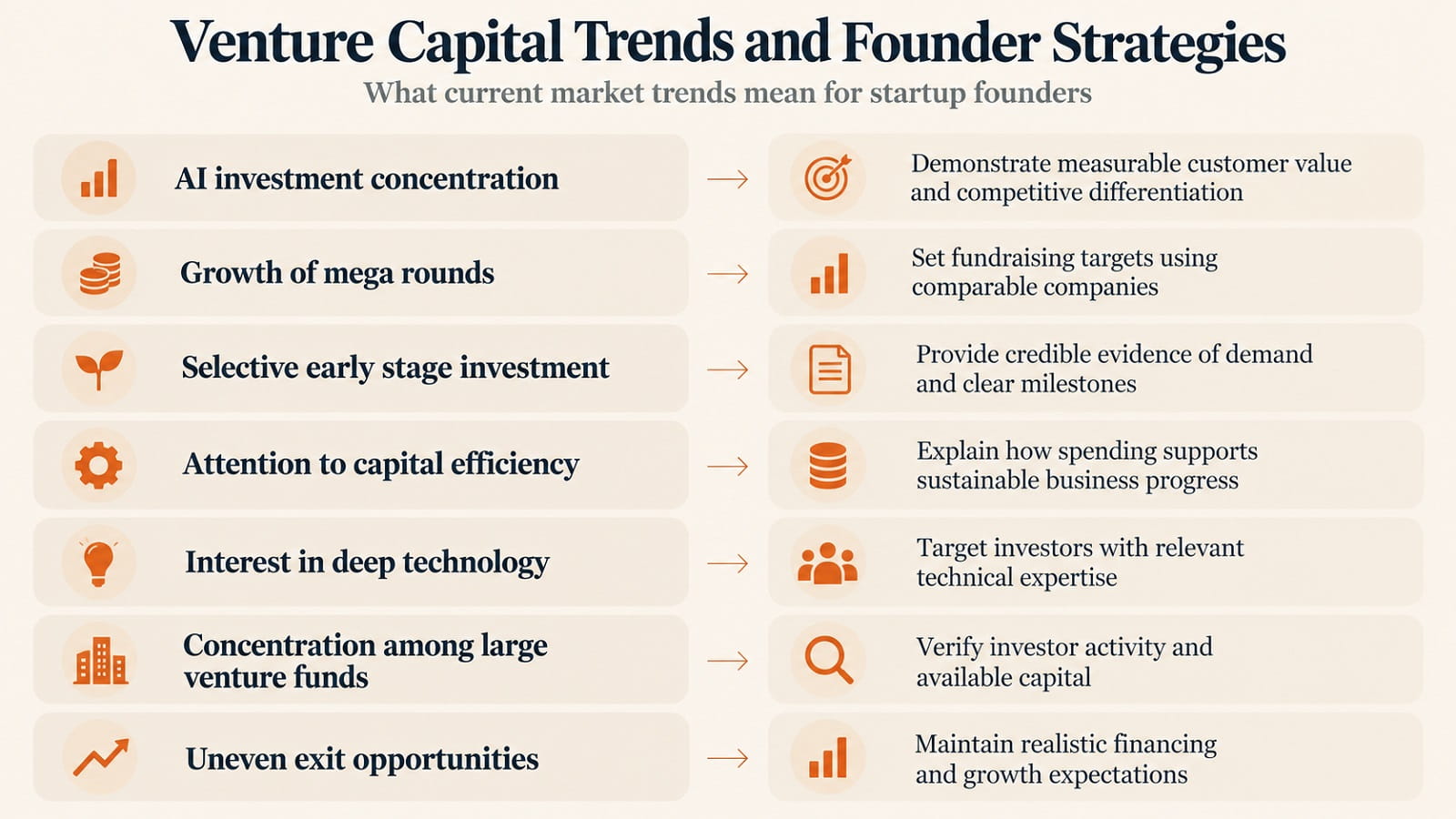
Venture Capital Trends and Founder Strategies
Founders should also assess their financial runway before approaching investors. Understanding available cash, operating costs, and the time required to reach important milestones can improve fundraising preparation.
Investor relationships are another consideration. Regular business updates and consistent progress can help potential investors understand a company before it formally begins raising capital.
The strongest fundraising strategy combines relevant market information with measurable business performance. Trends can help determine where to look for investment, but they do not replace the need for a convincing business case.
Venture Capital Outlook Beyond 2026
Several developments may continue influencing venture investment beyond 2026, although their future impact will depend on economic conditions, technological progress, and investor behavior.
Artificial intelligence is likely to remain an important investment category, but competition may increase pressure on startups to demonstrate meaningful differentiation. Businesses with strong customer relationships, valuable data, specialized expertise, and defensible technology may be better positioned than those relying on easily replicated features.
Demand for computing infrastructure, automation, energy systems, and advanced industrial technologies could also support continued investment. However, these sectors often require substantial capital and may be sensitive to changes in financing conditions.
The venture industry's liquidity environment will remain another important factor. More consistent acquisitions, public listings, and distributions to fund investors could improve confidence across the market. Continued concentration of exit activity, by contrast, may encourage investors to focus on a narrower group of companies.
Founders should avoid building their strategies around predictions of an inevitable investment boom. Preparing for different financing conditions provides greater flexibility than assuming capital will always be available at attractive valuations.
Final Thoughts
Venture capital trends in 2026 reveal a market characterized by substantial investment activity and increasing concentration. Artificial intelligence dominates funding, exceptionally large rounds influence overall statistics, and established venture firms attract much of the capital committed to new funds.
At the same time, many startups still face a selective fundraising environment, and strong investment totals have not produced an equally broad improvement in liquidity.
For founders, the important lesson is to distinguish market headlines from the conditions affecting their specific businesses. Successful fundraising depends on finding relevant investors, demonstrating commercial progress, managing capital effectively, and establishing realistic growth objectives.
Understanding where investment is going can improve strategic decisions, but the strongest foundation remains a business that creates meaningful value for its customers.
FAQ
What are the biggest venture capital trends in 2026?
The main trends include concentrated investment in artificial intelligence, exceptionally large funding rounds, selective early stage financing, greater attention to capital efficiency, growing interest in advanced technology infrastructure, and uneven exit opportunities.
Is venture capital funding increasing in 2026?
Yes. Crunchbase reported approximately $679 billion in global venture funding during the first nine months of 2026. However, a substantial share of that investment went to selected technology sectors and unusually large financing rounds, so the increase does not represent equally favorable conditions for all startups.
Which industries are attracting the most venture capital?
Artificial intelligence is the dominant investment category. Robotics, aerospace, semiconductors, data centers, energy, and other advanced technology industries are also attracting substantial investment.
Is it harder for early stage startups to raise venture capital?
Fundraising conditions vary by industry, stage, and company performance. Although significant capital remains available, investment is concentrated in selected businesses and some unusually large early stage rounds. Founders benefit from demonstrating credible customer demand, clear milestones, and a realistic use of funds.
How should startups adapt to changing venture capital trends?
Founders should target investors relevant to their industry and development stage, demonstrate meaningful customer value, manage operating expenses carefully, and maintain realistic financing plans. Market trends can guide fundraising decisions, but strong business fundamentals remain essential.

Mobina Khanki
Venture & Funding Writer at PinerookMobina Khanki covers venture capital, startup funding, fundraising, and startup finance for Pinerook, focusing on founders and investors.
 Seen first.