
Venture capital investment has reached extraordinary levels in 2026, but the headline numbers tell only part of the story. Large financing rounds are lifting global investment totals while the distribution of capital across companies and funding stages remains uneven. Some investors are committing billions to selected technology businesses, yet other startups face demanding valuation discussions and limited financing options. Understanding the market requires examining the relationship between investment volume, deal activity, company valuations, and the financial capacity of venture funds.
Venture capital market trends reveal how investors allocate money, price risk, and respond to changes in economic conditions and business performance. Within the broader context of Investment Trends, these movements help explain why investment activity can expand without producing a corresponding improvement in fundraising conditions for every company. The strength of the venture market depends not simply on how much capital is invested, but also on how widely financing is available and whether investments eventually generate financial returns.
This guide analyzes venture capital activity through the third quarter of 2026, including funding stages, deal concentration, valuations, fund formation, and exit conditions. It also explains how founders and investors can interpret market reports more accurately, with practical examples showing how financing terms influence company ownership and investment decisions.
What Are Venture Capital Market Trends?
Venture capital market trends are changes in the amount, distribution, pricing, and availability of investment in privately held businesses. They can be measured through financing activity, deal sizes, valuations, investment stages, fund commitments, and liquidity events. Together, these indicators reveal how investors evaluate opportunities and how financial resources move through the startup economy.
A venture market with increasing investment totals is not necessarily becoming more accessible. If a small number of companies receive exceptionally large commitments, the total value of transactions can rise while the number of businesses obtaining financing remains relatively limited. Conversely, a market with moderate funding totals may support a healthy range of smaller transactions and provide meaningful opportunities for new companies.
A reliable analysis therefore considers several indicators together. Investment value explains the amount of capital deployed, while deal counts indicate the breadth of activity. Valuations and financing terms reveal how investors price ownership, and exit activity helps determine whether capital can eventually return to fund investors.
The Global Venture Capital Market in 2026
Global venture capital activity has remained substantial throughout 2026, although investment levels have varied considerably between quarters. According to Crunchbase, venture funding reached approximately $159 billion during the third quarter, with close to 6,000 startups receiving capital. That represented a 53% increase from the corresponding quarter of 2025 but a 25% decline from the second quarter of 2026. The comparison illustrates how a market can report strong annual growth while simultaneously experiencing a quarterly slowdown.
Other research providers report different totals. KPMG recorded approximately $170.9 billion invested across 8,341 global venture transactions during the third quarter. CB Insights reported approximately $698 billion in venture investment across the first nine months of 2026, compared with Crunchbase's approximately $679 billion for the same period. These figures should not be treated as interchangeable because providers differ in transaction coverage, funding classifications, and reporting practices.
The important conclusion is not which database reports the largest number. Multiple independent reports identify substantial capital deployment alongside considerable concentration in relatively few transactions. For founders and investors, the critical question is whether that capital is reaching businesses across a wide range of stages or remaining concentrated among a limited group of companies.
How Venture Funding Is Distributed Across Investment Stages
Venture financing serves businesses with different levels of maturity and financial risk. Seed investment often supports initial validation and product development, while early stage capital can finance companies demonstrating customer demand and initial commercial growth. Late stage financing generally involves larger commitments to companies with more developed operations, although actual financing requirements vary considerably by industry.
Crunchbase reported the following global distribution during the third quarter of 2026.
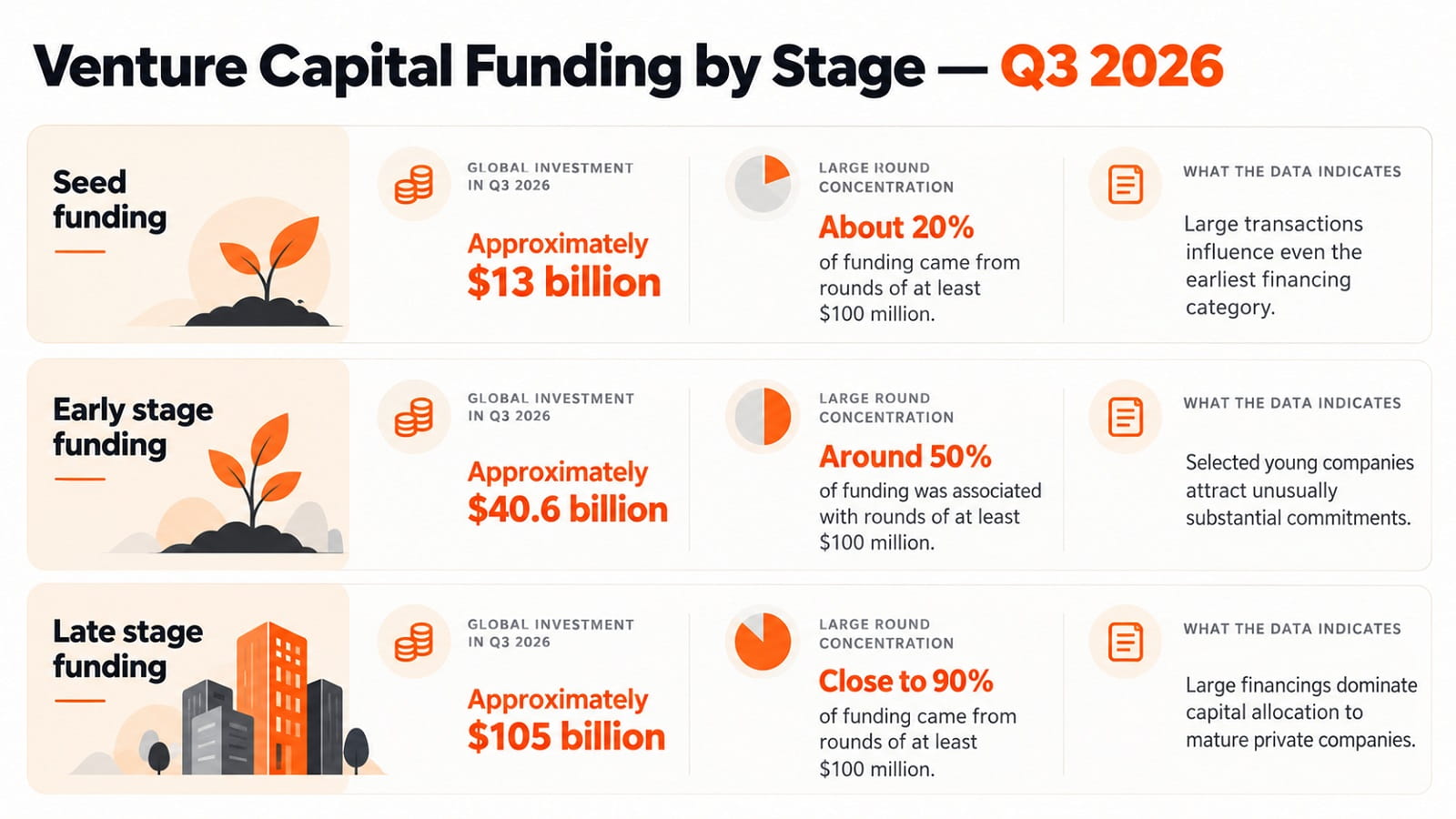
The stage totals are rounded and follow Crunchbase's classifications. Seed, early stage, and late stage categories are not defined identically across all venture databases. Some transactions involving corporate investors or companies with unusual financing structures may also be classified differently depending on the provider.
The figures show that large financing rounds influence every major investment stage, although their importance increases substantially at the later stages. Early stage funding is no longer necessarily associated with relatively modest checks, particularly when companies require advanced computing infrastructure or significant technical investment. This makes stage comparisons more complicated than simply assuming that younger businesses raise less money.
Why Larger Deals Are Reshaping Market Statistics
A defining feature of the 2026 venture market is the influence of exceptionally large financing rounds. Crunchbase recorded 27 companies raising at least $1 billion each during the third quarter, with those transactions accounting for approximately one third of global venture investment. CB Insights likewise found that rounds of at least $100 million represented roughly 80% of global funding during the quarter. Both observations demonstrate how a relatively small group of transactions can dominate market totals.
This concentration affects the usefulness of average financing amounts. When several companies raise billions of dollars, the arithmetic average round size can increase significantly even if typical financing conditions remain relatively unchanged. Median round size may provide a better indication of the central transaction in a dataset, although it also needs to be examined by stage, industry, and location.
Consider a simple example involving nine hypothetical venture rounds. If eight companies each raise $5 million and one company raises $500 million, the total financing value is $540 million. The average round is $60 million, yet the median is only $5 million. Using the average as a benchmark for a typical startup would therefore create a highly misleading impression of funding availability.
For practical market analysis, deal value and deal count should be examined alongside median financing size and the percentage of capital going to the largest transactions. These measures help distinguish broad financing activity from concentration among exceptional companies.
Venture Capital Valuations and Pricing Expectations
Company valuations influence both the financial return investors may achieve and the ownership founders retain after financing. A valuation represents an agreed transaction price under particular terms, not an objective guarantee of the company's future worth. Investors generally consider commercial performance, business risk, competitive differentiation, comparable transactions, and the possibility of eventually selling their ownership at an attractive price.
Market conditions affect the assumptions behind these negotiations. When investors expect faster growth or more favorable liquidity conditions, they may be willing to accept higher valuations for selected businesses. When financing costs rise or future outcomes become less predictable, investors may require a lower entry price or stronger contractual protections.
These dynamics do not affect every business equally. A company with strong customer retention, attractive margins, and meaningful strategic advantages may negotiate differently from a business with limited revenue and substantial financing requirements. Sector enthusiasm can influence comparable transactions, but it cannot replace the need to evaluate each company's actual financial position.
Understanding Valuation Differences Through a Practical Example
Consider Meridian Software, a fictional enterprise technology startup seeking $3 million in new equity financing. The company has established paying customers and wants to expand its commercial operations. Management receives potential investment proposals based on different valuations before the new capital is contributed.
To isolate the impact of valuation, assume that the investment amount remains constant and that there are no convertible securities, new option pool adjustments, or special contractual provisions affecting the ownership calculation.
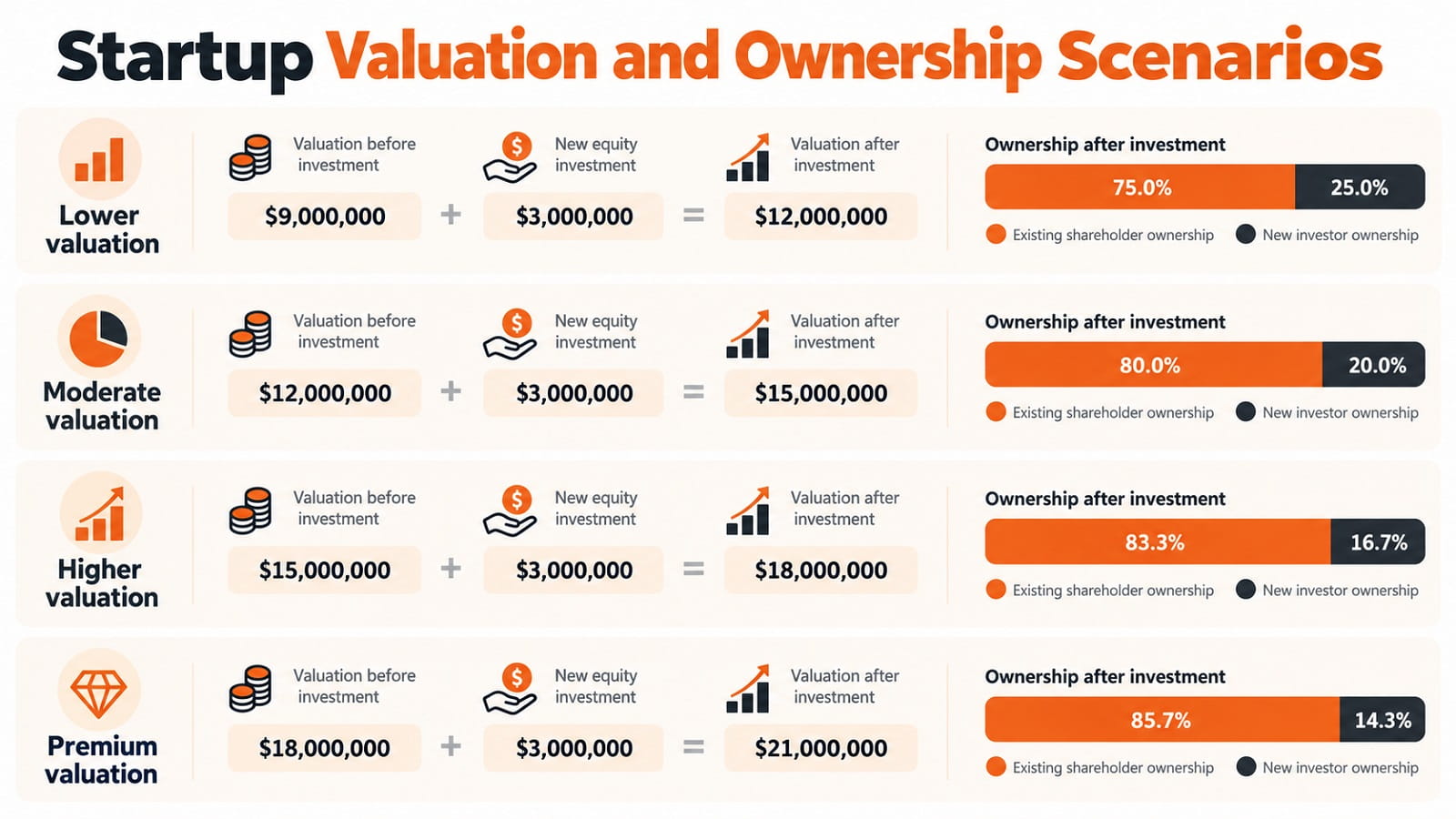
The ownership percentage of the new investor is calculated by dividing the amount invested by the valuation after financing. Under the lower valuation scenario, the investor receives 25% of the business. Under the premium valuation scenario, the same investment represents approximately 14.3% ownership.
The difference demonstrates why valuation negotiations matter to founders. However, accepting the highest possible valuation is not automatically the best decision. A very demanding valuation may create difficulties in a later financing round if the company cannot demonstrate performance sufficient to support it.
Actual investment agreements also include economic and governance terms beyond the headline price. Liquidation preferences, investor consent rights, anti dilution provisions, and option pool arrangements can materially affect the financial consequences. Founders should evaluate the full agreement with appropriate advisers rather than comparing proposed valuations in isolation.
How Funding Conditions Affect Different Companies
Venture capital markets do not move uniformly. A large company with substantial customer revenue and several interested investors may experience competitive financing conditions while a smaller business in a less popular sector struggles to secure initial meetings. Both can operate in the same country and raise capital during the same quarter, yet their negotiations may look completely different.
Investors also distinguish between companies that need capital to accelerate an established business and those that need financing to continue proving their commercial model. The former may offer more evidence about revenue, costs, and customer retention. The latter may present greater uncertainty but potentially meaningful future opportunities if the underlying assumptions prove correct.
For founders, these differences make relevant comparable transactions particularly valuable. Financing information from businesses with similar maturity, financial characteristics, capital needs, and operating environments can provide better context than the largest rounds reported in the technology press.
What Venture Fundraising Reveals About Available Capital
Venture market analysis also needs to distinguish investment in startups from fundraising by venture capital firms. These are separate transactions. When a startup raises a funding round, investors commit money to the company. When a venture firm raises a fund, institutional and other investors commit resources that the manager may subsequently deploy across portfolio companies.
This distinction is important because rising startup investment does not necessarily mean every venture manager has more money available for future transactions. According to PitchBook and the National Venture Capital Association, United States venture funds raised approximately $108.5 billion during the first nine months of 2026. However, funds of at least $500 million received 78.1% of those commitments while representing only 6% of funds closed.
The same report found that established managers raising their fourth fund or a later fund accounted for 88.2% of fundraising dollars. First time funds accounted for a considerably smaller share, illustrating how manager experience and established investor relationships can influence the distribution of commitments.
These figures suggest that funding capacity may be concentrated among relatively large investment organizations. Smaller venture firms can still offer valuable industry knowledge and access to early companies, but the availability of capital for their next funds may differ sharply from that of established managers.
Why Exits Matter to Venture Market Health
Venture capital depends on the possibility of converting private ownership into realized financial returns. Acquisitions, public offerings, and certain secondary transactions can create liquidity, although the amount returned depends on transaction prices, ownership rights, and investor agreements. Until ownership is sold or proceeds are otherwise distributed, rising portfolio valuations largely represent unrealized value.
Limited exit activity can influence future financing decisions. Institutional investors may have capital committed to earlier funds without receiving the expected distributions. This can reduce flexibility when deciding whether to support new investment vehicles, even if the reported value of existing portfolios has increased substantially.
The 2026 market illustrates this tension. PitchBook and NVCA recorded just 18 United States venture backed companies completing public listings during the third quarter, despite record investment activity over the first nine months. Research from the European Investment Fund and Invest Europe also identified fundraising and exit conditions as continuing challenges among surveyed investment managers.
A healthier market therefore requires more than strong investment announcements. It also depends on whether companies can reach commercial outcomes that support acquisitions, public listings, or other viable liquidity arrangements.
Geographic Differences in Venture Capital Activity
Venture investment is highly concentrated geographically, but the distribution changes between regions and reporting periods. KPMG reported that the Americas attracted approximately $101.2 billion during the third quarter of 2026, while Asia received $39.8 billion and Europe received $28.4 billion. The figures reflect reported investment under KPMG's classifications rather than the total entrepreneurial activity occurring within each region.
The United States remains a central source of venture financing, supported by established investment firms, deep technology markets, and access to major customers. However, financing availability within the country varies by industry and company stage. Similar distinctions exist across Europe and Asia, where a small number of major transactions can influence regional totals.
Geographic comparisons should therefore separate capital allocation from business opportunity. A company may operate successfully in a region that attracts relatively modest venture funding, while a heavily financed market can contain businesses facing substantial competitive pressure. Investors should evaluate company fundamentals alongside regional financing conditions instead of treating geography as a sufficient indicator of quality.
How Interest Rates and Economic Conditions Affect VC
Interest rates influence venture capital partly through the returns investors expect from alternative investments. When safer financial assets offer more attractive yields, the required return on uncertain private investments may increase. This can affect valuations, investor allocation decisions, and the willingness to finance companies whose expected cash generation lies far in the future.
Inflation and borrowing costs can also affect portfolio companies directly. Higher employee expenses, computing costs, construction costs, or debt payments increase the resources needed to reach commercial milestones. These pressures are particularly relevant for businesses developing major infrastructure or technologies with lengthy development periods.
Macroeconomic conditions should not be used as a complete explanation for every movement in venture funding. Strong company performance or strategic demand may support financing even during periods of economic uncertainty. The effect of economic changes depends on how they interact with company profitability, financing needs, customer demand, and investor expectations.
How to Analyze Venture Capital Market Reports
The first step in reading a venture market report is to identify the reporting period, geographic coverage, and types of transactions included. Some providers include particular corporate financing rounds or growth investments that others classify differently. Comparing global figures with national figures, or venture financing with broader private investment activity, can create conclusions that the underlying data do not support.
Next, compare investment value with the number of transactions. Rising dollars and falling deal counts suggest a different market from one experiencing growth in both measures. Examine how much of the total comes from exceptionally large rounds and whether seed, early stage, and late stage activity are changing together or following separate patterns.
Valuations and deal terms require another layer of analysis. A financing round announced at a substantial valuation may include provisions affecting ownership or investor protection. Similarly, reported funding commitments do not necessarily represent capital already spent by the business. These distinctions matter when interpreting what an announced transaction says about the health of the wider market.
Finally, examine venture fund fundraising and liquidity conditions. The amount of money available for new investments depends partly on fund commitments and the financial capacity of managers. Completed exits and realized distributions can reveal whether investment activity is producing the returns needed to support another cycle of financing.
What Venture Capital Market Trends Mean for Founders
Founders should use market data to understand financing conditions without assuming that the average reported transaction applies to their business. The most useful comparisons involve companies with similar customer profiles, growth stages, industries, and financial requirements. A funding announcement from a major AI infrastructure business may reveal little about the appropriate valuation of a smaller enterprise software company.
Preparing for investment requires a credible explanation of revenue, financial performance, customer demand, and the use of proposed capital. Management should understand how different valuation outcomes affect ownership and whether the company can realistically meet the expectations associated with its next financing round. Financing decisions should support business milestones rather than depend on continued market enthusiasm.
Founders should also plan for changes in investor interest. A financing strategy that works only under the most favorable valuation or fundraising assumptions leaves limited room for uncertainty. Testing alternative financing amounts, spending plans, and commercial outcomes can improve flexibility when negotiations develop differently than expected.
What Investors Should Monitor
Venture investors need to distinguish attractive markets from attractive entry prices. A rapidly expanding industry may produce valuable businesses while also encouraging valuations that assume unusually favorable outcomes. The potential for growth should therefore be considered alongside competitive positioning, financial requirements, and the conditions under which an investment could eventually be realized.
Portfolio concentration deserves particular attention when several companies depend on similar technologies, infrastructure providers, customer budgets, or financing conditions. Investing in multiple companies does not automatically provide meaningful diversification if their success depends on the same underlying assumptions.
Limited partners should also examine the financial condition and strategy of venture managers. Fund size, investment reserves, manager experience, fee arrangements, and realized distributions influence the actual investment proposition. These factors help explain why growth in overall market funding can coexist with pressure on particular investment firms.
Venture Capital Market Outlook Beyond 2026
The direction of the venture market will depend on whether substantial investment in technology produces sustainable commercial performance and whether liquidity conditions improve. Continued demand for AI infrastructure and related technologies could support large financing rounds, while more widespread commercial adoption might broaden investment into other industries. Neither outcome is guaranteed, and a small number of exceptional transactions may continue influencing headline totals.
Valuation conditions will also depend on broader financial markets, interest rates, customer demand, and the availability of future financing. Investors may continue distinguishing businesses with strong commercial evidence from companies relying primarily on long term growth expectations. The resulting market could remain highly active in dollar terms while still presenting uneven opportunities across company stages.
The most useful indicators of a broader market improvement will be greater participation across transactions, sustainable valuations, healthier venture fund fundraising, and realized exits. Together, those developments would provide stronger evidence of market health than funding totals alone.
Final Thoughts
Venture capital market trends in 2026 reveal an industry with substantial financial resources but significant differences in how those resources are distributed. Large technology rounds have increased reported investment totals, while valuation expectations, fund fundraising, and liquidity conditions remain important constraints across other parts of the market.
The distribution of investment across funding stages and the Meridian Software valuation example demonstrate why headline numbers need interpretation. The amount of capital invested does not explain how many businesses benefit, and the price of a financing round can materially affect future ownership and financial decisions.
For founders, investors, and fund managers, the strongest approach is to evaluate market data alongside actual business performance, financing terms, and realized investment outcomes. Those measures provide a clearer understanding of venture capital than investment totals viewed in isolation.
FAQ
What Are Venture Capital Market Trends?
Venture capital market trends describe changes in investment volume, deal activity, valuations, fundraising, and liquidity. They help explain where investors are allocating capital and how financing conditions differ across companies and investment stages.
Is Venture Capital Investment Increasing in 2026?
Global venture funding has reached exceptionally high levels during 2026. However, performance varies between quarters and data providers, while large financing rounds account for a substantial share of reported investment. Higher totals do not necessarily mean every startup can raise capital more easily.
Why Are Venture Capital Deals Getting Larger?
Some technology companies require substantial investment in research, computing infrastructure, and commercial expansion. Investor concentration in selected businesses also increases the influence of large transactions on market statistics, even when smaller financing rounds remain active.
What Is the Difference Between Deal Value and Deal Count?
Deal value measures the total capital invested across recorded transactions, while deal count measures the number of transactions. An increase in deal value with fewer deals may indicate that capital is becoming concentrated in larger financings.
How Do Venture Capital Valuations Affect Founders?
Valuations influence the percentage of ownership founders and existing shareholders retain when new equity is issued. However, economic and governance terms can affect the consequences of financing beyond the headline valuation.
Why Is Venture Fundraising Important?
Venture firms need financial commitments from their own investors before they can deploy capital across portfolio companies. Changes in fund fundraising can therefore influence the availability of future investment, particularly for managers with limited reserves.
What Indicates a Healthy Venture Capital Market?
A healthy market should support meaningful investment opportunities, reasonable financing terms, and sustainable business growth. Broad deal participation, access to funding across stages, and realized investment returns provide more useful evidence than unusually high investment totals alone.

Mobina Khanki
Venture & Funding Writer at PinerookMobina Khanki covers venture capital, startup funding, fundraising, and startup finance for Pinerook, focusing on founders and investors.
 Seen first.


