
Startup investment is changing in ways that headline funding totals do not fully explain. Record financing rounds can lift global investment figures even while founders outside the most popular sectors face difficult negotiations, longer fundraising processes, and more demanding evidence requirements. Understanding where capital moves now requires looking beyond the size of the largest deals.
Investment trends reveal how investors respond to technological advances, economic conditions, business performance, and the availability of future exits. For founders, those changes influence which milestones attract funding and how much financial flexibility a company needs. For investors, they affect valuations, portfolio concentration, and the likelihood that promising businesses can eventually deliver returns.
This guide examines the global venture market through the third quarter of 2026, the forces driving capital into particular industries and regions, and the signals that matter when assessing future investment opportunities. It also explains how to interpret funding data, compare company stages, and distinguish durable shifts from temporary excitement.
What Are Investment Trends?
Investment trends are observable changes in how much capital is committed, where it is allocated, which financing structures are used, and what investors expect in return. In the startup market, they are reflected in funding rounds, deal counts, company valuations, investment stages, sector activity, and liquidity events.
A rise in invested capital does not necessarily mean more companies are receiving checks. A few exceptionally large rounds can increase the total while deal activity across ordinary startups remains subdued. Similarly, a rise in announced valuations does not establish that investors have realized gains. Private company valuations reflect financing terms and expectations, while investment returns generally depend on distributions from exits or other liquidity arrangements.
The most useful interpretation considers volume, breadth, concentration, financing terms, and actual business progress together.
What the Global Venture Market Shows in 2026
The clearest recent signal is the gap between record capital deployment and how broadly that money is distributed. According to Crunchbase's global third quarter 2026 report, venture funding totaled approximately $159 billion across close to 6,000 startups in the quarter. Funding was lower than in the second quarter but higher than in the corresponding quarter of 2025.
Artificial intelligence companies accounted for approximately $102 billion, or 64% of the quarter's reported global venture investment. Just 27 companies raised rounds of at least $1 billion, and those deals represented around one third of all capital invested. Meanwhile, seed funding totaled approximately $13 billion, early stage funding $40.6 billion, and late stage funding $105 billion under Crunchbase's classifications.
A Snapshot of Recent Funding Signals
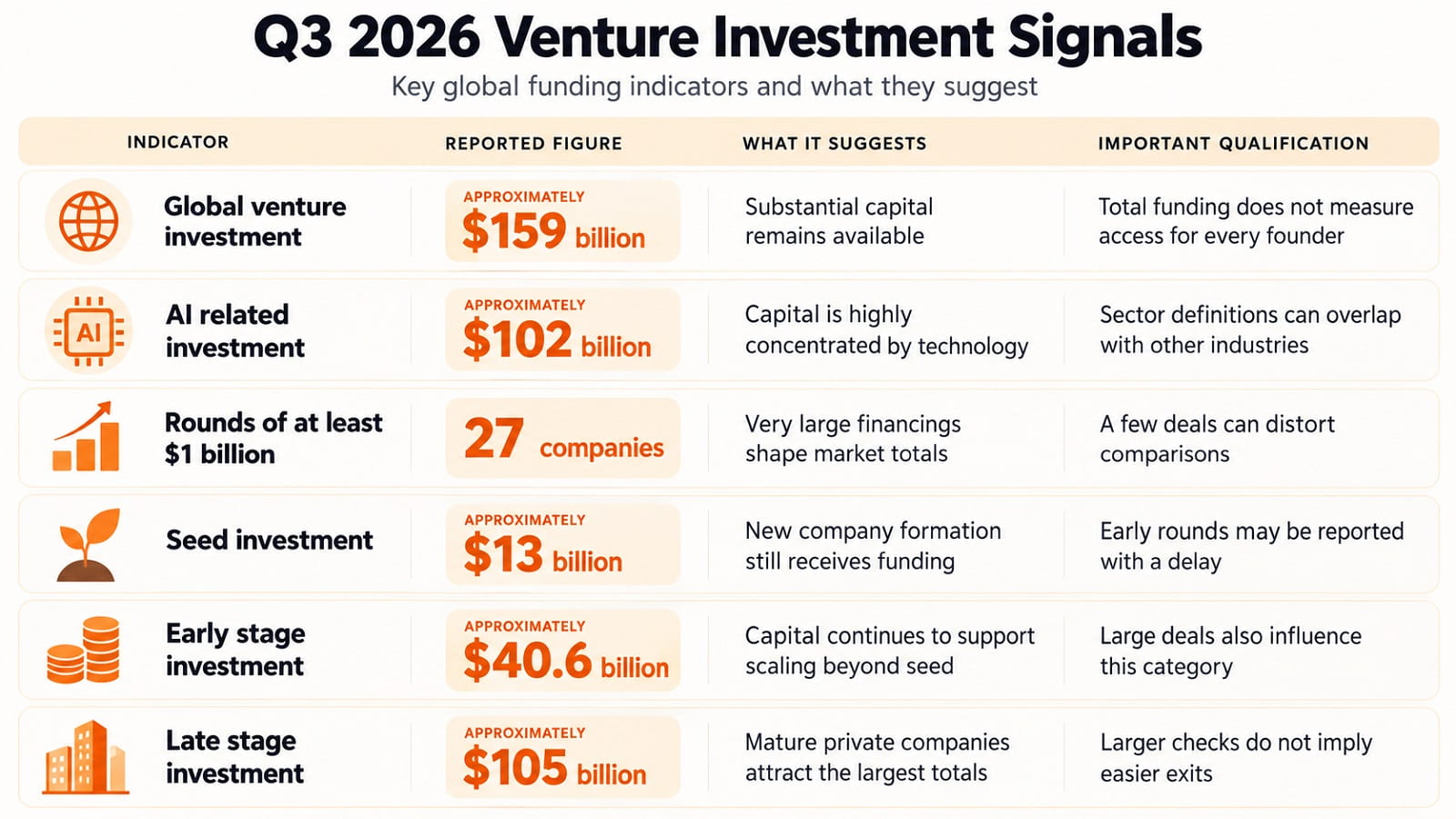
These figures come from one provider and one reporting period. They should not be combined mechanically with totals from different databases. Reporting coverage, stage definitions, deal announcement dates, and later revisions can create meaningful discrepancies.
The 2026 Global Innovation Index from WIPO also describes a market in which venture deal value has increased while the number of deals has narrowed. Taken together, the sources suggest a market with significant available capital but uneven access and intense competition for investment attention.
Why Venture Capital Is Becoming More Concentrated
Investors frequently allocate disproportionate resources to companies they believe can command large markets, defend technical advantages, or build strategically important infrastructure. In a market shaped by AI computing, data centers, automation, and advanced hardware, some businesses also require far more capital than traditional software startups.
This can produce a striking divergence. A small team building a focused business application may need modest seed financing, while a company training advanced models or developing major computing infrastructure may require enormous commitments before reaching scale. Both may be classified as technology startups, yet their capital needs and investor pools differ dramatically.
Concentration matters for founders because a favorable aggregate funding environment does not guarantee favorable terms for their particular company. It matters for investors because exposure to the same technology, customers, or infrastructure assumptions can accumulate across apparently separate portfolio companies.
A careful reading of startup investment trends therefore asks not only how much money was invested, but how many companies received it, at which stages, under what terms, and with what evidence of progress.
How the Venture Capital Model Is Evolving
Traditional venture funds invest in a portfolio of young businesses and expect a minority to generate outsized returns. That logic remains relevant, but larger financing rounds, longer periods of private ownership, and growing infrastructure requirements are changing how capital is assembled and deployed.
The debate around the future of venture capital includes several developments. Large institutional investors and strategic corporate participants can join substantial rounds, while smaller funds may specialize in early company formation or narrowly defined industries. Some ventures combine equity financing with grants, project finance, credit, or commercial partnerships when their assets and revenue patterns support those arrangements.
Fund economics still depend on outcomes rather than headlines. A high private valuation does not distribute cash to fund investors. Returns may depend on acquisitions, public listings, secondary transactions, or other realizations that can take years and remain uncertain.
Founders should understand the investment horizon and reserves of prospective investors. An investor capable of funding the initial round may not be able or willing to support a later round. Investors, meanwhile, need to evaluate follow on capital requirements and portfolio concentration rather than viewing the first check in isolation.
How Funding Expectations Change by Stage
The startup funding landscape is not one uniform market. Investors expect different types of evidence from businesses at different stages. A founder seeking an initial check may need to demonstrate a credible problem and early customer interest, while a later financing round usually requires more reliable operating and financial results.
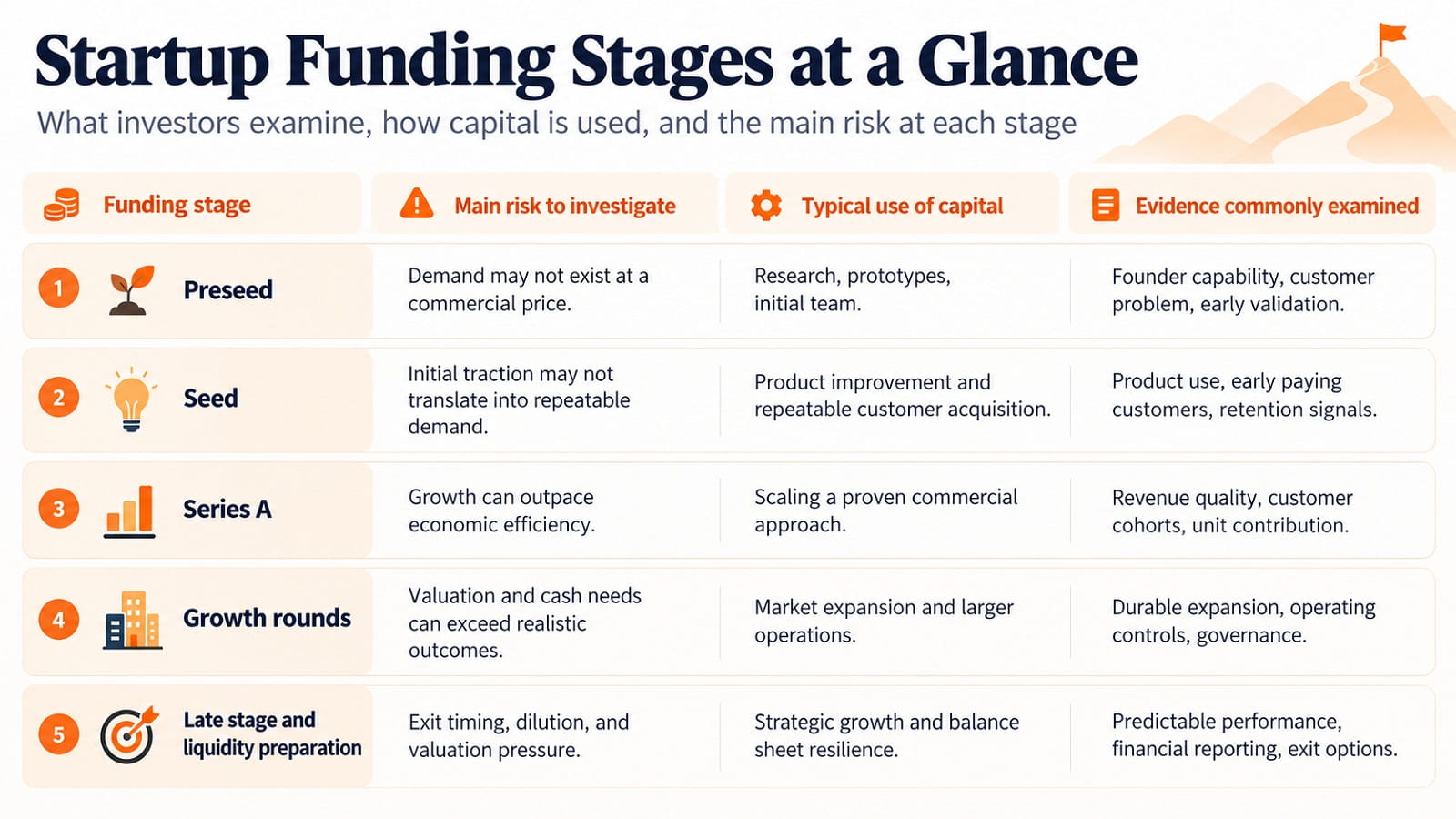
Stage labels vary across regions and databases, and a company's round name is not a substitute for evaluating its operating maturity. A large seed round may finance a capital intensive technology business, while a modest growth round may support an already profitable company.
For founders, the practical objective is to raise enough capital to achieve the next meaningful milestone with financial room for delays. For investors, it is to determine whether the proposed valuation and financing amount reflect the evidence already available and the risks still unresolved.
The Sectors Attracting Investment Attention
Technology creates investment opportunities, but investors ultimately need evidence that a company can turn an innovation into valuable and defensible commercial activity. Different sectors have distinct regulatory requirements, capital needs, customer adoption cycles, and routes to liquidity.
Artificial Intelligence and Computing Infrastructure
The scale of ai startup funding illustrates the influence of a transformative technology on venture allocation. Investment spans foundation models, data infrastructure, specialized chips, applications, robotics, and tools that support enterprise deployment.
The opportunity is not limited to companies developing models themselves. Businesses solving specific customer problems with automation may generate revenue without carrying the same infrastructure commitments as large computing providers. However, application companies still face differentiation, pricing, data security, distribution, and dependence on external model providers.
Investors should examine whether the company has a durable advantage beyond access to widely available tools. Useful questions include whether customers renew, how gross contribution changes with usage, and whether model or computing expenses create an unsustainable cost structure.
Financial Technology and Financial Infrastructure
The picture for fintech startup investment is more selective than the strongest headline totals suggest. Payments, financial infrastructure, compliance software, and businesses integrating financial services into existing workflows can appeal to investors, but regulatory exposure, fraud losses, and customer trust remain fundamental.
Different reports also measure different activity. KPMG's Pulse of Fintech H1 2026 covers a broader investment universe that includes transactions beyond ordinary venture rounds. Its total should not be compared directly with venture only funding estimates from Crunchbase.
A fintech company's prospects depend not simply on user growth but on licensing requirements, payment economics, loss exposure, compliance costs, and the stability of its partnerships. High transaction volume can coexist with weak financial contribution.
Climate, Energy, and Industrial Technology
Analysis of climate tech funding requires separating startup equity investment from much larger spending on energy infrastructure and industrial projects. The International Energy Agency's World Energy Investment 2026 examines broad energy capital flows, but those totals should not be interpreted as venture funding received by startups.
Businesses developing energy storage, grid technology, industrial efficiency, climate adaptation, or materials may need prototypes, laboratory testing, certification, and large deployments before they can demonstrate commercial scale. Funding structures often need to reflect that development process.
Investors should investigate technical performance, customer contracts, construction or manufacturing risk, and whether financing is available beyond the first demonstration. A grant or commercial purchase agreement can provide important validation without being equivalent to equity financing.
Robotics, Space, Security, and Advanced Science
Other technology investment trends include growing attention to robotics, advanced manufacturing, space systems, cybersecurity, and scientific innovation. These businesses may benefit from enterprise demand, strategic partnerships, public procurement, or advances in computing.
Yet they often have different timelines from digital software. Hardware verification, specialized labor, production capacity, and customer certification can delay revenue recognition and require substantial additional capital. Evaluation should be based on sector appropriate milestones instead of expecting identical growth patterns across fundamentally different businesses.
The Geography of Startup Investment
North America continues to attract a large share of reported venture capital. Crunchbase recorded approximately $91 billion for United States startups in the third quarter of 2026, representing around 57% of the global total reported by that provider. The geographic distribution of dollars, however, should not be confused with the distribution of startup talent or commercial opportunities.
The global startup ecosystem includes established financial and research hubs as well as regions building stronger relationships among universities, founders, investors, customers, and governments. In its corrected 2026 innovation cluster report, WIPO identifies Shenzhen, Hong Kong and Guangzhou; Tokyo and Yokohama; San Jose and San Francisco; Beijing; and Seoul among the largest innovation clusters. WIPO's ranking combines innovation activity with indicators that include venture deals, so it is not simply a list of cities receiving the most venture dollars.
Interest in emerging startup markets should be assessed using local evidence rather than treating every developing region as the same opportunity. Financing depth, regulatory stability, currency exposure, exit markets, and customer purchasing power differ considerably. Latin America, Africa, the Middle East, and Southeast Asia each contain several distinct markets with their own capital structures and commercial conditions.
A region can support valuable companies without attracting mega rounds. Founders may build durable businesses through customer revenue, domestic investors, and strategic partnerships. Investors entering unfamiliar markets should understand local legal rules and realistic routes to liquidity before assuming that valuations or growth patterns will resemble established hubs.
Economic Conditions, Regulation, and Exit Markets
Interest rates, inflation, currency movements, and the cost of borrowing influence investment decisions even when a startup does not directly use debt. Higher required returns can reduce the present value investors assign to distant future profits. Inflation can also increase payroll, energy, and infrastructure costs, changing the amount of financing a company needs.
Regulation is especially important for finance, healthcare, defense, energy, and data intensive technologies. A change in licensing rules or procurement policy may create market demand, delay deployment, or alter costs. Founders should explain both opportunities and constraints rather than assuming that supportive policy will remain unchanged.
Exit markets affect the willingness of investors to commit new capital. Initial public offerings, acquisitions, and secondary sales can provide liquidity, but a small number of exceptional transactions should not be read as proof that all startups have regained access to exits. Investors need to consider the practical buyers or public market comparables for each company.
How to Read Venture Capital Market Data Correctly
Comparing venture capital market trends requires consistent definitions. A quarterly total can move sharply because of one exceptionally large deal. Deal counts can be revised as previously undisclosed seed rounds enter databases. Investment stage labels may differ between providers, and an acquisition should not be treated as a new venture financing.
Useful questions include whether growth comes from more deals or larger average rounds, whether investment is concentrated in one sector, and whether valuations correspond to operating progress. Compare quarters and annual periods using the same provider whenever possible, and note changes in methodology.
For a more durable analysis, track several measures together: total deal value, number of financings, median financing size, funding by stage, share going to the largest rounds, and realized exit activity. Deal volume alone measures neither startup quality nor future investment returns.
A Practical Framework for Evaluating Investment Opportunities
Consider three fictional businesses from different industries. The amounts below are illustrative operating assumptions, not actual fundraising rounds or forecasts for those sectors. Each business has a different milestone and cash requirement.
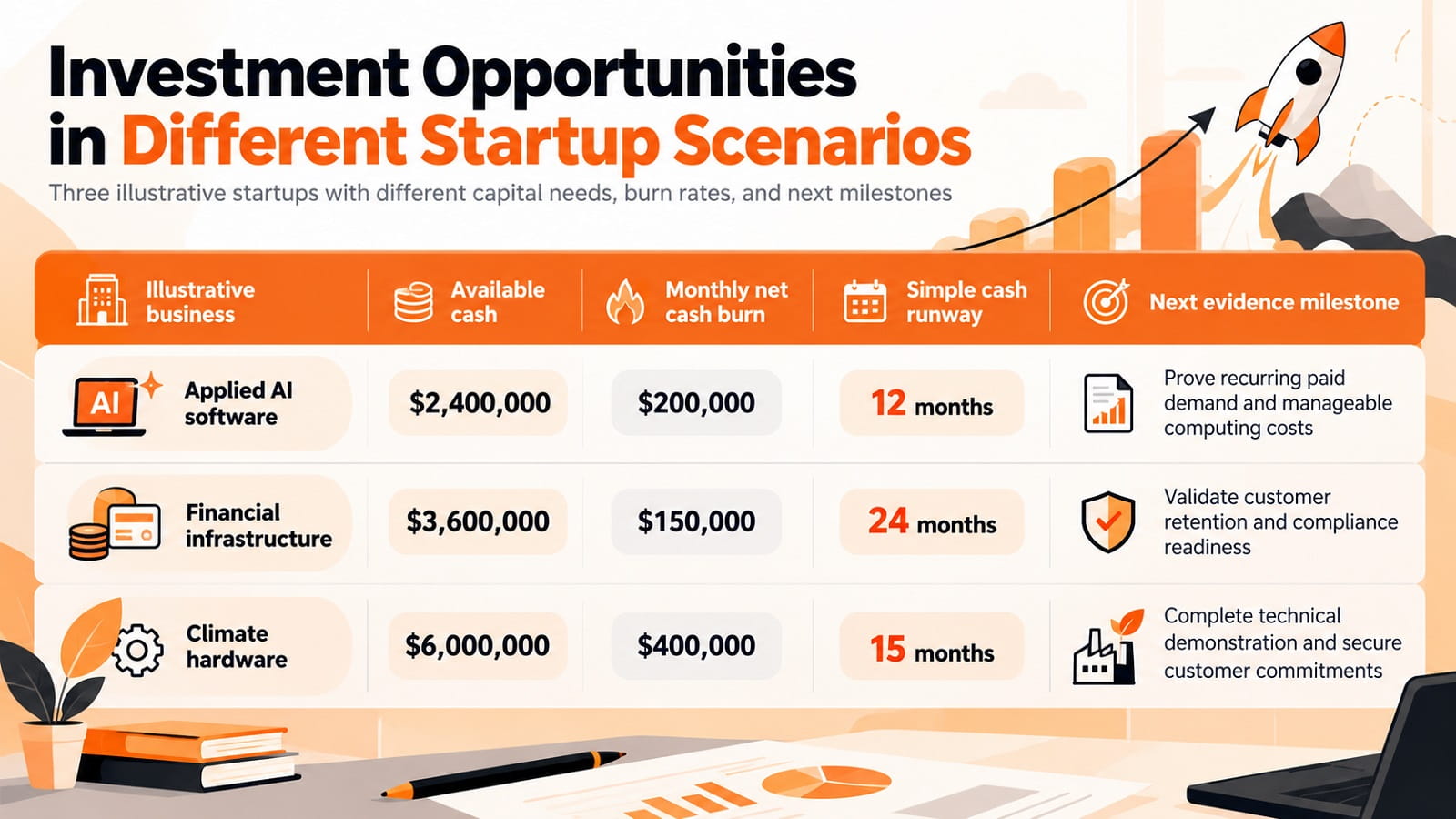
Runway here is calculated by dividing available cash by constant monthly net cash burn. It is not a prediction of the actual cash exhaustion date. Revenue, hiring, financing costs, or milestone spending can change the outcome considerably.
The applied AI company may appear attractive because of demand for its sector, but a twelve month runway is meaningful only if the next commercial milestone can be achieved before additional funding is needed. The financial infrastructure company has more time under its assumptions, although licensing delays could require an extended development period. The hardware company holds more cash but also consumes it much faster and may need financing tied to construction or demonstration milestones.
The central lesson is that an investment theme cannot replace company analysis. Sector momentum and a credible financing plan must be evaluated together.
What Founders Should Do With These Investment Signals
Founders should prepare a clear explanation of the customer problem, the evidence that buyers will pay, and the milestone a proposed round will finance. The presentation should connect financing requirements to realistic spending, operating progress, and the time required to achieve the next result.
An attractive market does not eliminate the need to show customer retention, delivery economics, competitive differentiation, and responsible use of capital. When a sector becomes crowded, investors may apply higher standards rather than fund every company with a fashionable description.
It is also useful to plan for slower fundraising than expected. Financial forecasts should include a scenario in which capital arrives late or a new round cannot be completed on the hoped for terms. Alternative financing structures may be relevant, but founders should examine dilution, repayment obligations, restrictions, and execution risks carefully.
What Investors Should Examine Beyond the Headline
Investors need to separate the popularity of a sector from the price and quality of an individual investment. Strong demand for a technology can coexist with unsustainable business economics or valuations that already assume extraordinary success.
Diligence should connect product differentiation with customer evidence, management capability, capital needs, governance, and a credible path to liquidity. For portfolio analysis, also consider common dependencies across holdings, such as the same cloud providers, regulations, major customers, or exit conditions.
A diversified list of companies does not necessarily produce diversified risk when their outcomes depend on the same economic assumptions.
The Investment Outlook Beyond 2026
The next phase of investment activity will depend on whether companies receiving substantial capital turn it into sustainable customer value and whether exit markets can support realized returns. Continued growth in AI infrastructure could reinforce market concentration. More widespread enterprise adoption could broaden opportunities into specialized applications, security, and operational software. Regulatory shifts or rising financing costs could instead restrain investment in capital intensive projects.
For climate and industrial technologies, deployment economics and the availability of suitable project finance may be more important than short periods of enthusiasm. For newer regional ecosystems, local customer demand and repeatable investment exits may matter more than occasional headline funding rounds.
The most defensible outlook is conditional. No single technology or geography is guaranteed to outperform. Future capital allocation will reflect the interaction of customer demand, financing conditions, competitive advantage, and actual investor liquidity.
Final Thoughts
Investment trends matter because they reveal how capital, technology, and economic expectations interact. The 2026 market demonstrates that substantial financing can coexist with narrow access, sector concentration, and continued uncertainty about exits.
Founders should use these signals to refine milestones and financial plans rather than assume that enthusiasm for an industry guarantees funding. Investors should evaluate whether attractive narratives are supported by customer demand, disciplined economics, and realistic capital requirements.
The best interpretation looks past the largest announcements and asks a more useful question: which businesses can transform investment into lasting economic value under plausible market conditions?
FAQ
What Are the Most Important Investment Trends in 2026?
Major themes include the concentration of venture financing in AI related companies, the impact of very large rounds on headline totals, varying access to financing across stages, and continuing attention to advanced technology and infrastructure. Investors should also monitor exits and financing terms.
Is Venture Capital Investment Increasing Globally?
Reported investment has reached very high levels in 2026, but results vary by quarter and provider. An increase in total capital does not establish that more startups receive financing, particularly when a limited number of very large rounds account for much of the activity.
Which Startup Sectors Are Attracting Investors?
AI, computing infrastructure, financial technology, energy, robotics, cybersecurity, and advanced science attract attention in different markets. Funding interest alone does not determine whether an individual business has sound economics or a suitable valuation.
How Do Interest Rates Affect Startup Funding?
Changes in interest rates can influence required investment returns, the cost of borrowing, and the value assigned to profits expected far in the future. Higher financing costs can also increase pressure on startups that need repeated capital injections.
What Is the Difference Between Venture Funding and Total Investment?
Venture funding generally refers to capital committed to startups through venture financing transactions. Total investment may include mergers, acquisitions, debt, infrastructure spending, grants, and other forms of capital. Different reports should not be treated as directly comparable without checking their scope.
Are Emerging Markets Becoming More Important for Startups?
Several regions are developing stronger entrepreneurial capabilities, but progress is uneven. Local access to capital, purchasing demand, currency stability, policy, and exit opportunities influence results. A promising innovation ecosystem does not guarantee an active venture market.
How Can Founders Use Investment Trend Reports?
Founders can use reports to understand sector activity, typical investor concerns, and regional differences. They should combine those signals with customer evidence and a realistic financing plan instead of treating headline funding totals as a prediction of fundraising success.
Do High Startup Valuations Mean Venture Investors Are Making Money?
Not necessarily. Private valuations are estimates informed by financing transactions and deal terms. Investors generally realize returns through liquidity events, and actual proceeds can differ substantially from earlier reported valuations.

Mobina Khanki
Venture & Funding Writer at PinerookMobina Khanki covers venture capital, startup funding, fundraising, and startup finance for Pinerook, focusing on founders and investors.
 Seen first.


