
Founders rarely make one big technology decision. They make dozens of small ones that quietly become the company’s operating constraints. Which tools to use, what to build internally, where customer data should live, how much infrastructure to own, when to invest in security, and when an engineering shortcut has stopped being a shortcut all shape the business long after the original decision has been forgotten.
That is why technology strategy should not be treated as a document produced by a CTO for an engineering team. It is a business discipline. The technology choices behind a product affect how quickly the company can learn, how much capital it consumes, how easily it can hire, how much risk it carries, and how difficult it becomes to change direction.
A useful technology strategy starts with the same principle that sits behind an AI native startup: use technology to increase leverage without turning every new capability into another permanent dependency.
The objective is not to predict the perfect architecture three years in advance. It is to make today’s decisions in a way that preserves tomorrow’s options. That means choosing where to move quickly, where to stay deliberately simple, and where a little more discipline now prevents a much larger problem later.
Key takeaways
Technology strategy is about business constraints, not technology fashion.
Early startups should optimize for learning speed and low operational complexity before optimizing for theoretical scale.
The best architecture is usually the simplest one that can support the next meaningful stage of the business.
Security, data ownership, vendor dependence, and technical debt are strategic issues because they affect future choices.
A technology roadmap should be tied to business milestones, not a fixed list of engineering projects.
What Technology Strategy Actually Means for a Startup
Technology strategy is the set of choices that determines how a company uses software, infrastructure, data, vendors, and engineering capacity to achieve business goals. It includes architecture, but architecture is only one part of the picture.
A useful strategy answers five practical questions. What must the company be able to do? Which capabilities create differentiation? Which problems are already solved by reliable vendors? What risks become expensive if ignored? And which decisions would be painful to reverse later?
This changes the founder’s relationship with technology. You do not need to know every framework or cloud service. You do need to understand the consequences of the choices your company is making.
A payment startup, for example, should care deeply about security, reliability, auditability, and data integrity. A lightweight consumer application may care more about speed of iteration and acquisition experiments. A hardware company has different infrastructure and supply chain constraints from a SaaS business. There is no universal “best stack” because there is no universal startup.
Start With the Business Constraint, Not the Technology
The most common technology mistake is starting with a tool. A founder hears that a new framework is faster, a database is more scalable, or an AI coding platform can build an application in a weekend, and the technology becomes the starting point for the decision.
The better sequence is the reverse: define the business outcome, identify the constraint, then choose the technology that removes it.
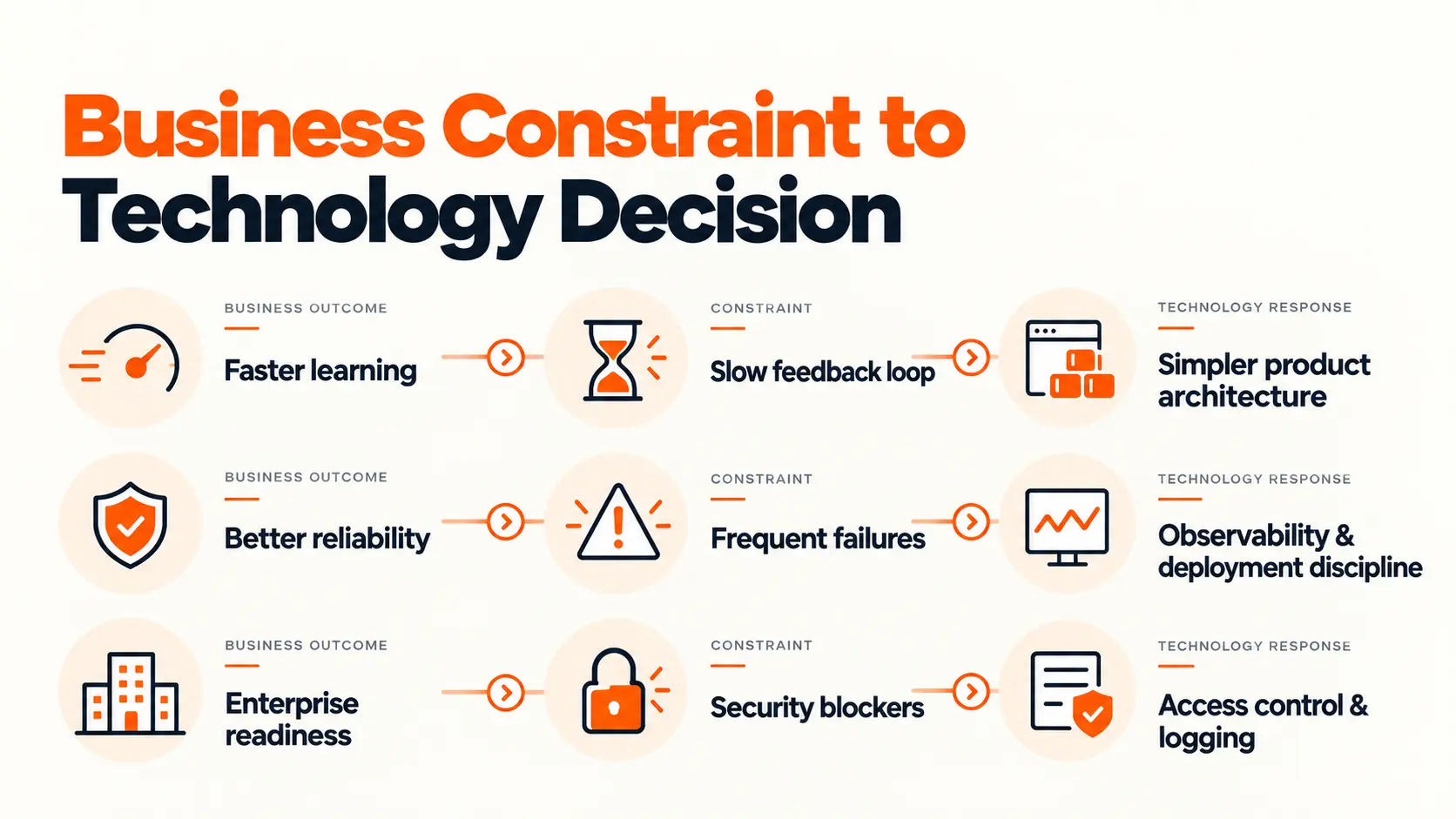
If the company needs to validate demand quickly, the technology should minimize time between customer feedback and product changes. If reliability is the constraint, observability and operational discipline may matter more than another feature. If enterprise customers are blocked by security requirements, access control, logging, data handling, and compliance readiness become part of the product strategy.
This is also why a founder should be skeptical of architecture work that has no visible business consequence. “We need to modernize the stack” is not a strategy. “We need to let two teams release independently because our current deployment process is slowing customer commitments” is a business problem that technology can solve.
The Technology Priorities Change as the Startup Grows
Technology should evolve with the company. The right decision at the validation stage can become the wrong decision after product market fit, but that does not mean the original decision was a mistake. The mistake is failing to recognize when the company has crossed a new threshold.
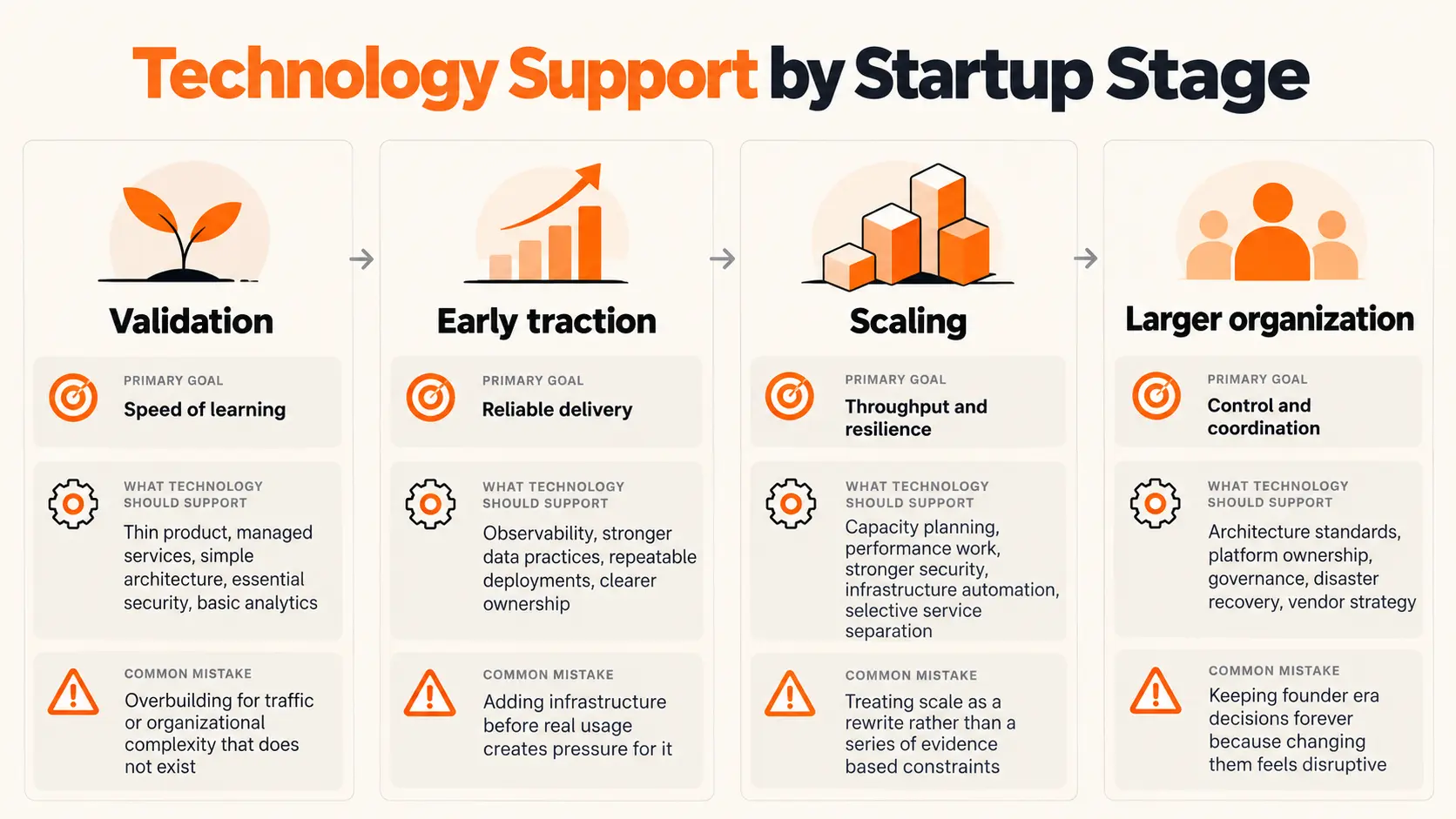
The important idea is stage fit. A startup should not pay the operational cost of a mature architecture before the business has earned the need for it.
Build a Stack That the Business Can Actually Operate
A startup tech stack is often described as a list of programming languages, frameworks, databases, cloud providers, and SaaS tools. For founders, that list is less useful than the system behind it.
A good stack has four properties. The team can work with it today. New engineers can understand it without months of archaeology. The company can replace individual components without rebuilding everything. And the operational burden is proportional to the company’s size.
In 2026, this matters even more because AI assisted development makes it easier to produce software quickly. The bottleneck can move from writing code to reviewing architecture, testing behavior, securing systems, managing dependencies, and deciding what should exist in the first place. Gartner’s 2026 technology outlook reflects the same broader shift toward AI native development while emphasizing infrastructure, security, and governance alongside faster software creation.
For a deeper layer by layer approach to choosing technologies, the startup tech stack cluster should focus on what founders actually need to standardize, what can remain flexible, and what should never become a source of unnecessary complexity.
Turn Technology Into a Roadmap, Not a Wish List
A technology roadmap should explain what the company needs from technology next and why. It should not be a long list of framework upgrades, infrastructure projects, and feature requests.
The best roadmaps are anchored to business milestones. Reaching a new customer volume may trigger performance work. Moving into enterprise sales may trigger security and audit requirements. Adding a second engineering team may require clearer service boundaries. Expanding internationally may create new data, reliability, or regulatory constraints.
This is why a useful roadmap contains fewer commitments than most engineering plans. It separates what is necessary now from what may become necessary later. It also identifies the evidence that would cause the company to move an item forward.
A practical technology roadmap for startups should therefore connect business milestones to technical decisions, with explicit reasons for what gets built, deferred, replaced, or deliberately left alone.
Decide What to Build, Buy, or Keep Flexible
One of the highest leverage technology decisions is also one of the easiest to get wrong. Founders often compare the price of a SaaS subscription with the salary of an engineer and conclude that building is cheaper. That calculation ignores maintenance, security, support, migration, opportunity cost, and the engineering time required to keep the system working.
The more useful question is not “Can we build this?” Almost anything can be built. The question is “Does owning this capability improve how we compete?”
Buying usually makes sense for mature, non differentiating capabilities such as authentication, payments, transactional email, standard analytics, payroll, and many internal workflow tools. Building becomes more defensible when the workflow itself is the product, when the company has proprietary data or logic that creates meaningful advantage, or when existing products create a constraint that directly limits the business.
There is also a third option: keep the decision reversible. Use an external service while the requirement is uncertain, but isolate the integration so that replacing the provider later is possible. That approach can preserve speed without turning an early experiment into permanent lock in.
The deeper build vs buy software decision should be evaluated through differentiation, total cost of ownership, switching cost, data control, and the value of engineering time, not through subscription price alone.
Manage Technical Debt Without Trying to Eliminate It
Technical debt is not simply bad code. Some debt is a rational trade: the company chooses a faster implementation because learning what customers want is more valuable than engineering perfection. The problem begins when a shortcut stops buying speed and starts charging interest.
Founders should look for operational symptoms rather than debating code quality in the abstract. Releases take longer. Small changes create unrelated bugs. Engineers avoid parts of the system. New hires need unusually long onboarding. The same area gets rewritten repeatedly. Product work increasingly requires “cleanup” before it can begin.
The goal is not a debt free codebase. The goal is debt that remains visible, intentional, and cheaper than the alternative. When a piece of debt repeatedly blocks revenue, reliability, hiring, or product learning, it has become a business problem and deserves priority.
A dedicated technical debt for startups guide can help founders distinguish useful early shortcuts from debt that is now slowing the company down.
Treat Cloud Infrastructure as a Business System
Cloud infrastructure gives startups flexibility because capacity can grow with usage instead of requiring large upfront hardware commitments. But flexibility can also hide complexity. A company can accumulate services, environments, data stores, observability tools, and permissions faster than it accumulates the people needed to operate them.
The founder level question is not which cloud provider is best. It is whether the infrastructure matches the company’s current workload, reliability requirements, team capabilities, and cash constraints.
Early teams usually benefit from managed services and a small number of well understood components. As usage grows, the important work becomes visibility and control: knowing what is running, what it costs, what can fail, how it scales, and who can change it.
That is why cloud infrastructure for startups should be designed around operational simplicity first, with more sophisticated capacity and resilience patterns introduced when actual usage creates the need.
Security Is Part of the Product Architecture
Security is often treated as a later stage concern because early teams are focused on product and growth. That approach becomes expensive when security requirements arrive through a major customer, a compliance review, an incident, or a funding process that exposes weaknesses.
Founders do not need enterprise security bureaucracy on day one. They do need clear ownership of accounts, permissions, secrets, backups, critical data, third party access, and incident response. NIST’s Cybersecurity Framework 2.0 and its small business guidance are useful because they emphasize understanding, prioritizing, and communicating cybersecurity risk rather than assuming a one size fits all control set.
The strategic principle is simple: protect the assets that can materially damage the company if they are compromised, and make access harder to abuse than to ignore. Security maturity should grow with the sensitivity of the product, the expectations of customers, and the consequences of failure.
A practical cybersecurity for startups framework should therefore begin with high value assets, access control, backups, monitoring, vendor risk, and a response plan before expanding into more advanced controls.
Make Data Useful Before Making It Complex
Data strategy is another area where startups can overbuild. A company does not need a large warehouse, a dedicated data team, and a complex analytics platform simply because it wants to be data driven.
The first requirement is consistency. The company should know what important events mean, where customer and product data live, which metric is authoritative, and who owns the definition. If two teams calculate revenue, activation, or retention differently, adding more infrastructure will not solve the underlying problem.
As the company grows, data infrastructure should evolve from reliable product instrumentation toward stronger pipelines, analytics, governance, and eventually more specialized systems when scale or complexity requires them. The architecture should follow the decisions the company needs to make, not the amount of data it wants to collect.
A focused data strategy for startups should begin with decision quality, clear ownership, and trustworthy definitions before it expands into more sophisticated infrastructure.
Do Not Confuse Scalability With Complexity
“We need to scale” is one of the most expensive sentences in startup engineering. It often arrives before the business has identified what is actually scaling: users, transactions, traffic, data volume, team size, release frequency, or operational risk.
A system can scale in one dimension and fail in another. More servers do not solve a slow database query. A queue does not solve a badly designed workflow. Microservices do not automatically make a team faster. Kubernetes does not create reliability simply because it can orchestrate containers.
For many early stage companies, a well structured monolith is easier to understand, test, deploy, and change than a distributed system. Service separation becomes more valuable when independent scaling, team ownership, reliability boundaries, or deployment needs justify the additional operational cost.
The practical monolith vs microservices for startups decision should therefore begin with the constraint the architecture must solve, not with the architecture pattern the team wants to use.
Protect Optionality When Choosing Vendors
Every external technology provider creates some dependency. That is not automatically bad. Managed services can save enormous amounts of engineering time. The mistake is allowing a dependency to become invisible until the company can no longer operate without it.
Before adopting a critical vendor, founders should understand what happens if pricing changes, service quality declines, the product is discontinued, data cannot be exported cleanly, or a competitor acquires the provider. The answer does not need to be a full replacement plan for every SaaS tool. It should be proportional to the consequence of losing the service.
A useful rule is to preserve optionality around the parts of the business that are strategically important. Keep ownership of core data. Isolate important integrations. Document critical dependencies. Avoid giving one provider control over multiple layers of a system when losing that provider would stop the business.
How AI Changes Technology Strategy in 2026
AI has changed the economics of software development, but it has not removed the need for technology strategy. If anything, faster software production makes strategic judgment more important.
Gartner’s 2026 technology trends put AI native development platforms, AI supercomputing, multiagent systems, confidential computing, physical AI, and preemptive cybersecurity among the technologies shaping the next phase of digital systems. Deloitte similarly frames 2026 around physical AI, agentic systems, AI infrastructure, the rebuilding of technology organizations, and cybersecurity.
For a startup, the practical implication is not “adopt all of this.” It is that the cost of experimentation has fallen while the cost of poor decisions can remain high. A team can prototype a new system quickly, but it still has to decide whether the capability belongs in the product, whether the economics work at scale, what data it depends on, and what happens when the underlying model or vendor changes.
Technology strategy in 2026 therefore needs a stronger distinction between experimentation and infrastructure. Experiments should be cheap and reversible. Critical systems should be boring enough to trust, observable enough to operate, and replaceable enough to survive change.
A Founder Framework for Technology Decisions
When a technology decision is unclear, I would use a short sequence before approving the work.
1. Start with the business outcome. State what needs to become faster, cheaper, safer, more reliable, or newly possible.
2. Define the constraint. Identify the current bottleneck and the evidence that it is real.
3. Separate the differentiator from the commodity. Own what makes the product valuable; avoid owning solved problems without a reason.
4. Estimate the total cost. Include engineering time, maintenance, vendor fees, migration, security, support, and opportunity cost.
5. Check reversibility. Ask how painful it would be to change the decision after customers, data, and employees depend on it.
6. Match complexity to evidence. Add architecture, infrastructure, and process only when real usage or risk justifies them.
7. Assign ownership. Every important technology system needs someone accountable for its outcome and ongoing health.
8. Set a review trigger. Define the condition that would cause the company to revisit the decision.
This framework keeps technology from becoming a separate planning universe. Every meaningful technical choice should connect to a business constraint, an economic tradeoff, or a risk the company has consciously decided to manage.
Common Technology Strategy Mistakes
Choosing technology because it is fashionable. A new framework or infrastructure pattern can be excellent and still be the wrong choice for a small team.
Optimizing for hypothetical scale. Designing for millions of users before the first thousand creates complexity without evidence that the complexity is needed.
Treating vendor cost as the whole equation. The cheapest subscription can be expensive if it creates manual work, poor reliability, or a difficult migration later.
Ignoring the team as a technology constraint. A theoretically strong stack that nobody on the team can confidently operate is not strong in practice.
Letting technical debt become invisible. Shortcuts are manageable when they are recorded and revisited. They become dangerous when the company forgets why they exist.
Confusing activity with progress. A large architecture project can consume months without improving customer value, reliability, or operating leverage.
Build for the Next Constraint, Not the Imaginary Future
The strongest startup technology strategy is rarely the most sophisticated one. It is the one that gives the company enough capability to move quickly while preserving the ability to change its mind.
Founders should expect the technology system to evolve. The stack will change. Vendors will change. Architecture will change. Security requirements will increase. Data will become more valuable. AI will alter how software is built and operated. None of that is a failure of the original plan.
A failure is allowing yesterday’s technology decision to become tomorrow’s constraint simply because nobody owns the decision anymore.
Technology becomes a strategic advantage when it helps a small company learn faster, ship reliably, protect trust, and spend engineering capacity on the parts of the business that customers actually value. That is the standard worth applying to every technology choice.
FAQ
What is technology strategy for a startup?
It is the way a startup decides how to use software, infrastructure, data, vendors, and engineering capacity to achieve business goals while controlling cost, risk, and complexity.
What should a startup technology strategy include?
It should cover the product architecture, technology stack, data, infrastructure, security, vendors, technical debt, engineering capacity, and the roadmap for changing those systems as the business grows.
Should startups use the newest technology?
Usually not by default. Proven technology is often better for early teams because it is easier to hire for, operate, debug, and replace. New technology should earn its place by solving a meaningful constraint.
When should a startup invest in architecture?
Architecture deserves more investment when real usage, reliability requirements, team structure, security needs, or operational complexity create a constraint that simpler choices can no longer handle.
Should startups build or buy software?
Buy mature commodity capabilities when they are not part of the competitive advantage. Build when custom technology directly supports differentiation, proprietary workflows, or a requirement the market does not serve well.
How much technical debt is acceptable for a startup?
Some technical debt is rational when it accelerates learning. It becomes a problem when it repeatedly slows releases, creates reliability issues, blocks hiring, or consumes more engineering capacity than the shortcut saved.
Does every startup need a CTO?
No. The need depends on product complexity, technical risk, team size, and how central technology is to the business. What every startup needs is clear ownership of important technology decisions.

Mohsen Avid
Founder & Editor, PinerookMohsen Avid is the founder of Pinerook, covering entrepreneurship, startup strategy, digital business, and the decisions behind building new ventures.
 Seen first.