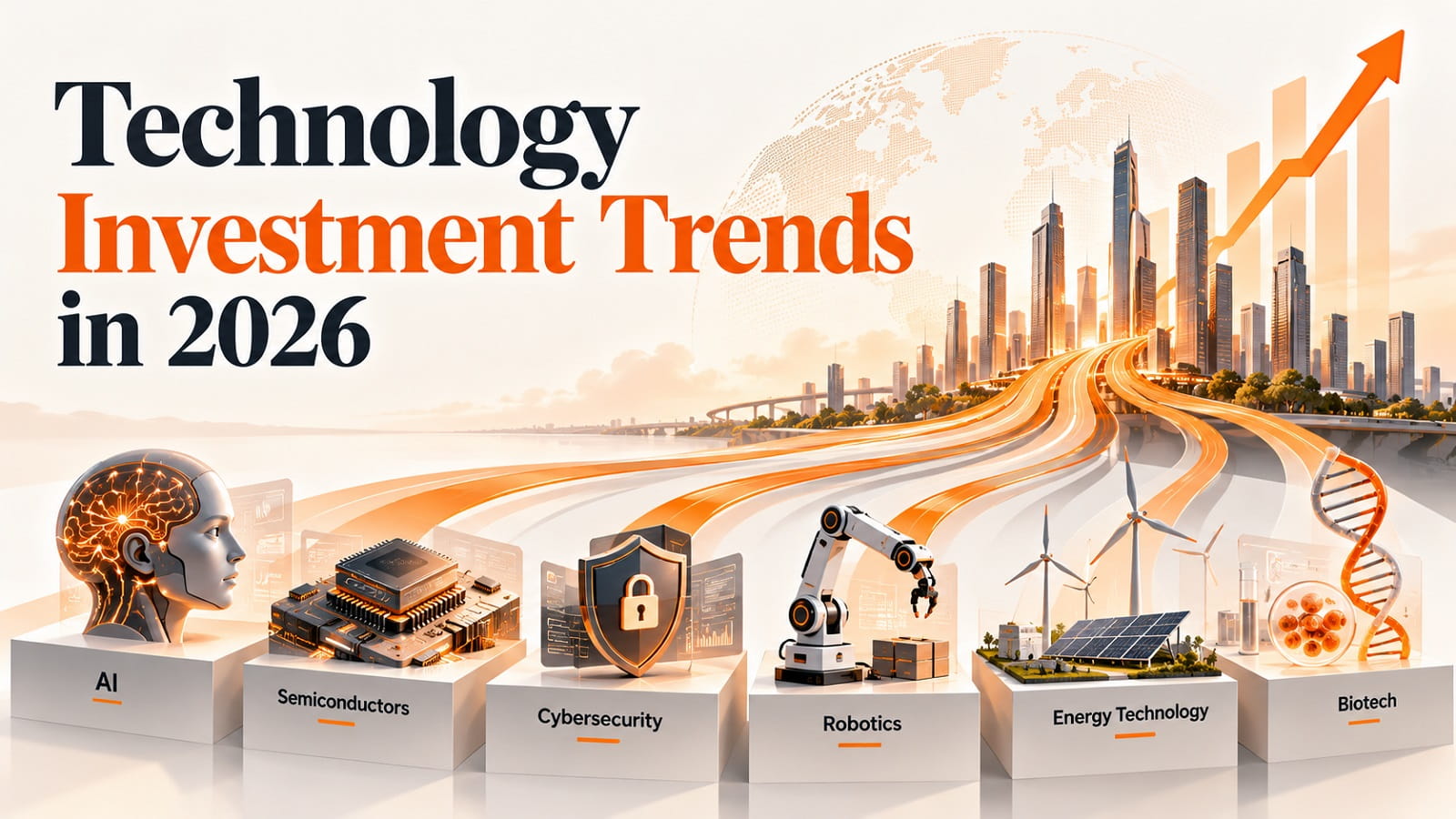
Technology investment in 2026 is being shaped by a fundamental shift in what investors consider valuable. Artificial intelligence continues to attract enormous financial commitments, but the opportunity extends far beyond software applications. Computing infrastructure, cybersecurity, robotics, energy systems, advanced semiconductors, and scientific technologies are becoming increasingly connected. Investors must now determine which innovations can produce durable commercial advantages and which may struggle to justify their development costs.
Understanding technology investment trends requires looking beyond the popularity of individual technologies. Within the broader context of Investment Trends, the most important question is how financial resources move toward innovations that demonstrate technical progress, customer demand, and sustainable economic value. Strong market interest can encourage investment, but it does not guarantee that every company developing a popular technology will become commercially successful.
This article examines the technology investment landscape in 2026, the sectors attracting attention, and the factors influencing investor decisions. It also explains how to evaluate commercial readiness, distinguish technology spending from startup investment, and allocate capital across opportunities with different risk profiles.
What Are Technology Investment Trends?
Technology investment trends describe changes in how companies, investors, and financial institutions allocate capital to technological development and commercialization. They reflect expectations about future demand, technical capabilities, competitive advantages, and the resources required to bring innovations into practical use.
These trends can be observed through corporate technology spending, private investment, research funding, strategic acquisitions, and infrastructure development. However, these financial activities measure different things. A company purchasing data center equipment is making a technology investment, but that expenditure is not equivalent to a venture capital firm purchasing shares in a startup.
Understanding this distinction is essential when interpreting reports about fast growing technology sectors. Strong corporate spending can indicate customer demand or infrastructure expansion, while venture funding reflects investors' expectations about potential financial returns. Both provide useful information, but neither independently establishes that an emerging technology represents an attractive investment opportunity.
The Technology Investment Market in 2026
Technology investment remains substantial in 2026, supported by demand for computing infrastructure, software, artificial intelligence, and digital services. Gartner's July forecast estimated worldwide information technology spending at approximately $6.37 trillion for the year, representing 14.2% growth from 2025. Data center systems were expected to experience particularly rapid expansion as businesses increased their computing capacity.
Gartner's September forecast also projected approximately $2.7 trillion in worldwide AI spending during 2026. This estimate includes infrastructure, software, services, and other AI related purchases. It describes expected customer and business expenditure rather than the capital invested specifically in privately held AI startups.
Venture capital figures provide a narrower perspective. Crunchbase reported approximately $159 billion in global startup funding during the third quarter of 2026, including about $102 billion directed toward companies associated with AI. A relatively small number of exceptionally large transactions accounted for a significant portion of total investment.
These figures demonstrate substantial financial interest, but their methodologies and measurement periods differ. Investors should not combine corporate expenditure, private equity investment, venture funding, and infrastructure project spending into a single estimate of capital available to technology startups.
Artificial Intelligence and Computing Infrastructure
Artificial intelligence remains a central driver of technology investment, but the financing requirements differ considerably across the businesses involved. Foundation model developers, computing providers, semiconductor companies, and specialized software developers participate in the same technological ecosystem while facing very different financial challenges.
Computing Capacity and Advanced Semiconductors
Training and operating sophisticated AI systems requires processors, memory, networking equipment, electricity, and specialized data center facilities. These requirements create opportunities for businesses supplying hardware, infrastructure management tools, cooling systems, and computing services.
However, large infrastructure investments also create substantial financial exposure. Equipment can become less competitive as technology improves, and long development schedules may delay revenue generation. Investors need to understand customer commitments, supply agreements, utilization assumptions, and the financial consequences of changes in computing demand.
A semiconductor startup may demonstrate impressive technical performance but still face expensive manufacturing and qualification processes. Investors should examine whether the technology can be produced reliably, whether customers can integrate it into existing systems, and whether expected commercial demand supports the capital required.
Enterprise AI and Autonomous Software
AI applications offer a different investment proposition. Companies developing enterprise automation, specialized assistants, or autonomous software systems may require less physical infrastructure than hardware businesses, particularly when they use existing computing platforms.
Their greatest challenge is often commercial differentiation. As access to capable models becomes widespread, investors need to identify why customers will continue purchasing a particular application. Valuable customer workflows, proprietary integrations, measurable productivity improvements, and dependable performance can help establish that distinction.
The financial model must also account for inference expenses and customer usage. A product can generate growing revenue while experiencing declining margins if computing requirements increase faster than prices. Investors should therefore examine the economics of delivering the service rather than treating adoption figures as proof of profitability.
Cybersecurity and Digital Trust
Cybersecurity remains an important technology investment category because organizations must protect digital systems, sensitive information, and essential operations. Increasing use of cloud services and AI can create new security requirements, while existing systems continue to face evolving threats.
Gartner's February 2026 research projected worldwide information security spending of approximately $244 billion for the year. This figure represents expected spending on security products and services, not venture capital investment in cybersecurity companies. Nevertheless, it provides context for the commercial budgets available to suppliers serving the sector.
Cybersecurity investors should examine product effectiveness, customer retention, deployment complexity, and integration with existing security operations. A startup may demonstrate strong detection performance in controlled testing but fail to deliver comparable results across complex customer environments.
Commercial differentiation also matters because businesses frequently purchase security products from established providers. New companies need to demonstrate clear advantages in performance, cost, operational efficiency, or protection against specific risks. Strong customer references and independently validated capabilities may be more persuasive than broad claims about technological superiority.
Robotics and Industrial Automation
Robotics investment is increasingly connected to developments in artificial intelligence, sensing, computing, and industrial engineering. Improvements in these technologies can support systems capable of completing more complex physical tasks, particularly in manufacturing, logistics, and other environments where labor availability, reliability, and operating costs matter.
McKinsey's Technology Trends Outlook 2026 identified robotics as one of the areas where extrapolated investment growth could more than double compared with 2025. That projection reflects the pace of financing during the first half of 2026 and should not be interpreted as a confirmed result for the full year.
The investment case for robotics differs from that of ordinary software. A robotic system must operate reliably in physical environments, where maintenance, safety, installation, and equipment replacement can affect profitability. Investors need evidence from actual deployments, not merely demonstrations performed under favorable conditions.
Customer economics provide another important test. A manufacturer purchasing an automated system must compare the full installation and operating costs with expected productivity improvements. If the financial benefit is uncertain or deployment requires extensive customization, commercial expansion may proceed more slowly than technical progress suggests.
Energy Infrastructure and Technology Investment
Energy investment is becoming more closely connected to the expansion of computing infrastructure. Data centers, industrial equipment, transportation systems, and electrification technologies all depend on reliable energy supply. As a result, investors are increasingly examining technologies related to electricity generation, storage, grid management, and energy efficiency.
The International Energy Agency projected approximately $3.4 trillion in total worldwide energy investment for 2026, including around $2.2 trillion for renewables, nuclear power, grids, storage, low emissions fuels, efficiency, and electrification. These estimates include substantial infrastructure expenditure by established businesses and other organizations. They should not be interpreted as funding raised by climate technology startups.
For technology investors, the opportunity lies partly in solving specific technical and commercial constraints. Grid monitoring software, industrial efficiency systems, advanced storage technologies, and energy management tools may help customers reduce operating costs or improve reliability.
However, commercial readiness varies substantially between technologies. Software that improves energy scheduling may reach customers relatively quickly, while a new battery chemistry may require extensive testing, manufacturing development, and certification. Investment analysis should reflect these differences instead of treating all energy technologies as equivalent opportunities.
Biotechnology and Scientific Innovation
Scientific technologies are attracting attention as computing, data analysis, and laboratory automation become increasingly integrated into research and development. Artificial intelligence may help researchers identify promising materials, analyze biological information, or improve experimental design, but scientific progress must still be validated through appropriate testing.
Investors considering biotechnology and scientific software should distinguish the underlying business models. A company selling research tools may generate commercial revenue from laboratories or industrial customers, while a therapeutic developer may face long periods of testing before obtaining the approvals required to sell a product.
These differences affect financing requirements and potential returns. Scientific milestones can create meaningful value, but they do not always translate into immediate revenue. Investors need to understand intellectual property rights, technical reproducibility, development costs, regulatory obligations, and the likelihood that a successful experiment can become a marketable product.
Quantum Computing and Space Technologies
Quantum computing and space technologies represent areas of potentially substantial long term innovation, but they involve considerable uncertainty. Some businesses are developing foundational technical systems, while others provide components, software, measurement tools, or services to customers already operating in related industries.
Quantum technology companies may demonstrate progress through improved system performance, error management, or specialized applications. However, technical improvements do not automatically establish a commercially useful advantage over existing computing methods. Investors need credible performance comparisons and realistic assumptions about when customers could benefit.
Space technology companies face different requirements involving manufacturing, launches, reliability, regulation, and access to customers. Certain applications, such as satellite data services, can create recurring commercial relationships, while infrastructure development may demand substantial initial capital.
McKinsey identified space technologies among the sectors with particularly strong projected investment growth in 2026. As with other frontier technologies, investors should separate enthusiasm for potential breakthroughs from evidence that an individual company can produce reliable revenue.
Comparing the Major Technology Investment Opportunities
The most useful sector comparison considers what customers are purchasing, which evidence supports the investment case, and what could prevent commercial success. The following table summarizes major technology opportunities without treating market interest as a guarantee of future returns.
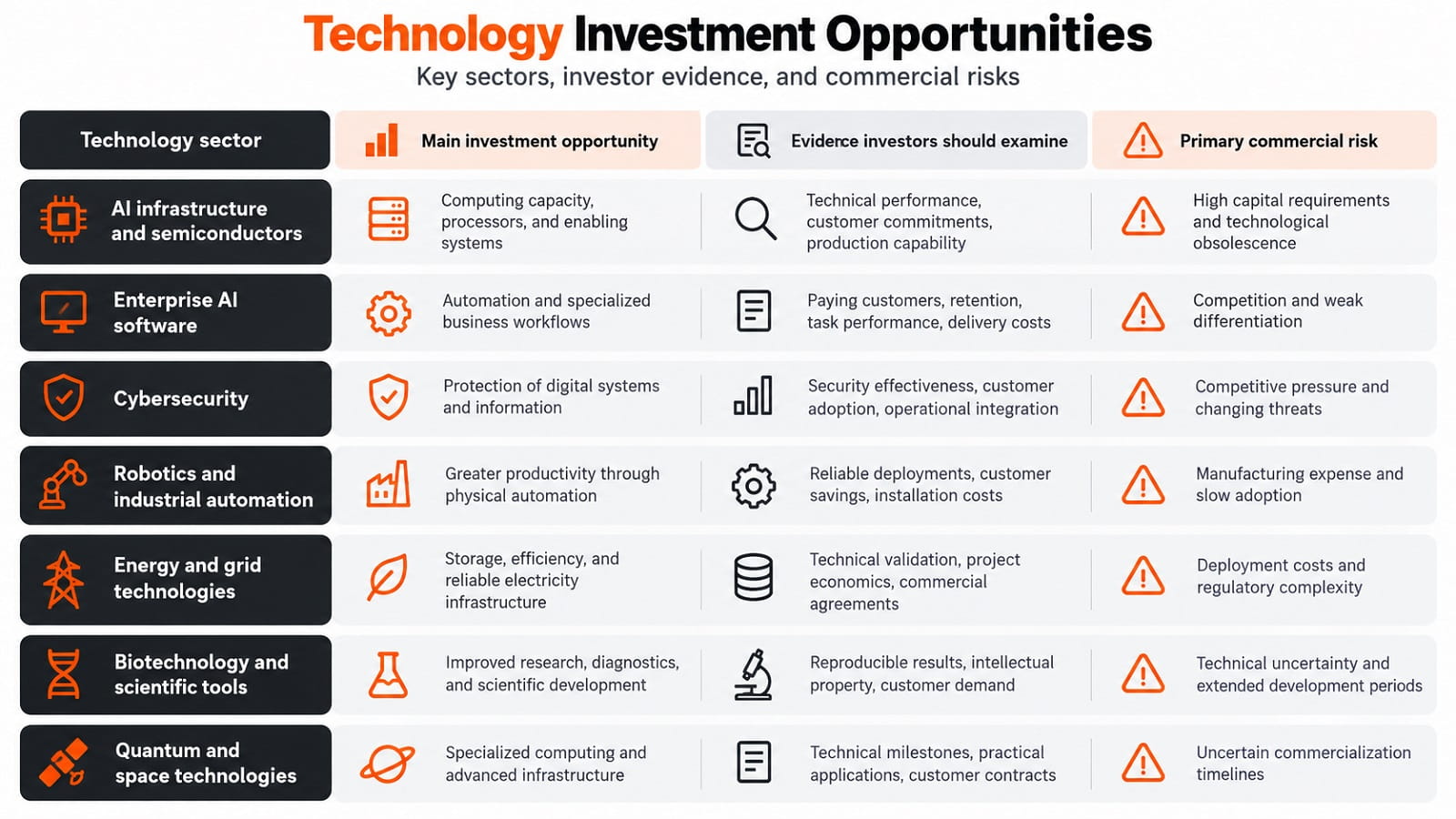
These categories overlap in practice. A robotics business may depend on AI processors, while an AI infrastructure project may require significant energy investment. An industrial technology company could also operate across software, hardware, and scientific development.
Investors should therefore evaluate the actual source of competitive advantage and financial exposure rather than assigning a business to one attractive category and assuming that classification explains its prospects.
What Makes a Technology Investment Attractive?
A compelling technology investment generally combines a meaningful customer problem, a defensible solution, and a plausible route to commercial returns. The technology itself is important, but investors must also examine whether its performance matters enough for customers to change their purchasing decisions.
Technical Validation and Commercial Readiness
Technical validation establishes whether a product can perform its intended function. Commercial readiness examines whether the product can be delivered reliably, purchased economically, and supported in normal operating conditions. These are related but distinct forms of evidence.
A prototype may demonstrate substantial technical progress without establishing manufacturing reliability or customer willingness to pay. Conversely, a relatively mature technology may support an attractive business when a company improves distribution, reduces costs, or solves a specific problem more effectively than existing suppliers.
Investors should identify which uncertainties remain unresolved and determine whether additional capital can reduce them through measurable milestones.
Competitive Advantage and Customer Economics
Technology businesses can develop competitive advantages through specialized expertise, intellectual property, customer relationships, integration capabilities, or economies of scale. However, these advantages should be demonstrated rather than assumed.
Investors need to examine how easily customers could switch to another provider and whether the company can maintain attractive financial margins as demand increases. Strong technical performance may attract initial attention, but sustained commercial success usually depends on delivering value at a price customers are willing to pay.
Capital Requirements and Time to Commercialization
Capital intensity affects the financing strategy and potential financial return. Software businesses may be able to test products with modest infrastructure, while semiconductor, robotics, and energy companies often require expensive physical development.
Investors should estimate the amount of capital needed before the business can generate dependable revenue and consider how many future financing rounds might be required. A promising company can face financial difficulty when technical milestones take longer than expected or when additional investment becomes unavailable.
A Practical Example of Technology Investment Allocation
Consider Horizon Ventures, a fictional investment firm evaluating five technology businesses. The firm has approved a maximum allocation of $6 million across the opportunities, but the companies are at different stages of technical and commercial development.
Rather than deploying the full amount immediately, Horizon Ventures considers an initial investment followed by additional capital if agreed milestones are achieved. This approach allows the firm to evaluate progress before making further commitments, although the legal rights and obligations attached to each financing would depend on the actual investment agreements.
The following allocations are illustrative. They are not recommendations for a real portfolio, and the company categories do not imply that one technology should receive more capital than another.
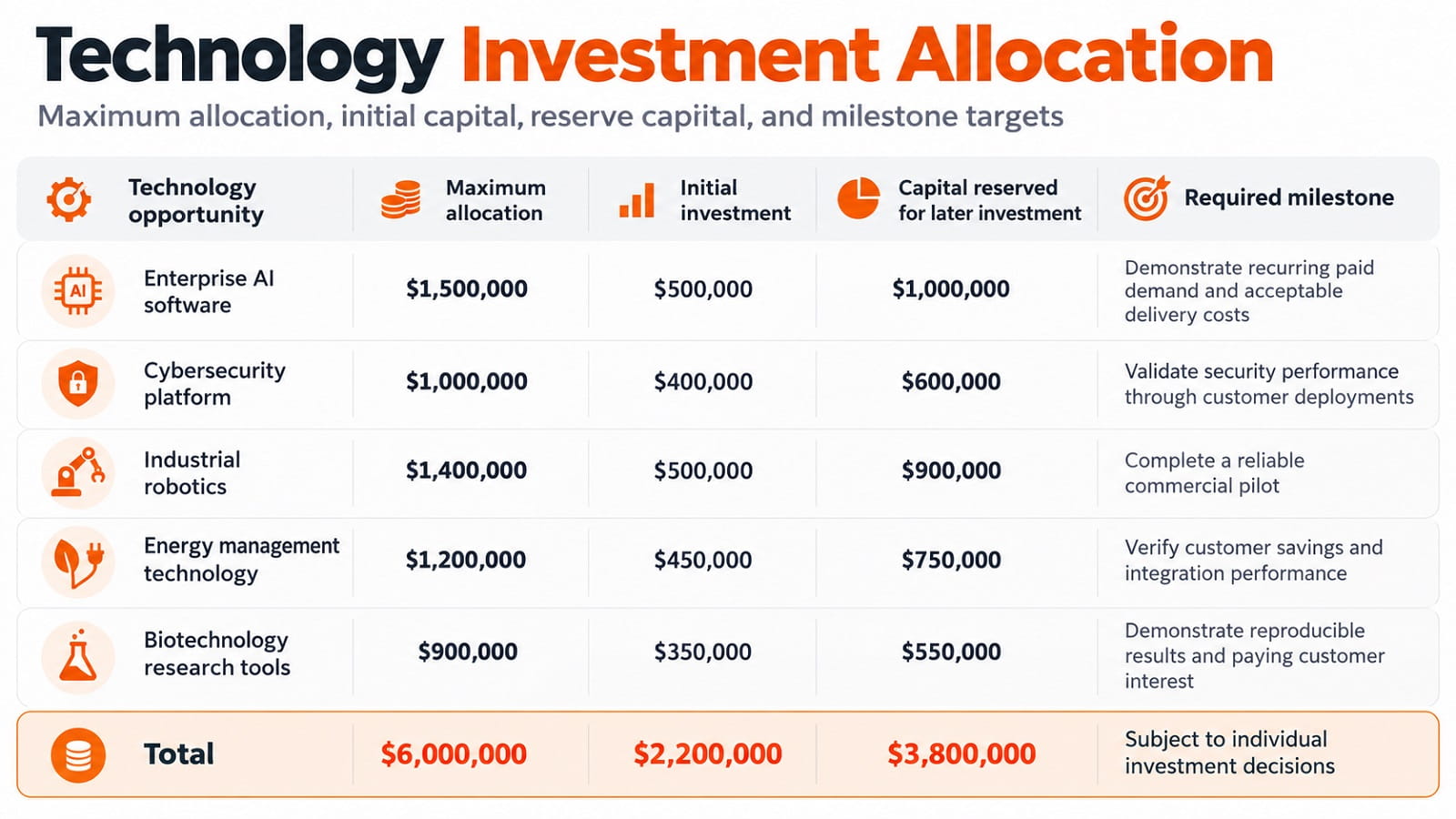
Under this illustrative structure, $2.2 million would be invested initially, while $3.8 million would remain available for potential subsequent investments. These amounts represent maximum planned allocations rather than guaranteed future funding.
The distinction matters because each business faces a different source of uncertainty. The enterprise AI company needs evidence of paying customer retention and sustainable delivery costs, while the robotics business must demonstrate reliable operation under commercial conditions. The biotechnology business faces additional questions about scientific reproducibility and adoption by research customers.
Horizon Ventures would need to evaluate the companies individually before releasing additional capital. Failure to reach a milestone could justify reconsidering the investment, while strong progress might support further funding. However, investment agreements, ownership dilution, and the availability of future capital must be examined before any commitments are made.
The example illustrates how investment allocation can be linked to evidence rather than distributing capital solely according to the popularity of individual technologies. It does not establish expected returns or eliminate the possibility of financial losses.
Technology Investment Risks Investors Should Not Ignore
Technology investors face risks that differ substantially across sectors, but several common patterns deserve attention. One is the possibility that market enthusiasm increases valuations before customer demand or commercial performance can justify them. A company may attract investment because it operates in a popular technological field without demonstrating a meaningful competitive advantage.
Another risk involves dependence on external infrastructure or suppliers. An AI application may rely on a particular model provider, while a hardware business may depend on specialist manufacturing capacity. Changes in pricing, availability, or contractual terms can affect product performance and operating costs.
Regulatory and security requirements can also influence commercialization. Products involving sensitive data, financial decisions, physical machinery, or scientific applications may need extensive testing and oversight. Investors should understand these obligations before assuming a product can expand quickly into additional markets.
Finally, technology development may require more capital than originally expected. Even successful technical progress can produce additional spending when companies move from prototypes to commercial deployment. Financial plans should consider delays, cost increases, and the possibility that future investment becomes more difficult to obtain.
How to Track Technology Investment Trends Accurately
Reliable technology investment analysis begins by identifying what a reported figure actually measures. Corporate IT spending, venture capital financing, public market investment, and infrastructure expenditure should be treated as separate indicators.
The second step is to examine the reporting period and methodology. A forecast for the full year is not equivalent to completed transactions, and an investment estimate covering several related technologies may include overlapping companies or activities.
Investors should also examine evidence beyond capital flows. Customer adoption, research progress, technical validation, product economics, and commercial partnerships can help determine whether a sector is developing sustainable demand.
The most valuable trend analysis combines financial activity with measurable operating performance. An emerging technology may receive relatively limited investment but still produce strong customer value, while a heavily financed sector may face substantial competition and uncertain returns.
Technology Investment Outlook Beyond 2026
The next phase of technology investment will likely be influenced by the relationship between computing demand, energy availability, scientific progress, and commercial adoption. AI infrastructure may continue creating opportunities for semiconductors, networking systems, and energy technologies, while robotics and scientific applications could benefit from advances in computing and automation.
However, strong investment activity does not guarantee continued growth at the same pace. Capital requirements, competition, changing customer budgets, and technical limitations could alter the attractiveness of individual sectors. Some technologies may progress rapidly toward commercial deployment, while others require additional years of research and infrastructure development.
For investors, the strongest opportunities will depend on identifying companies capable of converting technological progress into durable economic value. Evaluating technical readiness, customer demand, financing needs, and commercial risks will remain more useful than relying exclusively on sector popularity.
Final Thoughts
Technology investment trends in 2026 reflect a market in which digital innovation increasingly depends on physical infrastructure, energy, scientific capabilities, and commercial execution. Artificial intelligence is a major influence, but the investment opportunities extend across multiple connected industries.
The comparison of technology sectors and the Horizon Ventures example demonstrate why investors must evaluate opportunities according to their own technical and commercial requirements. A business developing enterprise software cannot be assessed using exactly the same assumptions as a robotics manufacturer or biotechnology company.
The most reliable investment approach combines technological understanding with financial discipline. Strong opportunities are those where technical progress addresses meaningful customer needs and where the company has a credible path toward sustainable commercial value.
FAQ
What Are the Biggest Technology Investment Trends in 2026?
Artificial intelligence, computing infrastructure, advanced semiconductors, cybersecurity, robotics, energy systems, and scientific technologies are attracting significant attention. Investment opportunities and financial risks differ considerably across these sectors.
Which Technology Sector Is Attracting the Most Capital?
AI and related computing infrastructure have attracted exceptionally large investment commitments in 2026. However, the answer depends on whether the comparison measures venture financing, corporate technology expenditure, or broader infrastructure investment.
Why Are Investors Interested in Robotics?
Advances in AI, sensing, and automation are expanding the range of tasks robotic systems may perform. Investors are particularly interested in technologies that can demonstrate reliable operation and measurable customer benefits.
Is Cybersecurity Still an Attractive Technology Investment?
Cybersecurity remains commercially important because organizations need to protect digital operations and information. The attractiveness of an individual investment depends on product performance, customer demand, differentiation, and valuation.
Are Quantum Computing and Space Technologies High Risk?
These technologies can involve substantial technical uncertainty, capital requirements, and long commercialization periods. Risks differ across companies developing foundational systems, components, and commercial applications.
How Can Investors Compare Different Technology Sectors?
Investors can compare technical readiness, customer evidence, competitive advantages, financial requirements, and the time needed to reach commercial milestones. Sector funding totals alone are insufficient for evaluating individual investment opportunities.
Does Higher Technology Spending Mean Better Startup Returns?
No. Higher spending may demonstrate demand for particular products or infrastructure, but startup investment returns depend on company performance, ownership terms, valuations, competition, and future liquidity.

Mobina Khanki
Venture & Funding Writer at PinerookMobina Khanki covers venture capital, startup funding, fundraising, and startup finance for Pinerook, focusing on founders and investors.
 Seen first.