
Technical debt for startups is the extra work a team creates when today’s software decisions make future changes slower, riskier, or more expensive. That debt can be a sensible price for learning quickly. It becomes a problem when the cost of carrying it starts to exceed the value of shipping faster.
A founder does not need to inspect every line of code to make that decision. The goal is to connect engineering concerns to delivery speed, customer reliability, and the next business milestone. A broader technology strategy for startups establishes those priorities; managing technical debt is how a team protects them when tradeoffs accumulate.
What Counts as Technical Debt?
Consider an MVP with a manual process for importing customer records. It helped the team launch quickly, but every new integration now requires custom fixes. The original shortcut has begun charging interest through repeated engineering effort. Missing tests around payments, hardcoded assumptions, and undocumented systems that only one engineer understands can create similar pressure.
Technical debt is not the same as every bug, outdated library, or unpopular coding style. A defect needs fixing because something is wrong. Debt matters because a design or process choice makes future work more costly. The practical question is whether that extra cost is material to the business.
When a Shortcut Is a Reasonable Tradeoff
Early startups often need to test demand before investing in a polished internal system. A temporary workflow may be appropriate if it helps validate a product within the current runway and its failure would have limited consequences. The tradeoff should be visible: what was deferred, why, who owns it, and when it must be reviewed.
Some areas deserve a higher bar from day one. Weak access controls, unreliable payment handling, or exposure of customer information should not be defended as ordinary launch shortcuts. A decision that creates unacceptable security or legal risk is not justified simply because the team is small.
How to Recognize Debt That Is Hurting Growth
Look for repeated symptoms: comparable features take longer to ship, regressions follow routine changes, or new hires depend on one engineer to navigate critical code. These are business signals, not complaints about style.
Technical debt is not the only explanation. Changing requirements or weak processes can cause similar delays. Ask for two recent examples, the time lost, and a small fix that would prevent recurrence. That makes the claim testable.
A Founder’s Framework: Fix, Schedule, or Accept
For each item, ask what happens if it waits, how often it creates friction, and what the smallest credible fix would be. Serious customer harm or security exposure takes precedence. Manageable delays can be scheduled before a milestone; minor friction can wait.
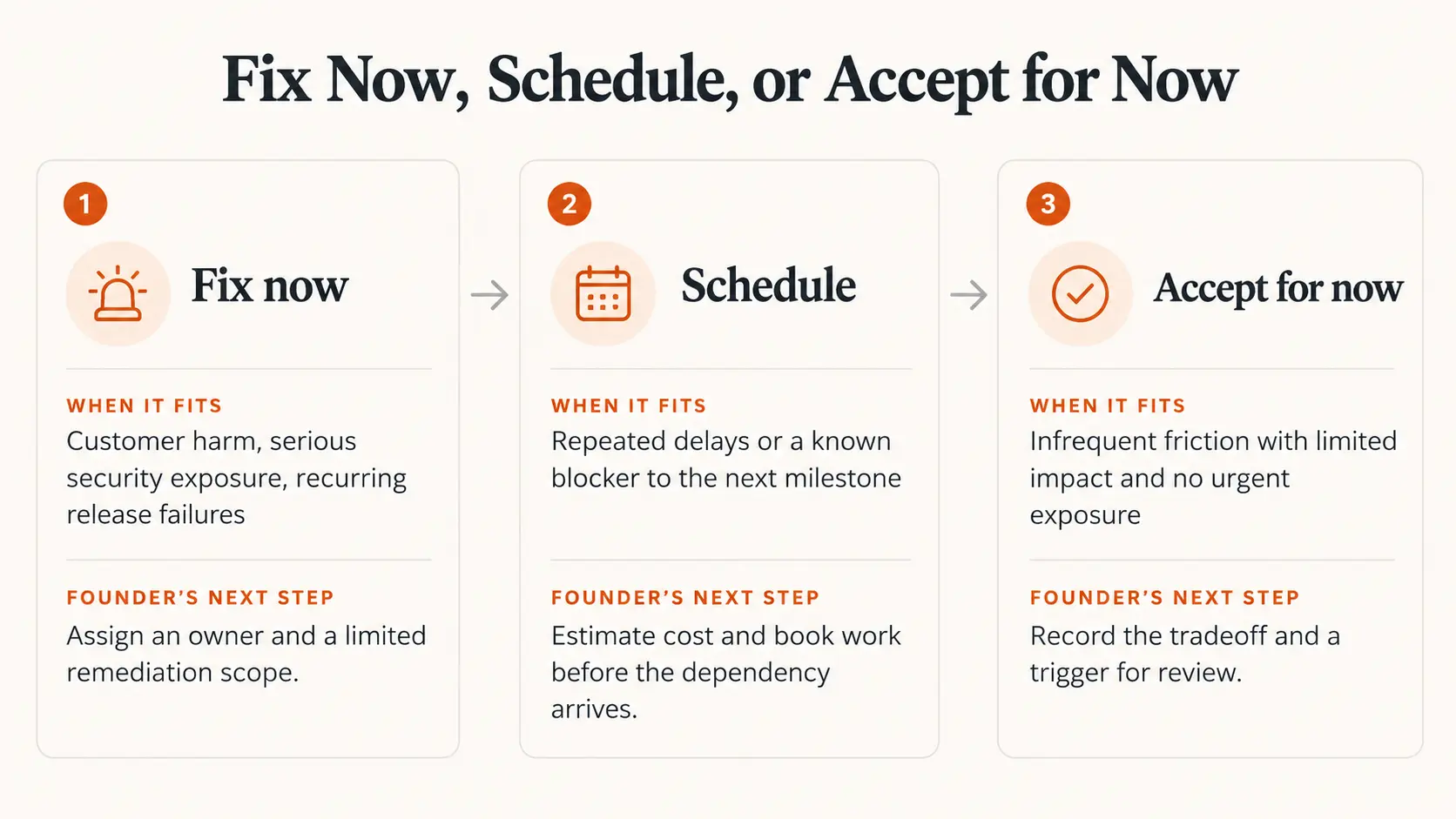
There is no universal percentage of engineering time that every startup must dedicate to cleanup. Set capacity according to observed risk, the size of the team, and the next delivery commitment. The decision should change when the evidence changes.
A Worked Example: The Cost of Waiting
Imagine a product team of five whose reporting module adds two extra engineer days to every substantial change. Six reporting changes are expected over the next quarter. If the pattern continues, the team may lose about 12 engineer days working around the problem. A targeted refactor is estimated at four engineer days.
On those assumptions, fixing the module could release roughly eight engineer days of capacity across the six changes. That is not an automatic cash saving, and the estimate could be wrong. The decision becomes stronger if the same delays are documented, the planned changes are likely to happen, and the team can verify the improvement after the fix.
Keep a Debt Register Small Enough to Use
For a small startup, a shared list is sufficient. Each entry should state the affected workflow, the specific friction or risk, evidence from recent work, an estimated fix, the accountable owner, and the date or event that triggers another review. A list of fifty unlabeled complaints is less useful than five clearly ranked business constraints.
For example: “Billing integration fails on retry; two manual recovery incidents this month; possible duplicate charges; owner: engineering lead; action: implement idempotency and automated retry tests before expanding billing volume.” A founder can evaluate that entry without needing a lecture on software architecture.
Review Debt When the Business Changes
Technical debt priorities shift after a significant customer launch, a rise in incident frequency, a new regulatory obligation, a material increase in traffic, or the departure of a key engineer. Revisit the highest risk items when one of those triggers occurs, and use a lightweight monthly discussion to keep ownership clear.
Avoid making a full rewrite the default response to frustration. Replacing a whole system can consume runway and introduce new defects while the product roadmap waits. First ask whether a focused redesign, better tests, reduced coupling, or improved documentation would solve the actual constraint. A complete rebuild requires a stronger case than “the code is messy.”
The Founder’s Bottom Line
The best technical debt decision is not the one that produces the cleanest code. It is the one that preserves customer trust and creates the most useful engineering capacity for the next stage of the company. Track observable cost, fix real exposure, and keep deliberate shortcuts visible until the business has a reason to revisit them.
FAQ
Is technical debt always bad for a startup?
No. A conscious, reversible shortcut may help validate demand before the startup spends money on infrastructure it may never need. The risk comes from hidden, high impact debt or shortcuts that are never reconsidered.
How can a nontechnical founder measure technical debt?
Look for repeated release delays, regression incidents, extra support work, and engineering time spent on workarounds. Ask for recent examples and compare the cost of the problem with a focused fix.
Should startups reserve 20 percent of every sprint for technical debt?
Not as a universal rule. A fixed allocation can be useful in some teams, but immediate risks and near term product demands vary. Decide based on the evidence and review the allocation regularly.
When should a startup rewrite its software?
Only when the existing system cannot meet an important requirement at an acceptable cost or risk, and smaller interventions are insufficient. Compare a rewrite with incremental replacement, including migration risk and the features the team would delay.

Mohsen Avid
Founder & Editor, PinerookMohsen Avid is the founder of Pinerook, covering entrepreneurship, startup strategy, digital business, and the decisions behind building new ventures.
 Seen first.