
A startup can have three analytics dashboards and still not know why customers leave after signing up. Product events say one thing, the billing system says another, and a weekly spreadsheet becomes the number everyone quotes in meetings. The problem is not too little data. It is the absence of a shared method for collecting, defining, and using it.
A practical technology strategy for startups should make important decisions easier before it adds infrastructure. The same principle applies to data. Founders need a small number of trusted answers about customer behavior and business performance, clear ownership of those answers, and a reason to act when the numbers change.
What data strategy means for an early startup
Data strategy is a plan for which information a company needs, where it comes from, how its quality is checked, who can use it, and which decisions it should inform. It is not a warehouse purchase, a dashboard redesign, or a commitment to track every click.
For a team still testing demand, the priority may be learning whether new customers reach the first moment of product value. After traction, the questions change to repeat usage, revenue quality, support burden, and growth efficiency. The data system should change only when the business questions require it.
A minimum viable data plan founders can operate
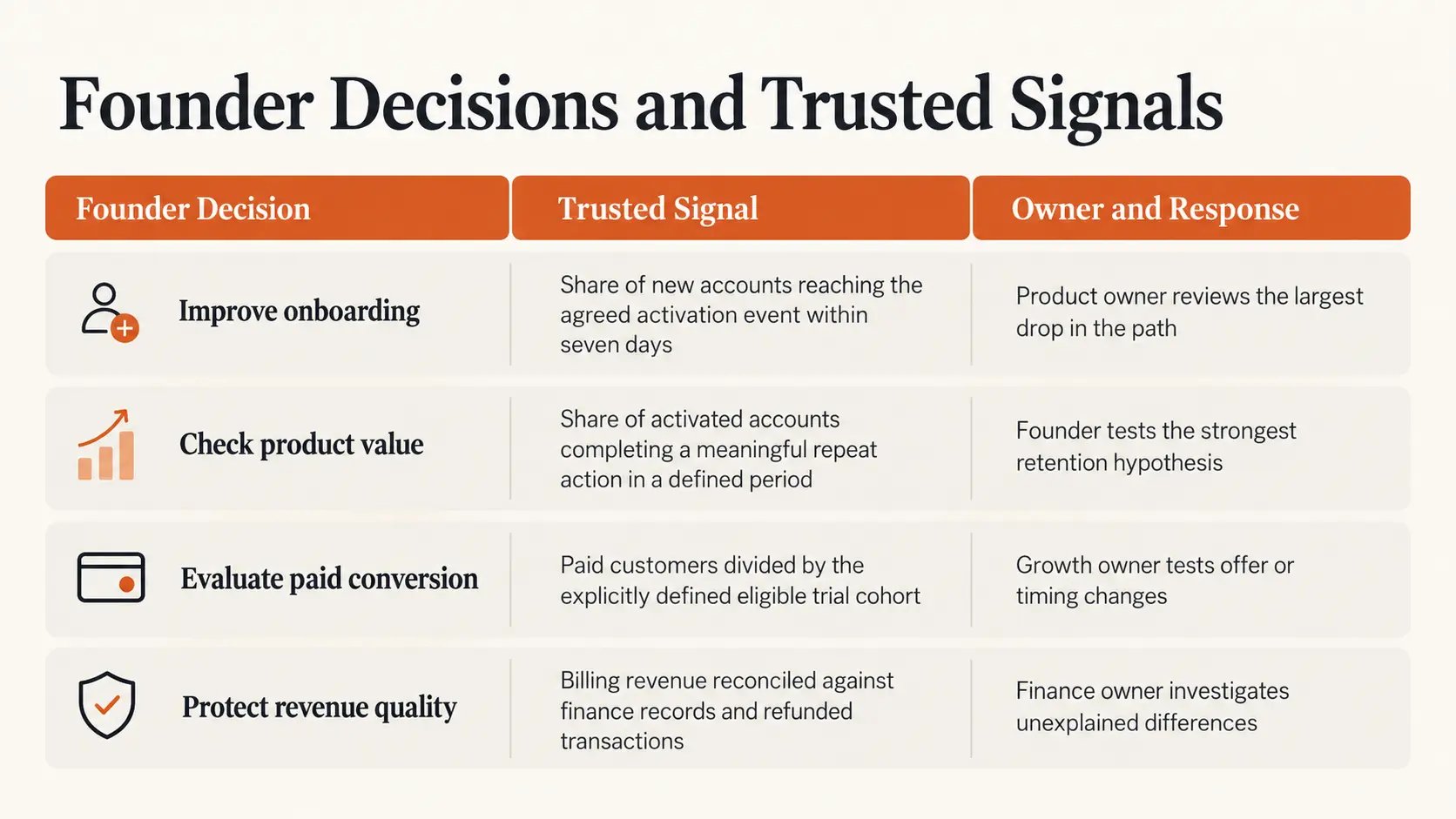
A practical data plan connects a question to a source and a next action. The example below is illustrative; the relevant metric and owner will depend on the product.
Start with decisions, then choose metrics
Begin with the decisions the company expects to make in the next month. Should onboarding be redesigned? Is a channel attracting customers who stay? Is the paid plan converting people who regularly use the product? Each decision needs an observable signal and an owner who can change something in response.
For example, a collaboration tool might define activation as creating a project and inviting a teammate within seven days of signup. That definition is more useful than a raw signup count because it tests whether someone reached the product experience the team believes creates value. But the definition must be written down, including the time window, eligible users, and exclusions.
Choose three to five operational metrics at first. Use acquisition, activation, retention, and revenue only where they reflect real decisions for the current business model. A marketplace, a B2B subscription product, and an API service will not have identical definitions of successful use.
Instrument the customer journey before building more dashboards
Track the smallest set of events that can explain the path from first use to customer value. A typical flow might include Account Created, Workspace Created, Teammate Invited, First Project Completed, and Subscription Started. Record a timestamp and only the event properties needed to answer the question. Define whether a repeated event is allowed and how anonymous visitors become known accounts.
For financially important events, such as successful payment or refunds, rely on authoritative server or billing records rather than a browser click that may not correspond to a completed transaction. Test the implementation with a real user journey before trusting the chart. Otherwise, a clean interface can conceal inconsistent event logic.
Make one definition authoritative
Disagreements about numbers often begin with definitions, not software. Does an active account mean one login or one meaningful task completed? Does monthly recurring revenue exclude paused accounts, discounts, and refunds? Are trials counted from signup date or activation date? These choices can materially change a growth story.
Keep a lightweight metric dictionary covering each critical metric, its exact calculation, data source, reporting period, and owner. When the definition changes, mark the change and avoid comparing old and new periods as though nothing happened. A founder should be able to answer “where did this number come from?” without asking three teams.
Check data quality before acting on the results
A weekly quality check can catch missing events, duplicate records, incorrect time zones, broken integrations, and inconsistent account identifiers. Reconcile revenue with billing, inspect a small sample of product journeys, and compare unusually sharp changes with releases or tracking changes before calling them customer behavior.
Imagine a dashboard reporting 500 completed onboarding flows while verified source records show 400. That 25% overstatement could make an ineffective experiment look successful. The right response is to investigate the collection process, not immediately to celebrate the reported improvement. When the dataset is small, checking a handful of actual records can be more valuable than adding another chart.
Protect customer data and limit unnecessary collection
Early teams should decide what personal data they genuinely need before adding events and integrations. Collecting every form field or user attribute can create privacy and security obligations without improving decisions. Restrict sensitive information in analytics tools, give access only to the people who need it, set reasonable retention periods, and understand where vendors send the data.
A clear owner for permissions and deletion requests matters as much as the dashboard owner. Requirements vary by jurisdiction, data category, and business model, so products handling especially sensitive data may need specialist legal and security review.
When a warehouse or dedicated data team becomes necessary
An early startup can often answer its main questions with trustworthy product analytics, billing reports, and a few reconciled spreadsheets. A central warehouse becomes more useful when important questions regularly require joining multiple systems, historical records are hard to reproduce, or manual reporting repeatedly consumes significant staff time.
The signal to invest is a recurring decision bottleneck, not a fashionable architecture. Before adopting a new platform, identify the report or workflow that currently fails, its cost to the business, and who will maintain the system after launch. Complexity is justified when it removes more friction than it creates.
A practical 30 day plan
In the first week, list the three decisions that matter most and agree on the success metric for each. In the second, document the critical events, their sources, and the person accountable for their definitions. In the third, test the events against real journeys and reconcile important financial figures. In the fourth, review the findings with the team and make one product or commercial decision using the evidence.
Record what changed because of the information. If every data meeting ends with another request for charts but no owner, hypothesis, or action, the startup has a reporting habit rather than a strategy. A useful data system should make its next decision faster, clearer, or less risky.
A useful data strategy stays deliberately small
Founders do not need perfect measurement before making decisions. They need to know which signals are credible, which assumptions remain uncertain, and when an error in the data could change the choice. Start with a narrow set of business questions, keep definitions stable, review quality routinely, and expand the system when its limitations are measurable.
The advantage is not having the most data. It is being able to distinguish what customers are actually doing from what the company hopes they are doing, and changing course before the cost of being wrong grows.
FAQ
What is a data strategy for a startup?
It is a practical plan for choosing valuable information, capturing it reliably, protecting it, and turning it into better product and business decisions.
What data should an early startup track first?
Start with a few metrics tied to the current business question, usually including evidence of activation, meaningful repeat use, and revenue where relevant. Define exactly how each metric is calculated.
Does every startup need a data warehouse?
No. Simple analytics and authoritative billing records may be enough until joining systems, historical reporting, or manual reconciliation becomes a recurring constraint.
Who should own data strategy without a data team?
The founder should own priorities, while a product or engineering lead owns instrumentation and quality. Each important business metric also needs a named owner who acts on it.

Mohsen Avid
Founder & Editor, PinerookMohsen Avid is the founder of Pinerook, covering entrepreneurship, startup strategy, digital business, and the decisions behind building new ventures.
 Seen first.