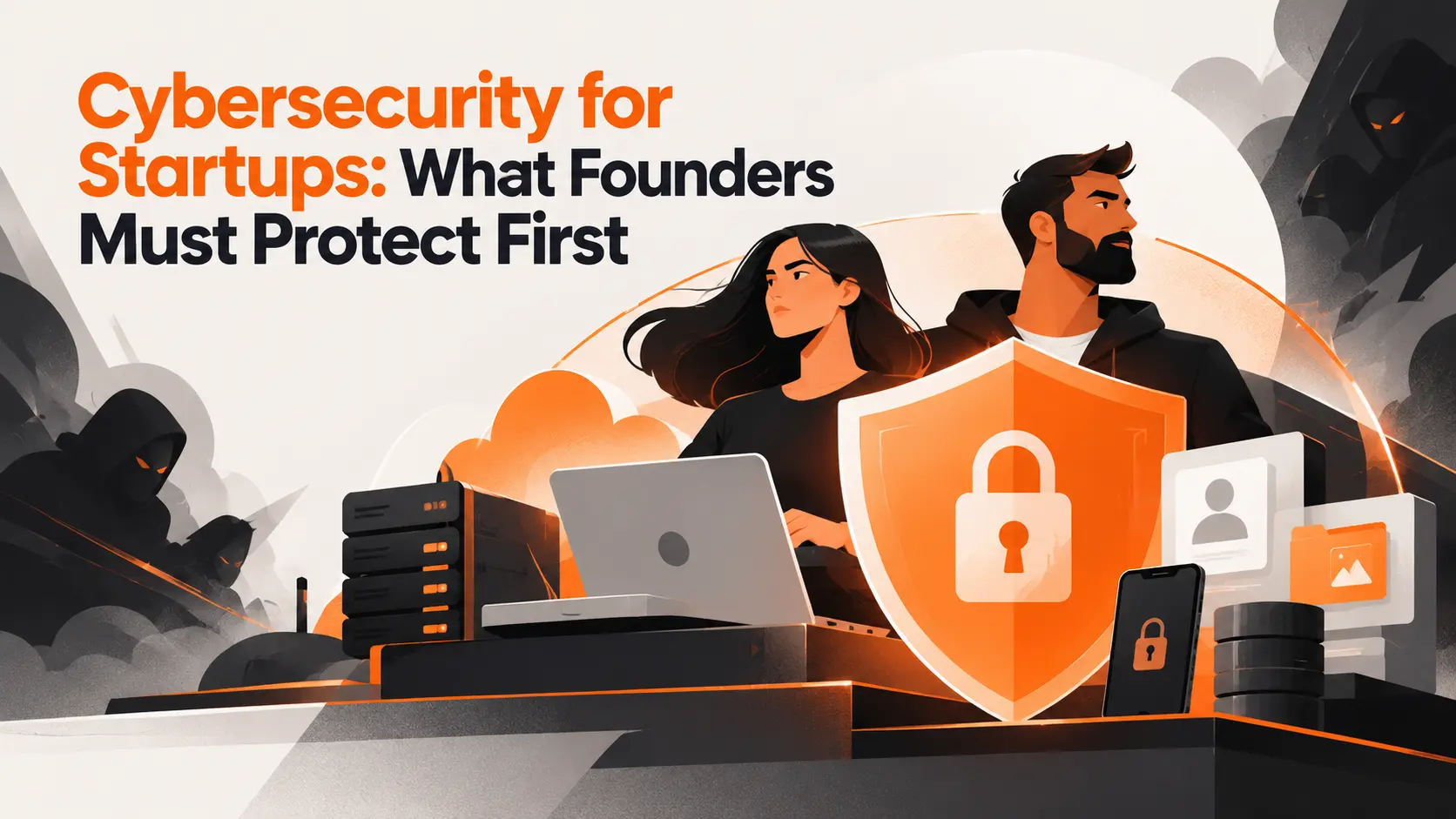
A startup does not need a large security department to suffer a serious breach. One compromised founder account can expose code, payment tools, or customer records. The practical starting point is not to purchase every security product on the market. It is to identify the few systems whose failure would interrupt the business, then put clear owners and basic safeguards around them.
Cybersecurity belongs inside a technology strategy for startups because every choice about accounts, vendors, product architecture, and data creates an operating risk. Early protection should be proportional to what the company handles today, while leaving room for stronger controls as customers and responsibilities grow.
Start with business exposure, not a tool checklist
Before buying software, map the assets a breach could damage: customer data, company email, source code, production access, billing systems, and the ability to recover the product. Then ask two questions for each asset: how could someone obtain unauthorized access, and what would the business lose if they did? That turns a vague security concern into a manageable priority.
A product handling health or financial information faces different consequences from an early prototype with no real user data. Even so, both should protect privileged accounts and source code. The correct minimum is determined by exposure, not by company headcount or a fashionable security stack.
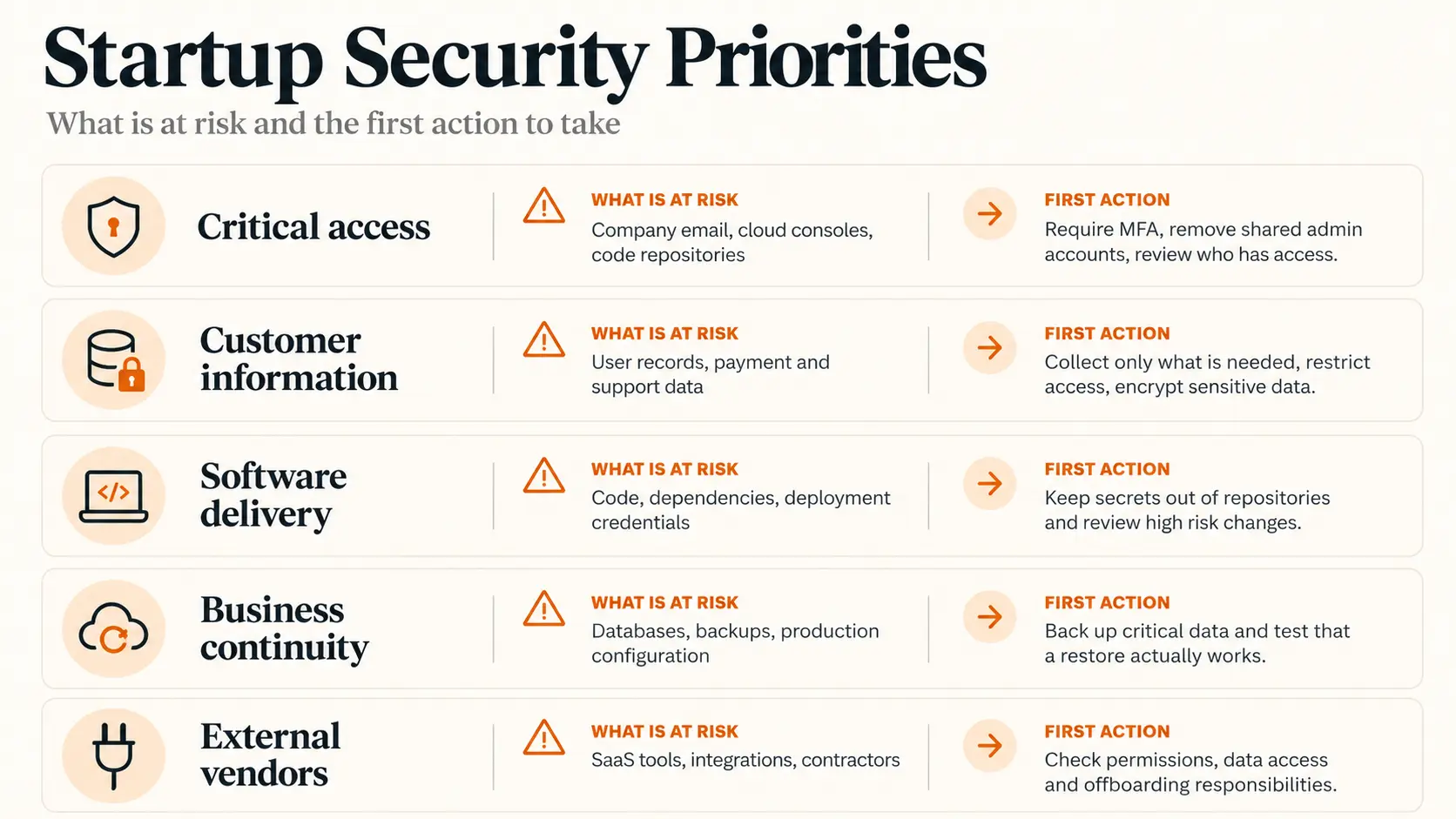
Five security priorities for a lean startup
The first controls should reduce common account, data, and recovery risks without requiring a dedicated security function. The table below is a sequence for discussion, not a claim that every startup faces the same threat level.
Give security a clear owner
When everyone assumes the cloud provider, contractor, or CTO is responsible, simple gaps persist. Assign one accountable person for access reviews, patching, backups, and incident coordination. The founder does not need to perform every technical task, but should know who can revoke access, who receives alerts, and who can authorize a production shutdown.
A useful monthly review asks whether former teammates still have access, whether important systems have MFA, whether patches are overdue, whether backups were restored successfully, and whether new third party tools are collecting more data than expected. These are operational questions with observable answers.
Protect the development and deployment process
Early teams often move quickly by giving engineers broad production permissions and reusing credentials across services. That convenience creates concentration of risk. Limit privileges to the work a person actually performs, use separate production credentials, and store secrets in managed secret storage rather than code or chat messages.
Add security checks to the normal release workflow: dependency updates, code review for sensitive changes, and monitoring for unusual sign ins or deployments. A small team benefits more from repeatable safeguards integrated into delivery than from occasional, exhaustive security exercises that no one has time to maintain.
Plan for an incident before the first incident
Assume a founder loses access to the primary email account on a Friday evening. The company should already know how to reach its identity provider, disable active sessions, preserve logs, identify what systems were accessed, and communicate with affected customers when required. Without an incident plan, the first hours are lost deciding who is in charge.
Write a one page response plan with an incident lead, emergency contacts, critical systems, backup locations, and rules for customer and regulatory notifications. Test one simple scenario each quarter. The FTC recommends incident response and recovery planning, and the NIST Cybersecurity Framework 2.0 organizes risk management around Govern, Identify, Protect, Detect, Respond, and Recover.
When a startup should invest in more formal security
Baseline controls belong in place early. More formal processes become worthwhile when exposure changes: larger volumes of sensitive data, enterprise customer requirements, regulated services, more contractors, or a growing number of production systems. This can justify penetration testing, stronger identity management, vendor reviews, or a dedicated security owner.
SOC 2 is frequently raised during enterprise procurement, but an audit report is not a substitute for working safeguards. Founders should distinguish a prospective customer asking for assurance from a legal obligation applicable to their specific industry or geography. Invest based on verified requirements and material risk rather than pursuing compliance badges as an end in themselves.
A practical security plan for the first 30 days
Week 1: Map the essentials
Identify critical accounts, databases, vendors, and production access. Choose an accountable owner and remove unused privileges, especially from former contractors.
Week 2: Close predictable gaps
Enforce MFA for privileged accounts, confirm device updates, move credentials into a secure manager, and limit access to customer information.
Week 3: Make recovery possible
Verify backups, run a restoration exercise, and document the steps required to recover the product and communicate during an incident.
Week 4: Build a repeatable routine
Review outstanding risks, assign deadlines, and schedule monthly access and patch checks. Document what remains intentionally deferred and why.
The founder’s test: can the company recover?
Perfect security is not an attainable milestone. A credible early program is one in which major exposures are understood, simple controls stay active, and the team can contain and recover from a disruption. If the company cannot explain who controls production, where sensitive data lives, or how backups will be restored, those gaps deserve attention before another security dashboard.
FAQ
What cybersecurity should a startup implement first?
Start with MFA, least privilege access, secure handling of secrets, regular software updates, and tested backups. Adjust the order if your product handles unusually sensitive information or has specific regulatory obligations.
Does a startup need a dedicated security team?
Not necessarily at the earliest stage. It does need an accountable owner and access to qualified help when a risk exceeds the team’s expertise. The need for specialized support rises with data sensitivity, scale, and operational complexity.
Is cybersecurity the same as SOC 2 compliance?
No. Cybersecurity is the ongoing work of managing threats and protecting systems. SOC 2 is an independent attestation report about the design or operation of specified controls. A report does not guarantee that incidents cannot occur.
How often should founders review startup security?
Review critical access and unresolved risks monthly, test recovery periodically, and reassess the approach after major product, staffing, customer, or vendor changes. High risk systems may need more frequent monitoring.

Mohsen Avid
Founder & Editor, PinerookMohsen Avid is the founder of Pinerook, covering entrepreneurship, startup strategy, digital business, and the decisions behind building new ventures.
 Seen first.