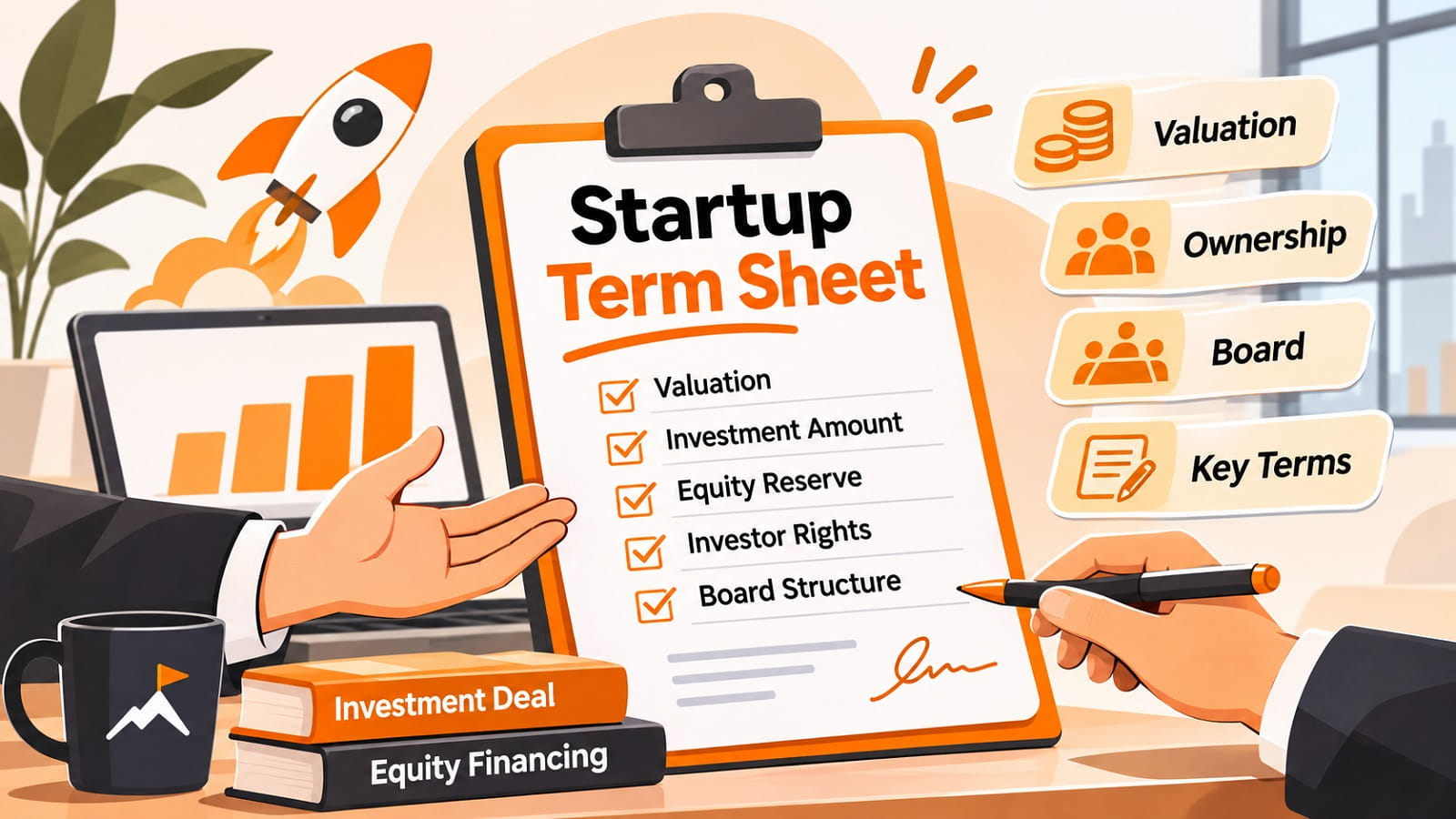
A startup term sheet is often the first document that turns an investor's interest into a specific financing proposal. It sets out how much capital the investor intends to provide, the valuation used to price the investment, and the rights the investor expects to receive. Although founders naturally focus on the amount of money being offered, other provisions can affect their ownership, decision making authority, and future fundraising opportunities. A carefully reviewed term sheet helps identify these consequences before the parties negotiate detailed legal agreements.
A term sheet is an important step within Term Sheets and Investment Deals because it establishes the commercial framework that later financing documents are expected to reflect. A company can receive two offers with different valuations and discover that the apparently more attractive offer leaves founders with less ownership after the transaction. Similarly, an agreement that appears reasonable on financial terms may introduce governance restrictions or procedural obligations that create problems later.
Understanding how to evaluate these documents requires more than knowing what individual clauses mean. Founders need to examine the relationship between valuation, employee equity reserves, investor rights, and closing conditions. This guide explains how to read a proposed term sheet, provides an annotated example, and compares two fictional investment offers to demonstrate how seemingly small differences can change the final outcome.
Understanding a Startup Term Sheet
A startup term sheet is a written summary of the principal terms proposed for an investment transaction. In a priced venture capital round, it commonly identifies the company, proposed investors, investment amount, valuation, securities to be issued, and important economic and governance provisions.
Its purpose is to establish agreement on major transaction terms before the parties spend substantial time and money preparing definitive financing documents. Rather than negotiating every provision in a long stock purchase agreement immediately, founders and investors use the preliminary document to resolve the commercial questions most likely to influence the transaction.
A term sheet is not the same as the investment agreement that ultimately governs a completed financing. Most proposed financing terms are ordinarily nonbinding, although some procedural provisions may create immediate legal obligations. Whether a particular clause is enforceable depends on its wording, the agreement as a whole, and applicable law.
The document should therefore be reviewed carefully before signing. Even where the investment itself remains nonbinding, the term sheet can establish expectations that become difficult to change during the final documentation process.
When Startups Receive Term Sheets
Founders generally receive a formal term sheet after an investor has completed sufficient preliminary evaluation to propose a transaction. The investor may have reviewed the company's business model, product, financial performance, capitalization, market opportunity, and financing requirements.
The timing varies by transaction. A startup raising its first institutional equity round may receive a relatively concise proposal, while a later financing involving multiple share classes and existing investor rights can require more detailed negotiations.
Not every fundraising arrangement begins with the same type of document. A priced preferred share financing differs from an investment through a SAFE or convertible note, which may have its own form of agreement and conversion terms.
A founder evaluating a priced equity proposal should confirm that the investment instrument and transaction structure are clear. Without this distinction, the parties may discuss valuation and ownership percentages using assumptions that do not match the proposed legal arrangement.
How to Read a Startup Term Sheet
A useful way to review a term sheet is to divide its provisions into economic terms, governance terms, and transaction process terms. Economic terms determine the financial consequences of the investment, including the price paid for shares and the rights affecting future distributions.
Governance provisions address how corporate decisions are made. They may establish board appointments, shareholder voting arrangements, and situations where particular investor approvals are required.
Transaction process terms concern what must happen before financing is completed. These can include due diligence, confidentiality, exclusivity, legal expenses, required approvals, and the conditions for closing.
The three groups should be examined together rather than independently. A company might negotiate an attractive price while accepting an unusually large employee equity reserve or broad investor consent rights. Understanding the complete arrangement helps founders assess whether the capital received justifies the obligations being undertaken.
An Annotated Startup Term Sheet Example
Consider HarborTech, a fictional enterprise software startup preparing to raise its first institutional equity round. The company has two founders, 10 million outstanding common shares, and no existing employee equity reserve. It has also confirmed that there are no outstanding SAFEs, convertible notes, warrants, or other securities that would affect the proposed pricing calculation.
A prospective investor proposes a $3 million financing at a $12 million pre investment valuation. The proposed transaction includes preferred shares, a post financing employee equity reserve, investor representation on the board, and selected contractual protections.
The following table summarizes the principal terms of the fictional proposal. It is an educational example rather than a document intended to be signed without legal drafting and review.
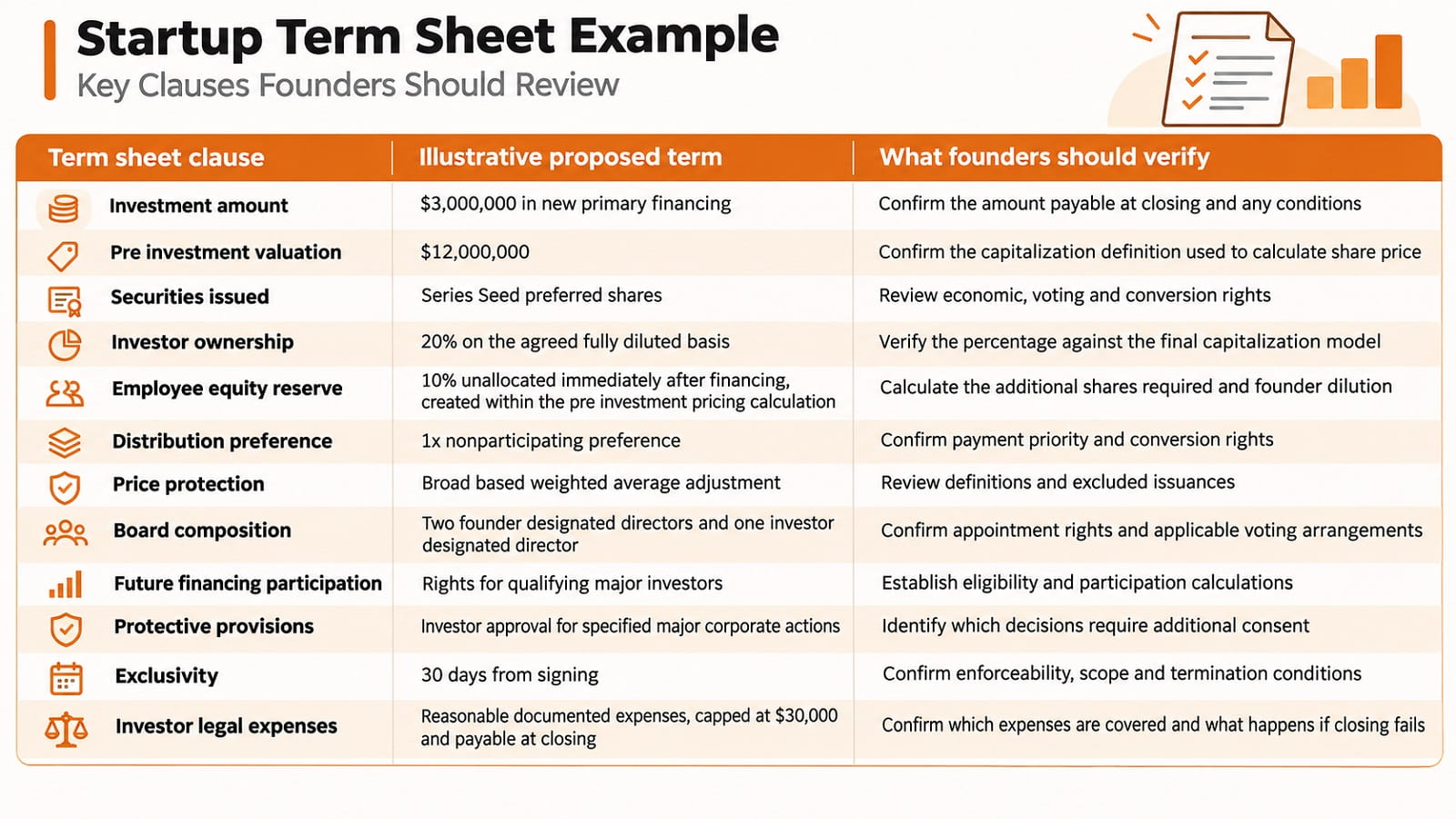
The terms illustrate why reading only the investment amount and valuation is insufficient. The investor is expected to receive 20% of the company, but the proposed employee reserve also affects the founders' ownership percentages.
The board structure gives the investor a designated director without automatically giving the investor control of the board. Nevertheless, separately negotiated protective provisions may require investor approval for certain decisions regardless of the number of board seats held.
The exclusivity and expense provisions create another category of consideration. The founders need to know which obligations take effect upon signing and whether they continue if the investment does not close.
Each item should be confirmed against the complete proposal and discussed with qualified legal advisers before the company accepts the terms.
Calculating the Investment Valuation
The starting point for understanding HarborTech's financing is the relationship between investment amount, pre investment valuation, and post investment valuation.
The company has a proposed pre investment valuation of $12 million. The investor intends to contribute $3 million through a primary equity investment, meaning the cash goes to the company in exchange for newly issued securities.
Under the simplified structure, the post investment valuation is:
Post investment valuation = $12,000,000 + $3,000,000 = $15,000,000
The incoming investor's ownership is:
Investor ownership = $3,000,000 ÷ $15,000,000 × 100 = 20%
This establishes the investor's percentage on the agreed capitalization basis. However, the remaining 80% is not necessarily held entirely by the original founders.
The term sheet also requires an unallocated employee equity reserve representing 10% of fully diluted capitalization immediately after financing. Because the reserve is included in the capitalization used to calculate the pre investment share price, the founders absorb its effect on their modeled ownership.
Under these assumptions, the founders collectively retain 70%, the employee reserve represents 10%, and the investor receives 20%.
That result demonstrates why a valuation calculation should be accompanied by a fully diluted capitalization model. A statement that an investor is purchasing 20% does not by itself explain how the other 80% will be distributed.
Understanding the Employee Equity Reserve Provision
An employee equity reserve can be a reasonable part of a financing proposal. Startups may need additional capacity to recruit senior employees and other specialists, and investors often want that capacity established before the financing closes.
The key issue is how the reserve is calculated and when it is included in the share price. A requirement for 10% unallocated employee equity after financing may involve issuing or authorizing additional potential shares before the investor's purchase is priced.
Founders should also distinguish the total equity incentive plan from the unallocated portion available for future grants. A company may already have outstanding employee options that count toward its fully diluted capitalization without being available for new awards.
In HarborTech's example, the company starts with no employee equity reserve. The full proposed 10% therefore represents new potential share capacity.
Because the term sheet includes that capacity in the pre investment pricing calculation, the founders collectively retain 70% rather than the 80% they would have held without the new reserve.
This outcome is not automatically unreasonable. The reserve may support an important hiring plan. However, its size should be connected to expected recruitment needs rather than accepted without calculation.
Comparing Two Startup Term Sheet Offers
Suppose HarborTech receives a second proposal from another investor. The first investor offers $3 million at a $12 million pre investment valuation and requires a 10% unallocated employee reserve after financing.
The second investor offers the same $3 million at a higher pre investment valuation of $13.5 million. However, the second proposal requires an unallocated employee reserve equal to 15% of fully diluted capitalization immediately after financing.
Both proposals include the required new reserve in the capitalization used for pricing the investment. For the comparison, assume HarborTech still has 10 million outstanding founder shares, no existing reserve, and no other securities.
Founder A holds 60% of the initial founder shares, while Founder B holds 40%. The following table compares the resulting ownership structure under each proposal.
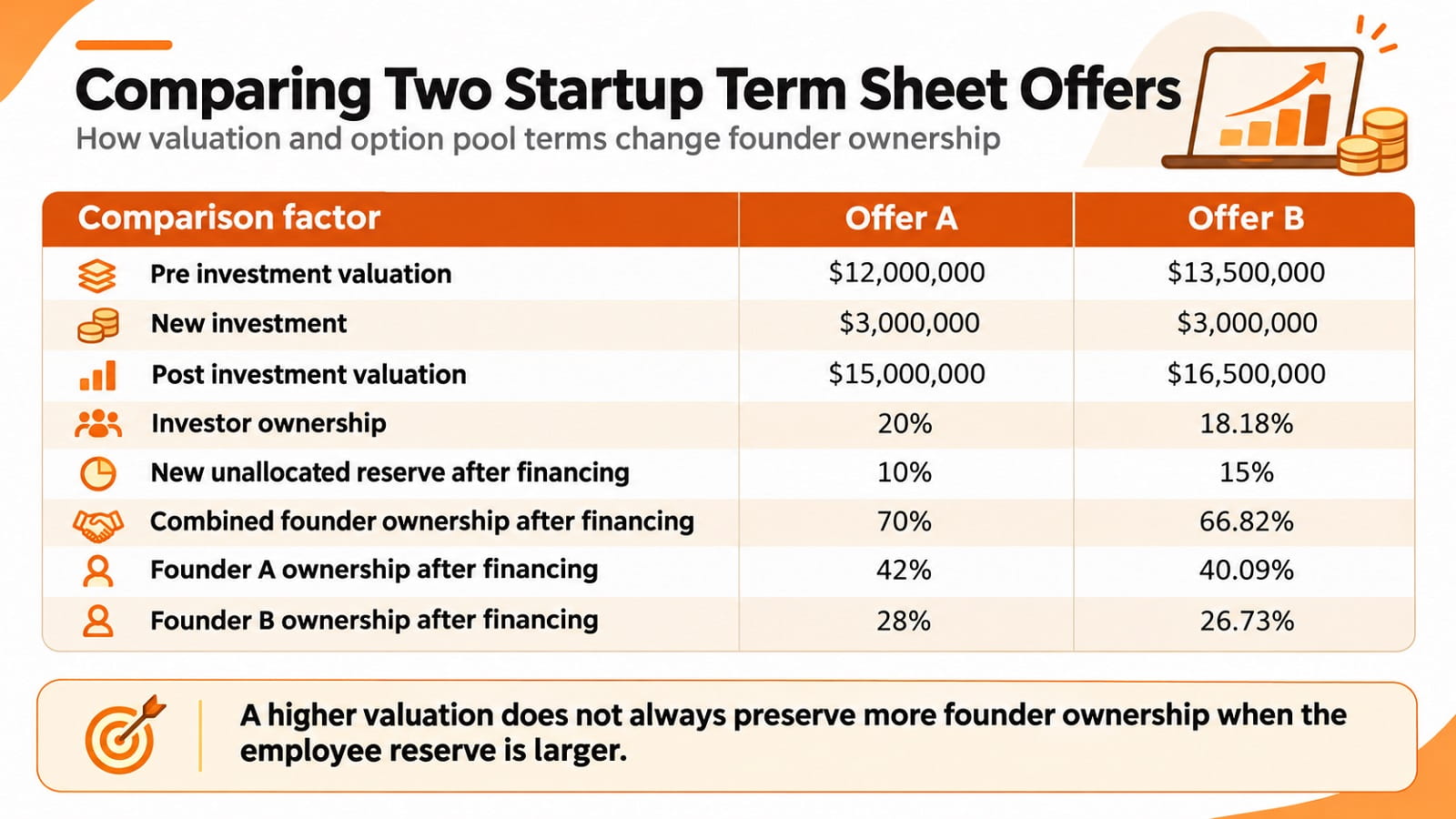
Offer B has a higher headline valuation and gives the incoming investor a smaller percentage of the company. Nevertheless, the founders retain less ownership because the required employee equity reserve is larger.
The calculation for Offer A begins with the investor's 20% ownership. Subtracting the 10% reserve leaves 70% for the founders.
For Offer B, the investor's ownership is calculated by dividing $3 million by the $16.5 million post investment valuation, resulting in approximately 18.18%. Subtracting that percentage and the 15% reserve leaves approximately 66.82% for the founders.
Because Founder A originally holds 60% of the founder shares, that founder receives 60% of the ownership remaining with the founding team. Under Offer A, this equals 42% of the company. Under Offer B, it equals approximately 40.09%.
The same approach gives Founder B approximately 28% under Offer A and 26.73% under Offer B.
The comparison demonstrates that a higher valuation does not necessarily preserve more founder ownership. Changes to the employee reserve can outweigh part of the apparent benefit.
This does not establish that Offer A is universally preferable. The founders must also evaluate the investor's experience, strategic contribution, economic rights, governance terms, and the equity needed for actual hiring.
The percentages are rounded, and the example assumes that both offers use consistent capitalization definitions. Actual share issuance calculations should be completed using the final transaction documents.
Reviewing Preferred Share Economics
A priced venture financing frequently involves preferred shares with rights that differ from the common shares held by founders and employees. These rights can affect distributions, conversion, voting, and future financing outcomes.
For an ordinary preferred financing, founders should examine whether the investment includes a nonparticipating or participating distribution preference and whether the preference multiple exceeds the amount originally invested.
A one times nonparticipating preference generally gives the investor a contractual choice between receiving the applicable preference amount and converting into common shares when conversion produces a more favorable result. The precise operation depends on the governing documents and the availability of proceeds.
Additional economic features can change the outcome. Cumulative dividends, redemption provisions, seniority between financing rounds, and participation rights may affect the value eventually available to common shareholders.
A founder reviewing the term sheet does not need to predict the company's future sale price. However, the company should model several hypothetical exit values to understand how the proposed preferred rights would influence distributions under different outcomes.
Investor Approval Rights and Board Structure
The governance section of a term sheet deserves separate attention because it can influence how the company operates after financing. Investors may request the right to appoint a director, observe board meetings, or approve specified corporate actions.
These mechanisms should not be treated as interchangeable. A board seat provides participation in board decisions, while an observer typically lacks a director's formal vote. Protective provisions may require specified shareholder approval even where the investor does not control the board.
Founders should identify which decisions are subject to additional consent. Such decisions may include issuing certain securities, changing specified governing provisions, or completing major corporate transactions.
The scope matters more than the presence of the provision alone. A requirement for investor approval before issuing a senior class of preferred shares is different from giving an investor a broad veto over routine staffing or commercial decisions.
The negotiation should preserve appropriate investor protections while allowing management and the board to operate within their lawful responsibilities.
Founder Vesting and Existing Ownership Agreements
Some investors review founder vesting arrangements when negotiating a financing. Their concern may be that a significant founder could leave shortly after the investment while retaining a substantial ownership position.
Where founders already have documented vesting or repurchase arrangements, the investor may examine whether those terms provide adequate protection. Where no arrangements exist, an investor may propose introducing restrictions or modifying the existing structure.
Founders should examine the specific consequences of any proposed reset. Requiring a founder to begin a new full service period without recognizing previous contributions can materially affect the rights associated with shares already acquired.
The agreement should clarify what happens following resignation, termination, disability, death, or a change of control where applicable. These outcomes may require different contractual treatment.
Any change should be evaluated alongside the founder's existing share documents and tax circumstances. It should not be accepted as a routine administrative clause without understanding the underlying consequences.
Binding and Nonbinding Terms
One of the most important parts of reviewing a term sheet is identifying which provisions create enforceable obligations before the financing closes.
The proposed valuation, investment amount, and principal shareholder rights are commonly expressed as nonbinding commercial terms. Their inclusion establishes the framework for negotiation, but it does not ordinarily compel the investor to fund the transaction.
Confidentiality and exclusivity provisions may be different. They can create immediate obligations even when the proposed financing remains subject to further review.
An exclusivity provision, sometimes described as a no shop obligation, may restrict the startup from soliciting or negotiating alternative investment proposals during a specified period. The restriction can be commercially significant because the company may have limited cash and need to keep fundraising options available.
Founders should confirm when exclusivity begins, how long it continues, which activities are restricted, and whether it can terminate early if the investor withdraws.
Expense provisions require similar attention. A company should know whether it must reimburse investor expenses only after a successful closing or whether certain costs could become payable even if the transaction fails.
The enforceability of these provisions depends on the actual wording and governing law. Legal review before signing is therefore important, even when the document is described as preliminary.
Due Diligence Before the Investment Closes
After the parties agree on a term sheet, investors normally continue examining the company before completing the financing.
The review may include corporate formation records, the capitalization table, existing financing documents, intellectual property assignments, employee agreements, financial statements, and material customer or supplier contracts.
Unresolved issues can affect the transaction. If a company has promised equity to an adviser without properly recording the commitment, the investor may request clarification before finalizing the capitalization model.
Similarly, uncertainty about ownership of essential intellectual property can create a significant concern during due diligence.
Founders can reduce these risks by preparing accurate records before fundraising begins. A clear ownership history, properly documented securities, and organized legal and financial information can make the transaction process more predictable.
The company should also understand which conditions must be satisfied before closing. Signing the term sheet should not be treated as confirmation that the funds are available to spend.
Negotiating a Startup Term Sheet Effectively
Effective negotiation begins with understanding the financial impact of the proposed terms. Founders should calculate ownership after financing, including any required employee equity reserve and the conversion of outstanding securities.
The next priority is identifying provisions that create significant economic or governance consequences. These commonly include distribution preferences, price protection, board representation, protective provisions, and potentially binding process obligations.
Not every term deserves equal negotiation effort. A founder should distinguish between customary provisions that work reasonably in the proposed transaction and terms that impose disproportionate restrictions or unexpected financial consequences.
The company should also consider the quality of the investor and the strategic value of the relationship. A financing partner who provides relevant expertise, access to customers, and credible support for future rounds may offer value beyond the headline valuation.
However, qualitative benefits should not substitute for reviewing contractual terms. Founders should compare proposals using consistent assumptions and confirm that commitments discussed during negotiation appear accurately in the final documents.
A clearly prioritized negotiation process is more effective than objecting to every provision. It allows founders to concentrate on terms that materially affect ownership, control, financing flexibility, and closing certainty.
Common Problems to Identify Before Signing
One potential problem is an employee equity reserve that is not supported by a credible hiring plan. A large reserve included in the pre investment pricing calculation can materially reduce founder ownership.
Another is a financing proposal that contains unexpectedly strong investor economic rights. A preference multiple greater than one, participation rights, or cumulative distributions can change the amounts available to common shareholders during a sale.
Founders should also examine broad approval requirements, unusually restrictive exclusivity provisions, and conditions that allow substantial portions of the proposed investment to remain uncertain.
A separate concern arises when the term sheet refers to important rights as standard without defining their intended scope. The parties may have different expectations about what those words mean.
These issues do not automatically make a transaction unacceptable. They indicate where additional explanation, financial modeling, or legal negotiation may be required before the company makes a commitment.
Moving From the Term Sheet to Final Agreements
Once the commercial terms are sufficiently settled, the parties prepare and negotiate definitive financing documents. In a typical US preferred stock financing, these can include a stock purchase agreement, amended corporate governing documents, an investors' rights agreement, a voting agreement, and documents governing specified share transfers.
The definitive agreements should reflect the important terms agreed in the preliminary proposal while addressing additional legal details required to complete the transaction.
Founders should pay attention to changes in wording that alter economic or governance rights. A provision may appear similar to the negotiated term while introducing different approval thresholds, exceptions, or conditions.
The financing becomes effective according to the execution and closing requirements established in those documents. The company should confirm that the expected securities have been authorized and issued properly and that the investment proceeds have been received.
A signed term sheet is therefore an important milestone, but completion of the financing remains a separate event.
Final Thoughts
A startup term sheet is more than a summary of proposed funding. It establishes the financial and contractual assumptions that guide the investment process and can influence company ownership, governance, and future financing flexibility.
The HarborTech example demonstrates why a higher valuation does not necessarily leave founders with a larger ownership percentage. When the employee equity reserve is included in the pricing calculation, its size can materially affect how the capitalization is distributed after closing.
Founders should approach the document as a complete business proposal rather than a valuation announcement. By reviewing the capitalization model, prioritizing important economic and governance terms, and understanding potentially binding obligations before signing, they can make more informed financing decisions and reduce uncertainty during the closing process.
FAQ
What Is a Startup Term Sheet?
A startup term sheet is a document summarizing the principal terms of a proposed investment. It commonly includes the investment amount, valuation, proposed securities, ownership arrangements, investor rights, and transaction conditions.
Is a Startup Term Sheet Legally Binding?
Many proposed financing terms are ordinarily nonbinding, but selected provisions may be enforceable. Confidentiality, exclusivity, expenses, and other procedural obligations should be reviewed according to their actual wording and applicable law.
What Should Founders Review First in a Term Sheet?
Founders should begin with the investment amount, valuation, financing structure, fully diluted capitalization, and employee equity reserve. They should then examine preferred economic rights, governance arrangements, and potentially binding provisions.
Can Two Term Sheets With Different Valuations Produce Similar Ownership Outcomes?
Yes. Differences in employee reserve requirements, convertible securities, and capitalization definitions can affect the final percentages. The headline valuation alone does not determine how much ownership founders retain.
Does Signing a Term Sheet Guarantee Investment?
No. A proposed investment generally remains subject to final documentation, due diligence, applicable approvals, and closing conditions unless the agreement expressly provides otherwise.
Can Founders Negotiate the Employee Equity Reserve?
Yes. Its size and treatment are often important parts of an equity financing negotiation. Founders can support a proposed reserve with hiring plans, existing equity commitments, and the company's expected financing timeline.
What Is an Exclusivity Provision in a Term Sheet?
It is a contractual provision that may restrict the company's ability to solicit or negotiate alternative investment opportunities during a specified period. Its scope, duration, and enforceability depend on the agreement.
What Happens After a Startup Term Sheet Is Signed?
The parties typically continue due diligence, prepare definitive financing agreements, obtain necessary approvals, and work toward closing. Funding occurs only after the applicable transaction requirements are satisfied.
Should Founders Hire a Lawyer Before Signing?
Qualified legal review is advisable because a term sheet may establish important commercial expectations and contain binding obligations. The appropriate advice should reflect the company's jurisdiction and the specific transaction.

Mobina Khanki
Venture & Funding Writer at PinerookMobina Khanki covers venture capital, startup funding, fundraising, and startup finance for Pinerook, focusing on founders and investors.
 Seen first.


