
Raising investment can change the future of a startup, but the amount of money offered is only one part of the agreement. Investors may also negotiate preferential financial returns, participation in future funding rounds, voting rights, board representation, and restrictions on share transfers. These provisions influence how a company operates after receiving capital and what founders and investors may receive if the business is eventually sold. Understanding the complete transaction is therefore essential before accepting an investment offer.
A startup term sheet brings the principal commercial and legal terms of a proposed investment into one document. It helps founders and investors establish a shared understanding before negotiating detailed financing agreements. Within the broader subject of Term Sheets and Investment Deals, the most important distinction is between agreeing on a company's valuation and agreeing on the rights attached to the investment. Two offers with similar valuations can produce substantially different outcomes because of their economic and governance provisions.
This guide explains the structure of venture financing agreements, the clauses founders should examine, and the relationship between early negotiations and final transaction documents. It includes a practical example showing how different investor preferences affect the distribution of acquisition proceeds, alongside a framework for reviewing ownership, control, and closing requirements.
Understanding Term Sheets and Investment Deals
A term sheet is a document outlining the principal terms under which an investor proposes to finance a company. It commonly identifies the investment amount, valuation, security type, expected ownership percentage, major investor rights, and conditions that must be satisfied before the transaction closes.
The document serves as the foundation for negotiating the final financing agreements. It allows the parties to address important economic and governance questions before committing resources to the complete legal process.
Most venture financing term sheets are predominantly nonbinding regarding the proposed investment itself. However, provisions dealing with confidentiality, exclusivity, expenses, or other procedural obligations may be binding, depending on their wording and applicable law.
Signing a term sheet therefore does not normally guarantee that the investment will close. Due diligence findings, unresolved negotiations, required corporate approvals, or other closing conditions can prevent the financing from proceeding.
Founders should examine the proposed obligations carefully rather than assuming that the document has no legal consequences simply because its principal investment terms are described as nonbinding.
How a Venture Investment Deal Develops
A typical venture financing begins with discussions about the startup's performance, capital requirements, commercial plans, and valuation. Investors assess whether the opportunity matches their investment strategy and whether the company can use additional capital effectively.
Once the parties reach preliminary agreement, a lead investor may propose a written term sheet. The document identifies the major terms that will guide subsequent negotiations and establishes the expected structure of the transaction.
The company and investor then undertake further due diligence and negotiate definitive agreements. This work may involve reviewing the capitalization table, intellectual property ownership, employment arrangements, financial records, material contracts, and corporate approvals.
The financing closes after the required documents are executed and applicable conditions have been satisfied. At closing, the company issues the agreed securities and receives the investment proceeds according to the transaction structure.
A company should not treat the proposed funds as available operating cash until the relevant investment has actually closed and the funds are received. Delays or changes during the financing process can materially affect its financial plans.
Investment Amount, Valuation and Ownership
One of the first financial questions in an equity financing is how much ownership the investor will receive for the money contributed.
The pre investment valuation represents the value agreed for the company before the new primary investment. The post investment valuation generally equals the pre investment valuation plus the new capital, assuming a straightforward primary financing without additional adjustments.
Consider a fictional startup called SummitBridge. The company negotiates an investment of $2 million at a pre investment valuation of $8 million. Under a simplified financing structure, the post investment valuation becomes $10 million.
The incoming investor's ownership is calculated as follows:
Investor ownership = $2,000,000 ÷ $10,000,000 × 100 = 20%
Existing shareholders collectively retain 80% under the stated assumptions. However, the final result can change when the company has outstanding convertible securities, warrants, or changes to its employee equity reserve.
The relevant capitalization definition must therefore be established before the share price is calculated. A valuation cannot be evaluated properly without understanding the number and type of securities included in the financing model.
Preferred Shares and Investor Economics
Venture capital financing frequently involves the issuance of preferred stock rather than ordinary common shares. Preferred securities can give investors specific rights that differ from those held by founders and employees.
These rights may concern distributions following a company sale, conversion into common shares, voting on particular corporate decisions, and adjustments following certain future financing events.
The exact rights depend on the company's governing documents and financing agreements. Investors holding 20% of a company on a common equivalent basis may receive an economic outcome that differs from 20% of the acquisition proceeds.
This distinction makes the security's terms as important as its percentage ownership. A founder comparing investment offers should understand both the capitalization changes and the rights attached to the securities being issued.
The Most Important Clauses in an Investment Term Sheet
A useful review separates financial provisions from governance obligations and transaction requirements. These groups are connected, but each introduces a different type of risk.
The following table summarizes major provisions that commonly appear in venture investment negotiations and identifies the questions founders should resolve before accepting them.
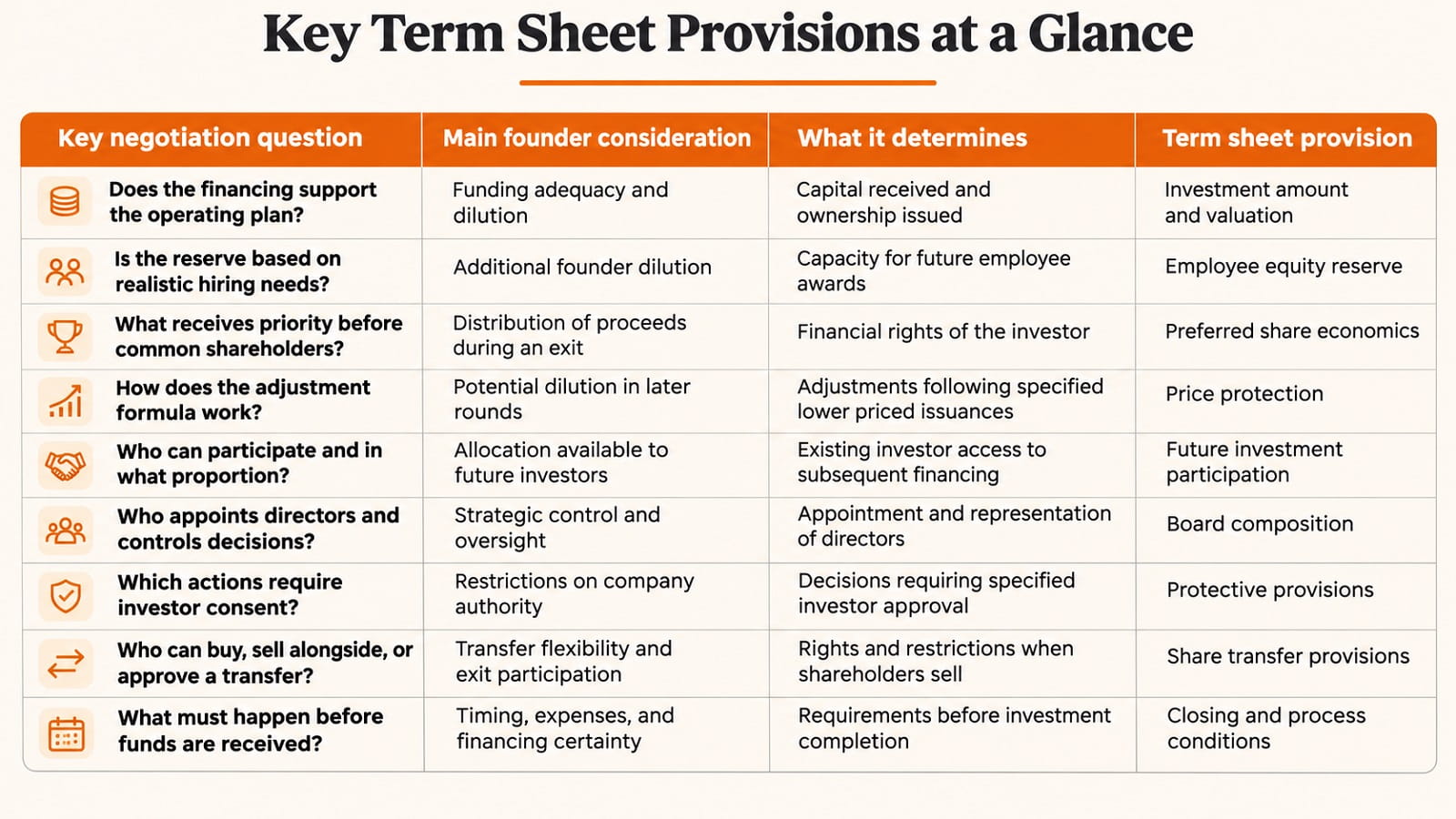
These provisions should not be reviewed independently. An investment may provide an attractive valuation while simultaneously introducing investor rights that materially affect future decision making.
Founders should understand the combined economic and governance consequences of the deal. A comparison based only on the amount raised and the percentage sold can overlook important long term obligations.
How Liquidation Preferences Affect Exit Proceeds
A liquidation preference determines the priority given to specified shareholders when certain distribution events occur. In venture financing, the provision can affect how acquisition proceeds are distributed between preferred investors and holders of common shares.
A one times nonparticipating preference generally allows the investor to receive the specified preference amount or convert into common shares and receive the corresponding ownership percentage, whichever produces the more favorable contractual outcome.
A participating preference operates differently. The investor may receive the preference amount first and then participate in the remaining proceeds according to the applicable participation terms.
Some participating arrangements include a maximum total return, while others have no contractual participation cap. The difference can materially affect how much value remains for common shareholders.
Founders should examine the preference multiple, participation rights, seniority relative to other securities, and any contractual limits. The economic effect is especially important when an acquisition occurs at a value that is modest relative to the financing history.
A Practical Example of Investor Exit Preferences
Consider SummitBridge after completing its $2 million investment. The investor owns 20% on an as converted basis, while founders and other common shareholders collectively hold the remaining 80%.
For illustration, compare two alternative investment structures. The first provides a one times nonparticipating preference. The second provides a one times participating preference without a participation cap.
Assume the investor's preference amount is $2 million, all sale proceeds are available for distribution to shareholders, and no other preferred securities, debts, transaction expenses, or conversion adjustments affect the outcome.
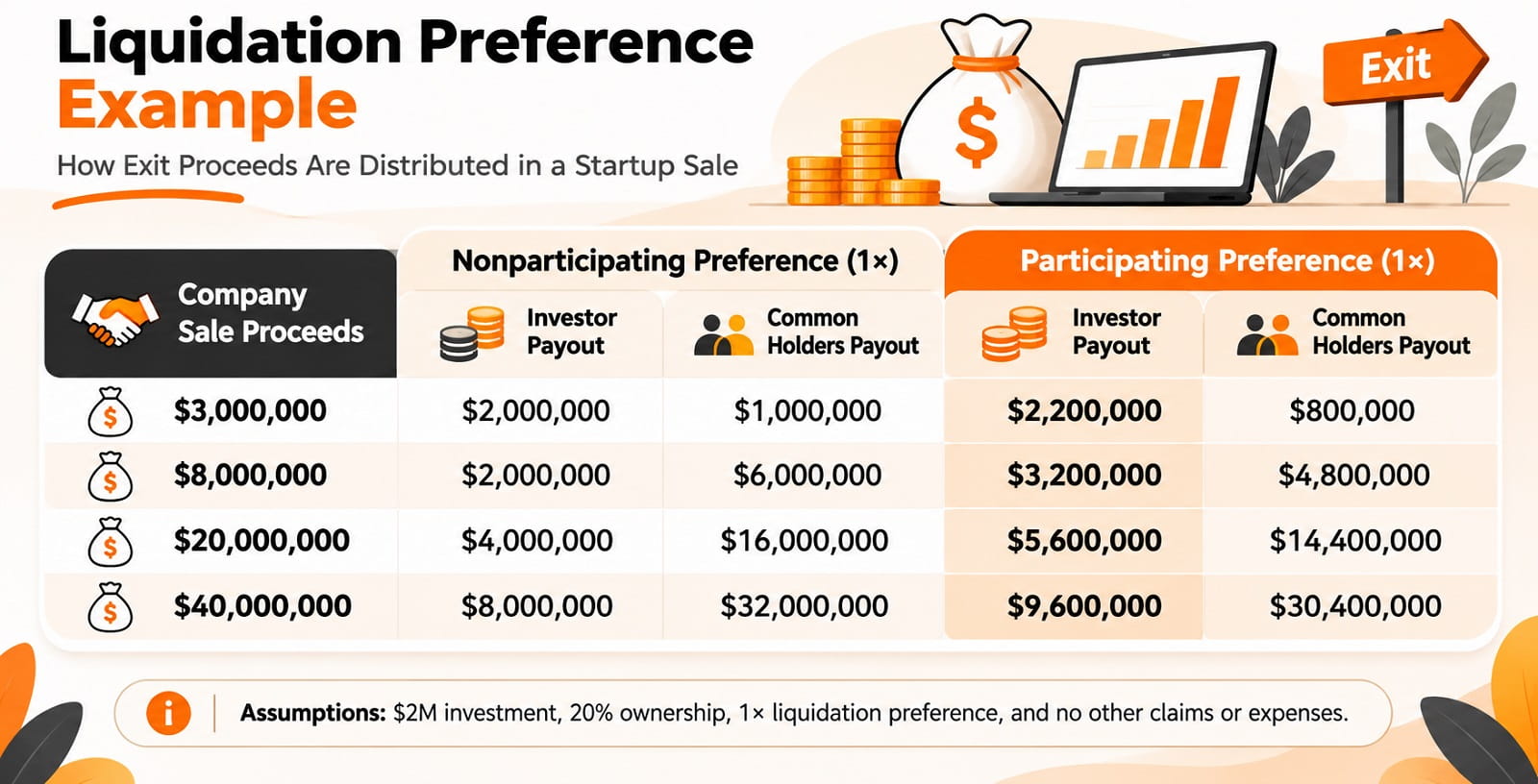
In the nonparticipating scenario, the investor compares the $2 million preference with the proceeds available from converting into a 20% common ownership position. At an $8 million sale value, 20% would equal $1.6 million, so the investor instead receives the $2 million preference.
At a $20 million sale value, conversion produces $4 million, which exceeds the preference amount. The investor therefore receives the larger amount under the assumed contractual terms.
The participating structure produces a different result. At an $8 million sale value, the investor receives the $2 million preference and 20% of the remaining $6 million. The total investor distribution is therefore $3.2 million, leaving $4.8 million for common shareholders.
At a $20 million sale value, the participating investor receives $2 million plus 20% of the remaining $18 million, resulting in $5.6 million.
These calculations demonstrate why an investment agreement should not be evaluated using ownership percentages alone. The rights attached to the investment can change the distribution of proceeds even when the financing amount and initial ownership percentages are identical.
The figures are illustrative and do not describe every possible structure. Actual distributions depend on the financing documents, outstanding obligations, other securities, transaction terms, and applicable law.
Down Round Protection and Conversion Adjustments
The term anti dilution refers to contractual mechanisms that may protect preferred investors when a company later issues shares at a price below an earlier financing price.
Such protections generally operate through adjustments to the preferred share conversion price or conversion ratio. They do not necessarily prevent the investor's percentage ownership from changing in every financing round.
A broad based weighted average adjustment typically considers the size and price of a subsequent issuance using a defined capitalization formula. A full ratchet adjustment may provide more substantial protection by adjusting the applicable conversion price to reflect the lower issuance price.
The effect depends on the precise contractual definition and any excluded issuances. Ordinary employee awards or other specified transactions may receive different treatment under the documents.
These rights can influence the economics of future financing, particularly when the company experiences a down round. Founders should understand which shareholders benefit from the adjustment and how it affects the ownership of common shareholders.
Maintaining Ownership Through Future Investment Rights
Contractual pro rata rights may allow qualifying existing investors to purchase additional securities in future financing rounds to maintain a specified level of ownership.
For example, suppose an investor holds 20% of a startup and the company later raises another $5 million. If the investor has the applicable participation right and the financing terms permit maintaining that position, it may be entitled to subscribe for approximately $1 million of the new round.
The investor must generally provide the additional capital to exercise the participation right. Merely holding the right does not automatically preserve the original ownership percentage without further investment.
These provisions can be valuable to investors who want to maintain exposure to successful portfolio companies. For founders, they can affect how much of a future financing remains available to new investors.
The agreement should specify eligible holders, participation calculations, notice requirements, exclusions, and any circumstances under which rights terminate or are waived.
Board Representation and Investor Control
Investment agreements frequently address who may appoint directors and how the company's board will be structured after financing.
The topic sometimes described as board rights investors involves three distinct questions: whether investors can appoint directors, whether they can observe meetings without voting, and whether particular decisions require separate approval.
A board seat gives an appointed director participation in board decisions, subject to the director's legal duties. An observer arrangement can provide access to certain meetings and information without automatically granting a vote.
Protective provisions are different because they may require approval from a specified shareholder class or group before certain corporate actions can proceed. These approvals can apply even when the investor does not control the board.
For example, an investor may negotiate consent rights over creating senior securities, amending specified provisions of the company's governing documents, or completing certain extraordinary transactions.
Founders should distinguish ordinary operational management from decisions requiring formal board or investor approval. An agreement that gives an investor broad control over routine business activities can create operational difficulties.
Shareholder Voting and Company Sale Decisions
As a startup grows, shareholders may disagree about whether the company should accept an acquisition offer. A majority may support a transaction while a minority believes the business should remain independent.
Contractual drag along rights can require specified shareholders to support or participate in an approved sale when the conditions set out in the governing agreement are satisfied.
The required approvals may involve the board, designated investor groups, and particular shareholder majorities. The documents should also define the types of transactions covered and any protections for shareholders who are required to participate.
These provisions can reduce the possibility that a minority shareholder prevents a transaction supported by the relevant approving parties. However, their effectiveness and fairness depend on the approval thresholds and the obligations imposed on participating shareholders.
Founders should pay attention to whether the agreement provides appropriate treatment of consideration, representations, indemnification obligations, and other terms imposed on shareholders during a sale.
Minority Shareholders and Participation in Share Sales
Contractual tag along rights generally allow specified minority shareholders to participate when another shareholder proposes to sell shares to a third party.
These provisions can help eligible shareholders avoid being excluded from a sale in which another holder receives an opportunity to realize value.
In US venture financing documents, a related mechanism is frequently described as a co sale right. Such rights may be combined with a right of first refusal governing transfers by founders or other specified shareholders.
A right of first refusal can give the company or designated investors an opportunity to purchase shares before a proposed transfer to a third party proceeds. A co sale right may instead allow eligible holders to include a specified proportion of their own shares in the proposed transaction.
The scope of these protections differs across transactions. Founders should examine the covered shareholders, sale thresholds, transfer exclusions, and the sequence in which the various rights apply.
Investor Agreements and Information Rights
A typical priced venture financing is documented through several agreements rather than a single contract.
An investor rights agreement commonly addresses contractual rights granted to qualifying investors, including access to financial information, certain registration rights, and opportunities to participate in future securities issuances.
Information rights may require the company to provide periodic financial statements, operating information, or other agreed reporting. The documents may limit these rights to investors meeting specified ownership thresholds.
Registration rights can become relevant if shareholders later seek to sell securities through transactions subject to applicable securities registration requirements.
Other rights can be documented in voting agreements, corporate governing documents, separate transfer agreements, or side letters. The location of a provision matters because different amendments, consents, and enforcement rules may apply.
Founders should review how the documents operate together. A restriction that appears reasonable in one agreement may have broader consequences when combined with approval rights contained elsewhere.
The Main Documents Used to Close a Venture Financing
A signed term sheet normally leads to several definitive agreements that establish the financing and its ongoing obligations.
The following table summarizes the functions of documents commonly used in US venture capital transactions. The actual set depends on the company's legal structure and the terms negotiated.
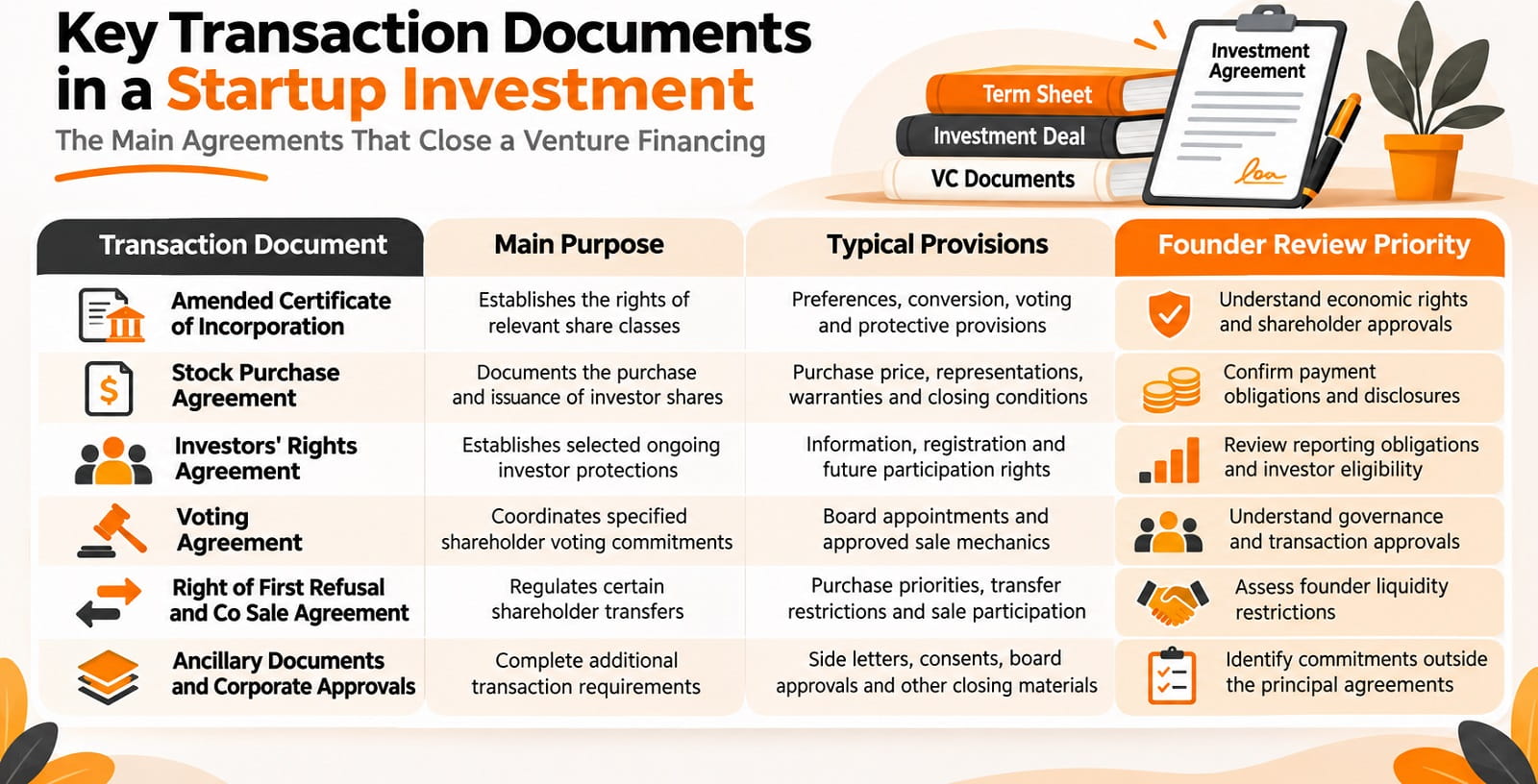
These documents generally become operative through the relevant execution and closing requirements. They should reflect the commercial agreement reached during negotiations, but they may introduce technical details that were not fully addressed in the original term sheet.
The company should verify that the capitalization model, authorized securities, investor rights, and closing obligations are consistent across the documents.
Legal counsel plays an important role in identifying conflicts and confirming that the agreements comply with applicable law. Model agreements provide useful reference points, but they are not substitutes for transaction specific review.
Confidentiality, Exclusivity and Binding Obligations
The fact that most proposed investment terms are nonbinding does not mean every provision in the term sheet lacks legal effect.
Confidentiality provisions can restrict the use or disclosure of information exchanged during negotiations. Exclusivity provisions may temporarily prevent the company from soliciting or negotiating competing financing proposals.
Expense provisions may determine who pays legal, accounting, and other transaction costs if negotiations continue or the proposed financing does not close.
Founders should pay particular attention to the duration and scope of any exclusivity period. An excessively broad restriction can interfere with alternative financing opportunities while providing no guarantee that the proposed investor will complete the transaction.
The language should distinguish obligations that take effect immediately from proposed terms that remain subject to definitive agreements. The legal consequences depend on the wording and governing jurisdiction.
Due Diligence and Closing Conditions
After preliminary terms are agreed, investors generally perform due diligence to evaluate the company's legal, financial, and operational position.
This may involve reviewing corporate records, ownership information, intellectual property assignments, employee agreements, material customer contracts, and outstanding liabilities.
The investor may also examine whether the company has issued shares properly and whether earlier financing agreements create rights that affect the new round.
Closing conditions identify requirements that must be satisfied before the transaction is completed. These may include corporate approvals, execution of necessary documents, completion of agreed compliance steps, and delivery of specified information.
Some financings are also structured with staged funding tied to time or milestones. These arrangements require clear definitions of when each installment becomes payable and which conditions must be met.
Founders should distinguish committed financing that is available at closing from capital dependent on future conditions. Financial planning based on uncertain installments can create unnecessary operating risk.
Negotiating a Balanced Investment Deal
Negotiating an investment deal requires a broader perspective than maximizing the headline valuation.
A higher valuation may reduce immediate ownership dilution, but additional rights can affect future financing, sale proceeds, and corporate governance. Founders should compare the economic value of the capital received with the obligations being accepted.
One useful approach is to evaluate the proposed transaction under several realistic scenarios. These can include a modest acquisition, a larger exit, a future down round, and a financing in which existing investors exercise participation rights.
The company should also model the expected ownership structure after closing. Employee equity reserves and convertible instruments can change the effective amount of ownership retained by the original shareholders.
Governance provisions deserve a separate review. Founders should understand who can appoint directors, which decisions require investor consent, and how disagreements may be resolved.
A balanced agreement provides investors with appropriate protections without unnecessarily restricting the company's ability to operate, raise additional capital, or pursue a commercially reasonable exit.
Common Mistakes Founders Make During Investment Negotiations
A common mistake is comparing offers based only on pre investment valuation. The calculation can overlook differences in preferred shareholder economics, employee reserves, and governance arrangements.
Another mistake is assuming that all investors receive identical rights. Different financing rounds or side letters may create different economic protections, reporting requirements, or participation privileges.
Founders may also underestimate the significance of restrictions on share transfers. These provisions can affect their ability to sell shares even when a willing purchaser exists.
A further risk is accepting broad veto rights without understanding how they interact with board authority and ordinary company operations.
Finally, signing a term sheet before reviewing its potentially binding provisions can create obligations even if the investment never closes. Confidentiality, exclusivity, and expenses should be understood before negotiations move into the more costly documentation stage.
Avoiding these problems requires careful scenario analysis, a reliable capitalization model, and appropriate legal review.
How to Review an Investment Offer Before Signing
The first step is to confirm the financing amount, valuation, security type, and expected ownership percentage using an updated capitalization model.
Next, founders should examine the investor's economic rights, particularly the preference structure, conversion terms, and protections that may become relevant in later financing rounds.
The governance review should address director appointments, voting commitments, protective provisions, and any additional contractual influence granted to the investor.
The company should then consider how the financing affects future transactions. Participation rights, transfer restrictions, and acquisition approval provisions can become important years after the original round closes.
Finally, founders should identify which parts of the proposed term sheet are binding, what due diligence remains, and what requirements must be satisfied before funds are received.
This sequence helps distinguish the immediate value of the investment from the obligations that may continue throughout the company's development.
Final Thoughts
Term sheets and investment deals define more than the price at which a startup raises capital. They determine how investors and founders share financial outcomes, what rights apply to future transactions, and who participates in important company decisions.
The SummitBridge example demonstrates how two investments with identical ownership percentages can produce different distributions when the business is sold. The comparison also illustrates why founders need to understand the rights attached to preferred securities rather than relying exclusively on the headline valuation.
A well negotiated investment agreement should support the company's financing needs while maintaining a workable relationship between founders and investors. Clear economic terms, proportionate governance protections, accurate ownership calculations, and appropriate legal documentation are central to achieving that outcome.
FAQ
What Is a Term Sheet in Startup Funding?
A term sheet outlines the principal terms of a proposed investment, including valuation, financing amount, investor ownership, economic rights, and governance arrangements. It normally provides the basis for negotiating definitive financing documents.
Is a Term Sheet Legally Binding?
Many venture financing term sheets are largely nonbinding regarding the proposed investment. However, confidentiality, exclusivity, expenses, and other specified provisions may create enforceable obligations depending on the agreement and governing law.
Does Signing a Term Sheet Guarantee Funding?
No. The investment may remain subject to due diligence, final legal documentation, required approvals, and other closing conditions. Signing the document does not necessarily require the investor to complete the transaction.
What Is the Difference Between Pre Investment and Post Investment Valuation?
The pre investment valuation represents the agreed company value before new primary financing. The post investment valuation generally includes the additional capital raised, subject to the assumptions and adjustments specified in the transaction.
Why Do Investors Receive Preferred Shares?
Preferred securities can provide negotiated economic and governance protections that differ from ordinary common shares. The specific rights depend on the company's governing documents and investment agreements.
How Do Investor Preferences Affect an Acquisition?
Preferences can determine how sale proceeds are distributed before or alongside common shareholders. The amount received depends on the preference multiple, participation structure, conversion rights, and other relevant claims.
Can Investors Prevent a Company From Making Certain Decisions?
They may have contractual consent rights concerning specified corporate actions. The scope depends on the applicable governing documents, share classes, and negotiated protections.
Can Existing Investors Participate in Later Funding Rounds?
Certain investors may hold contractual rights allowing them to purchase additional securities in subsequent financing rounds. The extent of participation and applicable conditions depend on the agreements.
What Happens After a Term Sheet Is Signed?
The parties generally continue due diligence, negotiate definitive agreements, obtain necessary approvals, and work toward closing. The investment is completed only when the relevant transaction requirements have been satisfied.
Should Founders Negotiate More Than Valuation?
Yes. Ownership dilution, economic preferences, governance provisions, future investment participation, transfer restrictions, and binding procedural obligations can all materially affect the company's future.

Mobina Khanki
Venture & Funding Writer at PinerookMobina Khanki covers venture capital, startup funding, fundraising, and startup finance for Pinerook, focusing on founders and investors.
 Seen first.


