A startup tech stack is the set of technologies used to build, run, and improve a product. It usually includes the interface, application logic, database, hosting, and services for essential functions such as authentication and payments. The right stack is not the newest collection of tools. It is the smallest dependable combination your team can ship, maintain, and adapt as customers reveal what they need.
For founders, this choice is one practical part of technology strategy for startups. A marketplace that moves money has different requirements from a content platform or an AI research product. Start with the product and the people building it, not with a list of fashionable frameworks.
Start With the Product, Not the Programming Language
Before comparing tools, describe the first customer experience you need to deliver. Is the product primarily a web application, a mobile app, or a service accessed through an API? Does it process payments, store sensitive information, support real time collaboration, or depend on machine learning? These requirements eliminate more options than a framework comparison does.
Then identify the constraints that are real today: who will maintain the code, how quickly the team must launch, what failure would cost customers, and which capabilities are genuinely essential. A familiar, well supported stack often beats a theoretically superior option that requires months of retraining.
The Core Layers of a Startup Tech Stack
Most software startups need the same basic layers, even when their products look very different. The table below shows what each layer is responsible for and a reasonable way to approach the initial choice.
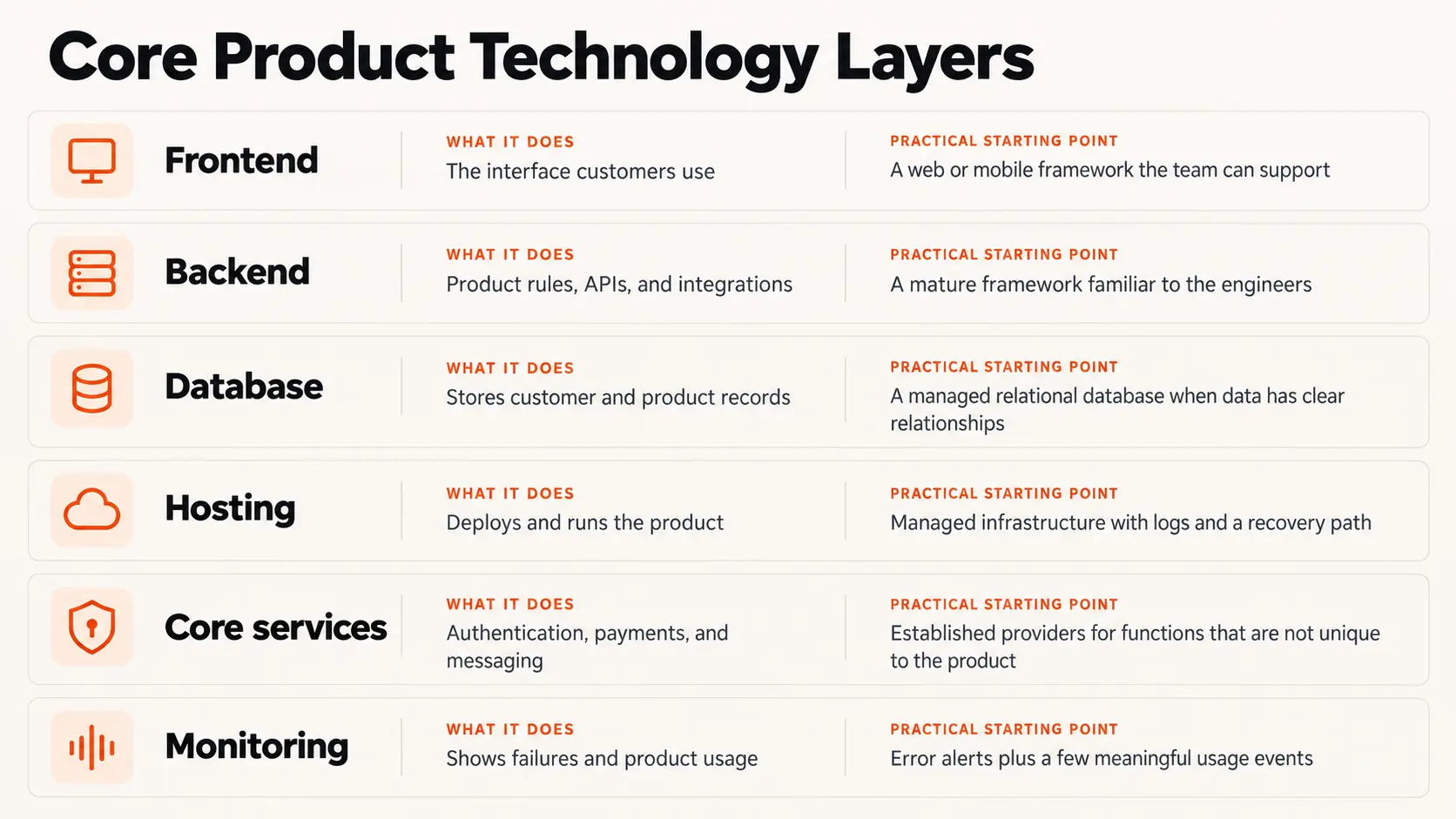
For example, a small web SaaS team might use React or Next.js, a Node.js or Python backend, PostgreSQL, and managed hosting. That is an example, not a universal prescription. A mobile first product may prioritize native or cross platform development, while an AI product may need a model API, evaluation checks, and usage controls on top of the same fundamentals.
How to Choose a Stack Your Team Can Operate
Prioritize Team Fluency and Hiring
The fastest stack is often the one your engineers already know well. Familiar tools reduce debugging time and make delivery more predictable. Before adopting a niche technology, ask whether a new hire could understand the system, whether documentation is strong, and whether the company could replace a departing developer without rebuilding the product.
Calculate the Cost Beyond Hosting
A low monthly hosting bill does not make a stack inexpensive. Consider engineering hours, maintenance, support, paid services, and the cost of changing direction. A managed service can be worth its subscription when it saves a small team from running infrastructure. A free tool can become expensive if it requires constant specialist attention.
Keep Important Choices Reversible
Some decisions are easy to change, such as an analytics dashboard. Others become deeply embedded, especially data storage, identity, and core application logic. Prefer clear interfaces, documented data models, export options, and a deployment process another engineer can reproduce. You do not need to avoid every dependency, but you should understand the cost of leaving it.
Make Reliability a Starting Requirement
Basic safeguards should not wait for a larger team. Protect production accounts with multifactor authentication, limit access, keep backups, and know how to restore service after a failed deployment. These are operating requirements, not reasons to build an elaborate infrastructure team before the first customer arrives.
Three Startup Scenarios, Three Different Choices
A B2B SaaS MVP
A team validating a subscription dashboard usually benefits from one coherent web application, a conventional database, managed deployment, and a payment provider. The goal is to test onboarding and customer value quickly. Building a distributed architecture before there is meaningful traffic would add work without answering the central product question.
A Consumer Mobile Product
If the main experience depends on camera access, notifications, offline behavior, or smooth device interactions, mobile requirements should lead the decision. A responsive website may be enough to test demand, but it should not automatically be treated as a substitute for a native mobile experience when device capabilities are essential.
An AI Product or AI Feature
An AI driven workflow still needs dependable user accounts, data handling, monitoring, and cost controls. A hosted model API may speed up initial testing, but the team must measure output quality, latency, and cost per useful task. Choose the model and surrounding tools based on the job customers need completed, not on a benchmark headline.
Use a Simple Decision Brief Before Committing
Ask the technical lead to document five things for each serious option: how it fits the product, how well the team knows it, how fast it can reach customers, what it costs to operate, and how difficult it would be to replace. Record the tradeoff in plain language. If an unfamiliar framework offers only a small performance advantage but adds hiring and maintenance risk, the decision should reflect that imbalance.
Make one person responsible for the final choice and revisit the assumptions after actual usage appears. A short written decision is more useful than an extensive architecture diagram that nobody updates.
When a Startup Should Revisit Its Tech Stack
Reconsider a technology choice when evidence changes, not when a new tool becomes popular. Warning signs include repeated outages, a deployment process that blocks releases, rising infrastructure costs per active customer, persistent hiring difficulties, or a feature the existing system cannot support safely. First identify the bottleneck. Improving one layer is often less risky than replacing the entire stack.
Build for the Next Real Requirement
A strong startup tech stack helps a small team learn from customers without creating unnecessary operating work. Choose tools your team can run confidently, keep the critical decisions understandable, and add complexity only when a real product requirement earns its place. The stack should make progress easier, not become the project itself.
FAQ
What is the best tech stack for a startup?
There is no single best stack. For many web products, a familiar web framework, managed database, reliable hosting, and established identity and payment services are a sensible starting point. The right combination depends on the product and the team.
Should a startup use no code tools or custom development?
No code tools can validate simple workflows quickly. Custom development becomes more attractive when the product depends on unique behavior, complex integrations, or control the platform cannot provide. Choose based on the next experiment, not a permanent ideology.
Does a startup need microservices from day one?
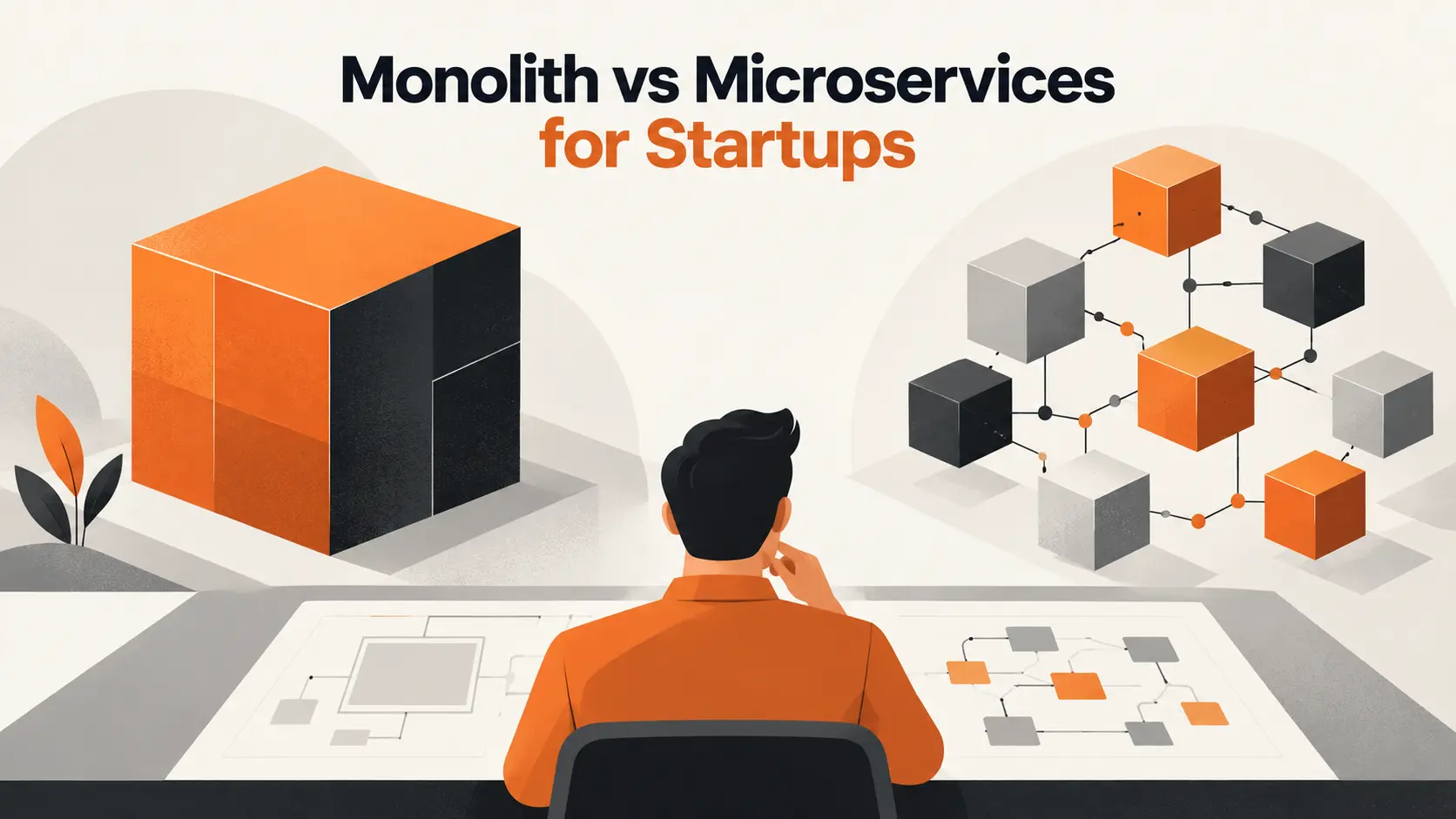
Usually not. A well organized application is often easier for a small team to ship and maintain. Separate services become useful when specific scaling, deployment, or team boundaries justify the added operational work.
How often should founders review their tech stack?
Review it when customer requirements, team capabilities, costs, or reliability needs change materially. A brief review during major product planning cycles is usually more useful than switching tools on a fixed schedule.

Mohsen Avid
Founder & Editor, PinerookMohsen Avid is the founder of Pinerook, covering entrepreneurship, startup strategy, digital business, and the decisions behind building new ventures.
 Seen first.