Startup loans provide financing to entrepreneurs who need capital to launch a business, purchase equipment, cover operating expenses, or support early growth. Unlike equity investment, a conventional startup loan allows founders to obtain funding without immediately selling ownership in the company. However, borrowing creates repayment obligations that can become difficult to manage when revenue is uncertain or the business takes longer than expected to reach profitability.
Within Startup Debt and Alternative Funding, startup loans are particularly relevant to founders who have a defined use for capital and a realistic way to repay it. Some lenders consider early stage businesses with limited operating histories, while others require established revenue, suitable collateral, or personal guarantees. Understanding these requirements helps founders distinguish between a loan that is technically available and financing that is financially appropriate.
This guide explains the main types of startup loans, common eligibility requirements, application documents, borrowing costs, and repayment risks. It also provides a practical financial example and a structured process for choosing financing that supports business development without creating excessive pressure on cash flow.
What Are Startup Loans?
Startup loans are financing arrangements that allow entrepreneurs or newly established businesses to borrow money under agreed repayment terms. The funds may support business formation, initial purchases, equipment, inventory, working capital, or other permitted expenditures.
The borrower generally repays the principal together with interest and applicable charges. The repayment period, interest structure, security requirements, and legal responsibility for the debt depend on the lender and the agreement.
Some loans are issued directly to a registered business. Others are personal loans intended for business purposes, meaning the founder remains personally responsible for repayment. This distinction is important because the legal borrower determines whose assets and credit may be exposed if payments are missed.
Loan availability also differs significantly by jurisdiction. Government supported financing programs may help qualifying businesses access funding, but approval is not automatic. Lenders still evaluate creditworthiness, affordability, and the intended use of funds.
How Startup Loans Work
A startup loan begins with an application describing the business, the amount requested, and how the money will be used. The lender reviews financial information and assesses whether the applicant can reasonably meet the proposed repayment schedule.
If the application is approved, the borrower receives an offer specifying the interest rate, repayment period, fees, and other conditions. The loan may be disbursed in one payment or made available through a credit facility, depending on the arrangement.
Loan Amount and Repayment Period
The amount available depends on the financing program, the applicant's circumstances, and the lender's assessment. Some programs provide relatively small loans for initial business expenses, while commercial facilities can support larger investments.
Repayment periods also vary. A short term can increase monthly payments but reduce the total interest paid. A longer term may lower monthly installments while increasing borrowing costs over time.
Founders should select a repayment schedule that reflects realistic cash generation rather than assuming revenue will grow fast enough to cover any installment.
Interest Rates and Additional Charges
Startup loans may carry fixed or variable interest rates. A fixed rate provides greater payment predictability, while a variable rate can change according to the contractual benchmark.
Origination fees, arrangement charges, guarantee fees, and early repayment provisions can also affect the total cost. Founders should distinguish the stated interest rate from the annual percentage rate or other applicable total cost measures.
Comparing loans solely by their advertised interest rates can therefore produce misleading conclusions.
Security and Personal Guarantees
Some lenders require collateral, such as business equipment or other eligible assets. Others may provide unsecured financing but request a personal guarantee from the founder.
A personal guarantee can make an individual responsible for specified business debts if the company fails to repay them. Founders should understand the scope of that liability before accepting an offer.
Not all startup loans require collateral or guarantees. The requirements depend on the provider, program, and applicant's financial circumstances.
Types of Startup Loans Available to Founders
Startup financing can take several forms. Each structure serves different business needs and may involve distinct eligibility requirements.
Traditional Business Term Loans
A business term loan provides a defined amount of capital that is repaid over an agreed period. Payments commonly include principal and interest, although the repayment structure depends on the contract.
Term loans may be suitable for equipment purchases, business expansion, or other expenditures with identifiable financial benefits. Established revenue and reliable financial records can strengthen an application.
However, newly created companies may struggle to qualify because they lack historical earnings or assets that demonstrate repayment capacity.
Government Supported Startup Loans
Government supported programs can improve access to financing for eligible entrepreneurs. Their structures differ across countries and should be evaluated individually.
In the United States, the Small Business Administration supports lending through participating institutions. Its 7(a) program can finance qualifying business needs, while its Microloan program provides smaller loans through approved intermediary lenders.
In the United Kingdom, the government backed Start Up Loans program offers eligible individuals personal loans for business purposes. These loans are legally distinct from conventional loans issued directly to a company.
Founders should verify current eligibility, geographic restrictions, repayment terms, and application conditions through the relevant official program.
Microloans and Community Lending
Microloans provide smaller financing amounts that may be useful for businesses with limited initial capital requirements.
Community lenders and nonprofit intermediaries sometimes combine financing with business support, training, or technical assistance. This can be valuable for entrepreneurs who need help preparing financial forecasts and business plans.
However, smaller loans are not necessarily easier to repay. Their affordability depends on the payment schedule, interest charges, and the company's available cash.
Equipment Financing
Equipment financing helps businesses acquire machinery, technology, vehicles, or other qualifying assets. Depending on the arrangement, the financed asset may serve as collateral.
This structure can be useful when the equipment directly supports revenue generation or essential business operations.
Founders should compare the financing term with the asset's expected useful life. Repaying equipment debt long after the asset becomes obsolete can create unnecessary financial pressure.
Business Lines of Credit
A business line of credit allows an eligible company to access funds within an approved limit, subject to the facility's terms.
Unlike a conventional term loan, the company may borrow only what it needs, with interest commonly calculated on outstanding balances. This can support short term changes in inventory, customer payments, or operating requirements.
However, credit lines may be subject to renewal conditions, borrowing limits, fees, or lender restrictions. They should not be treated as guaranteed permanent funding.
Comparing Startup Loan Options
Different loan structures vary in how capital becomes available, what the borrower must demonstrate, and which business needs they can support.
The following table compares common financing arrangements and highlights the details founders should examine before choosing a lender.
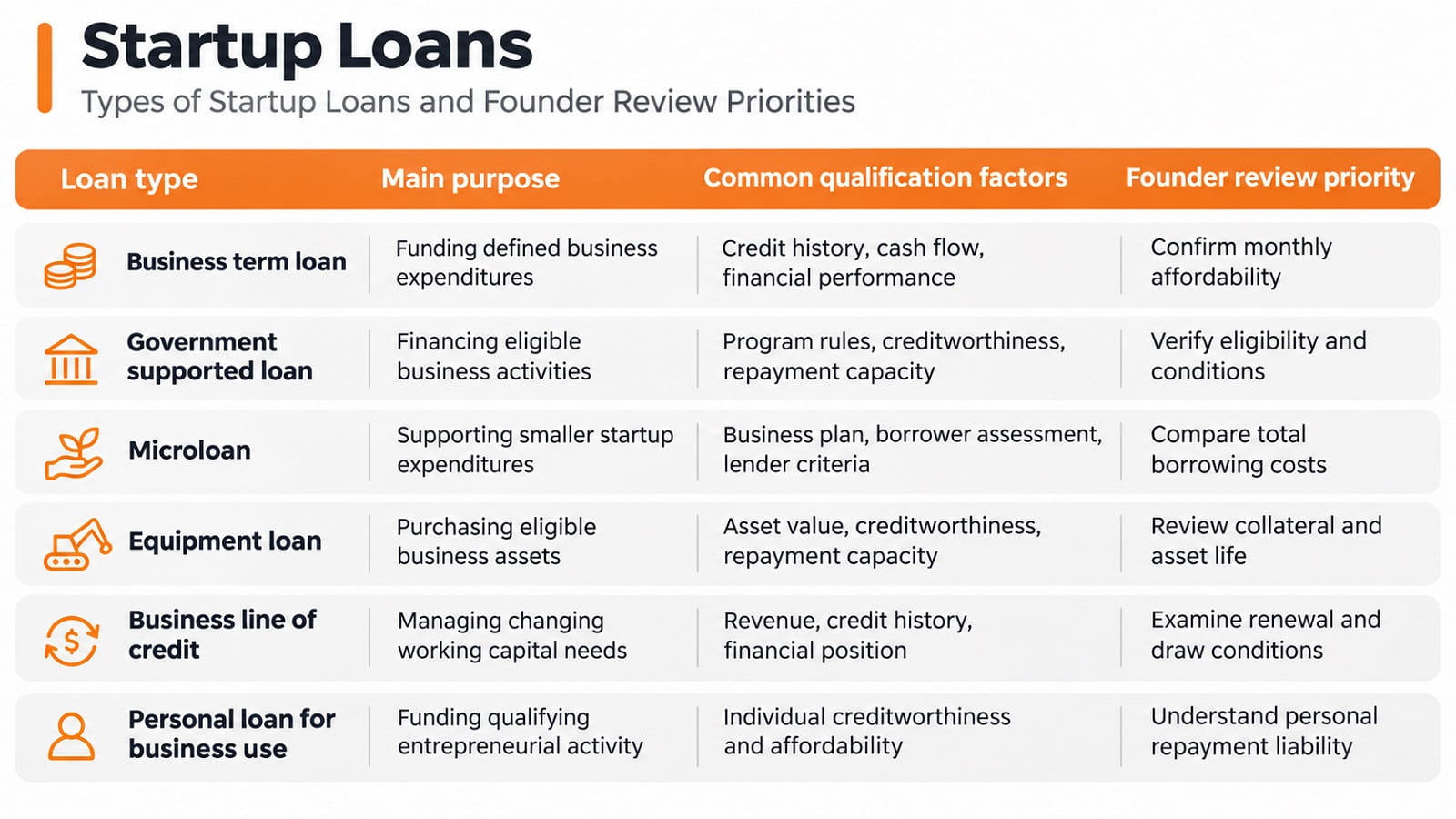
These arrangements should be evaluated according to their actual contractual terms rather than their names alone. A business term loan may provide predictable installments, while a credit line offers more flexible access to capital but can introduce renewal uncertainty. Government supported lending may improve accessibility, although it does not eliminate borrower obligations. The most suitable structure is one that matches the intended expenditure and the company's realistic repayment capacity.
Startup Loan Eligibility Requirements
Startup loan eligibility depends on the provider, country, business structure, and financing product. Although requirements vary, lenders generally want evidence that the borrower is legally eligible, understands the intended use of capital, and has a credible repayment strategy.
Creditworthiness and Financial History
Lenders may evaluate personal credit history, business credit records, existing debt, and previous repayment behavior.
For newly established businesses, the founder's personal financial position may receive greater attention because the company has limited operating history.
A strong credit profile can improve an applicant's prospects, but it does not guarantee approval. Lenders must also consider affordability and other underwriting requirements.
Business Plan and Use of Funds
A business plan should explain what the company sells, who its customers are, how it generates revenue, and why the requested capital is necessary.
The intended use of funds should be specific. Rather than requesting money for general growth, a founder might identify equipment costs, initial inventory, or a defined commercial launch.
This allows the lender to assess how the expenditure contributes to the company's expected financial performance.
Revenue and Cash Flow Forecasts
Existing revenue can support an application, but a newly established startup may need to rely on reasonable forecasts and other financial evidence.
A useful cash flow forecast should identify expected customer collections, operating expenses, tax obligations, and existing debt payments.
Lenders may examine whether the business can meet its obligations under less favorable conditions. Founders should therefore avoid relying entirely on optimistic growth projections.
Business and Personal Documentation
Applications may require company registration information, bank statements, tax records, financial statements, identification documents, and details of existing liabilities.
The requirements depend on the lender and financing program. A personal startup loan may also require a household affordability assessment, while a commercial facility can place greater emphasis on business financial records.
Accurate documents reduce the risk of avoidable delays and help the lender evaluate the application consistently.
How to Apply for a Startup Loan
A structured application begins before contacting a lender. Founders should first determine how much capital they require and whether the business can support repayment.
Calculate the Required Funding
Identify the expenditures the loan will cover, their expected timing, and the amount the company can contribute from its own resources.
The requested loan should reflect the financing gap rather than the maximum amount a lender might approve.
Borrowing more than necessary can increase interest expenses and reduce financial flexibility.
Identify Suitable Lending Programs
Compare lenders based on eligibility, loan purpose, repayment structure, and available financing amounts.
A newly established company seeking a modest initial investment may need a different program from a revenue generating business purchasing equipment.
Founders should prioritize lenders whose products match their actual circumstances rather than applying broadly without reviewing basic requirements.
Prepare Financial Evidence
Before submitting an application, assemble the business plan, cash forecast, and documents requested by the lender.
The financial projections should explain how the business expects to generate enough cash to cover operating costs and debt payments.
Where personal guarantees or individual affordability checks apply, founders should evaluate those obligations separately from business performance.
Review the Offer Before Accepting
Approval is not the final decision. The borrower should examine the repayment schedule, interest rate, fees, collateral requirements, guarantees, and default provisions.
If the offer depends on assumptions that the business cannot reliably meet, the founder may need a smaller loan, a different term, or another financing method.
A Practical Startup Loan Repayment Example
Consider CedarWorks, a fictional technology services startup that needs $60,000 to purchase equipment, establish its operating infrastructure, and support initial business development.
The company is considering a conventional installment loan with an illustrative fixed annual interest rate of 12% and a 36 month repayment period. Assume interest is calculated monthly, payments are equal, and there are no additional fees.
CedarWorks expects monthly customer collections of $8,500 and operating cash expenses of $6,500 before financing payments. This leaves $2,000 in monthly cash available before debt service.
The following calculation demonstrates the relationship between borrowing costs and the company's ability to repay.
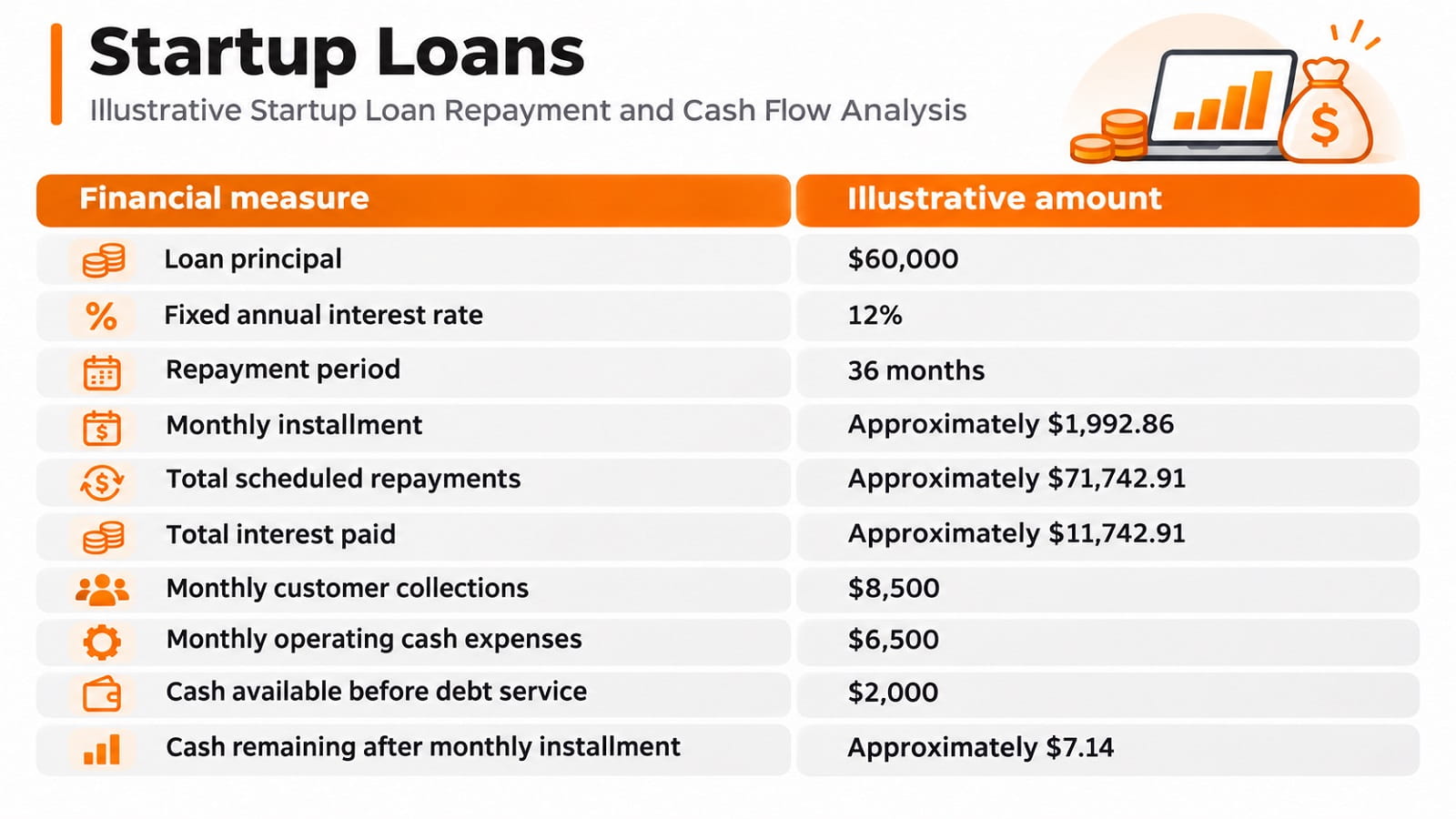
The example shows that CedarWorks can technically cover the scheduled installment under its initial assumptions, but it would retain only about $7 each month after operating expenses and debt service. This leaves almost no financial margin for unexpected expenses, delayed customer payments, or weaker sales. The calculation excludes taxes, additional investment requirements, and financing fees, so the company's actual position could be less favorable. A lender might also conclude that such limited repayment coverage is insufficient for approval.
Testing the Downside Scenario
Suppose CedarWorks experiences a 10% decline in monthly customer collections while operating cash expenses remain unchanged.
Monthly receipts would fall to $7,650, leaving only $1,150 available before loan payments. After the installment, the company would face a monthly cash shortfall of approximately $842.86.
This demonstrates why a startup should not evaluate loan affordability solely using its expected revenue forecast.
A financing arrangement that appears affordable under normal conditions may become difficult to sustain after a relatively small deterioration in business performance.
What the Example Means for Founders
The central lesson is that loan approval and loan affordability are different questions.
Even when a lender is willing to provide financing, the business should maintain enough financial flexibility to absorb fluctuations in revenue and expenses.
CedarWorks might reconsider the amount borrowed, adjust its investment schedule, improve operating margins, or explore a repayment structure better suited to its financial position.
The right decision should reflect the company's capacity to manage uncertainty rather than its ability to make only the first scheduled payment.
Understanding the Real Cost of Startup Loans
The total borrowing cost includes more than the principal and advertised interest rate.
Origination fees can reduce the net amount received while leaving the contractual principal unchanged. Variable interest rates can increase payments when benchmarks rise, and late payment charges may add costs if the borrower encounters financial difficulties.
Founders should also review collateral arrangements and personal guarantees. These provisions may create financial exposure that is not visible in a basic interest calculation.
A reliable loan comparison should consider net funds received, total scheduled payments, the timing of payments, applicable fees, and the consequences of missed obligations.
Risks of Taking a Startup Loan
Borrowing can provide useful capital, but it also introduces obligations that remain relevant when business performance weakens.
Repayment Pressure During Early Growth
Startups often face uneven customer demand and unexpected operating expenses. Fixed debt payments can become difficult when cash collections fall below expectations.
A loan should not depend entirely on achieving the most optimistic sales forecast.
Personal Financial Exposure
Some financing arrangements make founders personally responsible for repayment or require guarantees.
This may place personal assets or credit at risk if the business cannot meet its obligations. Founders should understand the legal borrower and the full scope of any guarantee.
Collateral and Default Consequences
Secured loans may give lenders rights over specified assets following a contractual default.
Agreements can also contain acceleration provisions, allowing the lender to demand repayment under defined circumstances.
These conditions should be reviewed before funds are accepted, not only when repayment difficulties arise.
Borrowing Before the Business Model Is Proven
Debt can be unsuitable when the startup has no credible repayment source and requires an extended period of uncertain development.
Borrowing to finance experimentation can create financial commitments before the business has evidence of sustainable demand.
Founders should evaluate whether the expenditure is likely to generate measurable commercial benefits within a suitable timeframe.
Startup Loans vs Equity Funding
Startup loans and equity investment address different financing needs.
Loans generally provide capital without directly issuing company ownership, but they require repayment. Equity investors receive ownership interests and typically accept uncertainty about when or whether they will earn a return.
A startup with predictable cash receipts may prefer borrowing to avoid dilution. A company developing an unproven technology may find equity more appropriate because its commercial results remain uncertain.
The choice also affects future flexibility. Existing loan obligations can influence future financing decisions, while equity investment changes the ownership structure and may introduce investor governance rights.
Founders should compare both methods based on business risk, cash flow, and long term objectives rather than assuming that avoiding dilution always produces the better outcome.
Common Startup Loan Application Mistakes
One common mistake is requesting more money than the business needs. A larger loan may increase financing expenses without improving the likelihood of reaching the intended milestone.
Another is preparing financial projections that do not reflect realistic customer demand or operating costs. Lenders may challenge unsupported assumptions, and founders risk accepting obligations that the business cannot afford.
Applying to unsuitable programs can also waste time. Eligibility requirements may exclude certain business types, locations, uses of funds, or applicants with insufficient creditworthiness.
Finally, founders sometimes accept the first available offer without comparing fees, payment structures, guarantees, and default provisions. The lowest advertised interest rate does not always produce the most suitable overall agreement.
Final Thoughts
Startup loans can help founders finance business formation, equipment purchases, working capital, and early growth without immediately selling equity. Their usefulness depends on whether the business can support repayment while maintaining enough cash to operate through uncertain periods.
Founders should assess eligibility, total borrowing costs, collateral, personal guarantees, and repayment schedules before accepting financing. A realistic cash forecast is particularly important because even a small reduction in customer collections can make an apparently affordable loan difficult to manage.
The strongest borrowing decision connects financing to a defined business need and preserves flexibility under less favorable conditions. Capital should help the startup reach its next milestone without introducing financial obligations that threaten its ability to continue operating.
FAQ
Can a New Startup Get a Loan Without Revenue?
Some lenders and financing programs consider businesses without established revenue. However, applicants may need suitable creditworthiness, a credible business plan, collateral, or other evidence supporting repayment.
Do Startup Loans Require Collateral?
Not always. Some loans are unsecured, while others require business assets or personal guarantees. Requirements depend on the lender, financing product, and applicant.
What Credit Score Is Needed for a Startup Loan?
There is no universal minimum credit score for every startup loan. Lenders and financing programs establish different criteria and may consider additional financial factors.
Are Government Supported Startup Loans Free?
No. Government support does not automatically make financing free. Programs may charge interest and require repayment, although their eligibility conditions and support arrangements vary.
Can Startup Loans Be Used for Working Capital?
Many financing products permit eligible working capital expenditure, but restrictions depend on the program and loan agreement. Founders should confirm permitted uses before accepting funds.
Do Startup Loans Affect Business Ownership?
Conventional loans generally do not require founders to issue equity. However, financing may involve guarantees, collateral, or other contractual obligations that affect financial flexibility.
What Happens if a Startup Cannot Repay Its Loan?
Consequences depend on the agreement and applicable law. They may include additional charges, default remedies, enforcement against collateral, or claims under personal guarantees.
Is a Startup Loan Better Than Investor Funding?
The appropriate choice depends on the company's ability to repay, growth stage, ownership objectives, and level of financial uncertainty. Borrowing is not necessarily preferable merely because it avoids immediate dilution.

Mobina Khanki
Venture & Funding Writer at PinerookMobina Khanki covers venture capital, startup funding, fundraising, and startup finance for Pinerook, focusing on founders and investors.
 Seen first.


