
A startup IPO allows a privately held company to offer shares to public investors for the first time. Going public can provide capital for expansion, establish a market for company shares, and increase visibility among customers and investors. However, the process requires extensive preparation. A startup must demonstrate that its financial reporting, corporate governance, operating performance, and public disclosures can meet the demands of a listed company.
Within Startup Exit and M&A, an initial public offering represents a different path from selling a business to an acquirer. The company generally continues operating independently while public investors become shareholders. Founders may retain significant ownership and management responsibilities, but they also face new disclosure requirements, market expectations, and restrictions on selling their existing shares.
A startup ipo involves preparing the business for public investors, selecting professional advisers, completing regulatory filings, and establishing an initial offering price. The process does not guarantee that founders will receive immediate liquidity or that the company's shares will maintain their offering value. This guide examines IPO readiness, listing requirements, the offering process, dilution, shareholder restrictions, and the responsibilities that follow a public listing.
What Is an IPO for a Startup?
An initial public offering is the first public sale of a company's shares through an applicable securities offering process. In the United States, a conventional registered IPO generally involves filing a registration statement with the Securities and Exchange Commission and meeting the requirements of the relevant stock exchange.
The offering may include newly issued shares, existing shares sold by eligible shareholders, or a combination of both. When the company issues new shares, the proceeds generally become available to the business after offering costs. When existing shareholders sell their shares, the proceeds generally belong to those shareholders instead.
This distinction is important for founders evaluating the purpose of going public. A company seeking capital for international expansion may structure its offering around new share issuance. A more established business might also seek opportunities for existing investors to sell part of their holdings, subject to the offering structure and applicable requirements.
An IPO also changes the environment in which the company operates. Financial information becomes available to public investors, share prices respond to market expectations, and management must communicate performance through a formal reporting framework.
Why Startups Decide to Go Public
Raising additional capital is one important motivation for an IPO. Public financing may allow a company to invest in product development, expand internationally, strengthen its balance sheet, or pursue acquisitions without relying entirely on private fundraising.
A public listing can also provide a potential path toward shareholder liquidity. However, the existence of a public market does not mean every shareholder can sell immediately. The timing and extent of permitted sales depend on the relevant securities, contractual restrictions, and applicable law.
Public status may offer other commercial benefits. A company can become more visible to institutional investors, potential employees, and business partners. Publicly traded shares may also be useful in certain acquisition or employee compensation arrangements.
These advantages come with costs. Public companies face recurring financial reporting, compliance expenses, investor scrutiny, and market pressure. Founders should evaluate whether access to public capital justifies the additional obligations and loss of privacy associated with listed company status.
When Is a Startup Ready for an IPO?
IPO readiness depends on whether a company can satisfy the relevant regulatory and exchange requirements while operating effectively as a public business. Revenue growth alone does not establish readiness, and profitability is not universally required under every listing pathway.
Investors generally expect reliable financial information, a credible business model, understandable growth assumptions, and management capable of communicating performance consistently. The company must also meet the quantitative and governance standards applicable to its intended exchange and listing category.
A startup should assess whether its internal financial processes can produce accurate reports within required deadlines. It should understand its customer concentration, operating cash requirements, material liabilities, and major commercial risks.
Management readiness matters as well. A company that depends on its founder for every important financial or operational decision may struggle with the responsibilities of public ownership. Strong finance, legal, compliance, and investor relations functions become increasingly important as an offering approaches.
IPO Readiness Requirements for Startups
Preparing for a public offering involves several connected workstreams. Finance teams must establish reliable reporting, legal advisers evaluate corporate and securities obligations, and management develops the company's public investment narrative.
The following table identifies principal readiness areas and the evidence a company should prepare before advancing toward a listing.
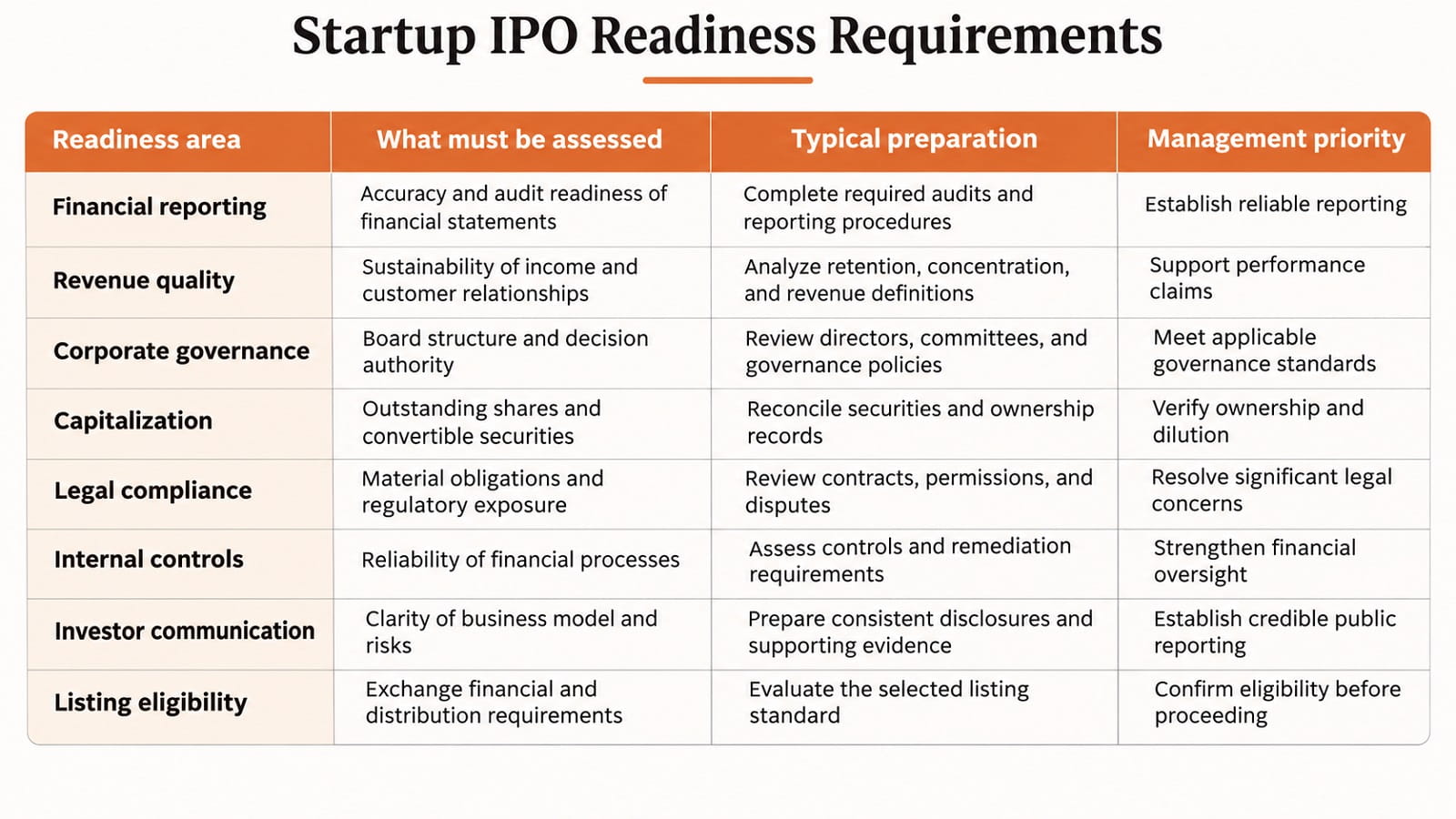
These requirements vary according to jurisdiction, issuer status, and exchange. Some companies may qualify for reporting accommodations or transitional governance arrangements, while others face more extensive obligations. Completing the readiness review does not guarantee an approved listing. It helps management identify weaknesses that could delay the offering or create problems after the company becomes public.
Financial Reporting and Corporate Governance
Public investors require information they can use to evaluate a company's performance and financial position. As a result, financial statements, accounting policies, risk disclosures, and management reporting receive greater scrutiny during IPO preparation.
For a conventional United States IPO, the registration statement generally includes audited financial statements and other required information. The applicable reporting periods and disclosure requirements depend on the issuer's status and circumstances.
Corporate governance is another important consideration. Exchanges establish requirements relating to board composition, independent directors, committees, and other governance arrangements. The exact standards depend on the selected market and any applicable exemptions or transition rules.
Founders should understand that reporting obligations continue after the IPO. Public ownership requires an ongoing ability to communicate material information accurately and comply with applicable securities rules, rather than treating regulatory preparation as a temporary task completed at listing.
How the Startup IPO Process Works
The IPO process typically begins with internal preparation and the selection of advisers. Companies may work with investment banks, securities lawyers, auditors, and other specialists to organize the offering and assess whether public market conditions are suitable.
The company then develops its registration materials and prepares for regulatory review. The offering process can include investor presentations, valuation discussions, marketing activities, and negotiations over the final offering price.
The sequence is subject to the rules of the relevant jurisdiction. For a conventional United States registered IPO, a company cannot complete the registered sale of securities before its registration statement becomes effective.
Preparing the Registration Statement
The registration statement provides investors with information about the issuer, its business, financial condition, risks, management, and proposed securities offering.
United States domestic issuers commonly use Form S 1, while certain foreign issuers may use Form F 1. Eligibility for particular forms or disclosure accommodations depends on the company and applicable rules.
Regulatory review may result in questions and amendments to the filing. This process helps address disclosure matters, but it should not be interpreted as an endorsement of the company's commercial prospects or the quality of the investment.
Underwriters and Investor Marketing
Investment banks acting as underwriters may assist with structuring the offering, assessing investor demand, marketing securities, and establishing the final price. Their precise responsibilities depend on the underwriting agreement.
Investor marketing commonly involves management presentations and discussions with prospective institutional investors. Demand gathered during the process can influence the number of shares offered and the final offering price.
A company should not assume that the valuation established during private financing will be accepted by public investors. Public market demand, comparable listed companies, growth expectations, and broader financial conditions may lead to a different valuation.
Pricing, Allocation, and Trading
Once the relevant registration requirements have been satisfied, the offering can be priced and shares allocated according to the applicable transaction process.
The company receives the proceeds attributable to its newly issued shares, less relevant offering expenses. Public trading subsequently begins under the arrangements established with the exchange.
The market price may differ from the IPO price as soon as trading starts. Strong initial demand does not guarantee sustained performance, and a weak debut does not necessarily determine the company's long term prospects.
Startup IPO Valuation and Shareholder Dilution
An IPO can increase the company's equity capital while reducing the percentage ownership of existing shareholders. This occurs when new shares are issued and the total number of outstanding shares increases.
The effect should be evaluated using the company's capitalization before and after the offering. Founders may retain the same number of shares but own a smaller proportion of the company.
A simplified ownership calculation is:
Founder ownership after IPO = Founder shares ÷ Total shares after IPO
The reduction in ownership percentage does not necessarily mean the economic value of the founder's holdings has fallen. That value also depends on the public share price and the number and rights of shares retained.
Founders should therefore distinguish percentage dilution, market valuation, and cash actually received. These measures answer different questions and should not be treated as interchangeable.
A Practical Startup IPO Example
Consider MeridianCloud Technologies, a fictional enterprise software startup preparing for a conventional public offering. Before the IPO, the company has 10 million ordinary shares outstanding, of which its founders collectively own 4 million.
MeridianCloud proposes to issue 2 million new shares at $15 per share. For this example, assume that no existing shareholders sell shares in the offering, no other securities are converted or exercised, and the underwriters charge a fee equal to 6% of gross proceeds.
The IPO would raise $30 million before expenses. After the assumed underwriting fee of $1.8 million, MeridianCloud would receive $28.2 million before other offering expenses.
IPO Proceeds and Founder Ownership
Because the company issues new shares, the total number of shares rises from 10 million to 12 million. The founders continue to hold 4 million shares, but their ownership percentage decreases from 40% to approximately 33.33%.
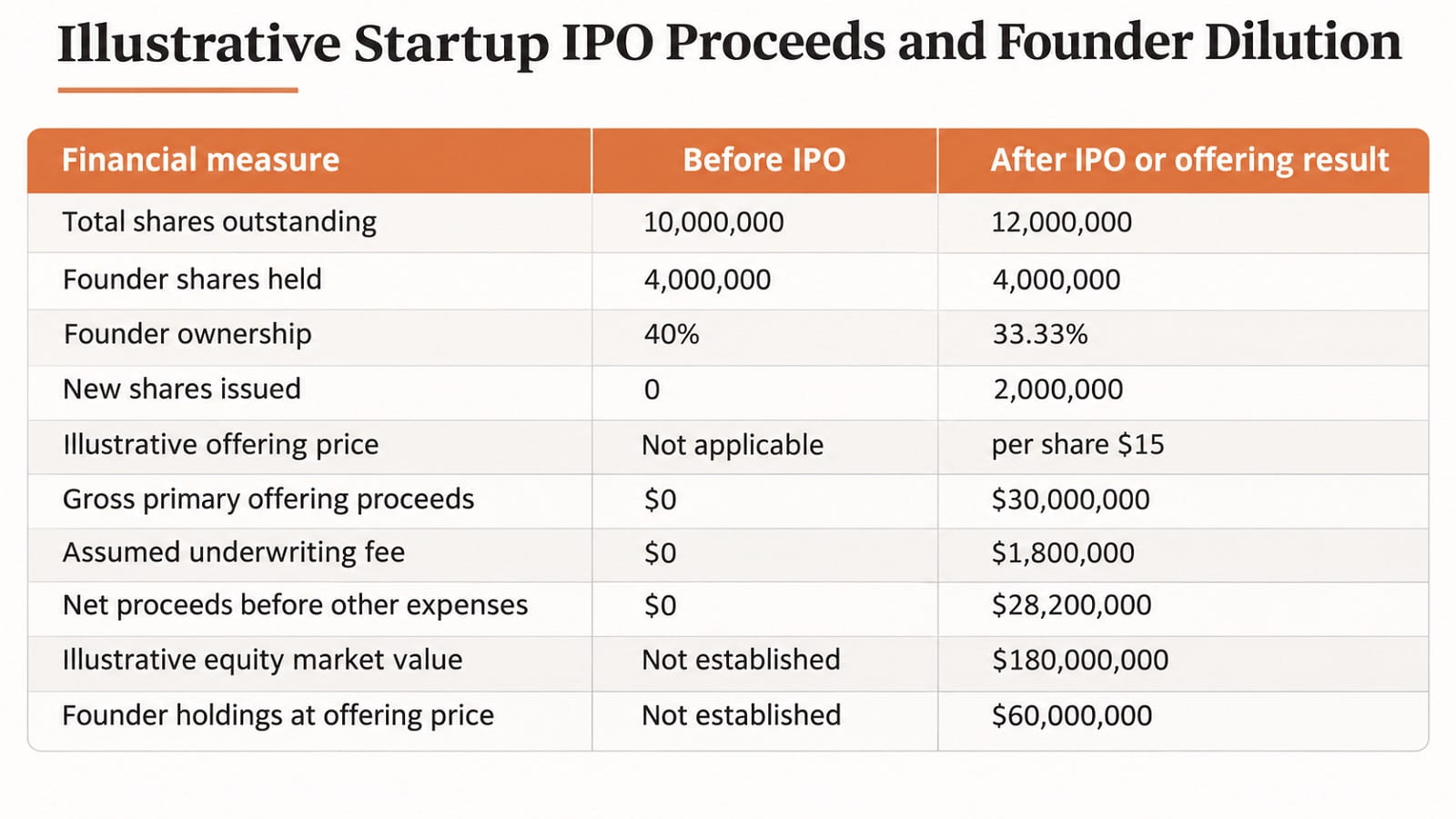
This example shows that an IPO can raise substantial capital for a startup without creating immediate cash proceeds for its founders. MeridianCloud receives the net primary offering proceeds, while the founders retain their existing 4 million shares. At the assumed offering price, those shares have an indicative market value of $60 million, but that value is not equivalent to realized cash. Restrictions on selling, market price changes, and transaction costs could materially affect the proceeds eventually available to them.
What the Example Means for Founders
MeridianCloud's founders should evaluate dilution alongside the benefits of raising $28.2 million before other offering expenses. The capital could support expansion, but successful deployment is not guaranteed.
They should also assess the implications of public ownership. New shareholders may influence governance, and management will face greater reporting obligations and market scrutiny.
The example assumes a fixed offering price and does not model future trading volatility, employee option exercises, convertible securities, or subsequent share issuance. Actual IPO capitalization calculations can be considerably more complex.
Lockup Periods and Founder Share Liquidity
Founders often retain significant shares after an IPO, but they may not be able to sell those holdings immediately. Existing securities can remain subject to resale restrictions, and shareholders may enter agreements limiting sales for a specified period.
A lockup period is a contractual restriction that commonly prevents certain insiders from selling shares shortly after an offering. A period of approximately 180 days is common in United States IPO practice, but the actual duration and permitted exceptions depend on the agreements.
The existence or expiration of a lockup does not automatically establish that every share can be sold without further restrictions. Applicable securities laws, insider trading rules, company policies, and market conditions may continue to affect transactions.
Founders should examine their permitted liquidity separately from the company's IPO financing objectives. A successful offering can improve the prospect of future share sales without guaranteeing an immediate personal financial exit.
IPO Costs and Timing Risks
Preparing a startup for public ownership can require significant expenditure. Companies may incur underwriting fees, legal expenses, audit costs, exchange fees, and continuing reporting expenses.
The preparation process may begin well before the intended listing date. Companies can spend months improving financial controls, preparing audited statements, establishing governance arrangements, and assessing investor demand.
Market conditions create additional uncertainty. A company may be operationally ready but decide to postpone its offering because public market valuations or investor appetite have weakened. Regulatory questions and incomplete records can also extend the timetable.
Founders should maintain sufficient financing and operating flexibility to manage these uncertainties. An IPO plan should not assume that the offering will close on a fixed date or deliver a predetermined amount of capital.
Life After a Startup Goes Public
The responsibilities of a newly public company continue after its shares begin trading. Management must communicate financial performance, maintain appropriate controls, and comply with the reporting requirements applicable to its issuer status.
The business will also be evaluated by a broader investor audience. Public shareholders may focus on quarterly results, cash generation, competitive developments, and the credibility of management's forecasts.
Founders should avoid allowing short term share price movements to determine every operating decision. Public market expectations matter, but long term business performance remains essential.
A public listing can create new opportunities for capital raising and acquisitions. It can also introduce market volatility, governance demands, and a loss of confidentiality over information that private companies may previously have kept internal.
When an IPO May Not Be the Right Choice
An IPO may be unsuitable when a company lacks reliable financial reporting, cannot meet applicable listing requirements, or would struggle to manage the costs of public ownership.
A startup may also determine that remaining private provides greater flexibility. Private financing, continued independent growth, or a strategic transaction can sometimes better support its commercial objectives.
The decision should reflect financing needs, business maturity, market demand, shareholder expectations, and the resources required for public reporting. A high valuation achieved in a private financing round is not sufficient evidence that public investors will support the same valuation.
An IPO should be pursued because it supports a credible business and financing strategy, not simply because becoming publicly listed is viewed as a sign of success.
Final Thoughts
A startup IPO can provide a significant source of growth capital and establish a public market for company shares. It also introduces financial reporting, governance, and disclosure obligations that can permanently change how the business operates.
Founders should evaluate IPO readiness through the quality of the company's financial information, operating systems, management structure, and ability to satisfy applicable listing standards. They must also understand how new share issuance affects ownership and why a public valuation is not the same as immediate personal liquidity.
Going public is most useful when it supports the company's long term financing and operating strategy. Careful preparation and realistic expectations help founders determine whether an IPO is an appropriate next stage for their business.
FAQ
What Is a Startup IPO?
A startup IPO is an initial public offering in which a privately held company offers shares to public investors for the first time. It can raise company capital and establish a potential public market for its securities.
Does a Startup Need to Be Profitable Before an IPO?
Not universally. Profitability requirements depend on the applicable exchange standards and listing pathway. Companies must satisfy the financial and other requirements relevant to their selected market.
How Long Does It Take for a Startup to Go Public?
Timing varies according to financial readiness, regulatory review, exchange requirements, and market conditions. Preparation may take many months, and an offering can be postponed if material issues remain unresolved.
Do Founders Receive Money From an IPO?
Not automatically. Newly issued shares generate proceeds for the company, while a permitted sale of existing shares may generate proceeds for selling shareholders. Founder liquidity depends on the offering structure and applicable restrictions.
What Happens to Founder Ownership After an IPO?
If the company issues new shares, existing shareholders generally experience percentage dilution unless they receive or acquire additional shares. Their economic value also depends on the market price and their continuing rights.
What Is an IPO Lockup Period?
It is a contractual restriction that limits certain shareholder sales after an offering. Its duration and exceptions depend on the relevant agreements and applicable legal requirements.
What Is the Role of an IPO Underwriter?
Underwriters may help structure, market, price, and distribute the securities offered. Their responsibilities depend on the particular offering and underwriting agreement.
Can a Startup Cancel or Delay Its IPO?
Yes. A planned offering may be delayed or withdrawn because of market conditions, regulatory matters, business developments, or financing considerations. Preparation does not guarantee a completed listing.

Mobina Khanki
Venture & Funding Writer at PinerookMobina Khanki covers venture capital, startup funding, fundraising, and startup finance for Pinerook, focusing on founders and investors.
 Seen first.