Raising startup capital in 2026 presents an unusual contradiction. Global venture funding has reached exceptional levels, yet those headline totals do not describe the experience of every founder. A relatively small group of companies is attracting enormous commitments while other businesses still need to establish credible demand, demonstrate disciplined spending, and persuade investors that the next round will produce measurable progress.
Understanding startup investment trends means examining what investors reward, how they evaluate risk, and why funding opportunities differ across companies. Within the broader context of Investment Trends, startup financing reveals a practical connection between technological enthusiasm, the economics of growing a company, and the expectations attached to external capital. For founders, the central question is not whether money exists in the market, but whether their business has evidence that justifies an investment on acceptable terms.
This guide focuses on the decisions behind fundraising: which signals matter, how to assess investor interest, what financial information to prepare, and how to protect the business if a round takes longer than expected. Market figures reflect information available on October 22, 2026.
What Startup Investment Trends Reveal About Fundraising
Startup investment trends describe changes in financing activity, investor preferences, valuations, deal structures, and the evidence required to secure capital. They are visible in funding volumes and deal counts, but also in less obvious developments such as longer diligence processes, different financing terms, and reduced capacity among some venture funds.
A rise in total investment can coexist with a difficult fundraising environment. If a limited number of businesses complete unusually large rounds, they can lift the market total even when smaller companies see little improvement in access to funding. Founders therefore need to separate broad market activity from conditions affecting their own stage, sector, geography, and financial position.
The 2026 Market in Context
Crunchbase reported approximately $159 billion in global venture funding during the third quarter of 2026, covering close to 6,000 startups. That was 53% higher than the same quarter in 2025, even though investment declined from the previous quarter. AI related companies received approximately $102 billion, representing 64% of the global quarterly total. Just 27 companies raised rounds worth at least $1 billion, accounting for roughly one third of capital deployed.
The United States market shows similar concentration. According to the third quarter PitchBook and National Venture Capital Association Venture Monitor, AI companies accounted for 82.7% of United States venture deal value through September 2026. That percentage covers the first nine months of the year, not the third quarter alone.
The reports also show why definitions matter. KPMG estimated global venture investment of approximately $170.9 billion in the third quarter, compared with Crunchbase's $159 billion. Their databases and classifications differ, so the figures should be attributed separately rather than combined into a single market total.
These data establish the market setting. They do not establish that any particular startup will find fundraising easier. What matters next is how investors translate their market views into individual investment decisions.
Why Capital Is Concentrating in Selected Startups
Capital concentration reflects both investor expectations and business requirements. Some advanced AI and infrastructure companies need extensive computing resources, specialist personnel, and large technical investments. Their financing needs are fundamentally different from those of a software business using existing infrastructure to serve a specific customer group.
Very large deals can also attract multiple categories of investors, including venture firms, strategic corporate participants, and institutions capable of committing substantial capital. Their participation does not mean a smaller venture fund has equivalent resources available for ordinary seed rounds.
The founder's response should be specific. Rather than presenting an entire industry as attractive, explain why the company has a defensible position within it. Evidence could include paying customers, specialized distribution, measurable cost advantages, regulatory capabilities, or proprietary technical results. Claims about market size alone rarely resolve questions about commercial execution.
What Investors Want to See Before Committing Capital
A persuasive fundraising presentation connects customer evidence to financial performance and a credible use of proceeds. Different investors place different weight on these measures, but founders benefit from having consistent definitions and reliable records.
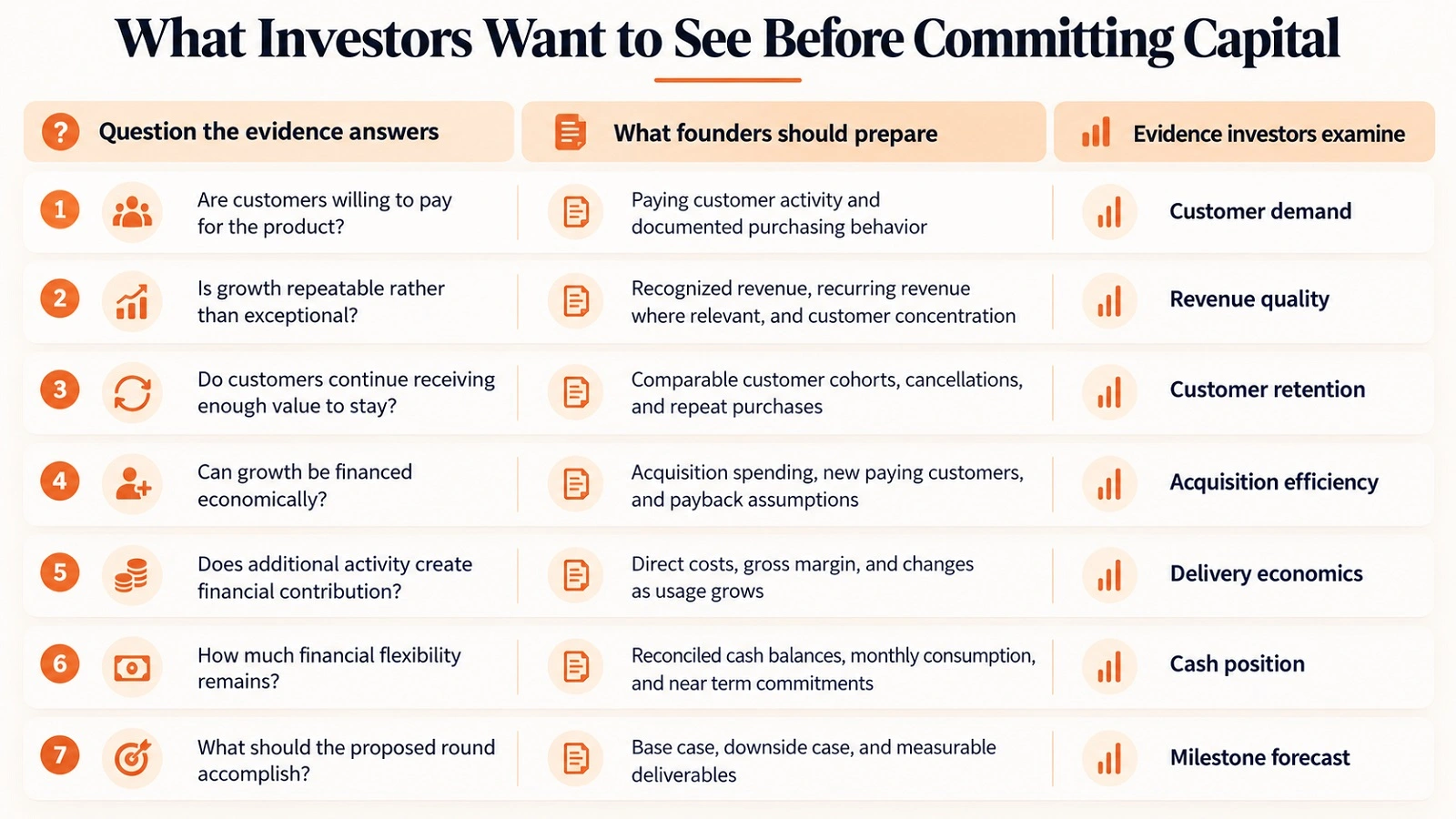
These are not universal thresholds. A research intensive company without commercial revenue may instead rely on technical validation and contractual milestones. A growing subscription business should generally have stronger evidence about retention and customer contribution.
The important principle is that claims should connect to evidence. A forecast showing revenue doubling is less convincing if customer additions, renewal rates, prices, and delivery costs cannot explain how that result would occur.
Fundraising Expectations at Different Stages
Before the First Institutional Round
A company seeking its earliest external financing may have a prototype, initial customer conversations, or a small number of paid pilots. Investors will often assess the founders' ability to identify a real problem and learn from the market. Strong early evidence is usually specific: an identified buyer, a clear reason to purchase, and documented results from initial tests.
At this point, a complex forecast is less useful than an honest explanation of uncertainty. Founders should identify the most important assumptions and define what the next investment will help validate.
Seed Financing
Seed investors commonly look for evidence that the product can attract customers beyond the founders' immediate network. Paying customer growth, continued use, and repeat purchasing can help establish that the opportunity extends beyond initial enthusiasm.
A seed round should finance clear operating milestones. Examples include validating customer retention, improving product reliability, or establishing a more consistent acquisition process. Investors also need to see that the company has enough resources to reach those milestones without depending on an immediate additional round.
Series A and Subsequent Growth
At later stages, an attractive narrative is usually insufficient without repeatable commercial performance. Investors may investigate the quality of revenue, the cost of acquiring customers, gross margin, cash requirements, and whether management reporting can withstand detailed scrutiny.
For companies expanding rapidly, investors must also understand how growth affects costs. Entering a new geography or hiring a larger sales team may produce additional revenue, but it creates commitments before the outcome is known. Demonstrating that expansion is measurable and manageable matters as much as reporting a large growth percentage.
Sector Demand Does Not Replace Company Evidence
AI is the clearest example of strong investment demand in 2026, but the commercial case differs sharply between computing infrastructure and business applications. Infrastructure companies may be judged on technical capacity, deployment requirements, and the financing of physical resources. Application companies must demonstrate customer willingness to pay, retention, and differentiation in a competitive software market.
Other sectors present different risks. Fintech startups may face licensing, compliance, fraud, and partner dependence. Climate hardware businesses can require long testing cycles and substantial capital before commercial deployment. Enterprise cybersecurity companies may experience lengthy purchasing processes but potentially valuable continuing relationships.
Industry popularity is therefore a starting point for research, not a substitute for diligence. A founder should explain why the business can satisfy the conditions that matter in its particular market. Investor enthusiasm may open a conversation, but it does not guarantee attractive terms or continued funding.
Investor Liquidity and Fundraising Capacity
Venture firms also operate under financial constraints. Their ability to invest depends on available commitments, existing portfolio obligations, and the timing of distributions to their investors. A large reported market total does not mean every fund can issue new checks.
The PitchBook and NVCA report found that United States venture fundraising dollars were heavily concentrated among established fund managers during the first nine months of 2026. It also described limited exit activity as an ongoing constraint on liquidity. These conditions help explain why an investor may express genuine interest in a company without having the capacity or mandate to lead its next round.
Founders should investigate an investor's stage focus, typical check size, existing portfolio, follow on strategy, and decision process. An investor who specializes in later growth rounds may not be suitable for an initial seed financing, regardless of personal interest in the product.
Building a Fundraising Plan Around Milestones
The amount raised should reflect the work required to reach a meaningful next stage, not simply a target valuation or the size of recent industry deals. Begin with the expected cost of product development, customer acquisition, hiring, and essential operations. Add foreseeable contractual commitments and allow for uncertainty in both revenue and payment timing.
Next, identify the milestone that could make the business more attractive to future investors. That might mean demonstrating repeatable sales, reaching a technical certification, or proving that customer contribution improves as the business grows.
Finally, test whether the proposed financing leaves room for delays. A company that reaches its milestone with almost no cash remaining may have little negotiating flexibility. Raising too little can force an urgent round; raising far more than needed may create unnecessary dilution or expectations that the company cannot reasonably meet.
A Practical Example of Funding Readiness
Consider OrbitDesk, a fictional software startup with $1.5 million in unrestricted cash. Its current operating cash payments exceed collections by $125,000 each month, producing a simplified cash runway of 12 months.
Management expects to strengthen customer retention and demonstrate a more consistent sales process within four months. It is considering additional hiring to accelerate growth, but the next investment round is not yet secured. To understand the consequences, the team compares four constant spending scenarios.
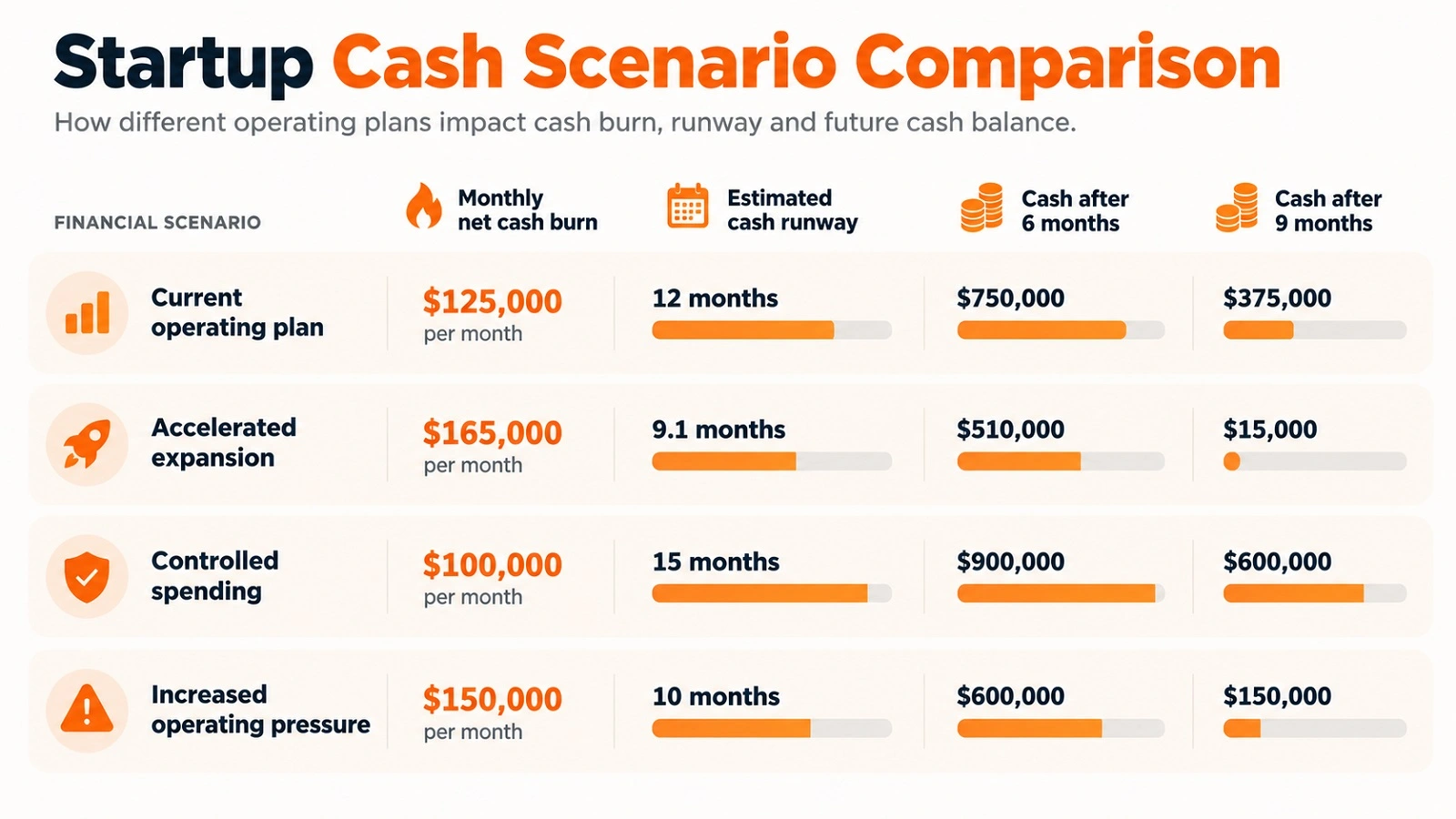
The figures assume no additional financing, no unusual cash movements, and constant monthly net cash consumption. They are planning scenarios, not forecasts of guaranteed outcomes.
Under the current plan, OrbitDesk retains $375,000 after nine months. Accelerated expansion would leave just $15,000 at the same point, giving management very little flexibility if negotiations take longer than expected.
Controlled spending preserves $600,000 after nine months. That does not automatically make it the best strategy. Additional hiring might create valuable growth, but the expected benefits need to be weighed against the loss of financial flexibility.
A useful financing decision would connect each proposed expense with its expected commercial milestone. Management can then compare whether the faster approach improves the probability of securing investment enough to justify the shorter runway.
Understanding Valuation, Dilution, and Deal Terms
Funding announcements often emphasize the size of a round and the company's valuation, but founders also need to understand the economic and governance terms attached to investment.
For a simple example, suppose a company has a $6 million valuation before a new $2 million equity investment. Ignoring other securities and adjustments, its valuation after the investment is $8 million and the new investor owns 25% of the company. Existing owners collectively retain 75% before any separate option pool changes or other dilution effects.
Actual financing documents may introduce important differences. Liquidation preferences affect how proceeds are distributed in a sale. Investor approval rights can influence major decisions. Participation rights in later rounds can affect future ownership. Convertible instruments may create dilution that is not immediately obvious from an announced headline valuation.
Founders should review the full capitalization table and financing documents with qualified advisers before accepting terms. A high valuation can be less attractive if the associated rights or future financing assumptions create substantial disadvantages.
Running an Efficient Investor Process
A fundraising process is easier to manage when the company has reliable information ready before investor outreach begins. Founders should assemble a concise presentation, consistent historical financial reports, a realistic forecast, customer evidence, ownership records, and documentation of major commercial commitments.
Investor targeting should be selective. A list of relevant firms with compatible investment stages, industries, and check sizes is more useful than approaching every investor visible in a funding database. Maintaining accurate notes about conversations also reduces inconsistent statements and repeated requests for the same information.
Founders should be prepared to explain weaknesses. Uncertain customer retention, slow enterprise sales, or concentration among a few clients may be legitimate risks. Addressing them directly with evidence and a credible plan is more useful than presenting projections that assume every problem has already been solved.
How to Interpret Investment Reports Without Misreading Them
Investment databases use different rules for defining financing stages, recording undisclosed transactions, and classifying industries. Later revisions can affect earlier totals, especially for smaller rounds. Reports may also cover different countries or include transactions that another provider excludes.
When interpreting a market report, compare figures from the same provider and equivalent periods where possible. Look at deal counts as well as total dollars, and ask whether a few large financings dominate the result. Distinguish completed financings from acquisitions, fund commitments, and infrastructure investments.
For founders, the most useful market data is often narrower than the global headline. Recent rounds involving businesses at a similar stage, serving comparable customers, and operating in the same region can provide more relevant context for investor discussions. Even those comparisons require attention to financing terms and business maturity.
What Could Change After 2026?
The next phase of startup financing will depend partly on whether major technology investments generate sustainable commercial results and whether exit activity provides liquidity to venture investors. Increased customer adoption could support investment beyond today's largest recipients of capital. Disappointing returns, financing constraints, or shifts in regulation could instead increase selectivity.
Founders cannot control these outcomes, but they can control how clearly they measure performance, manage spending, and prepare for alternative conditions. An investment plan based on credible milestones is more resilient than one that depends on continued enthusiasm for a particular technology.
Final Thoughts
Startup investment trends in 2026 show that substantial venture capital can coexist with highly uneven access to funding. Market enthusiasm, particularly around AI, explains part of the capital flow, but an individual startup still needs to demonstrate that investment can produce credible business progress.
For founders, the practical priorities are clear: document customer demand, understand the economics of growth, set realistic financing milestones, and protect enough cash to negotiate without unnecessary urgency. These decisions matter in a strong funding market and become even more important when investors grow selective.
FAQ
What Are the Main Startup Investment Trends in 2026?
Major developments include exceptional funding concentration in AI, very large financing rounds, continued selectivity for many smaller companies, and investor attention to customer evidence and capital requirements. Fundraising capacity and exit liquidity also remain important considerations.
Is It Easier for Startups to Raise Capital in 2026?
Not necessarily. Global venture totals are high, but substantial capital is concentrated in a relatively small number of companies. Fundraising conditions still depend on stage, sector, geography, financial performance, and investor availability.
What Do Investors Expect From Early Stage Startups?
Investors commonly assess founder capability, the customer problem, early validation, and a credible plan for using capital. As a company gains customers, repeatable demand, retention, and financial contribution become increasingly important.
How Much Funding Should a Startup Raise?
The appropriate amount depends on expected spending, the milestone the company needs to reach, existing cash, and uncertainty in revenue and fundraising timing. It should not be determined solely by industry funding headlines or a desired valuation.
Does a Higher Valuation Always Benefit Founders?
No. Valuation is only one element of a financing agreement. Dilution, liquidation preferences, governance rights, and the risk of a difficult future round can materially affect the economic outcome for existing shareholders.
Which Matters More, Growth or Profitability?
The relevant balance depends on the business stage and model. Investors may support current losses when spending produces credible long term value, but rapid growth without sound customer economics can create additional financing risk.
How Often Should Founders Review Investment Conditions?
Reviewing market reports quarterly can provide context, while monitoring relevant investor activity and the company's cash position should be an ongoing management responsibility. Internal financial forecasts may need more frequent updates when cash is limited.

Mobina Khanki
Venture & Funding Writer at PinerookMobina Khanki covers venture capital, startup funding, fundraising, and startup finance for Pinerook, focusing on founders and investors.
 Seen first.


