Raising money is one of the most consequential decisions a startup makes, but the largest funding round is not necessarily the most useful one. A founder developing an early prototype, a software company with recurring customers, and a manufacturer preparing its first commercial installation may all need capital for different reasons. Their available financing options also differ because investors and lenders evaluate business risk, revenue, assets, and future obligations in different ways. Choosing the wrong source of capital can create repayment pressure, unnecessary ownership dilution, or expectations the company cannot realistically satisfy.
The startup funding landscape includes the financial resources and investment structures available to businesses from their earliest development through commercial expansion. Within the broader context of Investment Trends, these options are influenced by economic conditions, investor preferences, business maturity, and the availability of appropriate financing. Understanding the landscape helps founders distinguish capital that supports uncertain development from financing designed for businesses with established revenue or dependable assets.
This guide explains the main startup funding sources in 2026, how financing options change as companies mature, and what founders should consider before accepting an investment or loan. It also compares equity, grants, and debt through a practical financial example, showing why the amount received is only one part of a successful funding decision.
What Is the Startup Funding Landscape?
The startup funding landscape describes the range of financing sources, financial institutions, investment structures, and conditions through which young companies obtain capital. It includes money provided by founders, customers, private investors, venture funds, governments, lenders, and strategic commercial partners. Each source has different eligibility requirements, financial consequences, and expectations about how the money will be used.
Some financing arrangements exchange capital for company ownership, while others require repayment or restrict spending to approved activities. Customer payments can finance operations without creating an external investment transaction, although they may introduce contractual delivery obligations. Founders need to understand these distinctions because financing changes both the company's financial position and its future flexibility.
The objective is not simply to raise as much money as possible. It is to secure suitable resources for a defined business milestone while keeping the company's obligations manageable.
How the Startup Funding Environment Looks in 2026
Global venture capital investment has reached unusually high levels in 2026, but access to financing remains uneven. Crunchbase reported approximately $159 billion in global venture funding during the third quarter, with close to 6,000 startups receiving investment. Artificial intelligence companies accounted for approximately $102 billion, or 64% of the quarterly total. A limited number of exceptionally large financing rounds also contributed significantly to the overall figures.
These numbers demonstrate that substantial investment capital exists, but they describe only one part of the financing landscape. A startup seeking a modest initial round may face different conditions from a company raising billions for computing infrastructure. Venture market activity also does not establish whether bank loans, research grants, or customer financing are available to a particular company.
The OECD's Financing SMEs and Entrepreneurs 2026 report provides a broader perspective. It examines debt, equity, financing based on assets, and public financing initiatives across 48 countries. The report describes relatively high borrowing costs compared with the period before the pandemic and continued challenges in accessing suitable credit. Its underlying financing statistics largely cover earlier years, so they should not be interpreted as a separate quarterly measurement of the 2026 venture market.
For founders, the implication is that financing opportunities must be evaluated individually. The appropriate choice depends on the company's business model, development stage, financial position, and ability to meet the obligations attached to the capital.
The Main Sources of Startup Funding
Startup financing is not limited to venture capital. Businesses can combine several sources over time, provided their contractual terms and cash requirements remain compatible. The table below compares common financing options and the main issues founders should examine.
No option is universally better than the others. Venture equity may suit a business developing technology with uncertain future revenue, while lending could be more appropriate for a company financing equipment against dependable cash flows. Grants may reduce dilution, but founders should not assume an award is unrestricted or immediately available.
The funding decision becomes more reliable when founders examine what each source expects in return, not just the amount of money being offered.
How Funding Options Change Across Startup Stages
Idea Development and Initial Validation
At the earliest stage, a startup may have limited financial evidence and no established customer revenue. Founder savings, appropriate personal contributions, early angel investment, and eligible research support can provide resources for product development and initial testing. Customer funded experiments may also be possible when prospective buyers are willing to pay for a prototype or limited service.
The main uncertainty is whether the proposed business can solve a problem customers consider valuable. Founders should avoid building a financing plan that assumes commercial demand is proven before relevant customer evidence exists. Investment at this stage should support experiments that clarify important technical or market assumptions.
Seed Funding and Early Commercial Traction
As the company develops a functioning product and begins attracting paying customers, more financing options may become available. Angel groups, seed venture funds, strategic investors, and selected public programs may evaluate early commercial evidence alongside the founding team's capabilities.
The investment case should explain how additional capital will improve the product, attract customers, or demonstrate a repeatable commercial process. Revenue expectations need to connect to identifiable customers, pricing, and operating costs. A company that has only completed a small number of pilot projects should distinguish those activities from established recurring demand.
Growth and Commercial Expansion
A startup with meaningful revenue and reliable financial reporting may be able to consider a wider combination of financing instruments. Venture equity can support expansion, while businesses with suitable cash flows or assets may investigate lending, equipment finance, or financing against receivables. Commercial partnerships can also help finance a larger deployment when customers are willing to make contractual commitments.
These options introduce different obligations. Equity investors generally seek ownership value, while lenders require repayment under agreed conditions. Founders must assess whether projected customer collections can support these commitments, particularly if growth involves additional hiring, infrastructure, or working capital requirements.
Equity Financing Versus Debt Financing
Equity financing raises capital in exchange for an ownership interest or a security that may later convert into ownership. Ordinary equity generally does not require scheduled repayment in the same way as a loan, making it potentially suitable for businesses with uncertain cash generation. However, issuing new shares reduces the ownership percentage held by existing shareholders unless other arrangements change the outcome.
Debt financing provides money under an agreement requiring repayment, usually with additional financing costs. It may allow existing owners to avoid immediate equity dilution, but the company must meet its obligations even if revenue develops more slowly than expected. Lenders may also require security, guarantees, financial covenants, or restrictions on particular business activities.
The appropriate choice depends on risk and cash flow. A company investing in uncertain research may have difficulty servicing a loan before commercial results are available. A profitable business purchasing revenue generating equipment might have a stronger case for debt, provided the expected cash flows support repayment under less favorable conditions as well.
Founders should also consider how new financing affects future investment rounds. Loan obligations can reduce the cash available for development, while an excessive equity valuation can create challenges when the company later seeks additional investment.
Where Convertible Instruments Fit Into Startup Funding
Some early investors finance startups using convertible notes or agreements for future equity rather than purchasing a fixed ownership percentage immediately. These arrangements may allow investors and founders to defer certain valuation decisions until a later financing event.
However, a convertible note is not identical to an agreement for future equity. Depending on the instrument and jurisdiction, a note may include interest, a maturity date, and repayment or conversion provisions. Agreements for future equity have their own conversion mechanics, valuation provisions, and potential dilution effects.
Founders should model how these instruments convert under different financing outcomes. A seemingly simple agreement can have a significant impact on the company's capitalization table when several instruments are outstanding. Qualified legal and financial advice is important before signing documents that affect future ownership.
Grants, Public Support, and Alternative Financing
Grants can be valuable when a startup is developing eligible technologies or completing defined research and demonstration milestones. In the United States, programs such as Small Business Innovation Research and Small Business Technology Transfer support qualifying research activities through competitive processes. Other countries operate different programs with their own eligibility rules and funding requirements.
Grant funding can reduce the need for equity investment, but it should not be treated as unrestricted cash. Awards may require approved expenditures, financial reporting, milestone verification, or reimbursement after expenses have already occurred. A company depending on a delayed grant payment still needs enough cash to meet obligations before that payment arrives.
Alternative financing may be appropriate when a startup already has relevant customers or assets. Invoice financing can provide access to capital against qualifying receivables, while equipment financing can support particular purchases. Revenue based arrangements may use a defined share of eligible receipts to calculate repayments. All these approaches require founders to understand the effective financing cost, contractual restrictions, and consequences of weaker commercial performance.
Equity crowdfunding may also provide an additional route where securities regulations permit it. However, investor eligibility, disclosure requirements, offering limits, and platform rules vary by jurisdiction. The fact that a funding method is available online does not remove the legal and financial responsibilities associated with raising capital.
How to Choose the Right Funding Source
Start With the Milestone, Not the Investment Amount
A financing plan should begin by identifying what the company needs to achieve. That could mean completing a prototype, establishing repeatable customer acquisition, securing a required authorization, or financing a commercial installation. The amount requested should follow from the cost and expected timing of that milestone.
Founders should separate necessary spending from activities that can be postponed. This makes it easier to determine the minimum financing requirement and the additional reserve needed for uncertainty. A larger round can support faster expansion, but it can also create unnecessary dilution or obligations when the company has not yet demonstrated that expansion is justified.
Assess Cash Generation and Repayment Capacity
Revenue does not automatically create available cash. Customers may pay after services are delivered, and the company may need to purchase inventory or equipment before collecting the associated revenue. Financial forecasts should therefore distinguish recognized income from actual cash receipts.
When considering a loan, founders need to test whether collections can cover scheduled payments while leaving enough money for ordinary operations. A lender's willingness to approve financing does not establish that the loan is the best financial decision for the company. The forecast should include weaker sales, delayed customer collections, and unexpected operating expenses.
Consider Ownership and Control
Equity investment affects more than the percentage shown on a capitalization table. Financing agreements may contain liquidation preferences, approval rights, information obligations, or provisions affecting future share issuances.
Founders should understand how these terms interact with existing shareholders and later investors. A financing offer with a higher valuation may not be economically preferable when its other provisions are less favorable. Comparing the complete financing agreement is more important than focusing solely on the headline investment amount.
A Practical Startup Funding Decision Example
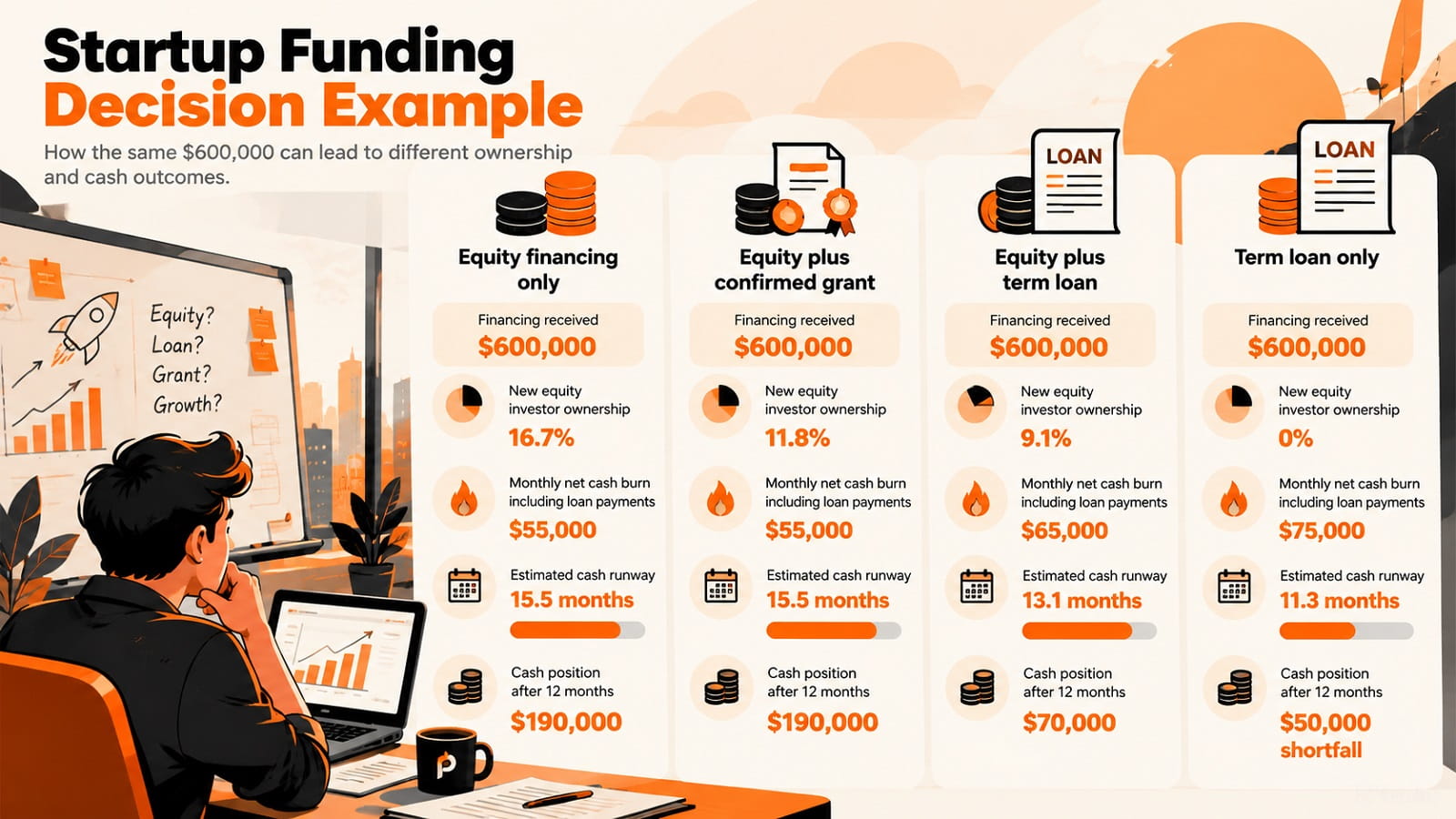
Consider BridgeFlow, a fictional software startup with $250,000 in unrestricted cash. Its monthly operating cash payments currently exceed customer receipts by $55,000. Management wants to secure another $600,000 to support product development and commercial expansion while maintaining enough financial flexibility to reach its next milestone.
The company's assumed valuation immediately before new equity investment is $3 million. Management is considering equity funding, a grant combined with equity, a combination of equity and debt, and debt alone. For a comparable illustration, each scenario provides $600,000 in financing cash at the beginning of the forecast.
The grant scenario assumes a confirmed $200,000 award paid immediately, with its permitted use covering eligible expenses already included in the forecast. Debt scenarios assume additional fixed monthly cash payments of $10,000 on a $300,000 loan or $20,000 on a $600,000 loan. These are illustrative financing assumptions, not advertised loan terms. Transaction fees, taxes, changes in revenue, and other unusual cash movements are excluded.
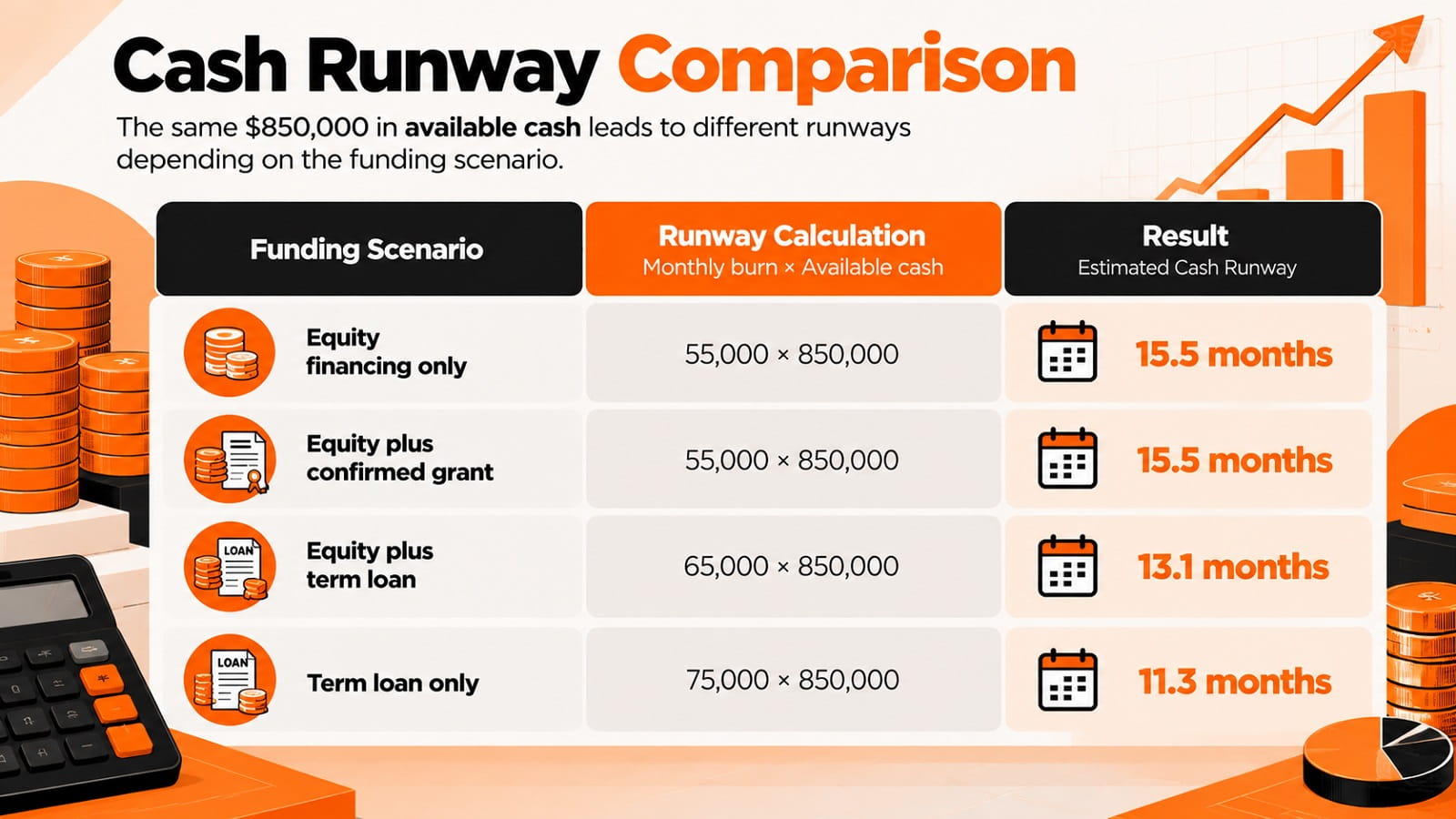
Each scenario begins with $850,000 in available cash after financing. Estimated runway equals this amount divided by constant monthly net cash consumption, including the stated loan payments where applicable.
In the equity only scenario, the new investor receives approximately 16.7% of the company because the $600,000 investment represents that proportion of the $3.6 million valuation after financing. If the company instead receives $400,000 in equity and $200,000 from the confirmed grant, the new equity investor receives approximately 11.8% ownership. The cash runway remains the same under the simplified assumptions because neither arrangement adds loan repayments.
Combining $300,000 in equity with a $300,000 loan reduces immediate equity dilution to approximately 9.1%, but the assumed additional $10,000 in monthly repayments shortens runway to 13.1 months. Funding the entire amount through debt avoids new ordinary equity issuance, yet the higher repayment burden causes the company to exhaust its modeled cash before the end of month twelve.
This comparison shows that equal financing amounts do not produce equal financial flexibility. A grant may be attractive but difficult to obtain or subject to restricted use, while a loan can preserve ownership at the cost of future cash obligations. The appropriate financing mix depends on availability, contractual terms, the probability of achieving the next milestone, and the company's capacity to absorb disappointing results.
How to Prepare for a Startup Funding Round
Regardless of the financing source, founders need accurate information explaining what the business does, how it earns money, and why additional capital is required. A reliable forecast should show the expected connection between customer activity, operating expenses, and cash. Historical financial records should be reconciled with bank balances, and important commercial commitments should be clearly documented.
For equity investors, preparation commonly includes a concise presentation, evidence of customer demand, company ownership records, and a financial plan explaining the intended use of investment proceeds. Lenders may focus more heavily on repayment capacity, existing obligations, financial statements, and qualifying collateral. Grant applications may instead require technical objectives, eligibility documentation, approved budgets, and milestone reporting.
The company should also maintain a downside scenario. If a financing round closes later than expected, customers pay slowly, or development costs increase, management needs to understand how much flexibility remains. That preparation improves the quality of fundraising decisions and reduces dependence on a single optimistic outcome.
Common Mistakes in Startup Funding Decisions
A frequent mistake is treating all financing as economically equivalent. Raising $500,000 through equity, debt, or an award can create very different obligations, even though the initial cash amount appears identical. Founders should compare dilution, restrictions, repayment requirements, and the timing of usable cash.
Another mistake is using major venture funding announcements as benchmarks for a company at a different stage. An infrastructure business raising billions may have little relevance to the financing requirements of a software startup with a small commercial team. Comparisons should reflect the business model, financial maturity, and actual investment conditions.
Finally, founders may overlook the effect of financing on future flexibility. A short repayment schedule can create a liquidity problem before the financed activity generates cash, while excessive dilution can reduce the founders' economic interest in later outcomes. Funding should support a credible business objective rather than merely postpone difficult operating decisions.
How the Startup Funding Landscape May Evolve
Changes in interest rates, investor liquidity, technology requirements, and public financing programs will continue influencing startup funding opportunities. Venture capital may remain concentrated in selected industries, while other businesses seek more suitable combinations of customer revenue, strategic investment, grants, and debt.
Alternative financing can broaden access to resources, but it is unlikely to eliminate differences between companies with uncertain future revenue and those with established financial performance. Lenders still need credible repayment prospects, and equity investors still need an attractive potential return. Public support also remains dependent on eligibility, budgets, and policy priorities.
The most resilient startups will be those that understand several financing options without assuming all are equally accessible. Maintaining reliable financial records and a realistic plan makes it easier to adapt when one source becomes unavailable or its terms change.
Final Thoughts
The startup funding landscape offers several ways to finance development and growth, but choosing among them requires an understanding of what the business can realistically achieve with the capital. Venture investment, debt, grants, and commercial financing serve different purposes, and their economic consequences extend beyond the amount received.
The BridgeFlow example demonstrates how four arrangements providing the same initial cash can produce different ownership outcomes and financial runways. A company that raises money while preserving equity may still create significant liquidity pressure if its repayment obligations are too demanding.
Founders should choose financing that matches their business stage, operating evidence, and next commercial milestone. A successful funding decision is one that enables meaningful progress while preserving the flexibility required to manage uncertainty.
FAQ
What Is the Startup Funding Landscape?
It is the range of capital sources, investment structures, and financing conditions available to new and growing businesses. It includes founder contributions, customer financing, angel investment, venture capital, grants, loans, and other suitable arrangements.
What Are the Main Types of Startup Funding?
The main categories include equity financing, debt financing, grants, customer funded operations, and financing supported by qualifying assets or receivables. Each creates different obligations and is suitable for different types of businesses.
Is Venture Capital the Best Funding Option for Every Startup?
No. Venture capital can support companies pursuing substantial growth under uncertainty, but it generally involves ownership dilution and investor expectations for significant returns. A business with stable cash generation may find customer financing or appropriate lending more suitable.
Can Startups Raise Capital Without Giving Up Equity?
Yes. Founder contributions, retained earnings, certain grants, and qualifying debt arrangements may provide capital without issuing ordinary equity. However, these sources can involve eligibility restrictions, repayment obligations, or other costs.
How Much Funding Should a Startup Raise?
The amount should reflect the cost of reaching a meaningful milestone, the timing of expected cash receipts, and an appropriate reserve for uncertainty. It should not be determined solely by the size of funding rounds announced by other startups.
What Is the Difference Between a Grant and a Loan?
A grant generally provides funding for approved activities under specified conditions and usually does not require ordinary loan repayment when those conditions are met. A loan creates repayment obligations under its agreement, potentially including interest, security, and financial restrictions.
Can a Startup Combine Equity and Debt Financing?
Yes, where suitable investors and lenders are available and the agreements allow it. The company should calculate how equity issuance affects ownership and how debt payments affect future cash, rather than comparing financing amounts alone.

Mobina Khanki
Venture & Funding Writer at PinerookMobina Khanki covers venture capital, startup funding, fundraising, and startup finance for Pinerook, focusing on founders and investors.
 Seen first.


