
A startup exit is rarely the result of a single negotiation. Founders may spend years building a product, attracting customers, raising capital, and developing relationships that eventually create an opportunity to sell the business. Yet receiving an acquisition offer does not automatically mean the company is ready to sell. An effective plan must address the founders' financial goals, investor expectations, market conditions, and the work required to make the business attractive to potential buyers.
Within Startup Exit and M&A, founders must distinguish between building a valuable company and preparing to realize that value. A business can have strong revenue and promising technology while facing ownership disputes, customer concentration, or operational weaknesses that complicate a transaction. Exit preparation connects long-term business development with the financial and practical requirements of selling shares or transferring control.
A startup exit strategy is a practical plan for determining when, why, and under what conditions founders and shareholders may pursue liquidity. It should identify realistic outcomes, explain how the company will become ready for a transaction, and establish alternatives if the preferred opportunity does not materialize. This guide examines the decisions founders should make, the preparation they should prioritize, and how they can evaluate potential exit offers without relying solely on headline valuations.
Why Startup Founders Need an Exit Plan
Founders often concentrate on customer acquisition, product development, and fundraising during the early years of a startup. These priorities are necessary, but they can lead to a situation in which ownership and liquidity decisions are postponed until an investor or buyer raises the subject. By that point, contractual commitments and financing arrangements may limit the options available.
Planning does not require setting an exact sale date or promising investors a particular return. Instead, it creates a framework for evaluating future opportunities. A founder who understands the company's likely buyers, shareholder obligations, and financial needs can decide whether to accept an offer, negotiate different terms, or continue building the business.
Exit planning also influences everyday operating decisions. Reliable financial reporting, transferable customer relationships, documented intellectual property rights, and a management team capable of operating without constant founder involvement can make a company more attractive to buyers. These improvements are valuable even if a transaction never occurs, because they also support stronger management and more predictable growth.
Defining Founder and Investor Exit Objectives
A useful plan begins with understanding what shareholders want to achieve. Founders may seek personal financial security, a complete departure from operations, or the opportunity to continue developing the product within a larger company. Investors may have different goals because their funds operate within investment periods and their returns depend on the rights attached to their shares.
These differences can become important when a buyer makes an offer. A founder may consider a transaction attractive because it provides substantial immediate liquidity, while a preferred shareholder may calculate the outcome differently under existing investment agreements. An offer that appears generous at the company level may not satisfy every shareholder.
Founders should therefore establish acceptable outcomes before negotiations become urgent. This involves identifying financial priorities, desired ownership after a transaction, willingness to remain employed, and the treatment of existing employees. It also requires understanding shareholder approval rights and any contractual restrictions that may affect a sale.
Establishing a Financial Target
Financial targets should focus on the amount shareholders expect to receive rather than the company's headline valuation. A founder who owns 25% of the company should not automatically assume that a $40 million acquisition produces $10 million in proceeds. Debt adjustments, investor preferences, options, expenses, and the timing of payments can change the result.
The plan should distinguish a preferred outcome from a minimum acceptable outcome. Both should be evaluated using realistic scenarios and professional advice regarding potential taxes and transaction costs. A fixed target without considering business performance or market demand may create expectations that cannot be supported.
Evaluating the Company's Exit Readiness
Exit readiness concerns whether a buyer can understand, value, and acquire the company without encountering avoidable uncertainty. It is not simply a question of whether the startup has reached a particular revenue level.
A company with a strong product may still struggle during negotiations if its financial records are inconsistent or important technology rights are undocumented. Similarly, a business with substantial sales may become less attractive when a single customer accounts for most of its revenue and renewal prospects are uncertain.
Founders should assess financial reporting, customer retention, corporate records, intellectual property ownership, team stability, and the reliability of internal operations. The objective is to identify issues that could delay a transaction or change a buyer's assessment of the company.
Preparing the Business to Operate Without Its Founder
A buyer may be concerned when the founder personally controls major customer relationships, approves every technical decision, or manages operations that no other employee understands. This dependence can make the business difficult to transfer or integrate.
Reducing key-person risk does not mean removing the founder from the company. It means assigning clear responsibilities, improving documentation, and developing managers who can maintain important functions. A business that operates reliably without continuous intervention may offer greater flexibility in negotiating the founder's responsibilities after closing.
Building a Practical Exit Readiness Plan
Exit planning becomes useful when strategic goals are translated into specific work. Founders should identify the evidence a buyer would need, the weaknesses that could affect negotiations, and the people responsible for improving those areas.
The following table provides a practical framework for organizing preparation. The priorities should be adapted to the startup's stage, business model, and likely transaction structure.
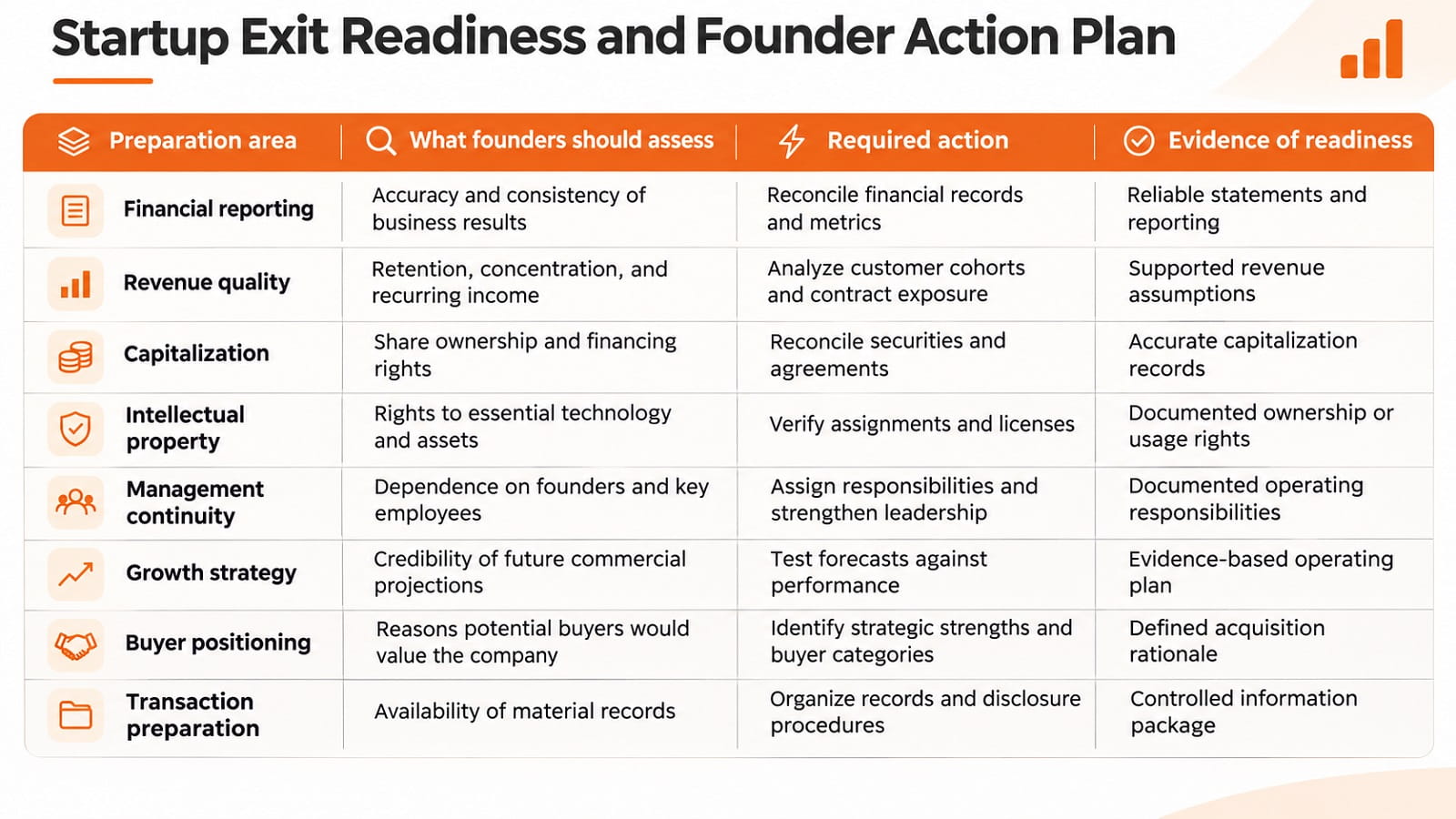
The preparation plan should distinguish actions that improve the underlying business from those that primarily support transaction execution. Better customer retention or stronger management can increase commercial value, while organizing legal records can reduce uncertainty and delays. Both matter, but they may require different resources and timeframes. Founders should prioritize issues according to their likely effect on buyer confidence and transaction completion.
Identifying Potential Buyers Before a Sale
A startup should not wait for an unsolicited acquisition offer before considering who might purchase the business. Understanding potential buyers helps founders recognize which capabilities, customer relationships, and commercial achievements could create strategic value.
Potential acquirers may include competitors, complementary technology providers, companies entering a new market, and investment firms seeking businesses with attractive growth prospects. Each group evaluates opportunities differently. A technology company might value a startup's product because it fills a gap in its portfolio, while a financial investor may focus more heavily on profitability, operating efficiency, and future returns.
Founders can develop a buyer landscape by examining previous acquisitions, strategic partnerships, product expansion, and investment activity within their sector. The objective is not to predict an exact buyer years in advance. It is to understand what makes the company relevant to organizations with the resources and motivation to complete a transaction.
Building Relationships Without Starting a Sale Process
Commercial relationships may eventually create acquisition opportunities, but they should remain grounded in genuine business objectives. Partnerships, integrations, and industry discussions can help companies understand each other's capabilities without creating an immediate obligation to negotiate a sale.
Founders should also avoid disclosing sensitive financial or technical information simply to attract buyer attention. As discussions become more serious, appropriate confidentiality protections and controlled information sharing become important.
Maintaining several credible relationships can improve optionality. Depending entirely on one interested party may weaken a seller's negotiating position, especially if the buyer changes its priorities or withdraws.
Choosing the Right Time to Exit
Timing is one of the most difficult parts of an exit plan because founders cannot control market conditions or buyer demand. A company might receive a strong offer before reaching its original growth target, while another may achieve impressive performance during a period when buyers are reluctant to complete acquisitions.
Founders should consider internal and external signals together. Internal indicators include revenue stability, customer retention, profitability, product maturity, and available cash. External indicators include comparable transactions, industry consolidation, financing conditions, and the strategic priorities of potential buyers.
An early exit can offer certainty and reduce future operating risk, but it may also limit participation in additional growth. Waiting can create greater value, although it exposes shareholders to competition, financing requirements, and changes in the market. The decision should reflect the probability and cost of each outcome rather than the assumption that the company will inevitably become more valuable.
A practical approach is to review the company's position regularly and establish conditions that would justify serious exit discussions. These could include reaching a sustainable operating model, receiving an offer that exceeds the risk-adjusted value of continued independence, or recognizing that a strategic partner could develop the product more effectively.
Aligning Exit Planning With Fundraising
Fundraising decisions influence future exit flexibility. Each financing round can change ownership, investor rights, and the financial threshold at which a sale produces an attractive return for shareholders.
Founders should understand how preferred shares, convertible instruments, participation rights, and approval provisions affect potential transactions. Raising capital at a higher valuation does not automatically improve the economics of every future exit. The additional investment may create expectations or contractual distribution rights that become important when a buyer makes an offer.
The founder's plan should therefore account for both company growth and the consequences of future dilution. Before accepting new financing, management can evaluate several possible exit values and determine how the proceeds would be allocated under the proposed terms.
These calculations are particularly important when the business is considering a financing round and a potential sale at the same time. The alternatives may offer different levels of certainty, control, and future participation.
A Practical Startup Exit Planning Example
Consider AtlasBridge Software, a fictional B2B software startup with $3 million in annual recurring revenue. Its founders are considering whether to continue operating independently for another two years or pursue an acquisition offer from a larger technology company.
AtlasBridge receives an indicative offer with an equity value of $18 million. The founders collectively own 45% of the company on a fully diluted, as-converted basis. Assume that the company's preferred shareholders would receive more by converting to common shares than by taking their liquidation preferences, and that all equity holders therefore participate proportionally.
Under these simplified assumptions, the founders' gross proceeds from the immediate sale would be $8.1 million. This figure excludes personal taxes and any expenses or adjustments not included in the assumed equity value.
Comparing an Immediate Exit With Continued Growth
Management believes that remaining independent could increase the company's value, but the result is uncertain. To evaluate the decision, the founders prepare several illustrative scenarios for a sale two years later.
The model assumes that the founders retain their 45% fully diluted ownership throughout the period, no additional financing or dilution occurs, and all shareholders receive proportional proceeds under each scenario.
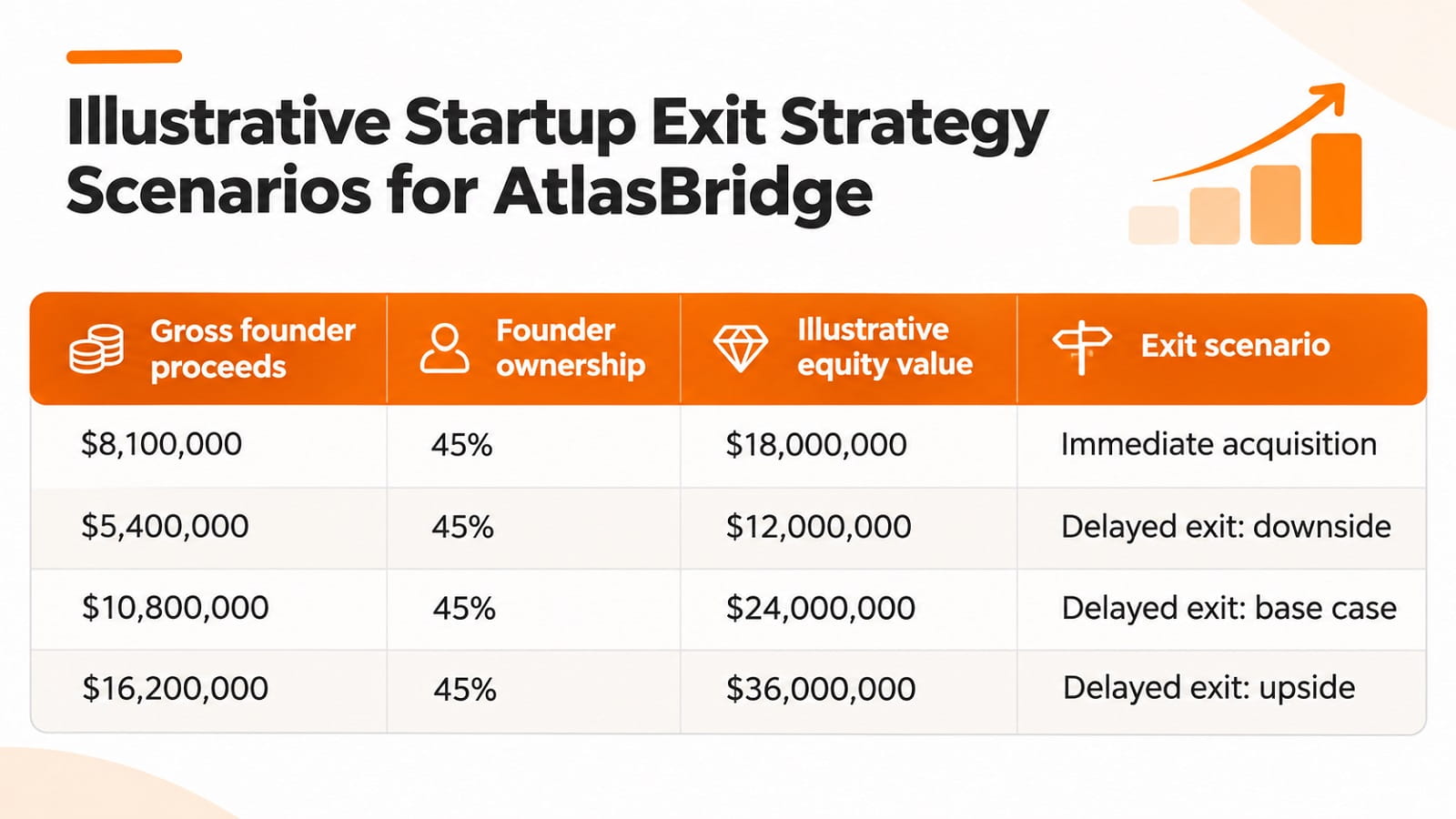
The figures show the tradeoff between immediate liquidity and the possibility of higher future proceeds. The base case produces $2.7 million more for the founders than the current offer, but the downside case produces $2.7 million less. The upside scenario offers substantially greater proceeds, although achieving that outcome may require additional customer growth, product development, and management execution. These figures are not probability-weighted or discounted for time, and they should not be interpreted as forecasts.
Making the Decision
AtlasBridge's founders should not choose the delayed exit solely because its upside scenario is larger. They need to assess the likelihood of each outcome, the capital required to continue operating, and the risk that a future buyer may not offer the projected value.
The decision also depends on their personal objectives and the buyer's proposed terms. An immediate cash acquisition may provide more certainty than a transaction involving substantial deferred consideration or continued employment obligations.
A stronger decision process would evaluate additional financial scenarios, confirm the contractual distribution rights of shareholders, and examine whether the company's growth plan is achievable. The purpose of the model is to make the tradeoffs visible rather than predict the eventual transaction price.
Preparing for Buyer Discussions and Negotiations
When a credible buyer expresses interest, founders need to distinguish exploratory conversations from formal negotiations. Early discussions may concern strategic fit, product capabilities, or broad commercial expectations. More advanced discussions can involve financial information, valuation, confidentiality arrangements, and the proposed transaction structure.
A founder should understand the buyer's motivation before focusing exclusively on price. A company interested in retaining the startup's team may propose different employment terms from one planning to integrate the product and reduce duplicated operations. These differences can affect the founders' future responsibilities and the certainty of shareholder proceeds.
Negotiations should also address the type and timing of consideration. Cash at closing, buyer shares, escrow amounts, and payments tied to future performance create different risks. A larger offer is not necessarily preferable when much of its value depends on conditions outside the sellers' control.
Qualified legal and financial advisers can help founders evaluate these matters and identify terms that may materially change the expected outcome.
Planning for an Unsuccessful Exit
Not every exit opportunity develops into a completed transaction. A buyer may withdraw after reviewing the company, financing conditions may deteriorate, or shareholders may reject the proposed terms.
Founders should maintain an operating plan that does not assume an acquisition will occur by a particular date. The company needs sufficient attention to customer service, employee retention, and financial management while discussions continue. Neglecting the business during negotiations can weaken the very performance that made it attractive.
The alternative plan may involve continuing independent growth, raising additional capital, reducing operating costs, or reassessing other transaction options. In distressed circumstances, management may need to consider more difficult choices involving asset sales or orderly closure.
Maintaining alternatives can reduce pressure to accept unfavorable terms. It also helps founders preserve business continuity when negotiations last longer than expected or fail to produce an agreement.
Common Startup Exit Planning Mistakes
One frequent mistake is assuming that increasing valuation will automatically increase the amount founders receive. Ownership dilution, investor preferences, debt, and contingent payments can change the result. Founders should evaluate net economic outcomes rather than rely on the value announced in a financing round or acquisition proposal.
Another mistake is preparing only after a buyer becomes interested. Missing records, unclear technology rights, and founder dependence can take time to resolve. Addressing these weaknesses earlier can make the company easier to evaluate and reduce avoidable complications.
Founders may also concentrate on a single potential buyer or assume that future market conditions will remain favorable. A flexible plan considers several credible alternatives and recognizes that public markets, acquisition activity, and buyer priorities can change.
Finally, a founder should not treat the sale as a purely financial decision. Responsibilities after closing, employee outcomes, product continuity, and personal willingness to remain involved may all influence whether a transaction is genuinely attractive.
Frequently Asked Questions About Startup Exit Strategy
What Is a Startup Exit Strategy?
It is a plan that explains how founders and investors may realize value from their ownership, what conditions would justify an exit, and how the company should prepare for a potential transaction.
When Should Founders Start Planning an Exit?
Founders can consider possible outcomes early in the company's development. Detailed preparation becomes more important as the business grows, attracts investors, or develops relationships with potential buyers.
What Is the Best Exit Option for a Startup?
There is no universally best option. The appropriate route depends on the company's financial position, buyer interest, shareholder objectives, and the expected risks and returns of remaining independent.
How Can Founders Increase Exit Readiness?
Founders can improve financial reporting, document ownership rights, strengthen customer retention, reduce key-person dependence, and develop evidence supporting the company's commercial value.
How Do Investors Influence Exit Decisions?
Investors may hold preferred shares, approval rights, and other contractual protections that affect transaction decisions and the distribution of proceeds. Their objectives may also differ from those of founders.
Should a Founder Accept an Early Acquisition Offer?
An early offer should be evaluated against the likely value and risks of continuing independently. Payment certainty, retained responsibilities, potential dilution, and the company's financing needs are important considerations.
Can a Startup Plan an Exit Without an Interested Buyer?
Yes. Founders can identify likely buyer categories, improve transaction readiness, and establish financial objectives before formal acquisition discussions begin.
What Happens if an Exit Plan Fails?
The company may continue operating, pursue financing, seek other buyers, or adjust its business strategy. Maintaining a credible alternative plan reduces dependence on a single transaction.
Final Thoughts
A strong exit plan gives founders a framework for making ownership decisions before negotiations become urgent. It connects shareholder objectives with the company's commercial position, potential buyers, and the conditions under which selling would be preferable to continued independence.
Preparation requires reliable records, clear ownership rights, strong operating practices, and an understanding of the financial outcomes available under different transaction structures. These improvements support negotiations while also making the company more resilient.
The goal is not to guarantee a particular acquisition price or exit date. It is to preserve credible options, understand the risks attached to each alternative, and make decisions that reflect both the company's value and the interests of its shareholders.

Mobina Khanki
Venture & Funding Writer at PinerookMobina Khanki covers venture capital, startup funding, fundraising, and startup finance for Pinerook, focusing on founders and investors.
 Seen first.