
Selling a startup can transform years of product development, fundraising, and customer acquisition into a financial outcome for founders and investors. However, the process involves much more than agreeing on a purchase price. Buyers examine the business, negotiate how ownership will transfer, and determine which risks they are willing to accept. Founders must understand these requirements because the structure of an acquisition can significantly affect the money they receive and their responsibilities after the transaction.
Within Startup Exit and M&A, selling a company represents one possible route to shareholder liquidity. A buyer may want the startup's technology, customer relationships, employees, or access to a new market. These motivations influence the value offered and the conditions attached to the purchase. Even a business with strong revenue may face difficult negotiations if its contracts, ownership records, or technology rights do not support the buyer's expectations.
A startup acquisition is a transaction in which another company or investor purchases a startup, an ownership interest in it, or selected business assets. The transaction may transfer complete control or establish a different ownership arrangement, depending on its structure. This guide explains how buyers evaluate startups, what happens during acquisition negotiations, how purchase agreements work, and why the final financial outcome can differ from the headline offer.
Why Companies Acquire Startups
Established businesses acquire startups for several reasons, many of which extend beyond the target company's current revenue. A buyer may want to enter a new market, introduce technology more quickly, expand its customer base, or obtain specialized capabilities. Understanding the acquisition rationale helps founders assess whether an interested buyer has a strong commercial reason to complete the transaction.
A technology company might acquire a startup because its product would take several years to develop internally. Another buyer may value an established customer base that can be introduced to additional services. In both cases, the target's value depends partly on how effectively the buyer can use the acquired business.
Financial buyers may have different priorities. Rather than integrating the startup into an existing product portfolio, they may focus on operating performance, predictable cash flow, and opportunities to increase value through continued ownership. These differences influence negotiations, management arrangements, and expectations after closing.
A buyer's strategic interest does not guarantee an attractive offer. Founders need to understand which capabilities the buyer genuinely values, whether those capabilities can be transferred, and what risks could prevent the expected benefits from being realized.
Types of Startup Buyers
Potential buyers generally fall into several categories, including strategic acquirers, financial investors, and companies seeking specific business assets or teams. Although their objectives can overlap, the commercial reasoning behind the purchase often affects the transaction structure.
Strategic acquirers usually examine how the startup fits their existing operations. They may value product integration, intellectual property, customer access, or competitive positioning. Financial investors often assess the company's future earning potential, management team, and opportunities for operational improvement.
Some buyers are primarily interested in a particular technology or group of employees. Such transactions may involve selected assets, employment arrangements, and retention incentives rather than a conventional purchase of an entire operating business.
Founders should evaluate prospective buyers according to their financial capacity, strategic objectives, decision-making process, and ability to complete the transaction. A buyer expressing interest is not necessarily prepared to make a binding offer.
How the Startup Acquisition Process Begins
Acquisition discussions may develop through commercial partnerships, direct outreach, investor introductions, or a structured sale process managed by advisers. Initial conversations generally focus on the company's products, market position, financial performance, and potential fit with the buyer.
At this stage, founders should distinguish general strategic interest from a serious acquisition proposal. A potential buyer may want to learn about the business without having obtained internal approval to pursue a transaction. Sharing highly sensitive information too early can therefore create unnecessary commercial risks.
As interest develops, the parties may enter confidentiality arrangements and exchange selected information. The buyer might request financial summaries, customer metrics, product demonstrations, or an overview of important intellectual property. Founders should maintain a consistent explanation of the business and ensure that figures supplied during discussions can be supported by underlying records.
The objective of this stage is to establish whether the buyer has a credible reason to proceed and whether the proposed transaction could satisfy the company's shareholders. Detailed negotiations should not begin solely because a prospective buyer expresses enthusiasm.
Valuation and the Initial Acquisition Offer
An acquisition proposal typically reflects the buyer's assessment of the company's financial performance, expected growth, strategic importance, and transaction risks. Different buyers may reach different valuations because they expect different benefits from owning the business.
A subscription software company might be assessed using recurring revenue, retention, profitability, and future growth. A startup with valuable technology but limited revenue may be evaluated more heavily on intellectual property, product capabilities, and the resources needed to commercialize them.
Founders should establish whether an offer refers to enterprise value or equity value. Enterprise value generally represents the value of the operating business, while equity value reflects the amount attributable to shareholders after relevant adjustments. Confusing these figures can create unrealistic expectations about transaction proceeds.
The offer should also specify the form of payment. A proposal involving immediate cash is economically different from one containing buyer shares, deferred payments, or additional consideration dependent on future performance.
Letter of Intent and Key Negotiation Terms
When discussions become serious, the buyer may present a letter of intent, commonly called an LOI. This document outlines the proposed transaction terms and provides a framework for further negotiations. Depending on the agreement and applicable law, some provisions may be binding even when the proposed acquisition itself remains subject to further documentation.
An LOI may address the proposed valuation, purchase structure, payment arrangements, exclusivity, confidentiality, and conditions required before closing. Founders should pay particular attention to how the document defines the transaction price and which financial adjustments remain open to negotiation.
Exclusivity can be especially important. If the seller agrees not to negotiate with other buyers for a specified period, it may lose competitive tension while the interested buyer conducts its investigation. Founders should understand the duration, termination conditions, and practical consequences before accepting such restrictions.
Although an LOI can create a common basis for negotiations, it does not necessarily guarantee completion. Material findings, financing problems, or disagreements over definitive documents may still prevent the transaction from closing.
Choosing the Acquisition Structure
The legal structure determines what the buyer purchases and how rights and obligations are transferred. Common approaches include purchasing shares, acquiring selected assets, or completing a statutory merger. Each can produce different consequences for contracts, liabilities, taxes, and shareholder approvals.
In a share purchase, the buyer acquires ownership of the target company through the relevant securities. The company generally continues to hold its assets and obligations, subject to the transaction and applicable law. An asset purchase instead focuses on identified assets and the liabilities the buyer agrees or is required to assume.
A merger combines entities through a statutory process. Its consequences depend on the jurisdiction and the specific structure selected. Founders should not assume that one arrangement is universally preferable because legal and tax outcomes vary.
The following table compares the main structures and the issues founders should review before proceeding.
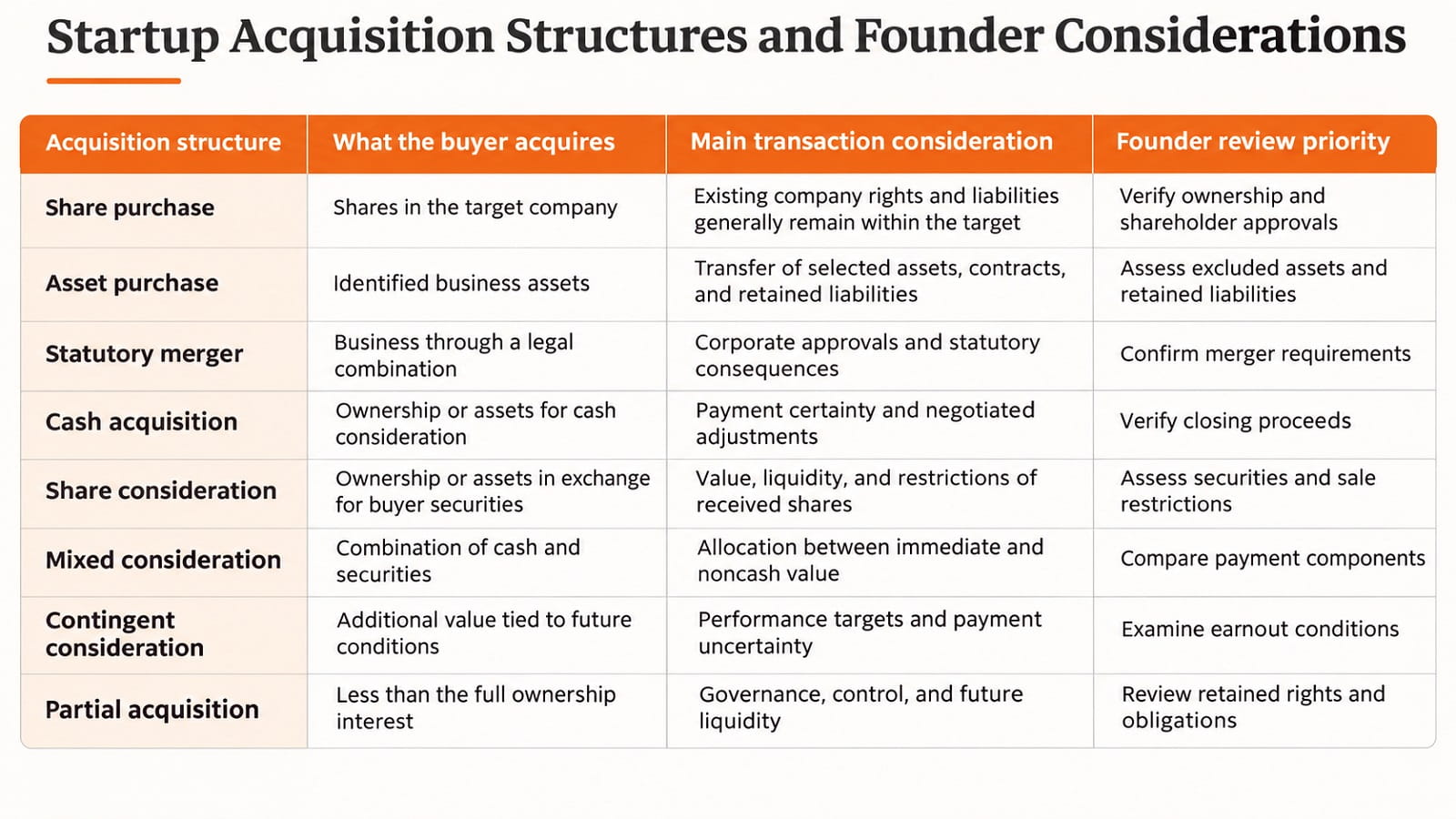
These categories describe different dimensions of a transaction and may overlap. A share purchase, for example, may use cash, buyer securities, or both. An acquisition may also include contingent payments alongside consideration delivered at closing. Founders should therefore review the complete transaction rather than select a structure based only on its label. Legal and tax advisers can help determine how the proposed arrangement affects the company and its shareholders.
Acquisition Due Diligence and Buyer Verification
After preliminary terms are established, the buyer usually conducts a detailed investigation of the startup. The purpose is to determine whether the business matches the information presented during negotiations and whether material risks justify changes to the offer or transaction conditions.
Financial reviewers may examine revenue recognition, cash flow, liabilities, customer concentration, and forecast assumptions. Legal specialists assess company ownership, material contracts, regulatory obligations, employment arrangements, and potential disputes. Technical reviewers may evaluate software architecture, security, infrastructure, and the reliability of important product capabilities.
Intellectual property is particularly important when the buyer values the startup's technology. If essential software was developed by contractors without adequate assignment agreements, the company may need to clarify its rights before completing the sale.
Founders should coordinate responses through a controlled information process. Inconsistent financial figures, incomplete records, or contradictory explanations can reduce confidence and extend negotiations. Identifying material issues before formal diligence can prevent avoidable surprises.
Purchase Agreements and Risk Allocation
Once the buyer has progressed sufficiently through its investigation, the parties negotiate definitive transaction documents. A share purchase agreement or asset purchase agreement may establish the purchase price, payment mechanics, representations, warranties, closing conditions, and allocation of contractual risks.
Representations and warranties are statements concerning specified aspects of the company or transaction. Their scope depends on the agreement, and inaccuracies can have consequences under negotiated indemnification or other contractual provisions. Disclosure schedules may identify exceptions to particular statements.
The agreement may also address purchase price adjustments, shareholder approvals, third-party consents, and obligations between signing and closing. Some transactions close when the definitive agreement is signed, while others require a separate closing after additional conditions are satisfied.
Founders should understand how liability limitations, escrow arrangements, and other negotiated protections affect their exposure after selling. The purchase price is important, but it is only one part of the economic and legal bargain.
Earnouts, Escrow and Deferred Payments
Acquisition consideration is not always paid entirely at closing. Buyers may retain part of the purchase price in escrow, issue shares instead of cash, or offer additional payments that depend on future performance.
An escrow can provide security for specified claims or obligations, subject to the agreement's terms. The funds may be released after a defined period or reduced if valid claims arise. Founders should examine the amount withheld, the release conditions, and the circumstances under which payments can be disputed.
An earnout links some consideration to future milestones, such as revenue, customer retention, or product development. These arrangements can help bridge disagreements about valuation, but they introduce uncertainty. The acquired business may operate under the buyer's control after closing, which can influence whether the targets are achieved.
Founders should distinguish purchase consideration from employee retention compensation. Payments dependent on continued employment may have different legal, tax, and economic consequences from amounts owed for shares or business assets.
A Practical Startup Acquisition Example
Consider VertexCloud Software, a fictional B2B software company that receives an acquisition proposal from a larger technology provider. The buyer offers total potential equity consideration of $24 million, combining immediate cash, an escrow amount, buyer shares, and a performance-based earnout.
For simplicity, assume the $24 million represents the total potential amount attributable to shareholders after any enterprise value adjustments. No additional debt, working capital adjustments, transaction expenses, or taxes are included in the calculation.
The founders collectively own 40% of the company on a fully diluted, as-converted basis. Assume that all equity holders participate proportionally, with no liquidation preferences or other rights changing the allocation. The founders' share of each payment component is therefore calculated at 40%.
Comparing Headline Value With Immediate Proceeds
The buyer proposes $17 million in cash at closing, $2 million held in escrow, $1 million in buyer shares, and up to $4 million in contingent consideration. Only the first component is assumed to be immediately available cash.
The following table shows how each component affects the founders' potential proceeds.
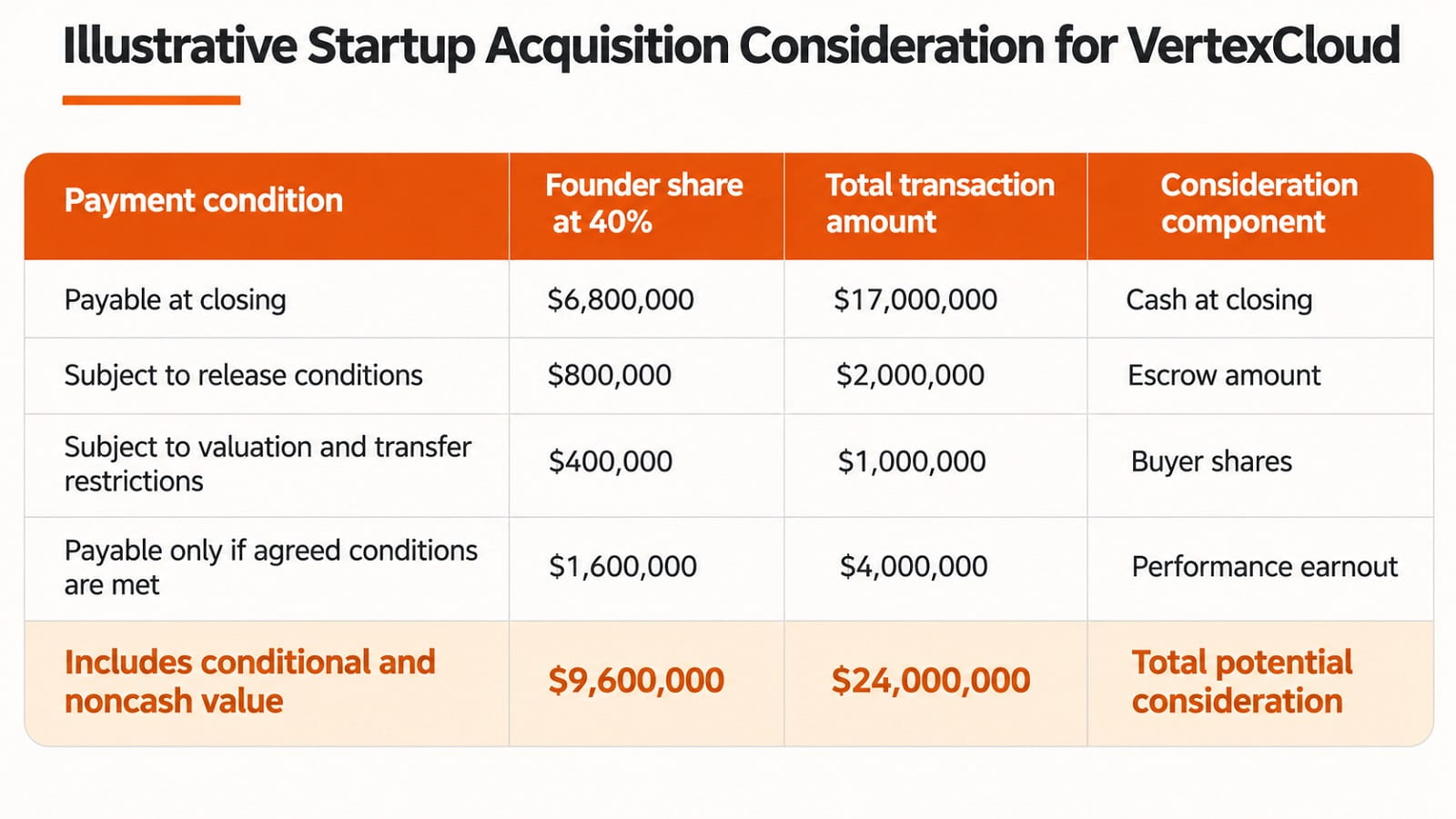
The founders' headline potential proceeds are $9.6 million, but the assumed cash available at closing is only $6.8 million before taxes and excluded expenses. The remaining $2.8 million consists of escrow, buyer shares, and contingent consideration, each subject to different conditions. The buyer shares may change in market value or be difficult to sell, while the earnout may never become payable. These differences demonstrate why founders should compare certainty and timing instead of treating every component as equivalent to cash.
Evaluating the Offer
VertexCloud's founders should examine the probability of receiving the deferred and contingent amounts. They should also understand whether the buyer can change the product strategy, operating budget, or customer relationships used to measure earnout performance.
If the company has alternative buyers, the founders can compare their offers using the same approach. A lower total price with more immediate cash might provide a more certain result, while a higher offer containing substantial contingent consideration could produce greater proceeds under favorable conditions.
The example does not establish that one structure is universally preferable. The appropriate decision depends on the founders' objectives, contractual protections, shareholder rights, and their assessment of the buyer's ability to complete the transaction.
Employee Retention and Post-Acquisition Integration
A successful closing does not necessarily end the founders' involvement. Buyers may require key employees to remain, assist with integrating systems, or manage important customer relationships during a transition period.
The buyer's integration plan can affect the original product, reporting structure, compensation arrangements, and employee responsibilities. Founders should clarify these expectations before closing, particularly when future payments depend on continued involvement or business performance.
Employee equity also requires attention. Options, restricted shares, and other incentive arrangements may be treated differently under the acquisition agreement. Founders should avoid promising particular payouts without confirming the applicable rights and transaction mechanics.
Clear communication helps preserve business continuity, but confidentiality obligations may limit what can be shared before the transaction is announced. Coordination with legal and human resources advisers is important when planning employee communications.
Why Startup Acquisitions Fail Before Closing
An acquisition can fail even after the parties agree on a preliminary valuation. Material due diligence findings, financing uncertainty, regulatory concerns, or unresolved negotiations may prevent completion.
One common difficulty is the discovery of information that changes the buyer's assessment of the business. Unreconciled financial metrics, missing intellectual property assignments, or unexpected liabilities can lead to revised terms or additional conditions.
Changes in the buyer's circumstances can also affect the transaction. Strategic priorities may shift, internal approval may not be obtained, or market conditions may reduce the buyer's willingness to proceed.
Founders should continue managing the startup while negotiations remain incomplete. Maintaining customer relationships, controlling expenditure, and preserving alternative financing options can reduce the consequences of an unsuccessful sale process.
Final Thoughts
Startup acquisitions involve a series of commercial, financial, and legal decisions that extend beyond agreeing on valuation. Buyers assess the company's strategic value and investigate whether its assets, contracts, technology, and financial performance support the proposed purchase.
Founders should understand the transaction structure, payment arrangements, shareholder rights, and responsibilities that may continue after closing. An offer with a higher headline price may not produce the most attractive outcome if substantial consideration is uncertain or subject to restrictive conditions.
Careful preparation, reliable business information, and appropriate professional advice allow founders to evaluate acquisition opportunities on their actual terms. The objective is to complete a transaction that reflects the value of the business while providing an acceptable financial outcome and a workable transition for the people involved.
FAQ
What Is a Startup Acquisition?
It is a transaction in which a buyer purchases a startup, an ownership interest, or selected business assets. The structure determines which rights and obligations are transferred.
Why Do Large Companies Acquire Startups?
Large companies may acquire startups to obtain technology, customers, specialized employees, intellectual property, or access to new markets. The acquisition rationale depends on the buyer's business objectives.
How Is a Startup Acquisition Price Determined?
Buyers evaluate financial performance, growth prospects, commercial risks, technology, and strategic benefits. The negotiated price also depends on market conditions and the alternatives available to both parties.
What Is the Difference Between a Share Purchase and an Asset Purchase?
A share purchase transfers ownership of shares in the target company. An asset purchase transfers identified assets and relevant obligations according to the agreement and applicable law.
What Happens During Acquisition Due Diligence?
The buyer verifies financial information, ownership records, commercial contracts, technology, legal obligations, and other material business claims before deciding whether to complete the transaction.
Do Founders Receive the Entire Purchase Price at Closing?
Not necessarily. Consideration may include escrow, buyer shares, deferred payments, and earnouts. Founder proceeds also depend on ownership percentages, investor rights, expenses, and applicable adjustments.
What Happens to Employees After an Acquisition?
Employees may remain with the business, join the buyer, or experience changes to their roles. Their treatment depends on the integration plan, employment agreements, equity rights, and applicable law.
Can an Acquisition Fail After Signing an LOI?
Yes. An LOI does not necessarily guarantee a completed sale. Due diligence findings, financing problems, unresolved contractual terms, or unmet conditions may prevent closing.

Mobina Khanki
Venture & Funding Writer at PinerookMobina Khanki covers venture capital, startup funding, fundraising, and startup finance for Pinerook, focusing on founders and investors.
 Seen first.