
Secondary shares allow existing shareholders in a private startup to sell their ownership interests to another investor without requiring the company to issue new shares. These transactions can provide liquidity to early investors, employees, and founders who otherwise might need to wait for an acquisition or public offering. However, private company shares are not traded as freely as shares listed on a stock exchange. A sale may require company approval, compliance with transfer restrictions, and a buyer willing to accept limited information and uncertain future liquidity.
Within Startup Exit and M&A, private share transactions provide an alternative to a complete company sale. A startup can remain independent while ownership changes between existing shareholders and new investors. This distinction matters because the money paid for existing shares generally goes to the seller, not to the startup. The transaction can change the shareholder base without increasing the number of outstanding shares or providing additional capital for operations.
Understanding secondary shares requires examining how private transfers are structured, how prices are negotiated, and which legal restrictions influence completion. The process also involves practical questions about buyer eligibility, shareholder rights, company records, and settlement. This guide explains these issues and uses a financial example to show how a private share sale affects the seller, buyer, company capitalization, and ownership percentages.
What Are Secondary Shares in a Startup?
Secondary share transactions involve the transfer of existing equity interests from a current holder to a new purchaser. The company has already issued the shares, so the transaction normally changes who owns them rather than creating additional securities.
For example, an early investor may own 100,000 shares in a private technology company. If that investor sells 25,000 shares to another eligible investor, the buyer receives the transferred ownership interest and the original investor retains 75,000 shares. Assuming no other changes to the capitalization, the company's total outstanding share count remains unchanged.
This differs from a primary financing round. In primary financing, a startup typically issues additional shares to raise money for business operations. Existing shareholders may experience percentage dilution because more shares become outstanding. A conventional secondary transfer does not create that form of dilution.
The distinction has important consequences for financial planning. A large private share transaction may suggest that investors are willing to pay for an ownership interest, but it does not necessarily improve the company's cash balance. Founders should therefore separate shareholder liquidity from corporate fundraising when discussing financing needs.
Why Private Startup Shareholders Sell
Private company shareholders may hold valuable securities for years without having a straightforward opportunity to convert them into cash. The absence of a public trading market can make it difficult to sell even when the startup has achieved substantial growth.
Early investors may seek liquidity because their investment funds are approaching the end of their planned holding periods. Other shareholders may want to rebalance their portfolios or reduce exposure to a single private company. Employees holding vested equity may also seek liquidity to address personal financial needs, subject to their equity agreements.
The company may support a controlled transaction when it wants to provide liquidity without completing an acquisition or public offering. This can be particularly relevant for mature private startups that intend to remain independent while allowing selected shareholders to realize some of their investment value.
Not every seller has the same objectives. An early investor may prefer to sell an entire holding, while an employee may want to sell only enough equity to cover exercise costs and taxes. These differences can influence the appropriate transaction structure and the amount of ownership transferred.
Primary Versus Secondary Share Transactions
The main difference between primary and secondary transactions is who supplies the securities and who receives the purchase proceeds.
In a primary transaction, the company issues new shares to investors. The company generally receives the investment proceeds and can use the capital for operating activities, subject to any restrictions or transaction costs.
In a conventional secondary transaction, the buyer purchases securities already owned by an existing shareholder. The seller receives the proceeds, and the company does not receive new share subscription capital.
A financing round can include both components. For example, an investor may subscribe for newly issued shares while separately purchasing existing shares from an early investor. In this case, only the primary component increases the company's outstanding share count, assuming no other changes.
The distinction is especially important when announcing transaction valuations. A buyer's willingness to purchase existing common shares at a particular price does not automatically establish the price or value of other securities with different rights.
How the Private Secondary Market Works
Unlike publicly traded shares, private startup equity does not generally have a continuously accessible market with transparent prices and readily available buyers.
Transactions may be negotiated directly between investors, arranged through specialized intermediaries, or organized as company supported liquidity programs. The process depends on the securities being transferred, the company's governing documents, and applicable legal requirements.
A direct transaction typically begins when a shareholder identifies an interested purchaser. The parties discuss the number of shares, proposed price, and conditions required for the sale. The buyer may request financial information or other evidence to assess the investment.
The transaction must then pass through the necessary legal and contractual checks. These can include company approval, verification of ownership, transfer restrictions, and any rights held by the company or other shareholders.
Company organized programs may provide a more coordinated process for multiple sellers. Such arrangements can establish eligible participants, a specific transaction period, and pricing or allocation procedures. However, participation and completion are still subject to the program rules.
Types of Secondary Share Transactions
Different transaction formats serve different shareholder needs. A single investor sale may be negotiated privately, while an organized liquidity program can allow several shareholders to sell under common procedures.
The following table compares major transaction formats and their practical considerations.
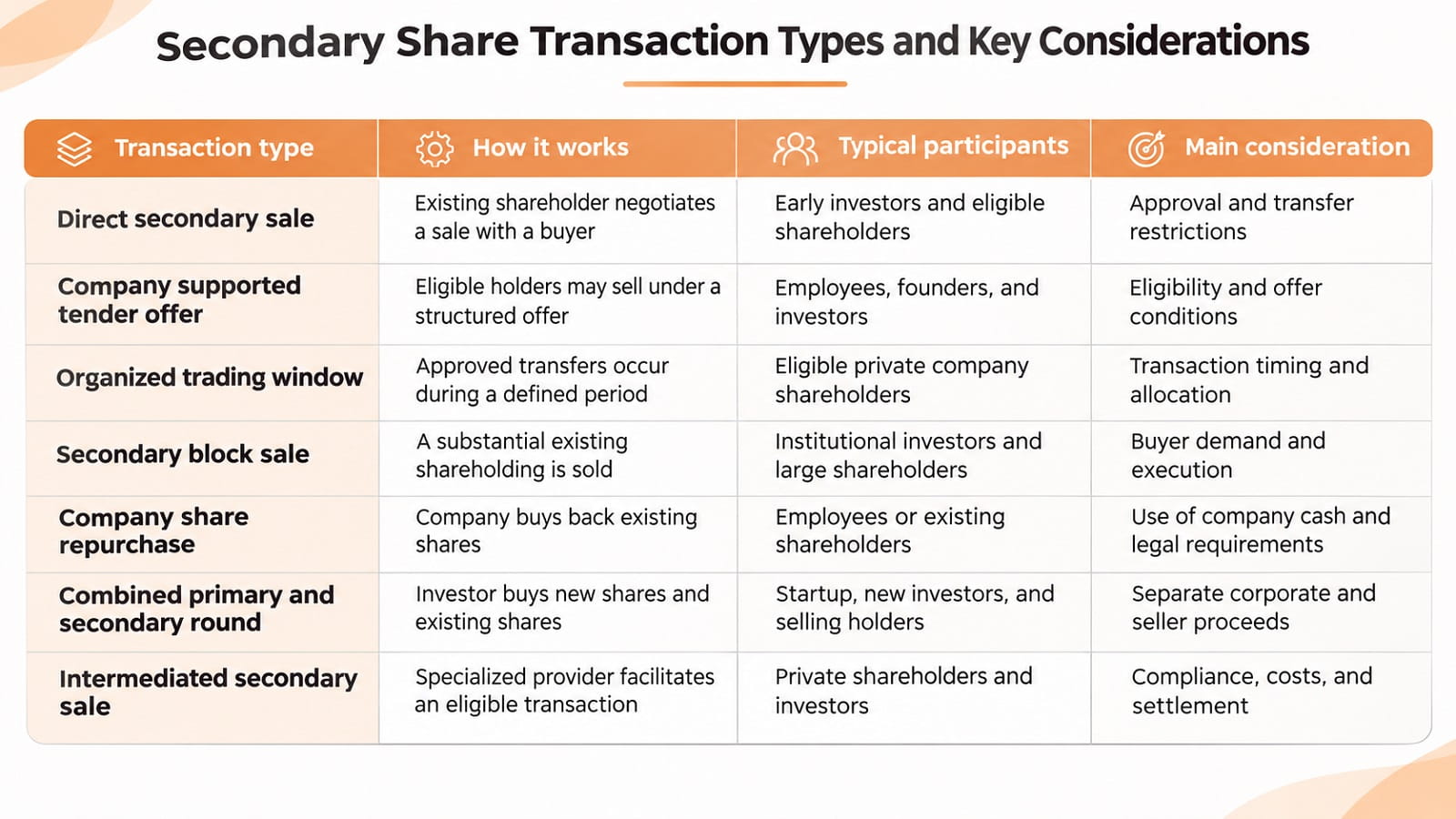
These formats are not legally interchangeable. A company repurchase uses company funds and may be subject to different corporate requirements from a sale to an outside investor. A tender offer can also involve securities rules and procedural requirements that do not apply identically to every privately negotiated transfer. Founders and shareholders should evaluate the actual transaction documents and applicable laws rather than assume that all secondary liquidity programs follow the same process.
Share Transfer Restrictions and Company Approval
Ownership of private shares does not necessarily provide an unrestricted right to sell them. Startup governing documents, shareholder agreements, and equity plans may limit transfers or require specified procedures before a transaction can proceed.
One common restriction is a right of first refusal, often called ROFR. Under such an arrangement, the company or another eligible party may have the right to purchase the offered shares under the conditions established in the agreement before the proposed outside buyer can complete the purchase.
For example, an investor may negotiate a sale with an outside purchaser and then be required to notify the company of the proposed terms. If the company has an enforceable right of first refusal, it may be entitled to exercise that right within the agreed period.
Other restrictions can involve board approval, limits on eligible purchasers, or restrictions intended to support regulatory compliance. The precise requirements depend on the documents governing the securities.
A shareholder should review these restrictions before entering a binding sale commitment. A negotiated price alone does not establish that the shares can legally be transferred.
Securities Law and Buyer Eligibility
Private share transactions may involve securities originally issued without public registration. In the United States, the resale must generally be registered or qualify for an available exemption, with relevant state securities requirements also considered.
Rule 144 provides one potential pathway for certain resales of restricted and control securities when its conditions are satisfied. However, it is not the only possible framework and does not automatically authorize every private share transaction.
The legal analysis may depend on the identity of the seller, the type of securities, holding periods, transaction structure, available exemptions, and whether an intermediary is involved.
Buyer eligibility also matters. Some transactions or platforms restrict participation to investors who meet specified legal or program requirements. A prospective buyer should not assume that willingness to pay establishes eligibility to complete the purchase.
Professional legal review is particularly important when dealing with complex ownership structures, cross border transactions, or securities subject to multiple restrictions.
How Secondary Share Prices Are Determined
Private share prices are generally established through negotiation, a structured sale process, or a program that applies specified pricing terms. Unlike public market prices, these values may not reflect frequent transactions between large numbers of buyers and sellers.
A buyer may examine recent financing rounds, financial performance, growth prospects, comparable businesses, expected liquidity timing, and the rights attached to the shares.
A recent preferred share financing price can provide a reference point, but it may not represent the appropriate value of existing common shares. Preferred securities can include liquidation preferences, conversion rights, and other protections that affect their economics.
The size of the holding, transfer restrictions, and available information may also affect negotiations. An investor purchasing a large block may have different objectives from one acquiring a smaller minority interest.
Sellers should distinguish a proposed purchase price from a reliable estimate of what all shareholders could receive. One negotiated transaction does not necessarily establish a universally applicable company valuation.
A Practical Secondary Share Sale Example
Consider AsterCloud Technologies, a fictional private software startup with 10 million ordinary shares outstanding. An early investor owns 1.5 million shares, representing 15% of the company.
The investor negotiates a sale of 400,000 existing shares to another eligible institutional investor at $12 per share. Assume the transaction receives all necessary approvals and is completed without any additional securities being issued or canceled.
Under these assumptions, the total transaction consideration is $4.8 million. The seller's holding decreases to 1.1 million shares, while the buyer becomes the owner of 400,000 shares.
The company's total share count remains at 10 million because the transaction transfers existing securities between investors.
Calculating Proceeds and Ownership Changes
For the example, assume that the seller incurs $48,000 in transaction expenses and that no other deductions are included. The net proceeds before taxes are therefore $4.752 million.
The buyer receives 4% of the company's outstanding ordinary shares. The original investor retains 11%, down from 15%.
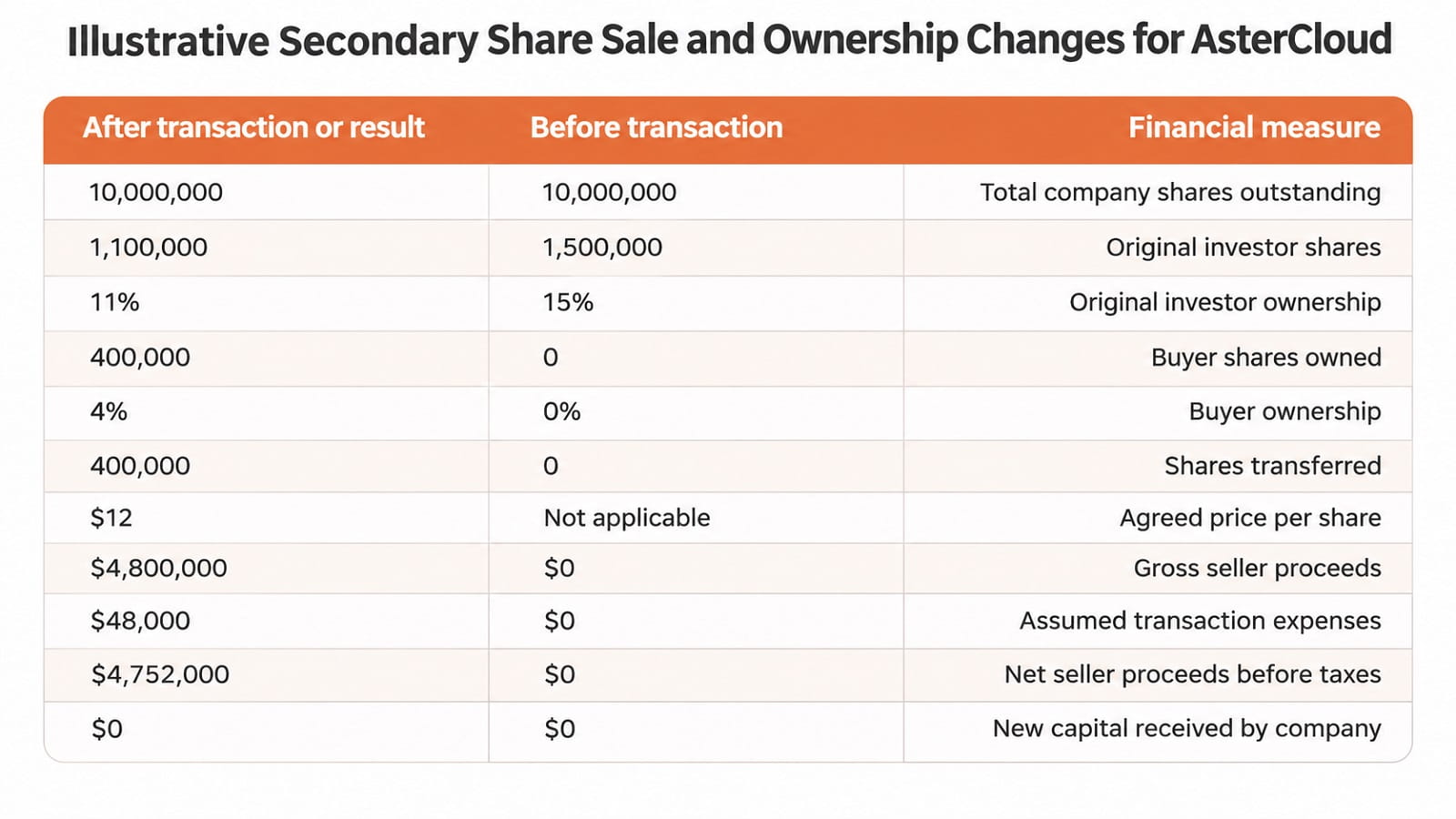
The example demonstrates that a private secondary sale can provide substantial liquidity to a shareholder without creating new financing for the startup. AsterCloud receives no primary investment proceeds from this transaction, and its outstanding ordinary share count remains unchanged. The original investor reduces ownership by four percentage points, while the purchaser acquires that same economic percentage under the stated assumptions. The net proceeds reflect only the illustrative transaction expenses and exclude taxes and any additional costs.
What the Transaction Price Implies
At $12 per ordinary share, the transaction implies a simple equity value of $120 million if the same price is multiplied by all 10 million outstanding ordinary shares.
However, this calculation should not be treated as a definitive valuation of the business. The buyer has purchased a specific minority interest under negotiated conditions. The transaction does not establish what another investor would pay for a controlling interest or for securities carrying different rights.
AsterCloud should also consider how the new shareholder fits within its ownership structure. Although the sale does not dilute existing shareholders, it changes the identity of one of the company's investors and may affect future shareholder communications or governance arrangements.
How a Secondary Share Transaction Closes
Completion requires more than an agreement on price. The parties need to verify ownership, confirm that the buyer can acquire the securities, and satisfy the applicable approval and transfer procedures.
The company or its representatives may need to confirm the number and class of shares held by the seller. Existing transfer restrictions and relevant shareholder rights must be reviewed before the transfer is authorized.
Depending on the arrangement, the parties may execute a share purchase agreement, required notices, and other supporting documents. Payment and share transfer can then occur according to the agreed settlement procedure.
The company's capitalization records should be updated to reflect the new owner. Where a transfer agent or equity management provider maintains the records, the necessary instructions must be completed accurately.
Settlement should not be considered complete merely because the parties have signed an agreement. Payment, legal transfer, and the recognition of the new shareholder must occur according to the governing documents and applicable law.
Risks for Buyers of Private Startup Shares
Buying private shares exposes investors to risks that may differ from those associated with listed securities.
The first concern is liquidity. A buyer may have no practical opportunity to sell the shares for several years. A future acquisition or IPO is possible, but neither is guaranteed.
Limited information is another challenge. Private companies generally do not disclose financial and operating information to the public in the same manner as listed companies. Buyers must understand what information they can lawfully obtain and how much uncertainty remains.
Valuation risk also matters. A company may grow more slowly than expected, require additional financing, or encounter financial difficulties that reduce the value of existing shares.
Finally, securities rights can affect economic outcomes. Common shareholders may receive less than preferred shareholders in certain liquidation or exit scenarios, depending on the company's agreements.
Buyers should evaluate the actual share class, rights, restrictions, and financial condition of the issuer before committing capital.
Risks and Responsibilities for Selling Shareholders
A seller should verify that the securities are transferable and that the proposed transaction complies with contractual and legal requirements.
The seller must also evaluate the amount of cash that will remain after transaction expenses and applicable taxes. An attractive gross sale price may not represent the final economic outcome.
Price negotiations involve an additional tradeoff. Selling today provides current liquidity but eliminates participation in future changes in value for the shares transferred. Remaining invested preserves that exposure while continuing the risk of illiquidity or capital loss.
Shareholders should also consider confidentiality obligations. Possessing company information does not necessarily authorize disclosing it to a potential buyer. Approved information sharing arrangements can be important during negotiations.
A disciplined sale process helps the seller evaluate the transaction without assuming that every interested buyer can complete the purchase.
When a Startup Should Support Secondary Liquidity
Supporting a secondary transaction can be useful when a startup wants to address shareholder liquidity needs while remaining privately owned.
A controlled program may help manage requests from employees and early investors, establish consistent procedures, and reduce uncertainty about permitted transfers. It can also allow management to understand who may enter the shareholder base.
However, company involvement requires resources. Management must consider compliance requirements, transaction costs, ownership records, and the potential impact on existing shareholder relationships.
A startup should not support liquidity merely to create the appearance of strong investor demand. The transaction should have a clear purpose, reliable procedures, and terms that appropriately balance the interests of the company and its shareholders.
The decision depends on financial maturity, investor demand, corporate governance, and whether management can administer the process without distracting excessively from business operations.
Final Thoughts
Secondary share transactions allow existing startup investors, founders, and employees to seek liquidity while a company remains privately owned. They can change the shareholder base without issuing additional equity or raising new operating capital for the business.
The value of these transactions depends on more than the agreed price. Transfer restrictions, buyer eligibility, securities rights, information availability, and settlement procedures all influence whether a sale can be completed.
For startups, an organized approach can support shareholder needs without compromising corporate governance. For buyers and sellers, careful review of the securities and transaction conditions is essential to understanding the financial risks and the actual ownership being transferred.
FAQ
What Are Secondary Shares in a Startup?
They are existing shares transferred from a current shareholder to another investor. The transaction generally changes ownership without requiring the company to issue additional shares.
Do Secondary Share Sales Dilute Existing Investors?
A conventional transfer of existing shares does not increase the company's outstanding share count and therefore does not create percentage dilution. A combined financing round may separately involve new share issuance.
Who Receives the Money From a Secondary Sale?
The selling shareholder generally receives the purchase proceeds. In a conventional sale between shareholders, the startup does not receive new share subscription capital.
Can Employees Sell Shares in a Private Startup?
Sometimes. Eligibility depends on whether employees hold transferable securities, the applicable equity plan, company approvals, legal requirements, and any available liquidity program.
How Are Private Secondary Share Prices Set?
Prices may be negotiated directly or established through a structured transaction process. Buyers consider financial performance, share rights, future liquidity, risk, and relevant market evidence.
What Is a Right of First Refusal?
It is a contractual right that may allow the company or another eligible party to purchase shares under specified conditions before an intended outside transfer is completed.
Are Private Secondary Share Sales Legal?
They can be, provided the transaction satisfies applicable securities laws, contractual restrictions, and other relevant requirements. The appropriate legal framework depends on the transaction.
Can Secondary Shares Be Sold Before an IPO?
Yes, where the securities are transferable and a permitted buyer and transaction structure are available. A future IPO is not required for every private secondary sale.

Mobina Khanki
Venture & Funding Writer at PinerookMobina Khanki covers venture capital, startup funding, fundraising, and startup finance for Pinerook, focusing on founders and investors.
 Seen first.