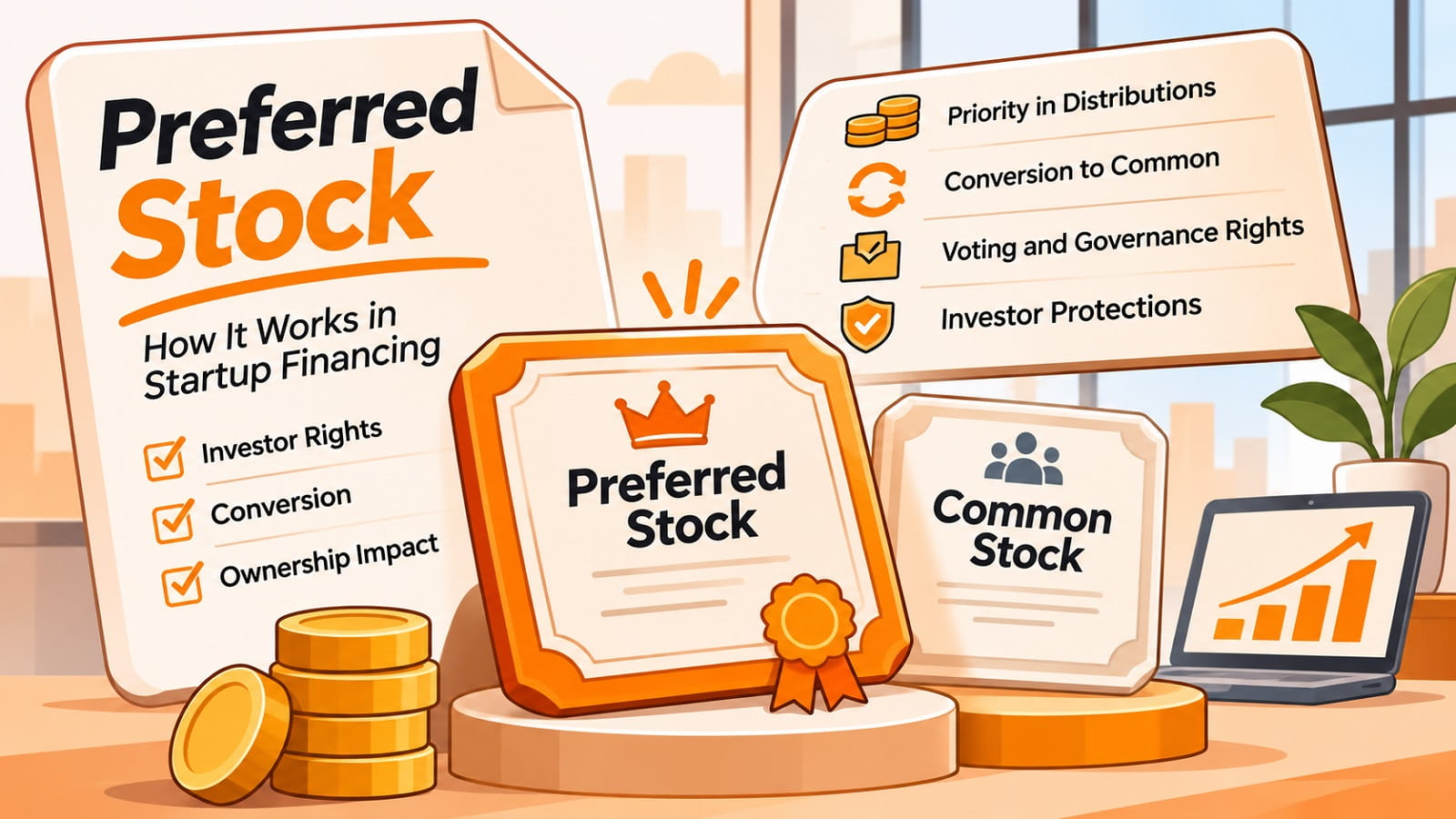
Preferred stock is one of the most important securities used in startup financing because it allows investors to acquire ownership while negotiating rights that ordinary shareholders may not receive. These rights can influence how investors participate in company sales, which corporate decisions require approval, and how their shares are treated during future financing rounds. For founders, understanding preferred shares is essential because two investors purchasing the same ownership percentage may receive substantially different economic and governance rights.
Within Term Sheets and Investment Deals, preferred shares provide the legal structure through which many venture capital investments are completed. They can combine ordinary equity ownership with contractual preferences concerning distributions, conversion, voting, and other matters. However, preferred stock does not have one universal set of rights, and the terms used by one startup may differ significantly from those negotiated by another.
This guide explains the purpose of preferred stock, its differences from common stock, and the documents that establish investor protections. It also provides a practical financing example showing how preferred shares are issued, represented in a capitalization table, and converted into common shares under an illustrative conversion arrangement.
Understanding Preferred Stock in Startup Financing
Preferred stock is a class of corporate equity that carries rights, preferences, or restrictions distinct from those attached to common stock. In venture backed companies, investors frequently receive preferred shares when they provide capital through a priced financing round.
The word preferred refers to the rights established for the security rather than a promise that the investment will perform better than common stock. An investor may receive priority in certain distributions, but the shares can still lose substantial value if the company performs poorly.
Preferred stock is especially relevant to startups because outside investors often want economic protections in exchange for accepting the uncertainty associated with young businesses. Founders, by contrast, commonly hold common shares that provide direct ownership without the same preferential economic claims.
In a US corporation, the rights associated with preferred shares are generally established through the certificate of incorporation and related corporate documents. The company may create different series with different terms, provided the relevant corporate requirements are satisfied.
Preferred Stock vs Common Stock
Common stock and preferred stock both represent equity ownership, but their economic and governance characteristics can differ. Common shares are often issued to founders and certain early shareholders, while preferred shares are frequently sold to venture investors.
Common shareholders typically participate in the residual economic value of a company after applicable obligations and preferential claims have been addressed. Preferred shareholders may have additional rights that affect their priority or the calculation of their distributions.
Voting rights require particular attention. Some preferred shares vote alongside common shares on an as converted basis, while investors may also receive separate class voting rights or contractual approval rights over specified decisions.
The following table compares important characteristics of the two securities in a typical US venture financing context. Every provision remains subject to the company's actual governing documents.
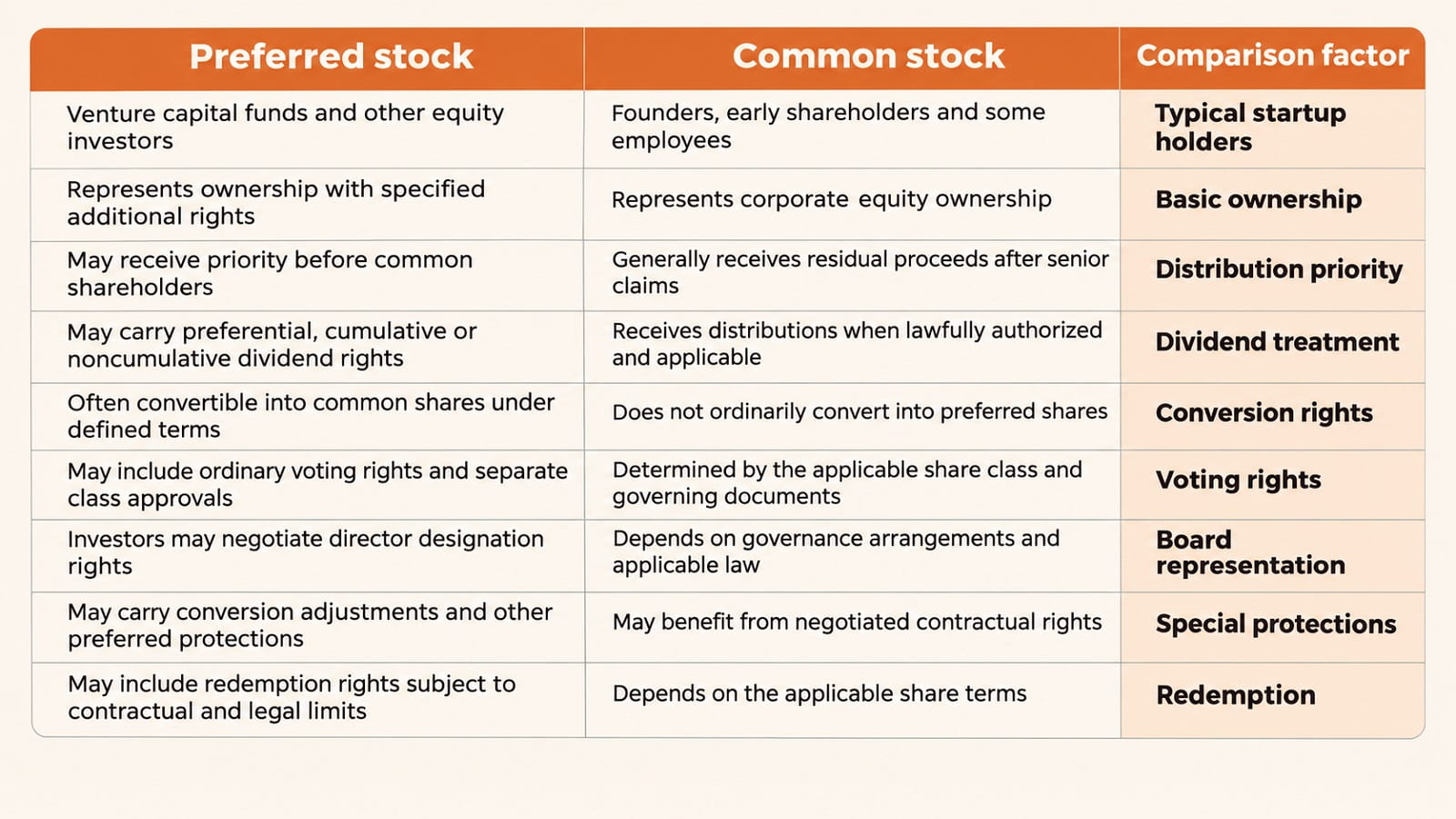
The differences shown in the table are not automatic consequences of the names common and preferred. For example, preferred stock does not necessarily pay dividends, and holding preferred shares does not automatically entitle an investor to appoint a director.
The company must examine the specific rights established for each share class or series. This distinction becomes especially important when a startup completes several financing rounds with different groups of investors.
Why Venture Capital Investors Use Preferred Shares
Venture investors provide capital to businesses whose future financial performance is uncertain. In exchange, they often seek an equity instrument that combines the opportunity to benefit from growth with negotiated protections addressing specific risks.
Preferred stock allows those terms to be documented within a corporate securities structure. Investors can negotiate certain distribution priorities, conversion provisions, and governance protections while retaining an ownership interest in the company.
For a startup, this structure can make institutional financing possible without transferring existing founder shares directly to investors. The company issues new preferred securities and receives the investment proceeds, while founders retain their existing common shares subject to the percentage changes associated with the financing.
The arrangement also creates a framework for additional investment rounds. A company may issue one preferred series during its seed financing and introduce another series when it raises institutional capital later.
How Preferred Stock Is Issued
A preferred stock financing ordinarily begins with negotiations concerning the investment amount, valuation, proposed security rights, and other principal transaction terms. The parties may document their preliminary agreement in a term sheet before preparing definitive financing agreements.
The company must then establish or confirm the authorized preferred securities and the rights applicable to the relevant series. Appropriate corporate approvals, governing document amendments, and other transaction requirements may be necessary.
Investors acquire the preferred shares under the agreed purchase arrangements. In a primary financing, the company receives the investment proceeds and issues the new securities to the investors.
The company's capitalization records should be updated to reflect the number of preferred shares issued, their series, their original purchase price, and their applicable conversion terms.
The final securities rights are determined by the legal documents, not merely by a summary percentage discussed during fundraising. Founders should ensure that the capitalization model and the definitive agreements describe a consistent transaction.
Preferred Stock Valuation and Purchase Price
The number of preferred shares issued during a financing depends on the negotiated valuation and the share count used for pricing. A simple priced round establishes a purchase price per share by dividing the agreed pre investment valuation by the relevant pre financing capitalization.
Suppose a startup has 9 million shares outstanding and negotiates a $9 million pre investment valuation. If there are no additional securities or capitalization adjustments, the financing price would be $1 per share.
An investor contributing $3 million at that price would receive 3 million newly issued preferred shares. The company would then have 12 million shares outstanding, consisting of 9 million common shares and 3 million preferred shares.
Assuming the preferred shares initially convert into common shares on a one for one basis, the investor would hold 25% of the company on an as converted basis.
This calculation establishes the initial ownership structure, but it does not mean the investor's preferred securities have identical rights to the common shares held by founders.
A Practical Preferred Stock Financing Example
Consider Oakridge Systems, a fictional enterprise technology startup established by two founders. The company has issued 5.4 million common shares to Founder A, 2.7 million common shares to Founder B, and 900,000 common shares to early team members.
Before financing, the company has 9 million issued and outstanding common shares. There are no unexercised options, employee equity reserves, SAFEs, convertible notes, warrants, or other potential shares included in this simplified example.
Oakridge Systems raises $3 million through the issuance of Series Seed preferred stock at a $9 million pre investment valuation. The investor purchases 3 million preferred shares at $1 per share, and the post investment equity valuation becomes $12 million.
For this example, every Series Seed preferred share is initially convertible into one common share. The following table records the securities issued after financing and the hypothetical share counts if all preferred shares were subsequently converted into common shares.
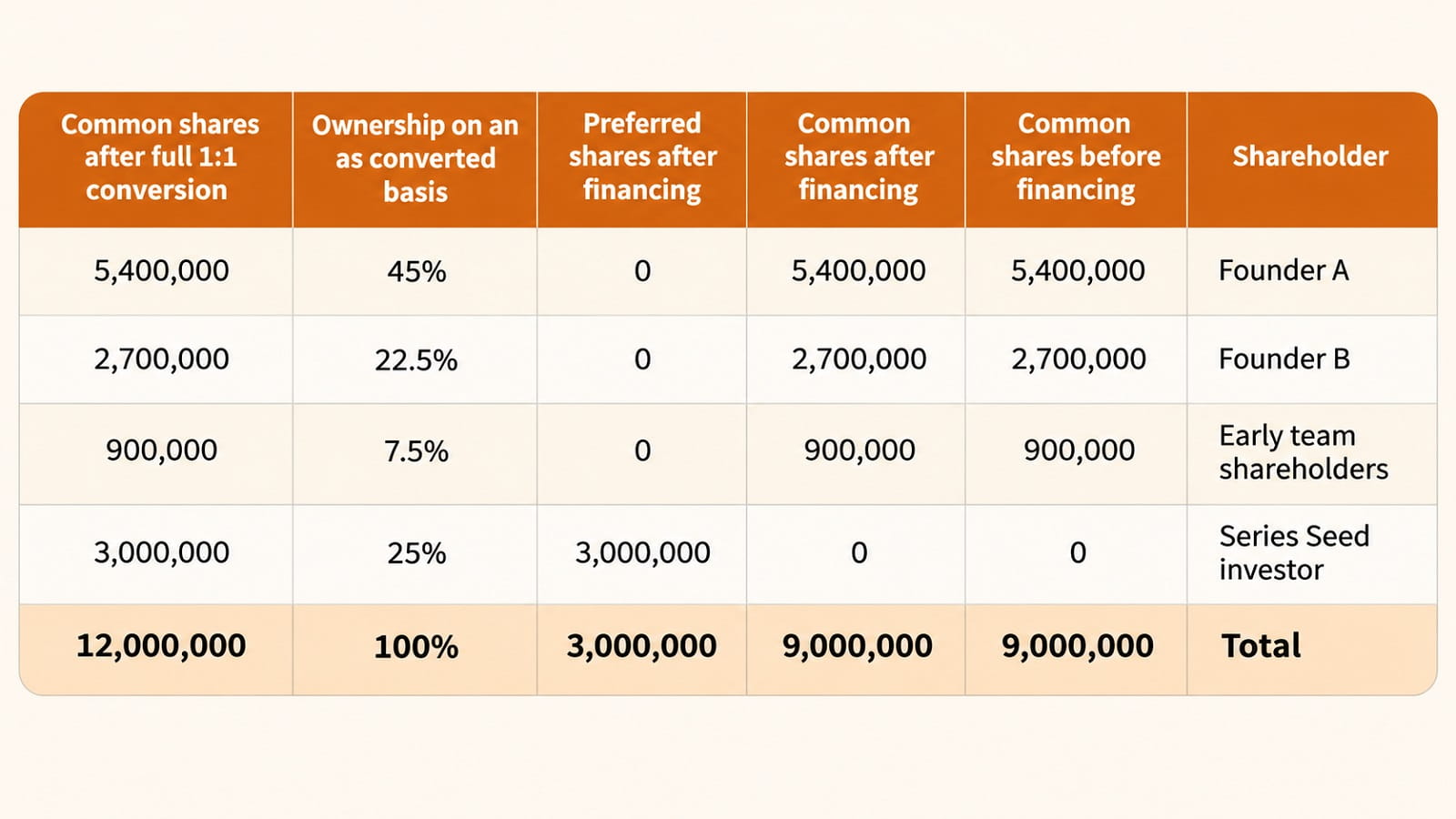
Immediately after financing, Oakridge Systems has 9 million common shares and 3 million preferred shares outstanding. The investor's preferred shares are represented as 3 million common equivalents for the ownership calculation.
If all preferred shares are converted at the assumed one for one ratio, the investor's 3 million preferred shares are replaced by 3 million common shares. The company then has 12 million common shares and no outstanding preferred shares from this series.
The total number of shares represented on an as converted basis does not change through this hypothetical conversion. Founder A remains at 45%, Founder B at 22.5%, the early team at 7.5%, and the investor at 25%.
However, the conversion can change the rights associated with the investor's securities. Once the investor holds common shares, the special rights attached to the converted preferred shares generally no longer apply to those shares.
This example demonstrates an important distinction: conversion can alter the legal and economic characteristics of a security without changing the shareholder's percentage ownership.
Understanding Preferred Stock Conversion
Convertible preferred stock gives the holder a right to convert preferred shares into common shares under specified conditions. The initial conversion ratio in many startup financings is one common share for each preferred share, although the ratio can be adjusted under the governing documents.
Conversion rights allow preferred shareholders to participate as common shareholders when doing so is economically advantageous. The relevant provisions determine whether conversion is optional, automatic following a qualifying event, or subject to other conditions.
For example, a qualifying public offering may trigger automatic conversion if the company's certificate of incorporation establishes that outcome. The investor would then hold common shares rather than continuing to hold the original preferred securities.
Conversion does not automatically create additional economic value. The benefit depends on the rights being exchanged and the circumstances of the transaction.
Founders should review the original conversion ratio, permitted adjustments, voluntary conversion rules, and automatic conversion conditions. These provisions influence both the security's treatment during corporate transactions and the calculation of common equivalent ownership.
Liquidation Rights Attached to Preferred Stock
One important economic characteristic of venture preferred shares is the possibility of priority distributions during specified liquidation or acquisition events.
Under a typical one times nonparticipating arrangement, an investor may receive a priority amount based on the original investment or convert into common shares when conversion would produce a larger distribution.
Participating preferred securities can operate differently because they may allow the investor to receive the priority amount and then participate in additional proceeds, subject to the applicable terms.
The value of these rights depends on the proceeds available after obligations senior to equity have been satisfied. A preference is not a guarantee that the investor will recover the original investment.
For founders, the essential point is that preferred and common ownership percentages do not always correspond directly to the percentage of acquisition proceeds received. The governing documents establish how the relevant distributions are calculated.
Dividend Rights and Preferred Shares
Preferred shares can include dividend rights that differ from those attached to common stock. The agreement may specify a dividend rate, priority, payment conditions, and whether unpaid amounts accumulate.
A cumulative dividend provision can allow specified unpaid dividends to accumulate according to the governing terms. A noncumulative provision generally does not provide the same right to accumulate dividends from periods when they are not declared or otherwise payable.
The existence of a dividend rate should not be interpreted as a promise of regular cash payments. Startup preferred dividends may depend on lawful declarations, applicable corporate restrictions, and other contractual conditions.
Many early stage technology companies prioritize reinvesting available resources into product development and growth rather than distributing earnings to shareholders.
Founders should nevertheless examine dividend provisions because accumulated or declared unpaid amounts may become relevant during an acquisition or other distribution event.
Investor Voting and Protective Provisions
Preferred shareholders may receive voting rights in addition to their economic ownership. Some arrangements allow preferred shares to vote alongside common stock using the number of common shares into which they are convertible.
Investors may also negotiate separate approval rights over specified corporate decisions. These protective provisions can apply even when the investor holds a minority economic position.
For example, a preferred shareholder class may need to approve certain changes to its rights, the issuance of specified senior securities, or other major transactions covered by the governing documents.
These provisions should not automatically be interpreted as complete investor control over the company. The outcome depends on voting thresholds, board authority, share classes, and the particular decisions requiring approval.
Founders should distinguish ordinary shareholder voting from class consent requirements and contractual governance commitments. Each can affect company decisions in a different way.
Board Representation and Preferred Investors
Board representation is another area in which financing negotiations can influence the relationship between investors and founders. Investors may request the right to designate one or more directors under the applicable voting arrangements.
A director appointed through an investor designation right generally serves as a director of the company and remains subject to applicable legal duties. The director is not simply an agent authorized to disregard those duties in favor of the appointing investor.
An investor may alternatively receive observer rights allowing a representative to attend certain board meetings without holding a director's formal vote. The scope of those rights depends on the agreement.
The number of preferred shares an investor owns does not automatically determine how many board seats the investor receives. Board composition must be examined through the company's governance documents and negotiated arrangements.
For founders, the central question is whether the resulting board structure supports effective oversight while preserving workable decision making.
Preferred Stock in Future Financing Rounds
A startup may issue multiple preferred share series as it raises additional capital. Each series can have a different original issue price, conversion terms, and economic or governance rights.
For example, Oakridge Systems could issue Series Seed preferred shares in its first institutional round and later sell Series A preferred shares to another investor group. The later series might have different preferences or rank differently in distributions.
The introduction of another preferred class can affect earlier investors and common shareholders. New shares increase the relevant capitalization, while additional contractual rights may change future distributions or governance arrangements.
Some investors negotiate rights that allow them to participate in later financing rounds. These rights generally require the investor to contribute additional capital when exercised.
Companies should examine how the provisions of existing preferred securities interact with proposed new terms. A financing transaction should be modeled across all relevant share classes rather than evaluated as if the new shares exist independently.
Preferred Stock and Price Protection
Certain preferred shares include price protection provisions that become relevant when a company later issues qualifying shares at a lower price.
These provisions commonly adjust the conversion price of the protected preferred shares. A lower conversion price may increase the number of common shares represented by each preferred share.
Different adjustment methods can produce different outcomes. Some formulas consider the amount of new financing, while others apply a stronger adjustment based primarily on the lower issuance price.
The result depends on the conversion provisions and any contractual exceptions. Not every issuance below an earlier investment price automatically triggers an adjustment.
The broader significance for preferred stock is that conversion rights can change over time. Founders and investors should therefore distinguish the original conversion ratio from the ratio applicable after any authorized adjustments.
Redemption Rights and Investor Liquidity
Some preferred securities contain redemption provisions that establish circumstances in which the company may or must repurchase shares according to the applicable terms.
Redemption rights can be structured differently. A provision may allow the company to redeem securities, give qualifying investors the ability to request redemption after specified conditions, or establish another negotiated arrangement.
Such rights remain subject to applicable corporate law and contractual limitations. In a Delaware corporation, a contractual redemption obligation does not eliminate legal restrictions on using corporate funds to repurchase shares.
A redemption provision should therefore not be treated as a guaranteed source of liquidity. The company's financial position and applicable restrictions may prevent payment when a redemption right becomes exercisable.
Founders should examine the timing, price calculation, approval requirements, and consequences of an inability to complete redemption. These obligations can affect financial planning even if the company expects to pursue an acquisition or public listing instead.
Preferred Share Price vs Common Share Value
The price paid by a preferred investor does not necessarily equal the value of the company's common stock. Preferred shares may contain additional contractual rights that influence how investors value the security.
For example, Oakridge Systems issues Series Seed preferred shares at $1 per share. That financing price establishes the price paid for the preferred security under the transaction terms.
It does not automatically establish that every common share can be sold for $1. Common shares may have different economic rights, transfer restrictions, and liquidity characteristics.
This distinction becomes important when a company grants employee stock options. For US private companies, the fair market value of common stock used for option pricing may be supported by a separate valuation process under the applicable tax rules.
Founders should therefore avoid using preferred financing prices as a universal measure of the immediately realizable value of every security in the company.
Where Preferred Stock Rights Are Documented
The preferred stock purchase is generally supported by several legal documents. In a typical US venture financing, the certificate of incorporation or its amended form establishes important rights of the preferred share series.
The stock purchase agreement addresses the investment transaction, including purchase terms, representations, and closing requirements.
Additional agreements may govern information rights, future investment participation, director designations, voting commitments, and restrictions on certain share transfers.
These documents operate together, but they do not necessarily perform the same legal function. Rights attached directly to a share class may be documented differently from contractual rights granted to specified investors.
Founders should ensure that the agreements use consistent definitions and that the final capitalization table reflects the securities actually issued.
Reviewing Preferred Stock Terms Before Fundraising
Before accepting a preferred financing proposal, founders should understand the number of securities being issued and the capitalization used to determine their purchase price.
They should also examine the rights attached to the proposed series, including distribution preferences, dividend provisions, conversion terms, voting arrangements, and any redemption rights.
Governance provisions deserve a separate review because board appointments and consent requirements can affect the company's flexibility long after the financing has closed.
Future financing consequences should also be considered. The company may need additional capital, and existing preferred rights can influence the structure and economics of subsequent rounds.
Finally, the proposed terms should be reconciled with the company's existing securities, contracts, and corporate records. Accurate documentation supports investor confidence and reduces the risk of ownership disputes or inconsistent financial models.
Final Thoughts
Preferred stock provides a framework for combining equity ownership with investor protections in startup financing. Its significance extends beyond the number of shares issued because the rights attached to those securities can influence distributions, corporate decisions, and future investment transactions.
The Oakridge Systems example illustrates how a preferred investor can acquire 25% ownership through a priced financing and later convert the preferred shares into common stock without changing the percentage ownership represented on the original as converted basis.
For founders, the essential task is to understand both the financial terms of the investment and the rights being created. Clear preferred share provisions, accurate capitalization records, and appropriately reviewed financing documents support better decisions as the company develops and raises additional capital.
FAQ
What Is Preferred Stock in a Startup?
Preferred stock is a class of corporate equity with specified rights or preferences that differ from those associated with common shares. Venture capital investors frequently receive preferred shares in priced startup financing rounds.
Why Do Startup Investors Buy Preferred Stock?
Investors may seek preferential economic rights, conversion provisions, and governance protections in exchange for providing capital. These rights can help define their position during future financing and company transactions.
What Is the Difference Between Preferred Stock and Common Stock?
Both represent ownership, but preferred shares may include additional rights concerning distributions, dividends, conversion, and corporate approvals. The precise differences depend on the company's governing documents.
Does Preferred Stock Always Pay Dividends?
No. Dividend rights depend on the terms of the shares and applicable legal requirements. A specified dividend rate does not necessarily mean investors receive regular cash payments.
Can Preferred Stock Be Converted Into Common Stock?
Yes, when the applicable securities include conversion rights. Many venture preferred shares are initially convertible on a one for one basis, subject to contractual adjustments and conversion conditions.
Does Preferred Stock Give Investors More Voting Power?
Not automatically. Some preferred shares vote alongside common shares on an as converted basis, while others carry additional class approval rights. Voting power depends on the agreed legal structure.
Can Preferred Stock Lose Value?
Yes. Preferred shareholders remain exposed to business and investment risks. Special rights do not guarantee repayment or prevent the security from losing substantial economic value.
Is Preferred Stock More Valuable Than Common Stock?
Preferred shares may have additional economic protections, but their value depends on the rights attached to the security and the company's financial circumstances. There is no universal price relationship that applies to every startup.
What Happens to Preferred Stock During an IPO?
Certain venture preferred shares automatically convert into common stock following a qualifying public offering when the governing documents provide for that outcome. The applicable conversion ratio and conditions determine the result.
Can a Startup Have Multiple Preferred Stock Series?
Yes. A company may issue separate preferred share series in different financing rounds. Those series can have different purchase prices, conversion terms, distribution priorities, and governance rights.

Mobina Khanki
Venture & Funding Writer at PinerookMobina Khanki covers venture capital, startup funding, fundraising, and startup finance for Pinerook, focusing on founders and investors.
 Seen first.


