
Mergers and Acquisitions Startups is a topic that explains how emerging companies combine operations, transfer ownership, or become part of larger businesses. These transactions may help startups expand into new markets, gain access to technology, or strengthen their competitive position. However, combining companies involves more than agreeing on a purchase price. The parties must consider how ownership changes, which legal entity continues operating, and whether the expected commercial benefits justify the costs and risks of the transaction.
Within Startup Exit and M&A, mergers and acquisitions represent transactions that can reshape a company's ownership, governance, and operating structure. Unlike an ordinary financing round, a merger may involve combining existing businesses, changing shareholder rights, and reorganizing employees, contracts, and technology. Founders need to understand these consequences before deciding whether a proposed combination offers more value than continuing independently.
For founders researching mergers and acquisitions startups, the central challenge is understanding how a business combination works and what happens after the transaction closes. The legal structure determines how companies are combined, but the outcome also depends on shareholder agreements, financial assumptions, regulatory requirements, and integration planning. This guide examines the principal merger structures, their consequences for founders and investors, and the practical issues that influence whether a transaction creates sustainable value.
Mergers and Acquisitions Startups: Core Concepts
Mergers and acquisitions, commonly known as M&A, describe transactions that combine businesses or change ownership and control. An acquisition generally involves one party purchasing a company, an ownership interest, or selected assets. A merger is a legally defined process through which companies combine under applicable corporate law.
The distinction is important because the legal entities may continue operating differently after the transaction. In a share acquisition, the target company can remain a separate legal entity under new ownership. In a statutory merger, one company may survive while another ceases to exist as an independent entity. Depending on the applicable law, a combination may also result in the formation of a new company.
Startups can participate in these transactions as buyers, sellers, or partners in a combination. A growing software company may acquire a smaller competitor to expand its product range. Two startups with complementary capabilities may combine to share resources and reach larger customers. An established corporation may also acquire a startup to obtain technology or specialized expertise.
The most suitable arrangement depends on the commercial objective and the legal consequences of achieving it.
Merger Versus Acquisition: Key Differences
A merger normally combines businesses through a statutory procedure. The participating companies follow applicable approval requirements and enter an agreement specifying how the combination will occur. The surviving or resulting entity then holds the rights and obligations assigned to it under the relevant law.
An acquisition does not necessarily combine legal entities. A buyer may acquire shares in a startup while preserving its separate corporate existence. Alternatively, the buyer may purchase selected assets and leave other assets or obligations with the selling entity.
These differences influence contractual rights, liability treatment, corporate approvals, and future operations. For example, a customer agreement may contain provisions requiring consent when ownership changes. Another agreement may restrict the transfer of contractual rights to a different entity. Whether a provision applies depends on its wording, the transaction structure, and the governing law.
Founders should avoid assuming that the same commercial outcome produces identical legal consequences. The legal mechanism must be assessed independently of the buyer's strategic objectives.
Strategic Reasons for Startup Mergers
A merger may create opportunities that neither business could achieve as efficiently on its own. Startups often operate with limited capital, small teams, and specialized capabilities. Combining complementary resources can improve their ability to compete, serve customers, or develop new products.
For example, one startup may have an established enterprise customer base but limited engineering capacity. Another may have strong technology but insufficient distribution. A merger could allow the combined business to offer a broader product while using existing customer relationships to support growth.
Potential advantages can also include reduced duplicated expenses, stronger bargaining power with suppliers, and access to specialized employees. However, these benefits are not automatic. Integrating products, management systems, and business cultures may require significant investment.
Before committing to a merger, founders should identify the expected commercial benefits and establish how those benefits will be measured. A transaction based on vague expectations of rapid growth is more difficult to evaluate than one supported by customer evidence, realistic operating assumptions, and a practical integration plan.
Main M&A Structures Used by Startups
Startup transactions can use different legal structures depending on the entities involved, the assets being transferred, and the desired ownership outcome. The chosen arrangement can affect shareholder approvals, contractual consent requirements, liability treatment, and the form in which the businesses continue operating.
A direct merger combines companies under a statutory framework. A triangular merger uses a subsidiary of the buyer as one of the participating entities. An acquisition can instead transfer shares or specified assets without requiring the target company to merge into another entity.
The following table compares common arrangements and the matters founders should examine before selecting a structure.
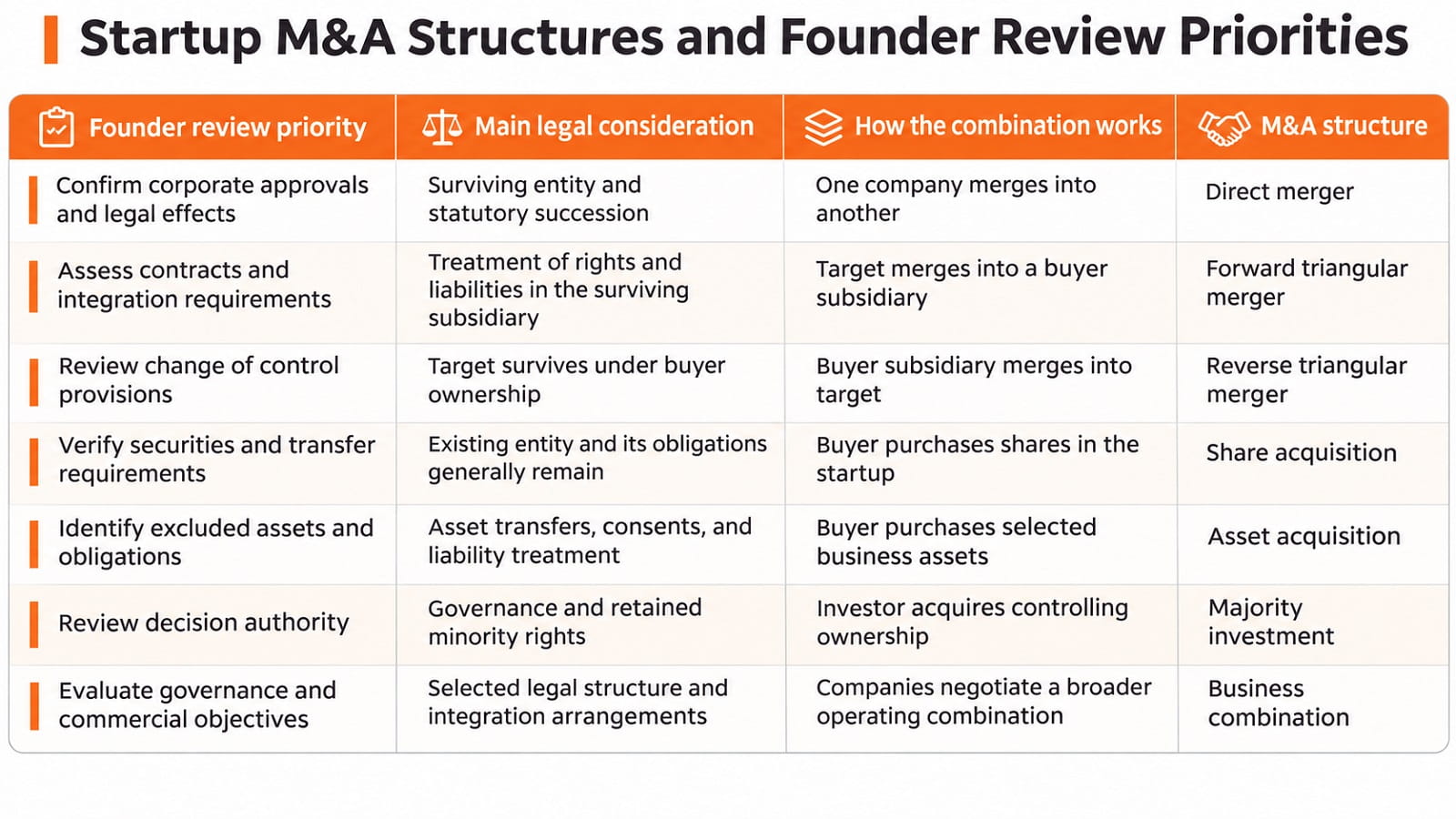
These structures have different legal consequences and may not be available in every jurisdiction. For instance, a reverse triangular merger can preserve the target company as a separate legal entity, but that does not automatically eliminate contractual consent requirements. Similarly, purchasing selected assets does not guarantee that the buyer can exclude every liability. The parties should assess the applicable law and the wording of material agreements before choosing a structure.
Shareholder Rights and Corporate Approvals
Shareholder approval is an important consideration when companies merge or transfer control. The required approvals depend on applicable corporate law, the company's governing documents, and any additional rights established through financing agreements.
A statutory merger may require approval from directors and shareholders. Preferred investors may also hold separate consent rights over particular transactions. These contractual requirements can apply even when a transaction has received the approvals otherwise required under corporate law.
Founders should examine outstanding securities before negotiating ownership terms. Convertible instruments, preferred shares, employee options, and other equity commitments may influence voting rights, potential dilution, or the distribution of transaction consideration.
Some shareholder agreements include drag along provisions that can require qualifying shareholders to participate in a sale when specified conditions are satisfied. Their scope and enforceability depend on applicable law and the relevant contractual language.
A complete understanding of shareholder rights helps prevent unexpected disagreements during negotiations. It also allows the parties to identify which approvals must be obtained before closing.
Valuation and Ownership Allocation
Valuation determines how the economic interests of the participating companies are represented in a merger. In a transaction involving cash, the agreed value helps establish the amount paid to selling shareholders. In a transaction involving shares, the negotiated values can determine the relative ownership of the combined company.
The parties may consider revenue quality, profitability, customer relationships, technology, growth expectations, and existing liabilities. Two startups with similar revenue may receive different valuations because their margins, customer retention, or future capital requirements differ.
Founders should distinguish enterprise value from equity value. Enterprise value generally represents the value of operating activities, while equity value reflects the value attributable to shareholders after relevant financial adjustments. Using inconsistent valuation definitions can distort the exchange ratio.
The negotiated ownership allocation is also affected by the rights attached to the securities being issued. Economic ownership, voting power, and control over major decisions are related but not necessarily identical.
A Practical Startup Merger Example
Consider NovaGrid Technologies, a fictional B2B software startup specializing in workflow automation. NovaGrid is considering a merger with ClearMetric Systems, a larger provider of enterprise analytics software.
Management believes the combination could allow both businesses to expand their product offerings and serve customers more efficiently. NovaGrid contributes specialized automation technology, while ClearMetric brings an established customer base and a larger sales organization.
For this simplified example, the parties agree that NovaGrid has an equity value of $12 million and ClearMetric has an equity value of $28 million. Both figures represent negotiated values attributable to shareholders, with no further cash, debt, or working capital adjustments.
Assume the transaction is completed using ordinary shares, no new capital is raised, and all existing shareholders participate proportionally. The example also assumes that no preference rights or option arrangements change the resulting allocation.
Calculating Ownership in the Combined Business
Under these assumptions, the combined equity value before incorporating potential synergies is $40 million. NovaGrid shareholders receive 30% of the combined ordinary equity, while ClearMetric shareholders receive 70%.
Management estimates that the merger could eventually produce $1.2 million in annual operating savings. The businesses also expect to incur $1.8 million in integration expenses during the first year. These amounts should be evaluated separately from the ownership calculation because expected savings are not equivalent to an immediate increase in equity value.
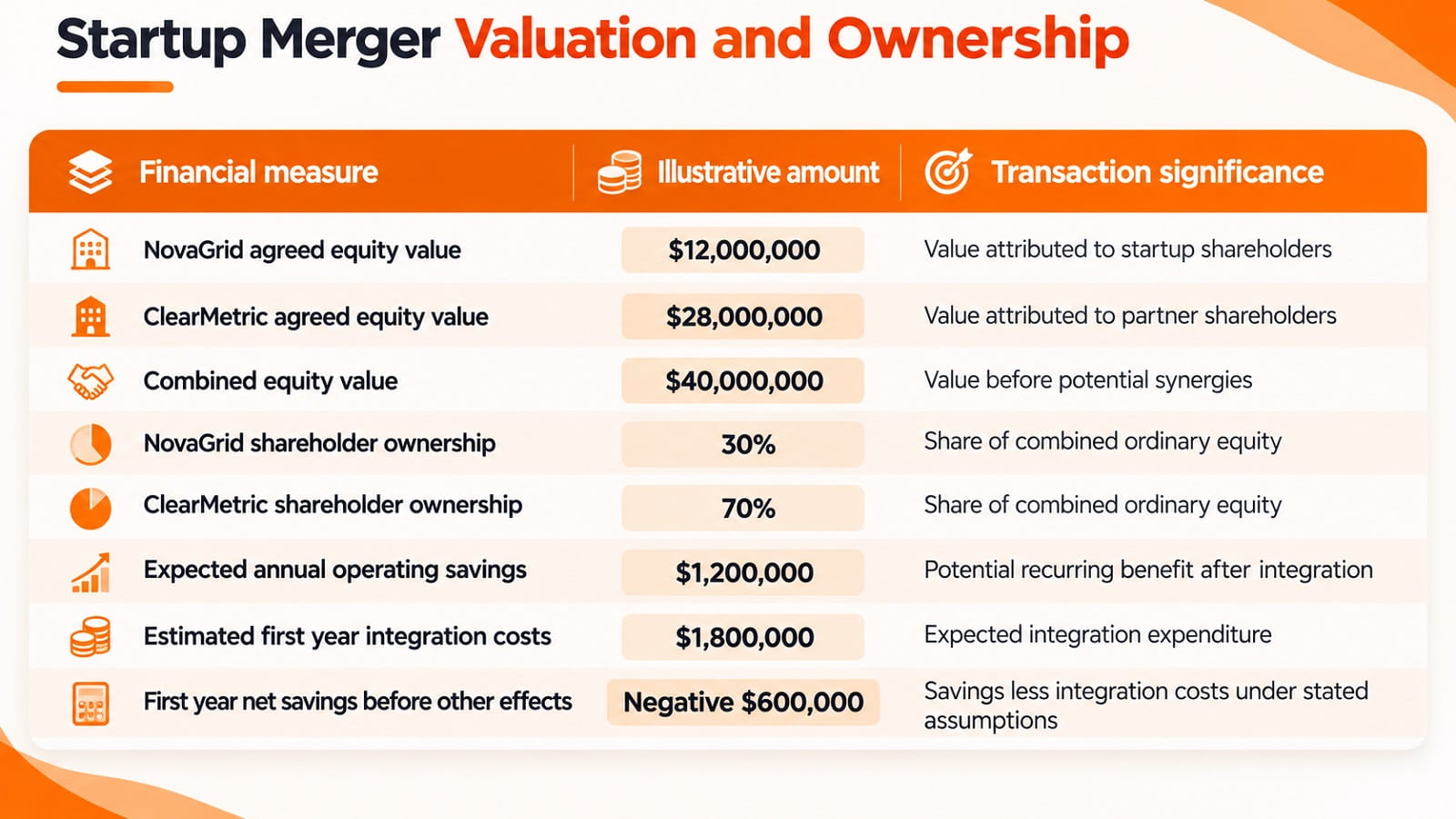
The example shows why merger benefits should be evaluated over time. Even if the companies achieve the full $1.2 million in expected operating savings during the first year, the assumed $1.8 million integration expenditure would produce a net negative effect of $600,000 before other financial consequences. This does not automatically mean the merger is unattractive. Recurring savings may provide benefits in later years, but the timing, probability, and costs of achieving them must be considered.
Assessing the Proposed Merger
NovaGrid's founders should examine whether the combined business can achieve its commercial objectives. Product integration may require additional engineering resources, and customers may not immediately purchase services from both companies.
The parties should also define management responsibilities. NovaGrid shareholders may hold 30% of the combined ordinary equity without having equivalent influence over board appointments or operating decisions.
A sound decision requires agreement on governance, integration budgets, and the evidence supporting expected synergies. Financial projections alone cannot establish whether the merger will succeed.
Due Diligence in a Business Combination
Merger due diligence examines whether the information supporting a proposed combination is reliable and whether either company has material risks that could affect the resulting business.
When shareholders from both companies will retain ownership, the investigation may operate in both directions. Each party needs to understand the business and obligations associated with the securities its shareholders will receive.
Reviewers typically examine financial reporting, material contracts, customer relationships, ownership records, technology, and regulatory obligations. The purpose is not simply to identify defects. It is to determine whether the findings affect the negotiated valuation, required approvals, or future operating plan.
For example, a software license may restrict use by certain affiliates, or a major customer agreement may contain provisions relevant to a change in control. These matters can influence the legal structure and integration arrangements even when the underlying business remains commercially attractive.
A material finding may require corrective action, revised transaction terms, or additional contractual protections. Founders should ensure that unresolved matters are assessed before the merger becomes effective.
Regulatory and Competition Law Considerations
Some mergers require regulatory notification or approval before closing. Competition authorities may examine whether combining businesses could reduce competition in a relevant market. Other regulations can apply when companies operate in sensitive industries or when foreign investment restrictions are relevant.
In the United States, qualifying transactions may be subject to notification requirements under the Hart Scott Rodino framework. The principal size of transaction threshold for 2026 is $133.9 million, although other legal tests, exemptions, and applicable rules affect whether a filing is required.
A startup should not assume that a transaction is exempt simply because it is a young business. Similarly, not every acquisition requires a regulatory filing. The relevant requirements depend on the transaction and the jurisdictions involved.
Cross border mergers may require analysis under several legal systems. Founders should identify potential approvals early because mandatory waiting periods or additional investigations can affect the transaction timetable.
Post Merger Integration and Operational Risks
The legal completion of a merger does not establish that the combined business will operate successfully. Integration determines whether employees, technology, customer relationships, and management systems can function effectively together.
Technology integration can be particularly demanding for software startups. Two companies may use different databases, security controls, development processes, and infrastructure providers. Combining these systems without adequate planning can interrupt services or create unexpected costs.
Commercial integration can introduce different problems. Sales teams may have conflicting pricing methods, customer agreements, or incentives. Customers might also be concerned about changes in product availability, support arrangements, or contractual responsibilities.
Management should establish practical integration milestones before closing. The plan should identify responsibilities, expected expenditure, critical dependencies, and how progress will be measured.
The purpose is to maintain business continuity while implementing improvements that support the original strategic rationale.
Governance and Leadership After the Merger
A combined business needs a clear decision making structure. Founders who previously controlled their companies may become minority shareholders or executives operating under a different board.
The parties should define leadership roles, approval authority, reporting responsibilities, and the process for resolving disagreements. Unclear governance can delay important commercial decisions even when the companies agree on the broader strategy.
Employee retention is another important consideration. Key engineers, managers, and customer relationship specialists may hold knowledge that supports the transaction's expected value. Uncertainty about their future responsibilities can increase the risk of departures during integration.
The governance framework should balance operational efficiency with the rights established in the merger agreement. Retaining meaningful influence may be important to founders, but that influence must be reflected in the relevant documents rather than assumed from their previous roles.
Common Risks That Can Undermine a Startup Merger
One significant risk is overestimating the benefits of combining businesses. Management may assume that sales teams can immediately cross sell products or that duplicated expenses can be removed without disrupting operations. In reality, integration may require investment before improvements become measurable.
Another concern is incomplete agreement on the future operating model. Companies can negotiate an ownership split while leaving leadership responsibilities, product strategy, or investment priorities unresolved. These disagreements can become more difficult after closing.
Contractual restrictions and liabilities can also create problems. Changes in ownership or legal entity structure may trigger obligations that were not considered during negotiations. The consequences can affect customers, suppliers, financing arrangements, or technology licenses.
Finally, founders may focus too heavily on the negotiated valuation while overlooking the rights attached to the shares they receive. A larger economic interest does not always translate into greater control or more certain future liquidity.
The strongest protection against these problems is a transaction supported by realistic assumptions, clear agreements, and a practical integration plan.
Final Thoughts
Mergers and acquisitions can help startups combine resources, enter new markets, and strengthen their commercial position. However, the success of a transaction depends on more than its negotiated valuation or expected revenue growth.
Founders need to understand the selected legal structure, shareholder rights, liabilities, regulatory requirements, and governance arrangements. They must also assess whether the expected operating benefits are achievable within a realistic budget and timetable.
A well planned merger connects the transaction's financial terms with the practical requirements of operating the combined company. When the parties establish clear responsibilities and evaluate risks before closing, they are better positioned to create lasting value for shareholders, employees, and customers.
FAQ
What Is the Difference Between a Merger and an Acquisition?
A merger combines businesses through an applicable statutory process. An acquisition involves purchasing a company, ownership interest, or specified assets. Their legal consequences depend on the structure and jurisdiction.
Why Do Startups Merge With Other Companies?
Startups may merge to combine technology, expand customer access, reduce duplicated costs, or strengthen their competitive position. The expected benefits must be evaluated against integration expenses and operational risks.
Can Two Startups Merge Without Cash?
Yes. A merger may use shares as consideration, allowing shareholders to receive ownership in the surviving or resulting business. The exchange ratio depends on the negotiated terms.
How Is Ownership Divided After a Merger?
Ownership is generally determined by the negotiated equity values, exchange ratio, capital structure, and rights attached to the securities involved. New investment or other adjustments may change the allocation.
Do Startup Mergers Require Shareholder Approval?
Many statutory mergers require corporate approvals under applicable law. Investor agreements and governing documents may create additional consent requirements.
What Happens to Existing Contracts After a Merger?
The result depends on the merger structure, applicable law, and contractual provisions. Some agreements may continue with the surviving entity, while others can require consent or create additional obligations.
Are Startup Mergers Subject to Competition Review?
Some transactions require competition or other regulatory review. Filing requirements depend on the jurisdictions, transaction characteristics, relevant thresholds, and applicable exemptions.
What Are the Main Risks of a Startup Merger?
Common risks include unexpected integration expenses, customer disruption, technology incompatibility, employee departures, contractual restrictions, and disagreements over management authority.

Mobina Khanki
Venture & Funding Writer at PinerookMobina Khanki covers venture capital, startup funding, fundraising, and startup finance for Pinerook, focusing on founders and investors.
 Seen first.