An investor rights agreement defines the contractual protections investors receive after funding a startup and the obligations the company must fulfill in return. These protections may include access to financial information, participation in future funding rounds, and rights connected to a potential public offering. For founders, the agreement matters because its consequences extend beyond the financing closing date and can influence how the company manages information, raises additional capital, and maintains investor relationships.
Within Term Sheets and Investment Deals, the investor rights agreement serves a different purpose from the documents governing share purchases, voting arrangements, or ownership transfers. It establishes continuing obligations between the company and eligible investors, often with different rights assigned to different shareholder groups. Understanding those distinctions helps founders evaluate whether the proposed terms provide reasonable investor protection without creating unnecessary operational restrictions.
This guide explains the main provisions of an investor rights agreement, how they operate in venture financing, and which terms deserve closer review before signing. It also provides a practical financing example and a negotiation framework focused on the decisions founders are most likely to encounter.
What Is an Investor Rights Agreement?
An investor rights agreement (IRA), frequently called an investors' rights agreement, is a binding contract between a company and specified investors that establishes rights associated with their investment. It is commonly used in priced venture capital financings, particularly when a startup issues preferred stock to institutional investors.
The agreement typically covers financial reporting, inspection rights, participation in future securities offerings, registration rights, and selected company obligations. These provisions give eligible investors defined ways to obtain information and protect their interests after purchasing shares. The specific rights, eligibility requirements, and exceptions depend on the negotiated document.
An IRA does not automatically give investors authority over every business decision. Corporate governance, ownership rights, and transaction approvals may be governed by separate agreements, the company's charter, and applicable law. Founders should interpret the IRA alongside those documents rather than treating it as a complete statement of investor control.
In US venture financings, the National Venture Capital Association provides a model Investors' Rights Agreement that parties can adapt to individual transactions. The model offers a useful reference, but its optional provisions and negotiated terms should not be mistaken for universal legal requirements.
How an Investor Rights Agreement Works
The agreement is usually negotiated during a financing round and executed alongside the relevant share purchase and corporate governance documents. Once it becomes effective, the company must perform the obligations specified in the contract, while eligible investors may exercise their rights according to the agreed procedures.
Some obligations begin shortly after closing. A company may need to deliver quarterly financial statements, provide an annual budget, or permit qualifying investors to inspect certain records. Other rights become relevant only when the company proposes a new financing, prepares for a public offering, or experiences a specified corporate event.
The practical effect depends on three questions: who qualifies for a right, what action activates it, and what the company must do when it is exercised. A financial reporting obligation can apply continuously, while a future investment right may require a formal notice and a decision within a specified period.
Key Provisions in an Investor Rights Agreement
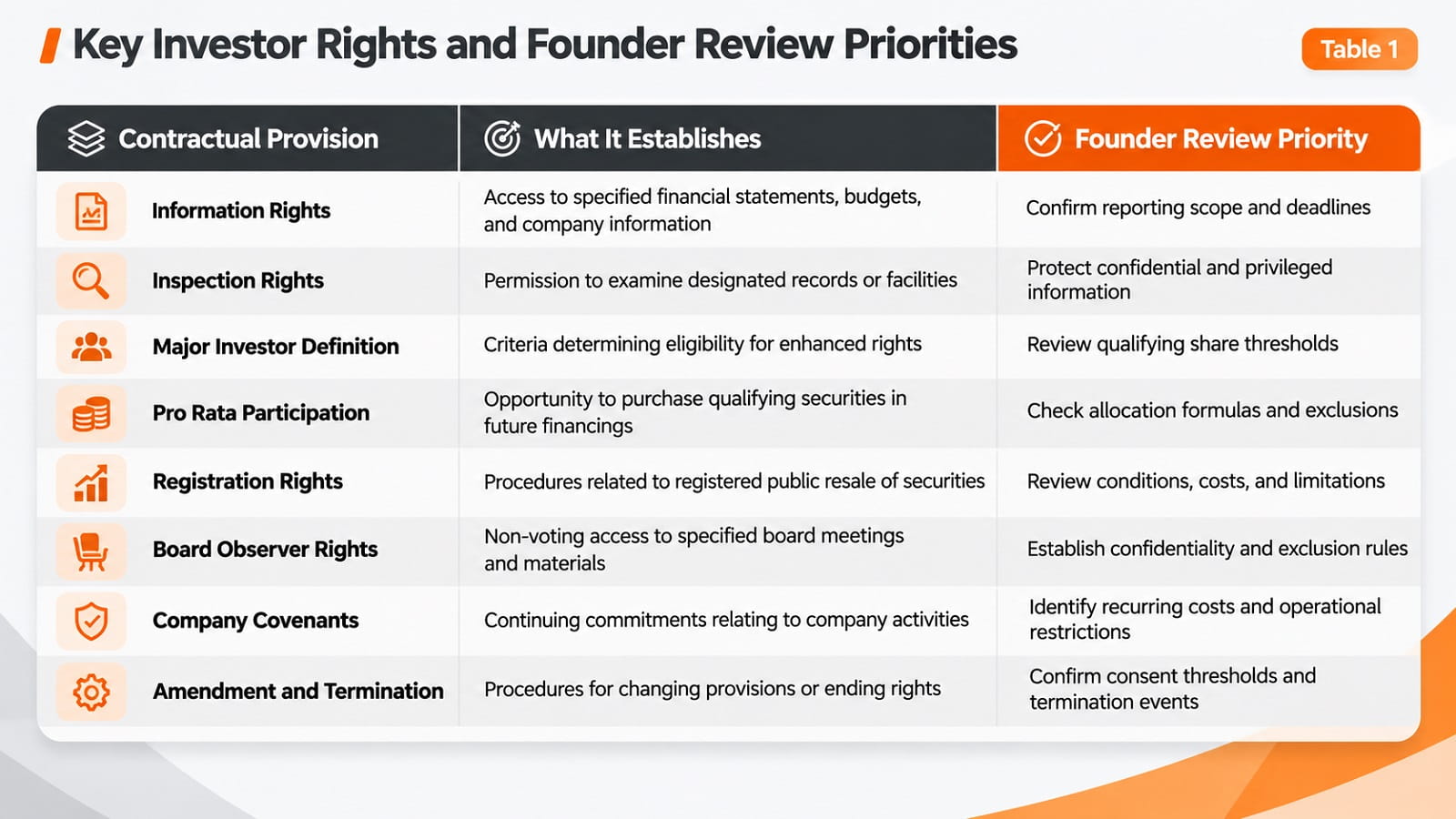
Although the exact terms vary, several categories of rights commonly appear in US venture financing agreements. Founders should evaluate each provision according to its purpose, eligibility requirements, and practical consequences.
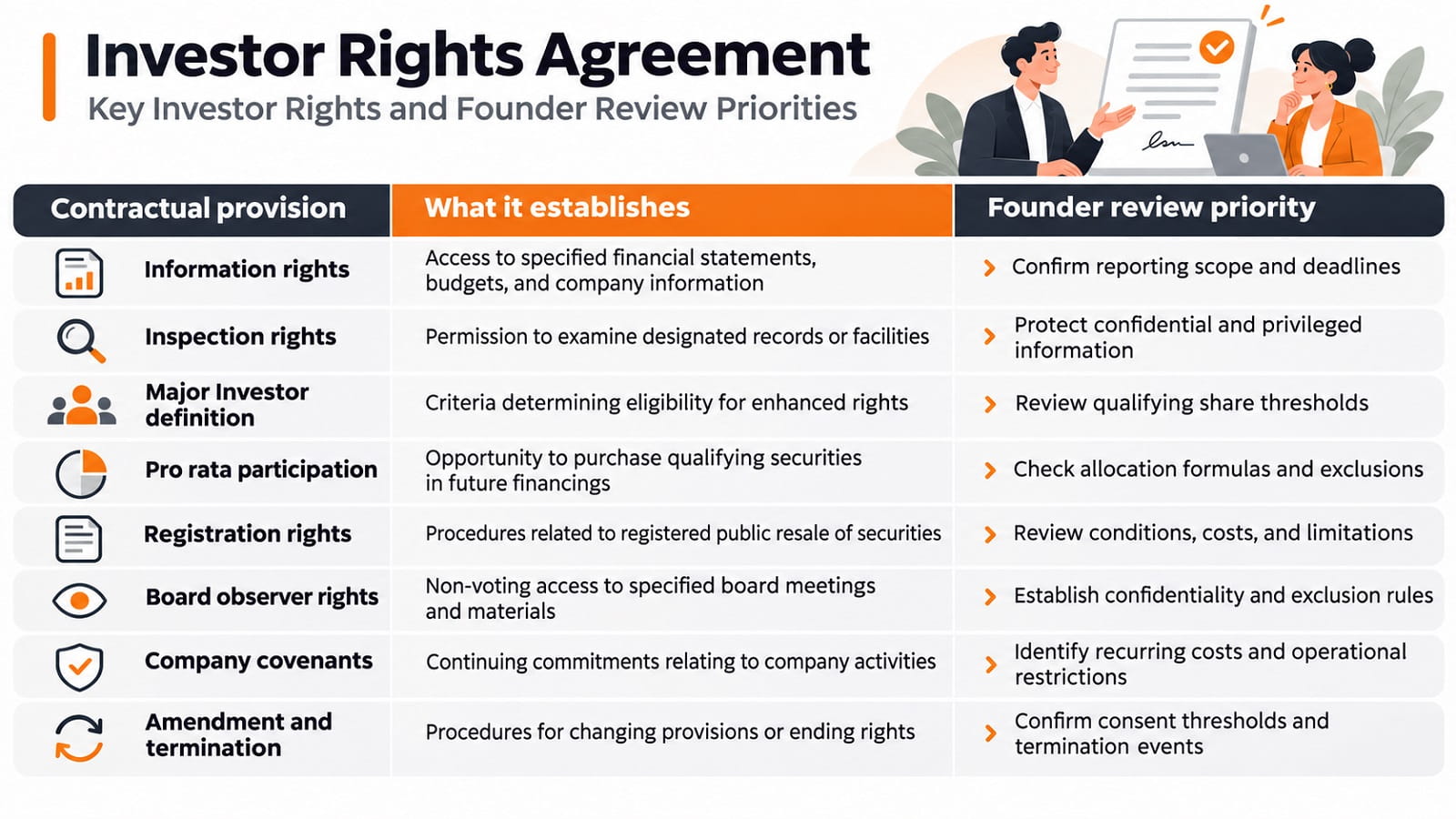
These provisions are connected, but they do not necessarily apply to the same investors. For example, a Major Investor may receive financial reporting and participation privileges unavailable to smaller shareholders. The agreement's definitions determine who benefits from each protection.
Information Rights and Financial Reporting
Information rights require a startup to provide eligible investors with specified financial and operational information. Depending on the contract, this may include annual and quarterly financial statements, operating budgets, capitalization information, and other agreed reports.
The main negotiation issue is whether the company's reporting obligations are realistic. A startup with limited accounting resources may need reasonable deadlines and a clear distinction between unaudited management accounts and audited financial statements. Requiring extensive reports without considering preparation costs can divert resources from operating the business.
Founders should also determine whether reporting obligations apply only to Major Investors and whether the company can withhold sensitive information in defined circumstances. Access to financial performance should be balanced with confidentiality, applicable legal restrictions, and legitimate commercial interests.
Inspection Rights and Confidentiality
Inspection rights may permit qualifying investors to review company records, visit facilities, or discuss performance with management. They can help investors understand material developments that are not fully explained by periodic financial reports.
These rights should normally operate within agreed procedures concerning notice, timing, confidentiality, and reasonable access. A company may also need exclusions where disclosure could compromise attorney-client privilege, expose sensitive technical information, or create competitive harm. The permitted restrictions depend on the agreement and applicable law.
Founders should examine whether an investor's representatives can access information and what obligations apply to those representatives. This becomes especially important when an investor has interests in other businesses operating in the same market.
Major Investor Status
Many agreements reserve certain privileges for investors satisfying a defined ownership threshold. These qualifying shareholders are commonly described as Major Investors, although the precise definition depends on the contract.
Eligibility may be measured using a minimum number of specified shares, ownership calculated on a particular basis, or another negotiated standard. The agreement may also establish how affiliated funds aggregate holdings and whether rights continue after partial share transfers.
A carefully defined threshold helps founders manage the number of parties entitled to enhanced information and participation rights. Without clear eligibility rules, the company may face uncertainty about its obligations as ownership changes through subsequent financing rounds.
Pro Rata Rights in Future Financing
Pro rata participation rights give eligible investors an opportunity to purchase a calculated portion of securities offered in a future financing. These rights can help investors limit ownership dilution when the startup issues additional equity.
The participation formula matters because it determines how much of a proposed financing may be reserved for existing shareholders. Some agreements use an investor's qualifying ownership percentage, while others establish particular calculations, notice procedures, or allocation rights.
Founders should examine which securities are included and which issuances are excluded. Employee equity grants, conversions of existing instruments, and certain strategic transactions may receive different treatment depending on the agreement.
Pro rata rights do not guarantee that an investor will always maintain the same ownership percentage. The investor must exercise the right where required, and other issuances or contractual exceptions may affect the final result.
Registration Rights and Public Offerings
Registration rights establish procedures that may allow eligible investors to seek registered public resale of their securities under applicable securities laws. They are usually more relevant to a startup's potential future public offering than to its daily operations.
Demand registration rights may permit qualifying holders to request a registration after specified conditions are satisfied. Piggyback registration rights may allow investors to request inclusion of their securities when the company conducts an eligible registration. These rights can be subject to timing restrictions, offering thresholds, underwriter limitations, and other conditions.
An agreement may also include market stand-off provisions restricting certain securities sales around a public offering. Founders should understand the company's potential legal and administrative obligations without assuming that registration rights provide immediate liquidity to investors.
Board Observer Rights and Company Covenants
Certain investors may negotiate non-voting observer access to board meetings and materials. These rights are not automatic features of every IRA and may instead appear in separate side letters. An observer generally does not acquire a director's voting power merely through attendance.
The agreement should specify whether the observer may receive confidential materials and when exclusion is permitted to protect privileged information or manage conflicts. Separately, company covenants may require maintaining specified insurance, implementing corporate policies, or complying with agreed operational commitments. Founders should assess the cost and practical effect of these obligations rather than accepting them solely because they appear in a standard form.
Investor Rights Agreement vs Other Financing Documents
An IRA should not be confused with the other legal documents executed during a venture financing. A stock purchase agreement generally establishes the purchase of securities, including pricing, closing requirements, and contractual representations. A voting agreement addresses specified shareholder voting arrangements and board composition, while a right of first refusal and co-sale agreement governs certain transfers of existing shares.
The company's charter can establish preferred share rights, including liquidation preferences and protective voting provisions. By comparison, the IRA commonly concentrates on continuing investor information, participation, and registration rights. These documents must operate consistently, but each serves a different contractual purpose.
This distinction matters during negotiation. A founder reviewing investor oversight should identify whether the relevant authority arises from the IRA, a side letter, a voting arrangement, or the charter. The answer determines which parties must consent to changes and which procedures govern the right.
A Practical Investor Rights Agreement Example
Consider Meridian Analytics, a fictional B2B software startup that has completed its initial product development and is preparing for a Series A financing. The company raises $4 million from a venture capital investor in exchange for newly issued preferred shares representing 20% of the fully diluted equity immediately after closing.
The investor rights agreement grants the investor quarterly financial information, annual budget access, qualified inspection rights, and the opportunity to participate in specified future equity offerings. For this example, assume the investor qualifies as a Major Investor and remains eligible for those rights throughout the period being examined.
How the Agreement Affects Financial Reporting
After the financing closes, Meridian must provide the financial statements specified in its contract. Management establishes a reporting schedule, assigns responsibility for preparing the information, and ensures the company can reconcile its financial results before delivery.
The agreement does not require the investor to approve every operating expense. Instead, it provides visibility into the company's performance through defined information rights. This distinction allows management to continue making ordinary business decisions while satisfying its reporting commitments.
How Participation Rights Affect the Next Funding Round
Suppose Meridian later plans to raise an additional $6 million by issuing new preferred shares. For simplicity, assume the investor's participation entitlement is calculated as 20% of the securities offered in that financing and that no contractual exclusions apply.
The investor could therefore have an opportunity to purchase $1.2 million of the new shares, leaving $4.8 million available for other investors. The calculation demonstrates how existing participation rights can affect the allocation of a future financing.
This illustration assumes a straightforward participation calculation rather than a particular market-standard contractual formula. Actual allocations depend on the agreement, qualifying securities, and financing structure. If the investor declines its allocation, the company may be able to offer those securities elsewhere, subject to applicable contractual procedures.
The important lesson is that founders must understand existing participation commitments before negotiating a new financing allocation. An unexpected conflict between promised rights and proposed share allocations can complicate an otherwise attractive investment opportunity.
Negotiating an Investor Rights Agreement as a Founder
Founders should approach negotiation by examining the obligations each right creates rather than rejecting investor protections categorically. Investors have legitimate reasons to request information and opportunities to participate in future financings. The challenge is establishing boundaries that remain manageable as the business develops.
For information rights, the priority is defining what must be delivered, when it is due, and which investors qualify. Reporting requirements should reflect the company's financial systems, while confidentiality provisions should protect information that could harm the business if disclosed improperly.
For participation rights, founders should examine the allocation formula, excluded securities, notice requirements, and consequences when an investor does not exercise its entitlement. These details affect fundraising flexibility more directly than a general statement that investors have pro rata rights.
Registration rights deserve a different assessment because they may create obligations at a much later stage. Founders should understand the conditions for exercising those rights, the potential expenses involved, and any restrictions on public resale.
Finally, company covenants, amendment provisions, and termination conditions determine how long the agreement remains relevant and how it can evolve. A right that seems reasonable when the company has three investors may become administratively difficult after several financing rounds. The contract should establish procedures that allow the business to handle those changes.
Common Mistakes When Reviewing Investor Rights Agreements
One mistake is assuming that using an established legal template eliminates the need for negotiation. Model agreements may contain optional language, alternative provisions, and definitions that significantly affect the company's obligations. The completed contract, rather than the reputation of the template, determines the parties' rights.
Another problem arises when founders focus only on immediate obligations while overlooking future financing requirements. Participation rights may have little effect on the day of signing but become important when a new lead investor expects a particular equity allocation.
Founders may also underestimate the administrative cost of delivering detailed financial information. Reporting deadlines that cannot be met reliably create unnecessary compliance problems. Similarly, inspection and observer provisions without suitable confidentiality safeguards can expose commercially sensitive information.
A final mistake is reviewing the IRA without examining related financing documents and investor side letters. Separate agreements may grant additional privileges or impose obligations that affect how the main contract operates. Reviewing the complete transaction documentation is necessary to identify conflicts and understand the company's actual commitments.
When Investor Rights Can Change or End
Investor rights agreements normally establish procedures for amendments, waivers, and termination. An amendment may require the company's consent and approval from a defined percentage of qualifying investors, while certain changes may require additional consent from adversely affected parties.
Individual rights may also depend on continued eligibility. An investor that transfers shares or falls below a specified ownership threshold could lose particular privileges if the contract provides for that result. Other rights may terminate upon a qualifying public offering, acquisition, or another defined event.
Founders should not assume that every right expires simultaneously. Information, participation, and registration rights may have different termination provisions. Understanding those conditions is essential when the company prepares for another financing or undergoes a major ownership change.
Final Thoughts
An investor rights agreement establishes important parts of the relationship between a startup and its investors after financing closes. Its provisions can affect reporting responsibilities, confidential information, future equity allocations, and potential public-market transactions.
For founders, the central objective is to understand how those rights operate in practice. Clear eligibility thresholds, achievable reporting obligations, appropriate confidentiality safeguards, and workable participation procedures can support investor protection without creating unnecessary operational complexity.
A carefully reviewed agreement provides greater predictability for both the company and its investors. Before signing, founders should ensure that the negotiated terms are consistent with the broader financing documents and suitable for the startup's expected development.
FAQ
What Is the Purpose of an Investor Rights Agreement?
An investor rights agreement defines specified continuing protections for investors and corresponding obligations for the company. Common provisions address financial information, participation in future financings, registration rights, and company commitments.
Is an Investor Rights Agreement Legally Binding?
A properly executed investor rights agreement can create enforceable contractual obligations, subject to applicable law and its terms. The rights granted depend on the agreement's wording, eligibility conditions, and other relevant legal requirements.
Does Every Investor Receive the Same Rights?
No. Agreements often distinguish Major Investors from smaller shareholders. Certain information, inspection, or participation rights may be reserved for investors meeting defined ownership thresholds.
What Is the Difference Between an Investor Rights Agreement and a Shareholders Agreement?
An IRA commonly governs particular continuing investor privileges in US venture financings. A shareholders agreement may cover a broader range of ownership, governance, and transfer arrangements. The distinction depends on jurisdiction and contractual structure.
Can Investors Maintain Their Ownership Through Pro Rata Rights?
Eligible investors may have the opportunity to purchase additional securities in qualifying financing rounds. Whether they maintain their ownership percentage depends on the participation formula, actual investment, exclusions, and subsequent share issuances.
Can an Investor Rights Agreement Be Amended?
Yes, if the amendment procedures established in the agreement are satisfied. The required approvals may involve the company, a specified investor majority, or other affected parties depending on the proposed change.
Does Every Startup Need an Investor Rights Agreement?
No. The need depends on the financing structure, jurisdiction, investor requirements, and applicable transaction documents. IRAs are common in priced venture capital financings but are not a universal requirement for every startup investment.

Mobina Khanki
Venture & Funding Writer at PinerookMobina Khanki covers venture capital, startup funding, fundraising, and startup finance for Pinerook, focusing on founders and investors.
 Seen first.


