
A successful startup rarely grows through the efforts of its founders alone. It draws on customers, skilled employees, experienced entrepreneurs, research institutions, investors, and service providers that help turn an idea into a business. When these resources are connected, young companies can learn faster, recruit more effectively, and find the support needed to reach larger markets. That combination, rather than the number of new companies in a city, is what makes a startup ecosystem valuable.
The global startup ecosystem is the network of entrepreneurial communities through which companies, talent, capital, knowledge, and commercial opportunities circulate. Within the broader context of Investment Trends, the strength of these networks helps explain why some locations consistently produce successful companies and attract investors while others struggle to convert innovation into commercial results. Rankings can reveal important differences, but their meaning depends on what each report measures and the period its data covers.
This guide explains the structure of startup ecosystems, identifies the leading hubs in 2026, compares major ranking methods, and examines the factors that help entrepreneurial communities mature. It also provides a practical framework for evaluating ecosystem health without confusing funding headlines, innovation output, and realized business success.
What Is a Global Startup Ecosystem?
A startup ecosystem is a connected community of people and organizations that participate in the creation and growth of innovative businesses. Its participants commonly include founders, employees, investors, universities, customers, accelerators, professional advisers, established companies, and public institutions. The global ecosystem is formed by the relationships linking these local and regional communities through investment, migration, research, partnerships, and international commerce.
The term is broader than the venture capital market. Financing is an important resource, but entrepreneurs also need people who can build products, customers who can evaluate them, and experienced operators who understand how companies grow. A city can attract substantial investment without offering equally strong access to every other resource. Likewise, a productive research center is not automatically a mature startup ecosystem unless scientific knowledge can move into viable businesses.
How Startup Ecosystems Actually Work
Effective ecosystems make it easier for founders to combine resources that are difficult to obtain independently. A researcher may meet a future cofounder through a university laboratory, receive guidance from an experienced entrepreneur, test a prototype with an industry partner, and approach investors after establishing commercial demand. Each relationship reduces a different kind of uncertainty. The advantage comes from the connections among participants, not merely from their presence in the same city.
Successful companies can strengthen these networks over time. Experienced employees may launch new ventures, founders who achieve successful exits may become mentors or investors, and early customers may introduce new businesses to established distribution channels. This recycling of experience and capital helps explain why entrepreneurial leadership can persist across generations of companies. It also shows why creating more startup events or office spaces alone does not guarantee lasting ecosystem performance.
The Leading Startup Ecosystems in 2026
StartupBlink's Global Startup Ecosystem Index 2026 places San Francisco Bay first among startup city ecosystems, followed by New York and London. The index evaluates startup activity, the quality of the ecosystem, and broader business conditions, using its own scoring model. Its scores are relative index values rather than dollar amounts, company valuations, or probabilities of startup success.
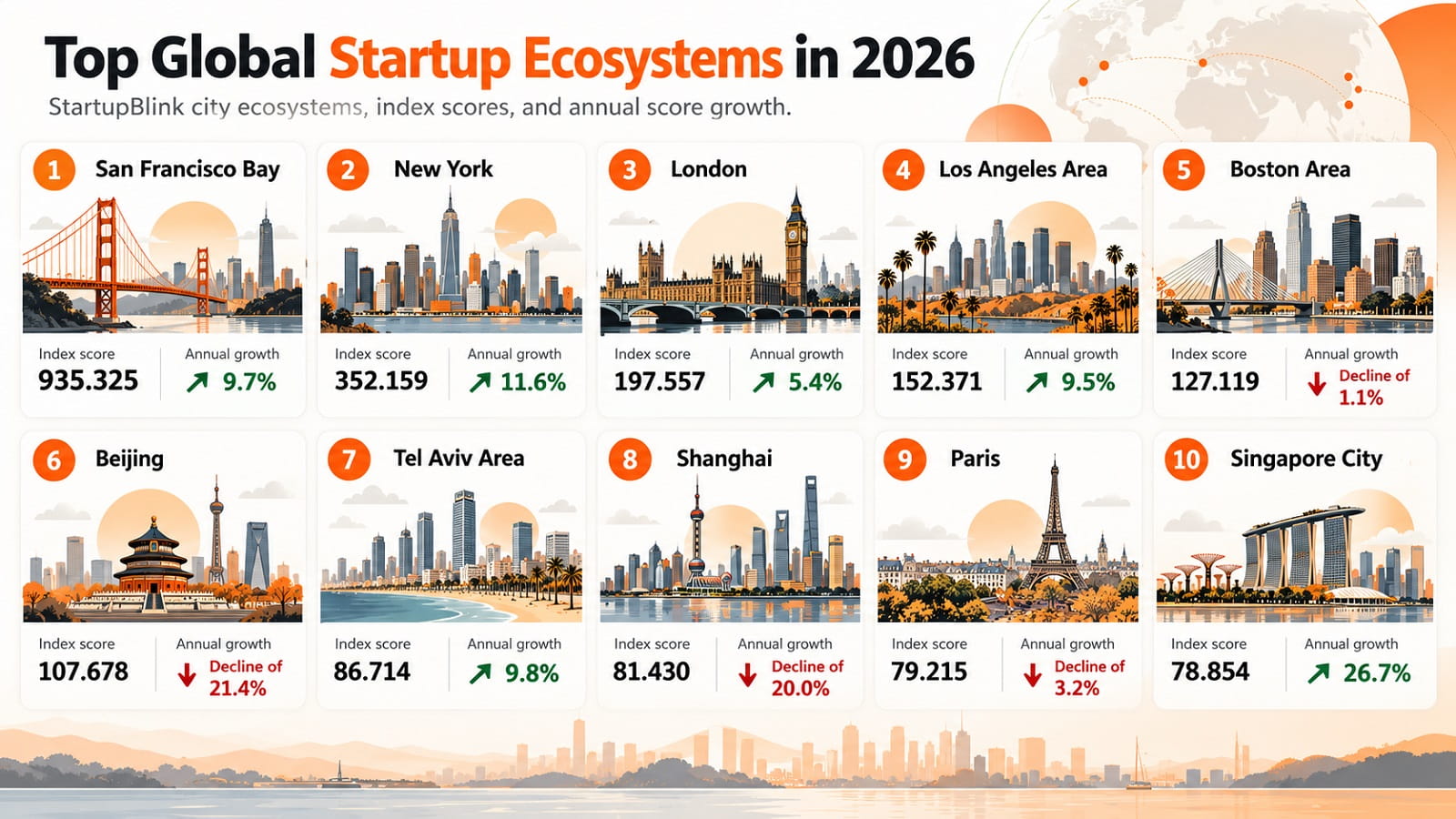
The size of San Francisco Bay's lead is notable, but the table should not be read as a forecast of investment returns. A lower ranked ecosystem may offer exceptional support for a specific technology or type of founder. Annual movements also reflect the index provider's methodology and changes in the performance of other cities. A rank improvement does not necessarily mean that every startup in that location is raising more capital or generating more revenue.
Startup Genome provides another established view. Its Global Startup Ecosystem Report 2026 keeps Silicon Valley, New York City, and London in the first three positions, while identifying Seattle's rise to tenth and Austin's move to eighteenth. These observations are valuable because they point to changes in established entrepreneurial networks, but the rankings should be interpreted using Startup Genome's separate criteria rather than mixed with StartupBlink's scores.
Why Global Startup Rankings Give Different Answers
There is no single universal measure of a healthy startup ecosystem. StartupBlink compares the scale and quality of startup activity alongside business conditions. Startup Genome emphasizes ecosystem performance, funding, market reach, talent, and specialized innovation capabilities. The World Intellectual Property Organization measures innovation clusters using patent filings, scientific publications, and venture capital deals. Each approach answers a different question, so a location can legitimately lead one list without leading another.
For example, WIPO's corrected 2026 innovation cluster ranking places Shenzhen, Hong Kong and Guangzhou first, followed by Tokyo and Yokohama, San Jose and San Francisco, Beijing, and Seoul. These are rankings of concentrations of innovation activity, not a competing list of the best environments for startup founders. WIPO also distinguishes the overall size of a cluster from innovation intensity relative to population, which can favor smaller, highly productive research communities.
Methodology matters even within a single report. Startup Genome's 2026 ranking of mature ecosystems weights performance at 27.5%, funding at 20%, market reach at 20%, talent and experience at 17.5%, AI native activity at 10%, and research and development at 5%. Its emerging ecosystem methodology uses a different weighting to reflect earlier stages of ecosystem development. Comparing a rank from one category or provider directly with another can therefore create a misleading impression of progress or decline.
The Resources Behind Successful Startup Ecosystems
Founders, Skilled Talent, and Operating Experience
Technical ability helps launch a product, but strong ecosystems also supply experienced operators who know how to recruit, price services, build sales processes, and manage growing organizations. These capabilities can circulate when employees leave established startups to create or join younger ones. Universities and professional training institutions expand the talent pool, while experienced founders provide lessons from successful and unsuccessful ventures. The quality of these connections is usually more important than the raw number of people employed in technology.
Investors and a Complete Financing Path
Early company formation may require modest seed investment, while expansion into international markets or advanced manufacturing can require substantially more capital. An ecosystem becomes more resilient when founders have access to investors at different stages and when those investors understand the industries operating locally. Access to seed financing alone is insufficient if promising companies cannot find suitable later capital. Equally, a few enormous funding rounds may inflate the area's investment total without showing that opportunities are broadly available.
Research Institutions, Customers, and Commercial Networks
Research universities and laboratories can supply new inventions, specialized expertise, and potential founders. However, commercialization requires practical connections to intellectual property support, product development, early customers, and industry partners. Established businesses can help by testing new technologies and becoming credible reference customers, although lengthy procurement processes can also slow younger companies. The strongest ecosystems connect research capability with genuine market problems instead of assuming that patents automatically become viable startups.
How Ecosystems Differ Across the World
North America contains several large and established startup centers with experienced venture firms, repeat founders, universities, and global customers. Its ecosystem strengths extend beyond one city, although access to those resources is uneven and local operating expenses can be substantial. Europe offers connected research centers, technology employers, and specialized industry clusters, but founders may need to navigate multiple legal and commercial environments to serve the region effectively.
Asian innovation networks include major manufacturing centers, scientific institutions, financial hubs, and large customer markets. Their capabilities differ across cities and industries, making national comparisons less informative than examining the specific combination of research, production, capital, and demand. WIPO's corrected 2026 ranking counts 25 of its top 100 innovation clusters in China and 20 in the United States, demonstrating that innovation activity is heavily concentrated even as more regions contribute to the global network.
Other regions contribute entrepreneurial talent and businesses addressing distinct customer needs, but ecosystem maturity should not be reduced to whether a city appears in a top ten list. The key analytical question is whether local institutions and companies can continually produce, support, and retain viable new businesses. Detailed decisions about entering a particular market belong to a separate assessment of demand, distribution, regulations, and commercial economics rather than to a general ecosystem ranking.
How to Measure the Health of a Startup Ecosystem
A ranking offers a useful starting point, but a durable assessment should look at multiple measures over time. Some indicators capture inputs such as capital and research capacity, while others capture outcomes such as customer growth, business survival, and realized exits. Tracking both avoids rewarding activity that produces little economic value.
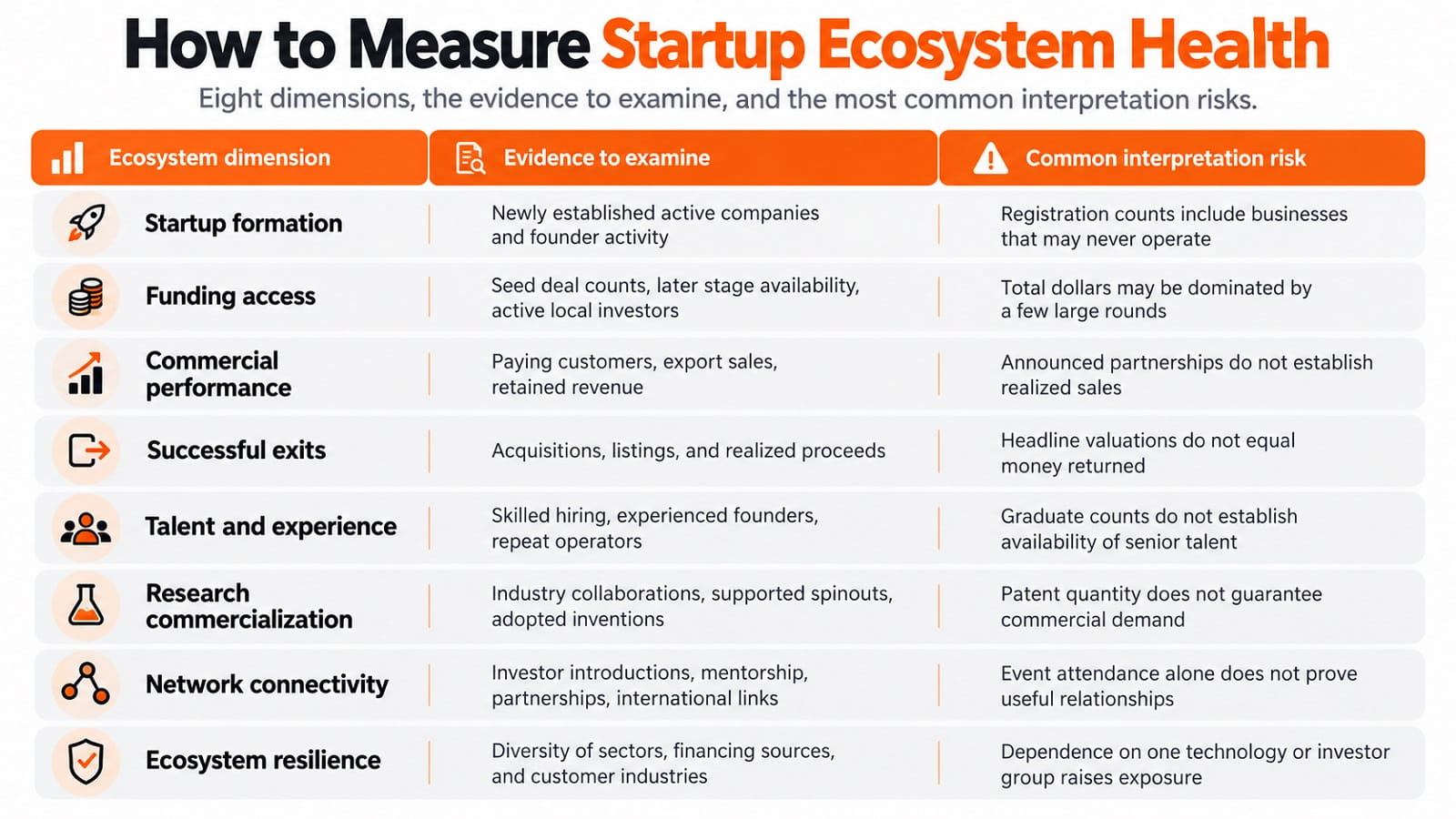
Measures should be defined consistently before drawing conclusions. A larger region will naturally generate more activity than a smaller one, so comparisons may need to account for population or company base. Historical data can also change as private financings and acquisitions become publicly known. Researchers should record reporting periods and avoid combining unlike measures simply to produce one apparently precise ecosystem score.
The Role of Universities, Governments, and Established Companies
Universities support entrepreneurial development through education, research, laboratories, and the commercialization of inventions. Their contribution is strongest when researchers and entrepreneurs can work with businesses that understand customer requirements and are willing to test new products. Academic publications can demonstrate scientific strength, but translating discoveries into companies often requires additional legal, technical, and commercial capabilities.
Governments influence ecosystems through education, infrastructure, competition policy, company formation rules, and the predictability of commercial regulation. Public programs may reduce specific barriers, but simply increasing the number of grants or incubators does not establish whether founders create businesses customers want. Policymakers need to examine outcomes over several years and distinguish programs that help companies secure customers from those that primarily increase reported activity.
Established corporations can become customers, partners, investors, and sources of experienced employees. Their involvement can shorten the path from technical development to commercial use when procurement is accessible and incentives are aligned. It can also create dependency when a startup relies on one corporate partner for distribution or product validation. Effective ecosystems create room for young companies to develop independent businesses, not just supply services to a small set of incumbents.
How Artificial Intelligence Is Changing Ecosystem Competition
Artificial intelligence is changing the resources needed for both startup formation and large scale technology development. Application businesses can use established models to build and test products with comparatively modest infrastructure, while foundation model and computing providers may require exceptionally large financing commitments. This difference can intensify concentration in ecosystems with deep capital markets and advanced research resources, without eliminating opportunities in specialized applications elsewhere.
Startup Genome introduced AI native activity as a distinct weighted factor in its 2026 methodology, reflecting the growing significance of that capability in ecosystem evaluation. Yet an area's share of AI companies cannot alone demonstrate that its startups have strong customer retention or defensible economics. A sound assessment considers AI activity alongside commercialization, access to computing, skilled talent, and the strength of underlying business results.
What Founders and Investors Can Learn From Ecosystem Data
For founders, an ecosystem assessment can identify where specialized mentors, potential hires, research partners, and suitable investors may be available. The most important question is whether those resources match the company's needs at its current stage. A hardware founder may benefit from proximity to technical testing and manufacturing partners, while an enterprise software company may gain more from access to customers and experienced sales professionals. A top ranked location is not automatically the right place for every business.
Investors can use ecosystem data to understand where promising companies originate and whether those companies have access to the resources required to mature. However, a startup's quality, investment terms, and potential exits require company specific diligence. Investing in a highly ranked city cannot substitute for examining financial performance or evaluating whether the company's competitive advantage is durable. Regional concentration in an investment portfolio also deserves attention when several companies depend on the same customers, investors, or technological assumptions.
The Global Startup Ecosystem Outlook Beyond 2026
Global competition among startup ecosystems will likely depend on their ability to connect research, finance, experienced talent, and actual customers. Major hubs retain significant advantages from accumulated networks and successful companies, but new specializations can allow other centers to become important within specific industries. Advances in remote collaboration may broaden access to expertise without making location irrelevant for research facilities, regulation, customer relationships, or institutional financing.
Future rankings will remain useful signals, but changes in methodology, technology priorities, and reporting coverage should be considered when comparing years. A more reliable indicator of ecosystem improvement is whether entrepreneurs can repeatedly turn ideas into sustainable companies, attract appropriate resources, and create outcomes that strengthen the next generation of founders. That process takes longer to measure than one year's funding announcements.
Final Thoughts
The global startup ecosystem is not simply a list of leading cities or the sum of venture investments announced each year. It is a network through which knowledge, talent, capital, and business experience help young companies develop. The most successful hubs combine those resources with actual customer demand and the ability to turn innovative activity into measurable outcomes.
The 2026 rankings demonstrate both the continuing strength of established startup centers and the importance of defining what is being measured. Startup ecosystem performance, scientific innovation, and investment volume are related but distinct. Founders, investors, and policymakers can make better decisions by examining those differences rather than treating a ranking position as a complete judgment of entrepreneurial potential.
FAQ
What Is the Global Startup Ecosystem?
It is the interconnected network of entrepreneurs, investors, skilled workers, researchers, customers, support organizations, and institutions that help new businesses form and grow. It includes both local startup communities and the international relationships connecting them.
Which Startup Ecosystem Ranks First in 2026?
San Francisco Bay ranks first in StartupBlink's Global Startup Ecosystem Index 2026. Startup Genome also ranks Silicon Valley first among its mature global startup ecosystems. Their methods and geographic labels are not identical, so rankings should be attributed to the relevant provider.
Why Does WIPO Rank Different Places First?
WIPO measures innovation clusters through international patent activity, scientific publications, and venture capital deals. Its corrected 2026 ranking places Shenzhen, Hong Kong and Guangzhou first for overall innovation cluster size. That is a different measure from a ranking focused on startup ecosystem performance and business conditions.
What Makes a Startup Ecosystem Successful?
Successful ecosystems connect capable founders with talent, funding, research, customers, and experienced operators. Strong relationships help new companies test ideas, recruit, grow, and eventually contribute knowledge and capital back to the community.
Is Venture Capital the Most Important Ecosystem Indicator?
Venture capital matters, especially for businesses pursuing rapid growth, but funding alone cannot establish ecosystem health. Commercial performance, access to appropriate talent, research commercialization, and realized outcomes are also important.
How Do Startup Ecosystems Support Economic Growth?
Startups can introduce products, create skilled employment, develop new industries, and improve existing business processes. Their broader economic contribution depends on successful commercialization, productivity, and lasting business activity rather than company formation figures alone.
Can Smaller Ecosystems Compete With Major Global Hubs?
Yes, particularly through specialized research, industry expertise, and strong customer relationships. They may still face constraints in financing or access to experienced operators, so ecosystem progress is best assessed against clear goals and comparable measures.

Mobina Khanki
Venture & Funding Writer at PinerookMobina Khanki covers venture capital, startup funding, fundraising, and startup finance for Pinerook, focusing on founders and investors.
 Seen first.