Geoeconomic risk management is the process of identifying how tariffs, sanctions, export controls, investment restrictions and shifting political alliances could interrupt a business, then deciding what to monitor, protect and change before those threats become costly. A useful framework connects policy developments to specific revenue streams, essential suppliers, financing arrangements and management decisions. Its purpose is not to predict every geopolitical event. It is to preserve options when the conditions for international business change.
These challenges arise within Geoeconomic Fragmentation, the broader reorganization of economic relationships along political and strategic lines. For companies, the practical problem is narrower: a restriction matters when it can delay a component, close a market, trap cash or make a contract impossible to perform. Managers therefore need a disciplined way to distinguish serious exposure from alarming but commercially irrelevant headlines.
What Geoeconomic Risk Management Covers
Geoeconomic risks emerge when governments use economic policies for strategic or security objectives, or when political tension changes the reliability of commercial relationships. They may involve tariffs, sanctions, restrictions on technology exports, investment screening, data rules, public procurement requirements or limits on the movement of capital. Such measures differ in legal design and timing, yet they often affect the same set of business outcomes: sales continuity, input availability, pricing power, cash access and the ability to fulfil contractual commitments.
This is related to geopolitical risk management but is not identical to it. A company might prepare for physical conflict, personnel safety and political unrest under a broader geopolitical program. Geoeconomic analysis concentrates on the economic instruments and transmission channels that change transactions even when there is no direct physical disruption. It is particularly relevant to manufacturers, international service providers, investors, importers and firms relying on regulated technology or foreign financing.
An effective process makes three questions answerable. Which dependency could fail? What would that failure do to cash flow and operations? What decision would reduce the loss at an acceptable cost? A list of country risk scores cannot substitute for those answers.
Start With Dependencies, Not Country Headlines
The first task is to map where the organization actually depends on international relationships. Revenue exposure should be examined by customer jurisdiction, billing currency and the legal entity serving the customer. Supply exposure requires looking beyond direct vendors to critical components, specialized inputs, subcontractors and logistics routes. Financing exposure includes lenders, correspondent banks, payment processors and the jurisdictions in which cash balances are held.
Consider a business that buys components from three distributors in different countries. A simple supplier count suggests diversification, but the distributors may all purchase a specialized material from one upstream producer. The same dependency can occur when a company has several banks that rely on a common settlement network. Concentration should be mapped at the point where a disruption would actually stop a service, not only at the point where the company signs a contract.
The output is an exposure inventory with an owner, a business consequence and an estimate of how long operations could continue without the relationship. Firms do not need perfect data on every counterparty before starting. They should begin with products, customers and financial channels whose failure would materially affect liquidity or contractual performance.
Separate Policy Restrictions From Ordinary Business Volatility
A change in shipping prices, a weak local currency or reduced customer demand can be serious without being evidence of geoeconomic fragmentation. Managers should distinguish the initiating event from the commercial symptom. For example, higher component prices may reflect a new tariff, energy costs or the temporary closure of a factory. The appropriate response depends on which mechanism caused the problem.
This distinction avoids expensive reactions to weak signals. A proposed export restriction is an early warning, but not necessarily an enforceable prohibition. An announced sanctions package may include exemptions, transition periods or licensing provisions. A firm should therefore track the legal text, jurisdictions, covered products, effective dates and counterparties before translating a policy development into an operational order. Legal interpretation belongs with qualified advisers rather than a general news monitoring team.
In 2026, the World Economic Forum identified geoeconomic confrontation as the leading perceived global risk in its survey for that year. The finding establishes the salience of the issue among surveyed experts; it does not mean that every company faces the same probability or size of loss. Exposure must still be assessed at company level.
Prioritize Risk by Financial Materiality and Speed
Risk registers often become long collections of scenarios without a clear decision rule. A more useful ranking separates probability, possible financial loss, time available to respond and the effectiveness of existing controls. Probability estimates for rare political events can be highly uncertain, so managers should not create false precision. A qualitative likelihood range supported by specific evidence is often more defensible than a point estimate.
Financial materiality requires more than estimating lost sales. A restriction can change gross margin through higher input costs, lengthen the cash conversion cycle, trigger loan covenants or create contractual penalties. The business should calculate the impact over a defined period and consider how much of the exposure could be offset by price changes, inventory, alternative suppliers or insurance.
A low probability event that could halt the only revenue generating product deserves different treatment from a frequent but manageable delay. Equally, a dramatic global headline should rank low when the organization has little direct or indirect exposure. The aim is to allocate preparation resources according to avoidable damage, not the volume of media attention.
Use Scenario Analysis to Make Choices Before a Shock
Scenario planning is valuable when it tests actual management choices. Rather than forecasting which country will introduce the next tariff, a company can examine three plausible operating conditions: limited new restrictions, a wider disruption affecting several jurisdictions, and partial stabilization. Each scenario should specify the mechanism, duration, affected business lines and assumptions about customer demand, foreign exchange and access to financing.
The financial model should connect these assumptions to operating cash flow and liquidity. Management can then test questions such as whether a supplier qualification project should begin now, what amount of additional inventory is affordable, and how much revenue could be served if a payment channel became unavailable. A stress test is incomplete when it shows a loss but does not identify who must act and how quickly.
The International Monetary Fund has recommended scenario analysis and stress testing for financial institutions facing geopolitical risks because shocks can interact with traditional market, credit and liquidity exposures. Companies outside the financial sector can apply the same decision logic at a simpler scale, while recognizing that the IMF guidance is directed primarily at financial stability and institutions.
An example illustrates the discipline. Suppose a hypothetical manufacturer earns annual revenue of $20 million, with $6 million tied to a product requiring a single restricted input. The relevant scenario is not automatically a $6 million loss. Managers must estimate the interruption period, existing inventory, substitute inputs, customer deferrals and contribution margin before arriving at a credible cash impact. The assumptions should be documented and revisited as evidence changes.
Define Early Warning Indicators and Decision Thresholds
Monitoring works when indicators connect to explicit actions. Useful policy signals include publication of draft regulations, additions to sanctions lists, changes in export licensing requirements, new investment screening rules and official notices affecting customs treatment. Useful business signals include supplier lead times, unsuccessful settlements, customer order cancellations, inventory coverage and the concentration of revenue in affected jurisdictions.
These signals have different reliability. A draft policy may never enter into force, while a failed payment or a blocked shipment demonstrates direct operational friction. Teams should record the source, update frequency and confidence level of each indicator and distinguish policy announcements from measures that have become effective. This is especially important where different agencies administer tariffs, licensing and sanctions.
The trigger for management review should be observable. For instance, a company might initiate an alternative supplier assessment when a proposed rule covers a critical input, but only shift orders once legal applicability, stock coverage and substitute quality have been confirmed. Thresholds should prompt investigation or action, not mechanical reactions to every new headline.
A Practical Geoeconomic Risk Response Framework
The following framework links major exposure types to monitoring signals, management decisions and accountable teams. It is an illustrative operating tool, not a substitute for legal advice or a prediction of future restrictions. The correct thresholds depend on the company’s cash position, contracts, sector and risk tolerance.
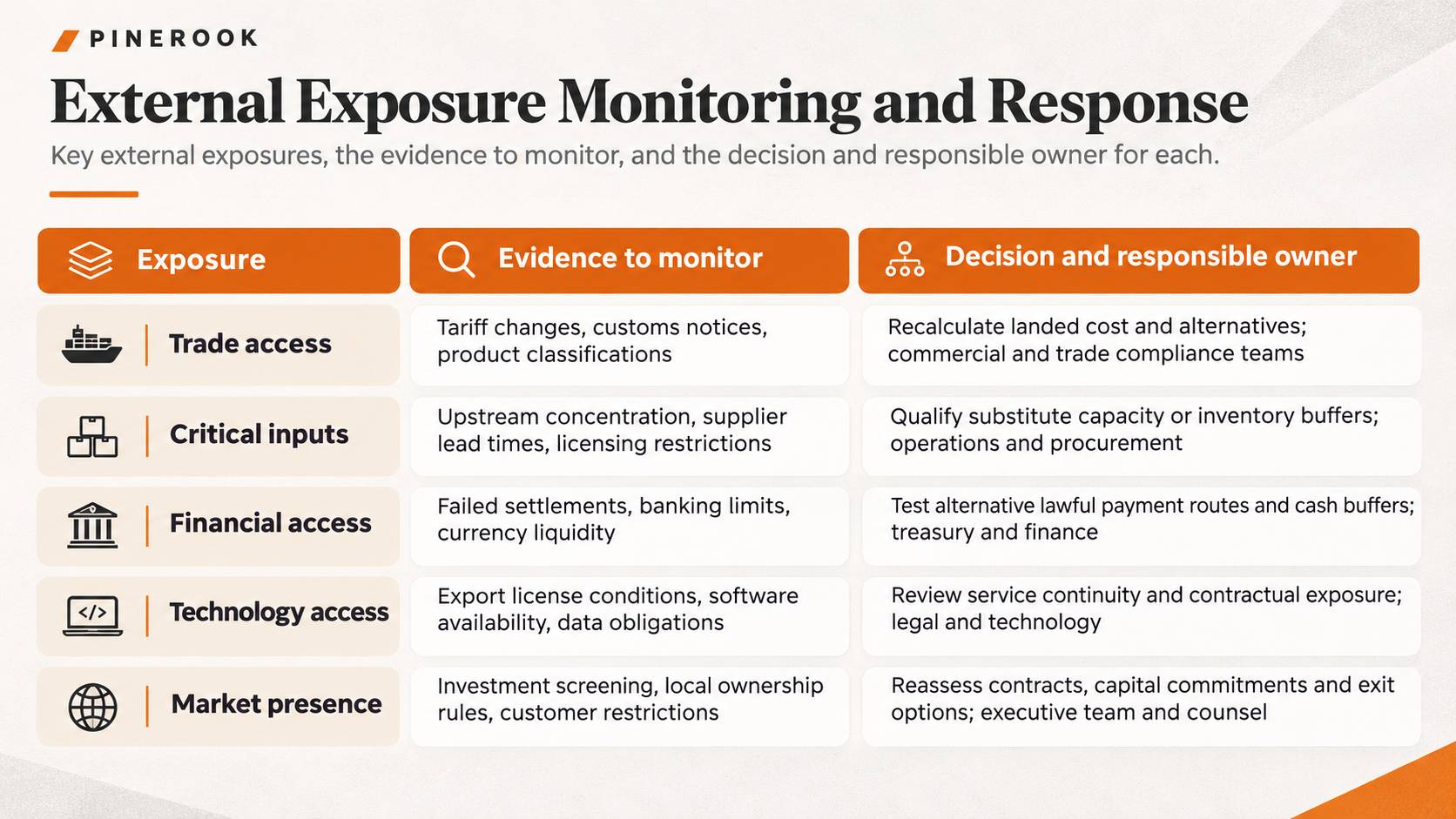
The strongest response may be to accept a manageable risk rather than pay for a second operating system. Review the expected benefit of each proposed control, including how much disruption it prevents, what it costs to maintain and whether it creates new dependencies. Risk reduction and economic efficiency are not mutually exclusive, but the balance must be explicit.
Build Resilience Without Assuming Domestic Production Is Safer
Diversifying suppliers can improve continuity, yet diversification is not equivalent to moving every activity closer to headquarters. A second supplier in a different country may reduce correlated exposure at a lower cost than relocating a factory. The relevant question is whether alternative capacity can deliver a qualified input during the specific disruption being considered.
The OECD Supply Chain Resilience Review published in 2025 warned that broad efforts to relocalize production could reduce global trade and real output without consistently improving resilience. The finding comes from modeled scenarios rather than a universal forecast for every firm. It cautions against assuming that geographic proximity alone removes concentrated inputs, infrastructure bottlenecks or regulatory risks.
For a company facing severe contractual penalties if one component is unavailable, additional inventory or redundant capacity may be worth the cost. For a standard item with many substitutes, the same expenditure may destroy value. Evaluate the expected interruption cost and the recurring cost of protection separately, and favor measures that are reversible when policy conditions change.
Test Treasury Exposure and Access to Working Capital
Financial channels can fail independently of physical supply. A company may be able to ship goods but unable to receive payment through its usual bank, convert a currency or repatriate cash. Treasury should identify critical currencies, settlement banks, funding maturities and customer payment dependencies, then assess liquidity under a plausible interruption.
This does not mean bypassing sanctions or using unapproved intermediaries. Any alternative arrangement must be legally permitted and screened by qualified compliance professionals. The practical objective is to preserve legitimate transaction options, maintain sufficient accessible liquidity and avoid relying on a single financial counterparty without recognizing that concentration.
Stress testing should also consider indirect effects. Higher freight and input costs can increase the need for working capital just as lenders become more cautious. Market volatility may affect collateral values or refinancing terms. A company that appears profitable on an accrual basis can still face a short term cash constraint when receivables arrive late and inventory must be rebuilt.
Assign Ownership and Review Risk as a Management Decision
Risk analysis often fails at the point where a department identifies a threat but no one has authority to respond. A simple governance structure gives each material exposure an owner, defines the decision that person can make and specifies when escalation to senior leadership or the board is required. Procurement should not unilaterally accept sanctions exposure, while legal counsel should not be expected to decide commercial inventory targets.
The 2026 McKinsey survey of 202 senior executives found that only 15 percent reported a dedicated geopolitical intelligence unit and roughly one in three never used scenario based analysis to test readiness. These are survey results for the respondents, not estimates for all businesses. They nevertheless highlight the gap between awareness and operational preparation.
A practical cadence combines periodic review with immediate escalation for material events. The board or executive committee should revisit exposure when entering new markets, making large capital commitments, signing concentrated supply contracts or changing financial providers. A scenario is useful only if someone knows what action it would authorize.
An Illustrative Case: A Manufacturer Facing Export Controls
Imagine a small manufacturer selling specialized equipment to customers in several countries. Its engineering team depends on one imported control module, and a substantial share of sales comes from clients that require that module. A proposed export licensing restriction creates uncertainty, but management does not yet know whether the final rule will cover the product.
The firm begins by confirming the module classification and upstream supplier concentration. It estimates how many weeks existing stock can support orders and asks legal counsel to interpret the possible licensing requirements. Finance models the cash effect of two possible delays and the cost of qualifying an alternative module. Sales identifies which deliveries could be rescheduled without breaching contracts.
Under the initial scenario, the firm continues lawful purchases while accelerating documentation and technical testing. If an enforceable restriction applies, the predetermined response is to prioritize existing commitments, seek appropriate legal authorization where available and activate qualified alternatives. If restrictions do not materialize, the firm retains a useful supplier map without having paid for a complete relocation. This is an illustrative example, not a report of an actual company.
How to Start a Geoeconomic Risk Program in One Month
During the first week, select the business lines that matter most to revenue and liquidity and map their foreign dependencies. In the second week, identify plausible restrictions and define what would make them material to contracts, production or cash. In the third week, build one realistic stress scenario and test whether current buffers, suppliers and financial relationships would withstand it. By the final week, assign owners, establish a small set of monitored signals and record the decisions each signal should trigger.
This is an initial operating cycle rather than a claim that a complex organization can solve all international risk in thirty days. The program should improve over time as the company obtains better supplier information, learns from policy changes and updates its financial assumptions. A small, reviewed plan is often more valuable than an elaborate register that nobody uses.
FAQ
What is geoeconomic risk management?
It is the process of identifying how politically driven economic restrictions may affect a business and preparing proportionate operational, financial and compliance responses. The focus is on the pathways from policy to business outcomes.
How is geoeconomic risk different from geopolitical risk?
Geopolitical risk covers a broader range of political and security developments. Geoeconomic risk focuses on how economic measures such as tariffs, sanctions, export controls and capital restrictions alter trade, investment and financing.
What should a company monitor first?
Begin with policies and operational signals tied to critical dependencies. These may include export licensing notices, sanctions updates, important supplier delays, blocked settlements and changes in market access affecting material revenue.
Can scenario analysis predict a trade restriction?
No. Scenario analysis tests how a company would operate if specified conditions occurred. It helps managers compare choices and prepare contingency plans without claiming precise forecasts of rare political events.
Is moving production closer to home always safer?
No. Domestic production can still depend on imported materials, foreign technology and concentrated infrastructure. The resilience benefit should be compared with the costs and the specific source of exposure.
Who should own geoeconomic risk within a company?
Senior management should assign clear accountability while legal, compliance, procurement, finance and operations contribute specialized evidence. Material decisions about capital, markets or continuity should be escalated through an agreed governance process.

Masoumeh Jahangard
Markets & Economy Writer at PinerookMasoumeh Jahangard covers markets, economic trends, and business conditions for Pinerook, focusing on how they affect startups and growing companies.
 Seen first.