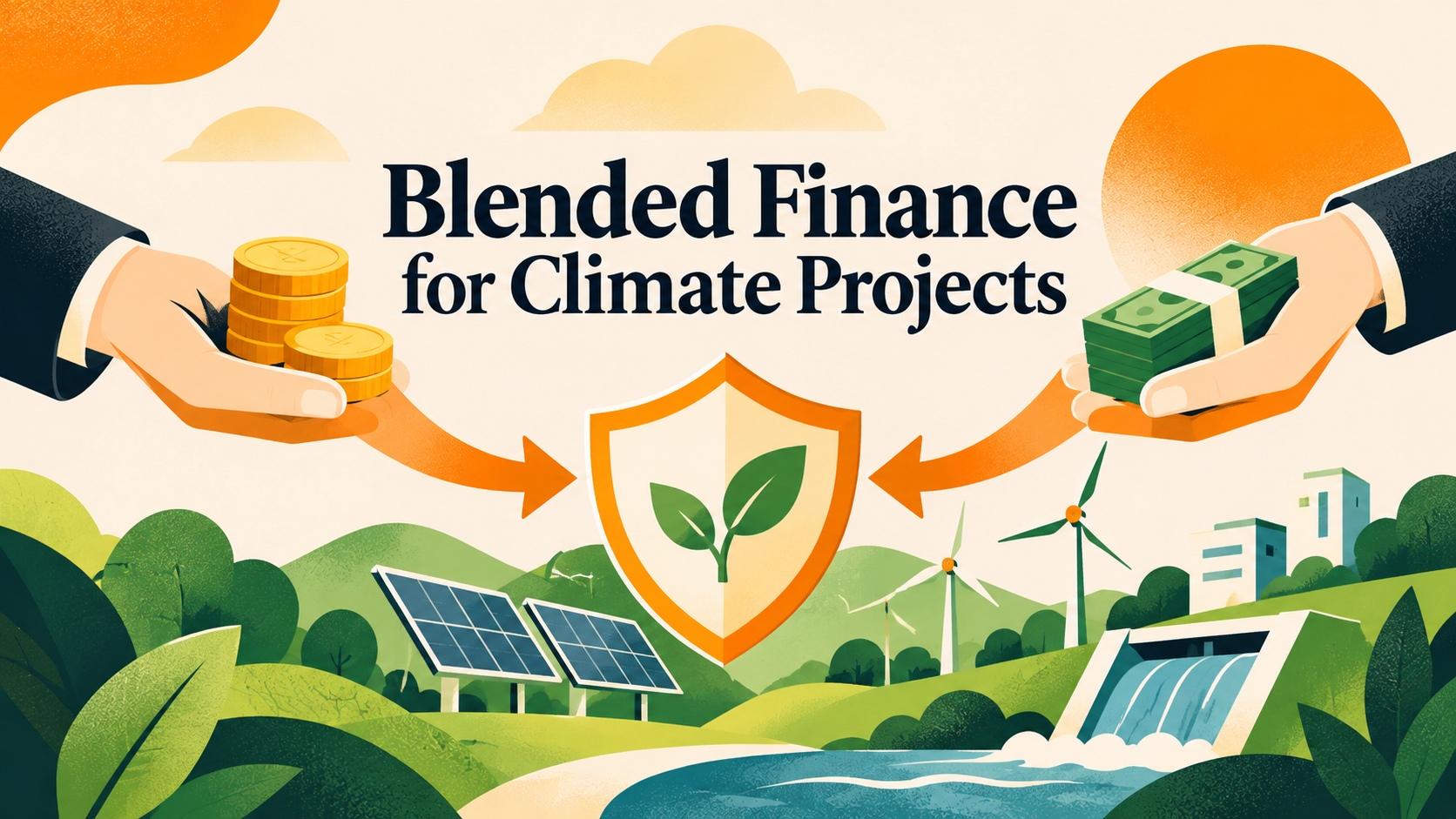
Blended finance for climate projects combines development oriented finance with commercial capital to support investments that are beneficial for the climate but cannot yet secure enough market funding on acceptable terms. It can involve a concessional loan, a guarantee, a grant for project preparation, or a junior investment that takes losses before senior investors. Its purpose is to mobilise additional investment, not merely to make an already profitable project cheaper.
A climate investment may need additional financial support because its benefits reach far beyond the revenue that a developer can charge for. Within the wider Climate Finance system, blended finance addresses that gap by using catalytic capital to change the risks or returns of a specific transaction, making participation possible for investors who would otherwise decline.
For a founder, project developer, policymaker, or investor, the practical question is whether the proposed structure removes a real obstacle to financing. A successful arrangement should improve bankability, allocate risks transparently, produce measurable climate outcomes, and limit the public support to what is necessary. A large financing announcement alone cannot demonstrate those results.
What Blended Finance Means in a Climate Project
Blended finance is a financing approach rather than one financial product. A transaction deliberately combines resources from development institutions or philanthropic providers with capital from commercially motivated investors. Public participation does not always mean a grant, and commercial participation does not always mean equity. What matters is the role each source plays in overcoming an identifiable investment barrier.
Concessional capital offers terms that a market provider would not ordinarily accept for a comparable risk. It may charge a lower interest rate, accept a longer repayment period, take a junior position, or provide protection against a defined loss. Other development finance may participate at commercial terms while helping establish investment standards or confidence. A green bond sold at ordinary market terms, by itself, is not automatically blended finance.
The distinction matters because climate impact and financial additionality answer different questions. A solar plant may reduce emissions, yet have enough reliable cash flow to attract normal bank loans. If so, public support may be unnecessary. Another project may have strong economic benefits but lack contractual revenues, local currency financing, or a credible operating history. Blending can be appropriate when a targeted intervention changes that situation.
Why Climate Projects Struggle to Attract Commercial Capital
Some clean energy and resilience projects are technically sound but fail the financial tests used by lenders. Revenue may depend on a utility with uncertain payment capacity, customers may be unable to afford initial charges, or domestic banks may be unwilling to provide long maturities. In other cases, a new technology has too little operating history for risk to be priced confidently.
Climate adaptation presents a further complication. Flood protection, drought resilience, or heat protection may prevent substantial social and economic losses without creating a direct revenue stream that repays private investors. Public grants or budget funding may therefore be more suitable than attempts to force a commercial structure onto every useful investment.
Before using a subsidy, project sponsors should identify whether the barrier is primarily financial, contractual, regulatory, or operational. A guarantee can manage a defined credit exposure, but it cannot by itself repair unpredictable tariffs or replace an absent legal framework. The International Energy Agency made this distinction in its October 2026 analysis of renewable energy investment in Southeast Asia.
Who Provides the Capital and Who Bears the Risk
Climate blended finance normally involves the project sponsor, one or more development or philanthropic capital providers, commercial investors, and an entity responsible for managing the financing arrangement. A development bank may provide a subordinated loan while a local bank provides senior credit. A philanthropic foundation might fund early technical preparation. A public agency could instead guarantee a specified share of lending losses.
The capital providers do not all receive the same economic rights. Senior lenders usually have priority in receiving payments and recovering their claims. Junior lenders or equity investors typically absorb losses earlier in return for a different level of risk and expected return. Guarantees change the allocation of certain losses but are contingent commitments rather than money paid into a project on the first day.
The structure also needs a governance framework. Investors must know who approves projects, monitors environmental outcomes, determines defaults, releases guarantees, and resolves conflicts. Without credible project contracts and operational management, a complex capital stack can create the appearance of protection without actually improving repayment prospects.
The Main Instruments Used in Climate Blended Finance
Different barriers call for different responses. A grant for engineering studies helps prepare a project that is not yet investable, while a subordinated tranche can protect senior investors from a defined layer of loss. A guarantee may address a specific lender concern without supplying upfront cash. The choice should follow the underlying financing problem, not the popularity of an instrument.
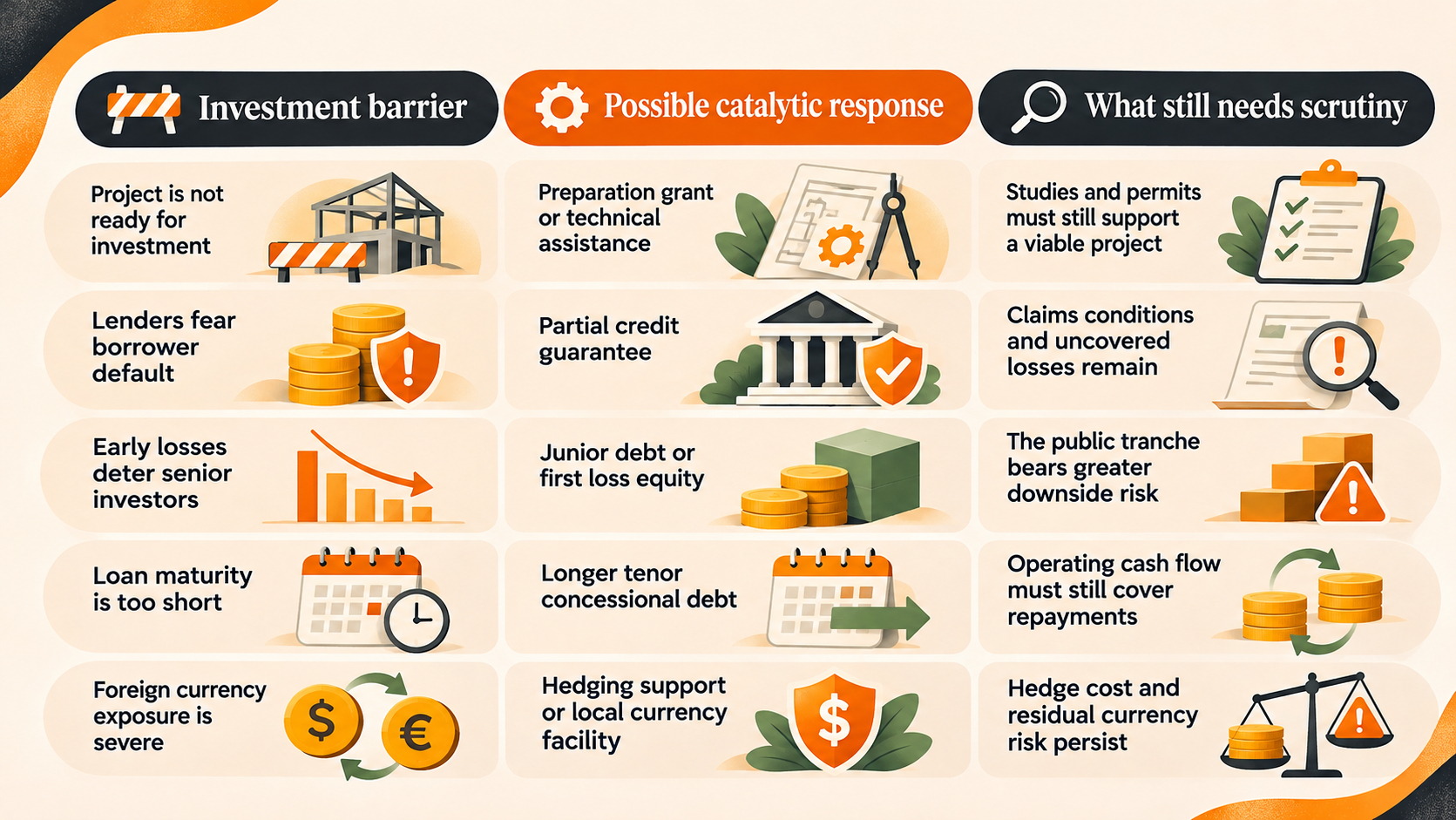
None of these tools eliminates commercial discipline. A guarantee may reduce losses for a lender while transferring risk to a public balance sheet. A longer maturity may relieve repayment pressure without fixing weak demand. The financing plan must show why a specific intervention changes the investment decision and whether a less expensive alternative could achieve the same result.
A Worked Example: Financing a Clean Water and Energy Project
Consider a hypothetical project that requires 20 million dollars to install efficient pumping equipment and improve water delivery in a drought exposed region. Expected user payments and utility savings can support debt service, but commercial lenders are concerned about payment delays and the limited operating history of the new equipment. The figures here illustrate capital structure, not a proposal for a real project.
The sponsor provides 4 million dollars in ordinary equity. Commercial lenders offer 12 million dollars in senior loans. A development finance institution supplies 4 million dollars of subordinated concessional debt that ranks behind senior lenders in repayment. These commitments total 20 million dollars. Senior lenders may become willing to participate because the subordinated debt accepts a defined portion of the downside before their claims are impaired, subject to the legal waterfall and other project liabilities.
In this simplified structure, 4 million dollars of concessional debt sits alongside 12 million dollars of senior commercial debt. Dividing 12 by 4 yields a ratio of three units of senior credit per unit of concessional debt, but that arithmetic is not proof that all 12 million dollars were mobilised by the concessional intervention. A proper additionality claim would ask whether the commercial lenders would have invested anyway and apply a consistent attribution method.
A partial guarantee offers an alternative. If a guarantor covers up to 3.6 million dollars of qualifying losses on the 12 million dollar commercial loan, that guarantee is a contingent exposure, not a further 3.6 million dollars of project funding. The financing plan cannot count both the full loan proceeds and the guarantee ceiling as cash raised. In either structure, a project still needs realistic demand, sound contracts, insurance where suitable, and credible operation.
Financial Additionality and the Minimum Necessary Subsidy
Financial additionality means the development or concessional intervention causes finance to become available on a scale, timing, maturity, or set of terms that would not otherwise be achieved. It is not enough to show public and private investors standing beside each other in a transaction. The causal relationship matters, as the OECD explains in its blended finance guidance.
A funding proposal should document the original market constraint. Evidence might include declined lending offers, unaffordable loan terms, a missing hedging product, or financing that matures well before project revenues are expected. The sponsor should then explain how a specific form of public support addresses that constraint, rather than applying a broad subsidy to the entire project.
Concessionality should generally be limited to the amount required to mobilise credible commercial participation and achieve the intended development outcome. Excessive support can crowd out normal providers, transfer undue returns to private investors, and consume resources that other projects need. Transparent terms and a plan to reduce dependence on support over time help protect the public interest.
How to Evaluate Risk, Returns, and Project Bankability
A careful appraisal begins with expected cash flow. The developer should test the sensitivity of revenue to delayed customer payments, lower demand, higher operating expenses, and changes in interest rates. In emerging markets, foreign currency borrowing can create repayment stress when a project receives local currency income. Guarantees and hedges should be judged against those specific exposures.
Risk allocation also has a price. A lower coupon or a junior tranche may make the project feasible, but the benefit must be considered alongside fees, transaction costs, governance obligations, and potential public losses. A project that appears profitable only because assumptions ignore those costs is not yet bankable.
Investors should additionally review environmental and social safeguards, procurement standards, the ability to measure climate outcomes, and how unresolved disputes would affect project operations. The strongest structures pair financial protections with operational capability rather than substituting financial complexity for a weak project.
Measuring Success Beyond the Headline Leverage Ratio
A leverage or mobilisation ratio can describe how much commercial finance is associated with a catalytic contribution, but the definition must be explicit. A number that uses the face value of guarantees in its denominator is not directly comparable with one based on paid in grants or the grant equivalent of concessional loans. Counting the same investment across several providers also risks overstating results.
Financial evaluation should examine private capital genuinely mobilised, the cost and loss exposure of public support, eventual repayment, and whether repeat transactions can attract commercial investors without continued subsidies. Climate evaluation should separately measure outcomes such as verified emissions avoided, energy access improved, or physical resilience increased. A transaction can raise substantial capital and still deliver weak results for the communities it is supposed to serve.
Distribution matters as well. Projects in countries with established banking markets are usually easier to finance than those in fragile or very low income settings. If an instrument performs well only in comparatively safe markets, a strong aggregate mobilisation ratio may conceal limited progress where financing gaps are greatest.
What the Latest Evidence Shows in 2026
Convergence reported in October 2026 that private investor commitments across the broader blended finance market reached 11.2 billion dollars in 2025, compared with 8.8 billion dollars in 2024. Its report recorded 123 climate related transactions in 2025. These are observations from the blended finance market, not measurements of all public or private climate investment globally.
The same assessment reported a notable increase in climate adaptation blended finance volume during 2025, although opportunities and financing conditions remain uneven across countries. More activity does not automatically imply that every transaction was additional, that investor losses disappeared, or that sufficient capital reached the most vulnerable economies.
The OECD and the International Energy Agency have also placed greater emphasis on targeted structures and mature project pipelines. An October 2026 IEA study of renewable energy in Indonesia, the Philippines, and Viet Nam found that financing interventions are most useful when specific project risks can be mitigated. Market barriers rooted in tariffs, regulation, or other structural conditions require broader reforms in addition to finance.
Real Examples and What They Demonstrate
The GAIA climate investment platform described in OECD case studies combines layered capital with technical assistance and foreign exchange risk management. Its design illustrates how investors with different risk appetites can participate in a common vehicle. Projected social and climate benefits should, however, be distinguished from results that have already been achieved.
The Catalytic Climate Finance Facility, a collaboration involving Climate Policy Initiative and Convergence, reported in September 2026 that 17 supported financial vehicles had raised 308 million dollars in new commitments and unlocked more than 700 million dollars through direct investment and cofunding. Those figures describe the programme and its reporting scope; they do not establish a universal multiplier for other climate projects.
The common lesson is not that every project needs a layered fund. Effective support starts with a credible investment pipeline, clear financial constraints, capable partners, and measured outcomes. Smaller projects may be better served by pooled facilities or technical preparation than by a complex standalone transaction.
When Blended Finance Is the Wrong Solution
Blending is unnecessary when commercial investors are already willing to fund an investment on suitable terms. It is also inappropriate when the public contribution simply replaces private capital that would have entered anyway, or when commercial returns depend on an indefinite subsidy without a clear development rationale.
Some public goods cannot generate enough revenue to sustain debt even after risk sharing. Direct public spending or grants may be more efficient for such projects. Elsewhere, weak contracts or regulatory uncertainty may be the main obstacle, making institutional reform more important than a new guarantee product.
A useful decision rule is to require three answers before committing catalytic funds: what specifically stops finance from flowing, why will this instrument change that outcome, and how will both the public cost and climate benefit be measured? If any answer is weak, the proposed structure needs further work.
Blended finance for climate projects is most valuable when it addresses a real financing failure with a proportionate intervention. A grant, guarantee, subordinated loan, or carefully designed fund can help bring commercial capital to a credible climate investment. The test of success is not the complexity of the arrangement or the size of the announcement, but additional capital, disciplined risk allocation, durable project economics, and verifiable climate outcomes.
FAQ
What is blended finance for climate projects?
It is the strategic use of development or catalytic capital alongside commercial funding to overcome risks or return constraints that would otherwise prevent climate investment. The intervention should mobilise additional finance and serve a clearly defined climate objective.
How is blended finance different from a government grant?
A grant may be one component of a blended structure, but blended finance also coordinates commercial investors and other instruments. A standalone grant for a public project is not necessarily blended finance if it does not mobilise additional commercial capital.
Does a first loss investment guarantee that senior investors cannot lose money?
No. A junior tranche can absorb an initial layer of losses, but senior investors can still lose money if losses exceed the protection or if contractual protections do not apply. The precise waterfall and legal terms govern outcomes.
How is private capital mobilisation measured?
Measurement should identify finance caused by the intervention, attribute it consistently, and avoid counting guarantees as upfront project cash. Ratios are meaningful only when the types of capital and measurement rules are disclosed.
Can blended finance support climate adaptation?
Yes. It can help finance resilient agriculture, water systems, or other adaptation investments when credible revenue or repayment mechanisms exist. Projects with little commercial income may still need predominantly public grants.
When should a climate project avoid blended finance?
A project should not seek concessional support when ordinary commercial funding is available on workable terms, when a subsidy would replace private money, or when the core problem is an unviable project rather than a resolvable financing barrier.

Masoumeh Jahangard
Markets & Economy Writer at PinerookMasoumeh Jahangard covers markets, economic trends, and business conditions for Pinerook, focusing on how they affect startups and growing companies.
 Seen first.