What Is Geoeconomic Fragmentation?
Geoeconomic fragmentation is the policy driven or politically induced reorganization of international economic relationships. Governments may impose tariffs, sanctions, investment screening, export controls, subsidies, or procurement restrictions. Businesses respond by changing suppliers, relocating production, reconsidering market access, and increasing inventory or financing buffers. Some of these responses are economically rational defenses against concentrated risk; others increase costs by limiting competition and the benefits of specialization.
The concept is broader than a trade war. Fragmentation can affect goods, services, foreign direct investment, portfolio capital, data, intellectual property, skilled labor, and financial infrastructure. It also differs from ordinary regional integration, which may expand trade with nearby partners without necessarily discriminating against distant ones. The central analytical question is whether economic ties are being reorganized because of policy and geopolitical alignment rather than only price, quality, or distance.
A useful starting distinction is between fragmentation and diversification. Replacing a single supplier with several suppliers across different regions may increase resilience while keeping markets open. A blanket restriction on otherwise competitive partners may reduce dependencies but also impose lasting economic losses. The same policy can have mixed effects across industries, countries, and time horizons.
Why the Global Economy Is Reorganizing
Several forces intersect. Governments have become more sensitive to strategic dependencies in semiconductors, energy, pharmaceuticals, communications, and critical minerals. Tariff disputes and national security restrictions change relative prices and market access. Industrial policies steer capital toward domestic production or favored allies. Sanctions and compliance risks create obstacles for banks, logistics providers, and cross border counterparties. Together, these factors can make geopolitical predictability as relevant as unit production cost.
Technology is not simply another sector exposed to these policies; it is also an engine of trade. The McKinsey Global Institute reported in March 2026 that semiconductors and data center equipment accounted for roughly one third of global merchandise trade growth in 2025. That demonstrates why a narrow picture of trade collapsing is misleading: strategic rivalry can coexist with expanding, technology led trade and new connections between emerging economies.
The October 2026 UNCTAD Trade and Development Report described the emerging pattern as selective fragmentation rather than generalized deglobalization. Its headline finding was that global trade reached about $35 trillion in 2025 despite conflict and rising trade restrictions. The aggregate can be resilient while individual firms face more complicated routing, compliance, and pricing decisions.
The Main Channels of Economic Fragmentation
The first channel is trade policy. Higher tariffs and restrictive standards can redirect imports to alternative countries or encourage regional production. These changes sometimes protect strategic supply but can also reduce choice and efficiency. The second is investment: screening rules, ownership restrictions, and sanctions can alter where multinational companies build facilities or deploy capital. Even where no formal ban exists, the prospect of future restrictions may influence long lived investments.
A third channel concerns technology and data. Export controls, incompatible standards, or data localization requirements can split technology ecosystems and raise the cost of serving multiple markets. A fourth concerns finance, where different sanctions regimes, payment access, liquidity conditions, and settlement arrangements can increase friction in cross border transactions. A fifth is commodities: energy, agricultural goods, and strategic minerals may become especially sensitive to transport bottlenecks and diplomatic relationships.
A serious economic analysis follows the channel all the way through to a measurable outcome. A tariff is not automatically equivalent to a permanent rise in consumer prices; the effect depends on exchange rates, exporters’ margins, substitution options, and pass through. Similarly, a new investment restriction does not necessarily reduce total global investment by the same amount: some capital may move elsewhere rather than disappear.
Globalization, Regionalization, and Friend Shoring
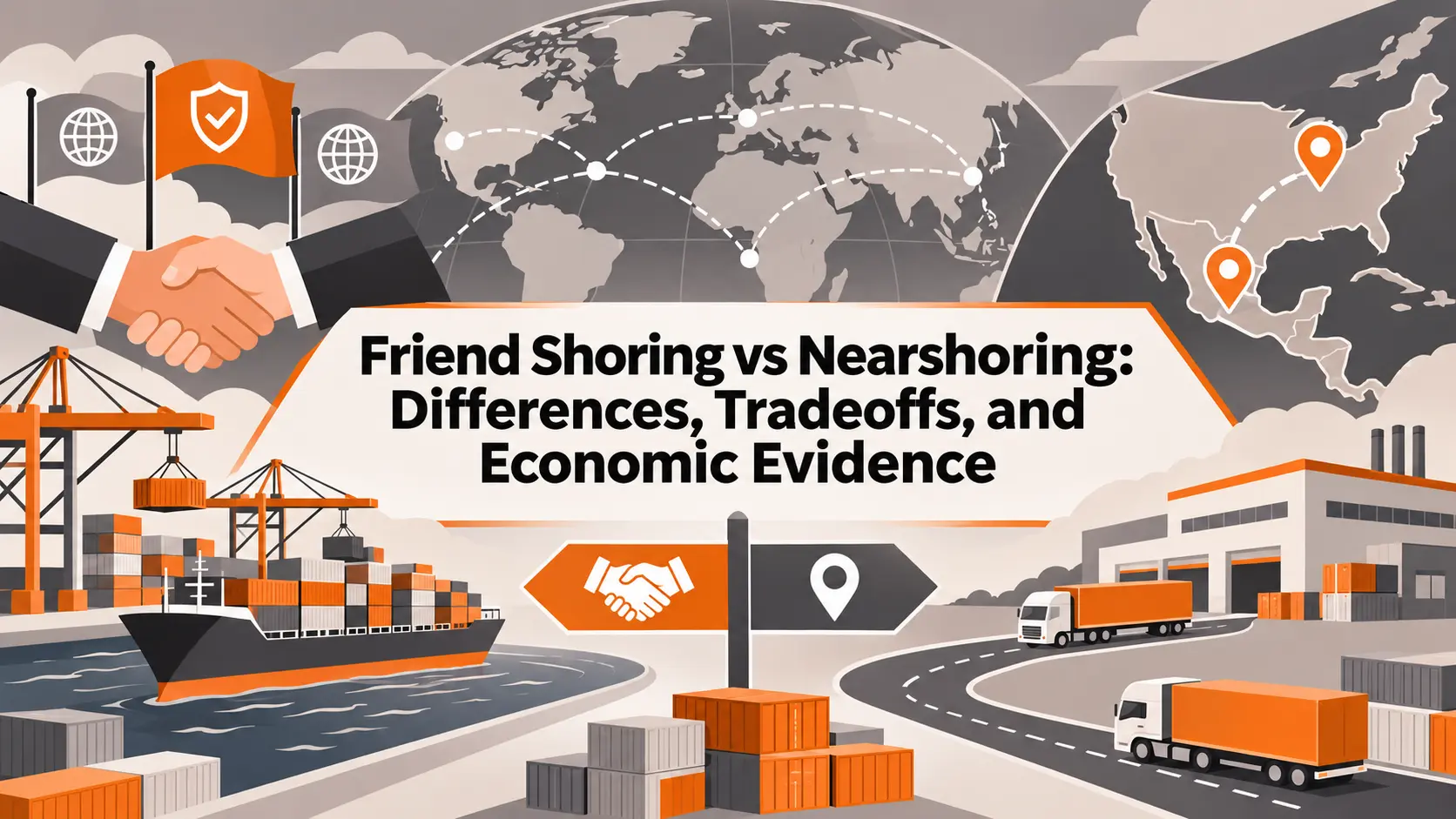
The words used to describe trade realignment can obscure the evidence. Globalization refers to international economic integration, while regionalization describes a greater concentration of relationships within geographic regions. Friend shoring is sourcing or investing in politically aligned countries, whereas nearshoring emphasizes geographic proximity. Reshoring moves production back to the home country. Those strategies can overlap, but they should not be treated as interchangeable.
In practice, firms may combine them. A manufacturer may maintain a global customer base while moving one critical component to a trusted jurisdiction and adding a backup supplier nearby. That is a more precise description than saying its supply chain has simply “deglobalized.” The strongest interpretation depends on observing changes in actual flows, not just corporate announcements.
Understanding Friend Shoring vs Nearshoring helps explain why geopolitical distance and geographic distance can move in different directions. In its 2026 study, McKinsey found trade was increasingly oriented toward geopolitically aligned partners, even as physical supply chains did not uniformly become shorter.
How to Measure Fragmentation Without Misreading the Data
No single statistic establishes whether a country or the world has fragmented. Analysts should compare bilateral trade shares, effective tariff rates, the geographic and political concentration of suppliers, sector specific import dependencies, inward and outward investment flows, and the cost of cross border payments. A rise in trade with one partner may reflect strong demand, exchange rate changes, or changes in prices rather than a durable structural realignment.
The indicator also needs a time frame and denominator. A trade share can fall even when the absolute value of trade rises, and nominal trade growth may reflect inflation rather than higher volumes. When discussing Geoeconomic Fragmentation Indicators, it is especially important to separate announced policy changes from realized changes in trade and capital movement.
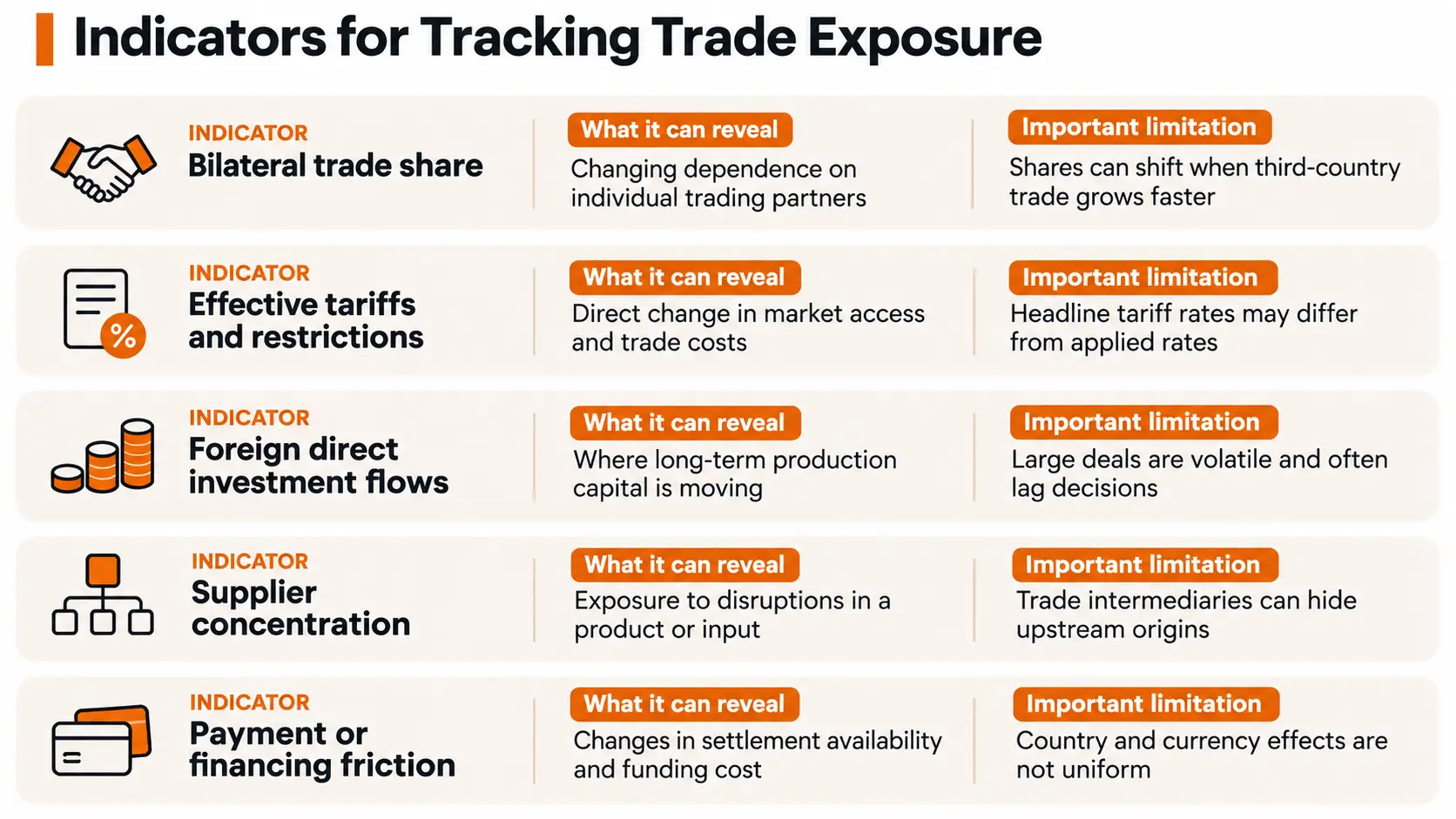
Taken together, these measures show why fragmentation must be studied at both aggregate and sector levels. An economy may trade extensively while still depending on a very small number of suppliers for essential equipment. Conversely, a modest shift in bilateral trade need not imply that global markets are breaking apart. Evidence becomes more reliable when observed changes match a plausible policy mechanism.
Trade Fragmentation and Supply Chain Resilience
A concentrated supply chain can be efficient in ordinary conditions yet fragile when a shock hits. Governments and businesses therefore have legitimate reasons to invest in alternative suppliers, reserves, and redundancy. The problem is that resilience is not free. Moving production to a higher cost location, duplicating inventory, or qualifying new suppliers can tie up capital and raise prices.
The economics of Trade Fragmentation and Supply Chains should be evaluated as a trade off between the expected cost of disruption and the recurring cost of risk reduction. An expensive supplier switch may be rational for a component that would otherwise stop an entire production line, but wasteful for a widely available input. Policymakers face a similar choice when subsidizing strategic capacity: benefits should be weighed against fiscal costs and possible retaliation.
The U.S. Federal Reserve’s December 2025 analysis found that trade fragmentation is neither uniform across countries nor symmetric across exports and imports. This matters because models that assume a simple separation into blocs can exaggerate some effects and overlook the role of intermediary or “connector” economies.
Capital Flows and the Financial System
Fragmentation also influences capital allocation. A country may attract more investment because firms seek a new manufacturing base; another may receive less because sanctions, screening, or uncertainty increase the risk of operating there. Capital can be diverted rather than destroyed, but diversions may put investment in less productive locations. Investors also have to price legal enforceability, currency access, and the stability of financial relationships.
The topic of Financial Fragmentation and Capital Flows deserves separate analysis because financial frictions operate differently from trade barriers. Banks and investment funds depend on regulations, correspondent relationships, clearing systems, and access to liquid currencies. Restrictions can produce funding mismatches or settlement delays even where the underlying trade remains legal.
Countries are not equally exposed. Small economies dependent on imported intermediate goods, external financing, or a narrow export market may find it harder to absorb a geopolitical shock. Larger economies have more internal alternatives, although they can still incur sizable efficiency losses. The IMF has emphasized that fragmentation can reduce productivity, investment, and international risk sharing, with substantial differences between advanced and developing economies.
What the Economic Costs Really Mean
Forecasts of fragmentation costs should be read as conditional scenarios, not predictions that a particular percentage loss will occur. The World Trade Organization’s 2026 World Trade Report modeled a “geo fragmented world” in which global GDP was 5.1% lower and exports 18.6% lower than in a cooperative reference scenario. The result illustrates the possible scale of damage if the multilateral system splits into politically aligned blocs; it does not describe an observed decline of that size in 2026.
The cost depends on how trade is rerouted, how fast firms adjust, whether new suppliers can scale, and how governments retaliate. Producers protected from foreign competition may benefit, while downstream businesses and consumers pay more. Some intermediary countries may gain business as supply chains reorganize. It is therefore better to explain distributional winners and losers than to present a single world GDP number as the whole story.
Comparing Economic Costs of Geoeconomic Fragmentation across studies also requires checking the baseline, time horizon, sectors, and modeled policy shock. Estimates based on tariffs alone cannot be assumed to capture restrictions on investment, technology, and financial services. Scenario assumptions matter at least as much as the headline result.
Emerging Markets, Connector Economies, and Uneven Exposure
Emerging markets are not a homogeneous group. Some face higher financing costs, limited bargaining power, and dependence on global demand. Others gain new export orders when large economies diversify suppliers. Countries with established logistics networks, skilled labor, and credible trade rules may attract redirected investment. Yet acting as a connector does not remove the risk that restrictions eventually extend to goods routed through third countries.
The subject of Geoeconomic Fragmentation in Emerging Markets should distinguish short term trade diversion from lasting development gains. A sudden rise in assembly exports is not proof that a country has acquired domestic technology capabilities or captured greater value added. Analysts must look at local employment, domestic supplier networks, productivity, and investment that survives once the initial policy shock fades.
UNCTAD’s 2026 assessment points to these uneven consequences. Its analysis finds that global trade can remain resilient while developing regions face differentiated growth prospects, technological barriers, and pressures from higher costs. The important question is not simply whether a country benefits from reorientation today, but whether it can build durable economic capability from that opportunity.
Practical Decisions for Businesses and Investors
For international businesses, fragmentation changes the assumptions behind location strategy, supplier selection, working capital, and market entry. Management should map essential inputs and identify the jurisdictions, intermediaries, and settlement methods on which revenue depends. A supply chain with multiple immediate vendors may still rely on a single upstream source. Equally, alternative factories are of limited value if export licensing or payment access fails.
A useful approach is to develop several plausible scenarios rather than a single forecast. The central case may assume that friction remains selective; a downside case may combine higher tariffs, more restrictive export rules, and delayed settlements; an upside case may involve negotiated trade agreements and fewer restrictions. The company can then identify decisions that work across scenarios and those that should be triggered by evidence.
The framework below is illustrative, not a forecast of policy changes. It allows managers to translate Geoeconomic Risk Management into concrete actions without treating every headline as an emergency.
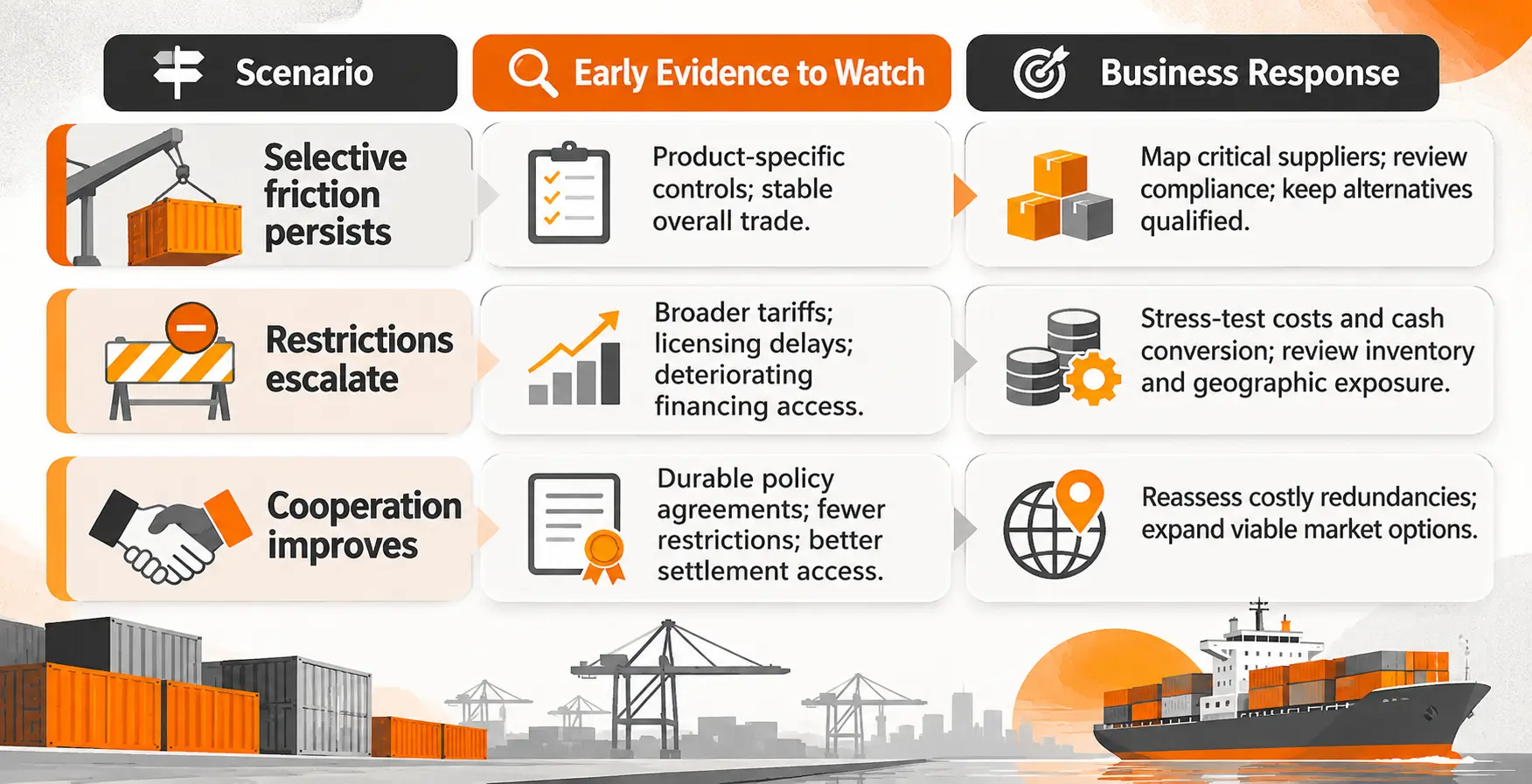
The aim is to avoid two mistakes: ignoring structural risk because aggregate trade numbers look strong, and overreacting to geopolitical news without evidence of a material business impact. A good decision process assigns responsibility for monitoring risks and sets thresholds for reviewing, rather than automatically reversing, a strategy.
How the Outlook Could Develop
Three uncertainties stand out. First, governments may distinguish narrowly defined strategic sectors from ordinary commerce, limiting fragmentation costs. Second, competition over advanced technology and critical inputs may keep restrictions in place even when tariff tensions ease. Third, emerging market trade networks may expand enough to diversify global production, but not necessarily to overcome divisions in standards, finance, or regulation.
The debate around Future of Globalization should therefore move beyond an all or nothing framing. The global economy may stay deeply connected while connections become more conditional, politically filtered, and costly to maintain. That combination is consistent with the 2026 evidence of record trade alongside shifting geopolitical alignments.
Conclusion
Geoeconomic fragmentation is best understood as a change in the rules and geography of economic interdependence, not the end of international trade. The evidence points to selective shifts in trading relationships, investment incentives, and strategic dependencies. Their economic consequences depend on policy design, firm adaptation, sector exposure, and the availability of credible alternatives. For analysts and decision makers, the most useful question is not whether globalization is “over,” but which connections are becoming more expensive, less reliable, or more valuable and why.
Frequently Asked Questions
Is geoeconomic fragmentation the same as deglobalization?
No. Fragmentation describes the reorganization of economic relationships along political and strategic lines. Trade can continue growing in aggregate while particular relationships weaken or shift toward different partners.
What causes geoeconomic fragmentation?
The principal drivers include trade restrictions, sanctions, investment screening, technology controls, security concerns, and efforts to reduce dependence on concentrated suppliers. Each operates through different costs and incentives.
Does fragmentation always reduce global trade?
Not necessarily in the short run or in every sector. Trade can be rerouted through new partners, and demand can expand for other reasons. Severe, persistent restrictions can nevertheless lower trade and economic output relative to an open system baseline.
Why are emerging markets especially relevant?
Many have limited buffers against external shocks, but some can attract redirected manufacturing and investment. The outcome depends on productive capacity, institutions, access to finance, and the ability to retain local value added.
How can investors assess fragmentation risk?
They can examine revenue by jurisdiction, sourcing concentration, currency exposure, regulatory restrictions, financing dependencies, and scenario sensitivity. A single geopolitical risk score is usually too coarse to substitute for asset specific analysis.
What is the difference between nearshoring and friend shoring?
Nearshoring prioritizes geographic closeness; friend shoring prioritizes political alignment. A supplier can be nearby without being politically aligned, or aligned while being geographically distant.

Masoumeh Jahangard
Markets & Economy Writer at PinerookMasoumeh Jahangard covers markets, economic trends, and business conditions for Pinerook, focusing on how they affect startups and growing companies.
 Seen first.