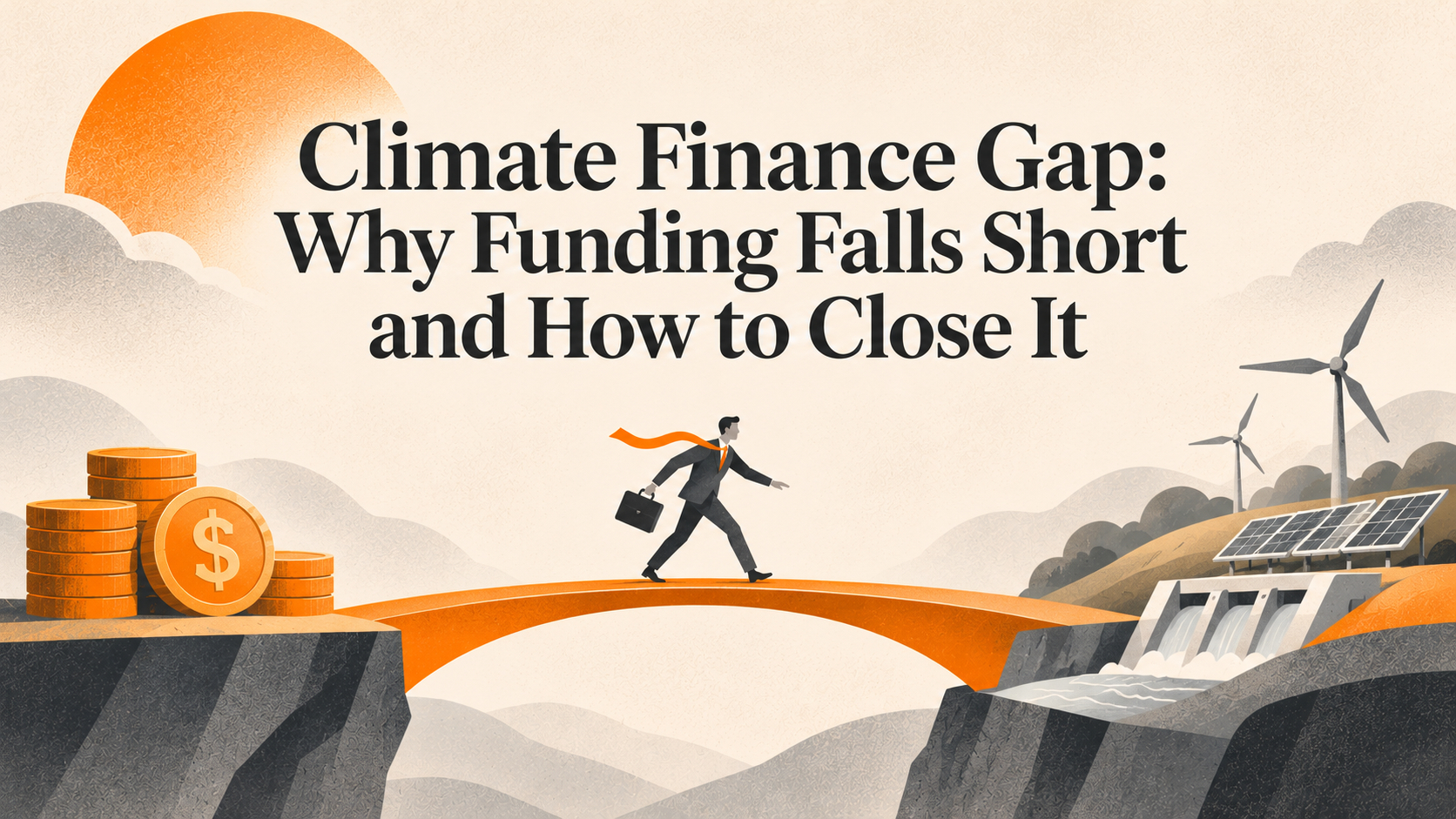
The climate finance gap is the difference between the capital actually reaching climate action and the investment required to meet a defined climate objective. It remains large even after years of record spending because finance is concentrated in particular technologies and markets, while many urgent projects cannot secure affordable funding. Understanding the gap requires more than comparing two impressive dollar figures. The purpose, geography, period, and accounting method behind each number determine what the comparison really means.
For readers exploring the broader economics of Climate Finance, the central question is not simply where more money could come from. It is why finance fails to reach investments that have clear climate and economic value, and how governments and financial institutions can change those conditions. This article separates measurable financing shortfalls from political pledges, identifies the structural barriers that cause them, and sets out a practical way to evaluate solutions without mistaking announcements for money delivered.
What Is the Climate Finance Gap?
A climate finance gap exists when the amount of eligible financing deployed during a defined period falls below the estimated amount required to achieve a particular objective. The objective might be a global emissions pathway, a national climate plan, or a programme to reduce physical climate risks. A single universal gap does not exist because the required investment changes with the scenario, policy assumptions, coverage of sectors, and treatment of public and private spending.
The distinction between investment needs and available funding is important. A cost estimate might include additional power networks, clean transport, stronger buildings, and protection against extreme weather. A financing estimate records the capital reaching eligible activities under a particular methodology. Even when both values are reported in dollars per year, the comparison is meaningful only if the years, coverage, and price basis are sufficiently aligned.
How Do Researchers Measure the Gap?
Analysts generally work from one of two directions. A model based assessment estimates the investment needed to meet an emissions or temperature objective, then compares it with observed financing. A country based assessment starts with national targets and project plans, estimates their cost, and identifies the sources expected to cover them. These approaches can produce different results without either being wrong. National ambitions may not yet match a global temperature pathway, while modelled investments may not be fully reflected in national budgets.
Before using a gap estimate, check whether the denominator covers mitigation, adaptation, or both; whether it includes households and domestic private investment; whether finance is counted at commitment or disbursement; and whether projections use constant or current prices. It is equally important to ask whether the estimate concerns an annual investment requirement or the cumulative shortfall over several years. Mixing a cumulative need with one year of observed funding can generate a striking but meaningless headline.
What the Latest Climate Finance Numbers Show
Climate Policy Initiative reported that global climate finance exceeded USD 2 trillion in 2024, with a preliminary estimate of about USD 2.1 trillion for 2025. Its 2026 needs analysis points to average annual financing requirements of roughly USD 7.8 trillion from 2025 through 2030 under the scenarios examined. The figures indicate a major scale problem, but the observed 2024 flow is not a direct measurement of a future year shortfall. The growth rates, price assumptions, and investment scope still matter.
The adaptation picture is narrower but particularly revealing. UNEP estimated that international public adaptation finance from developed to developing countries reached USD 28.2 billion to USD 31.7 billion in 2024, against developing country adaptation needs of around USD 305 billion annually by 2035. The flow measure covers only a subset of possible finance, while the needs estimate has a different horizon and broader purpose. Their separation is evidence of a serious funding challenge, not a precise subtraction that represents all adaptation spending.
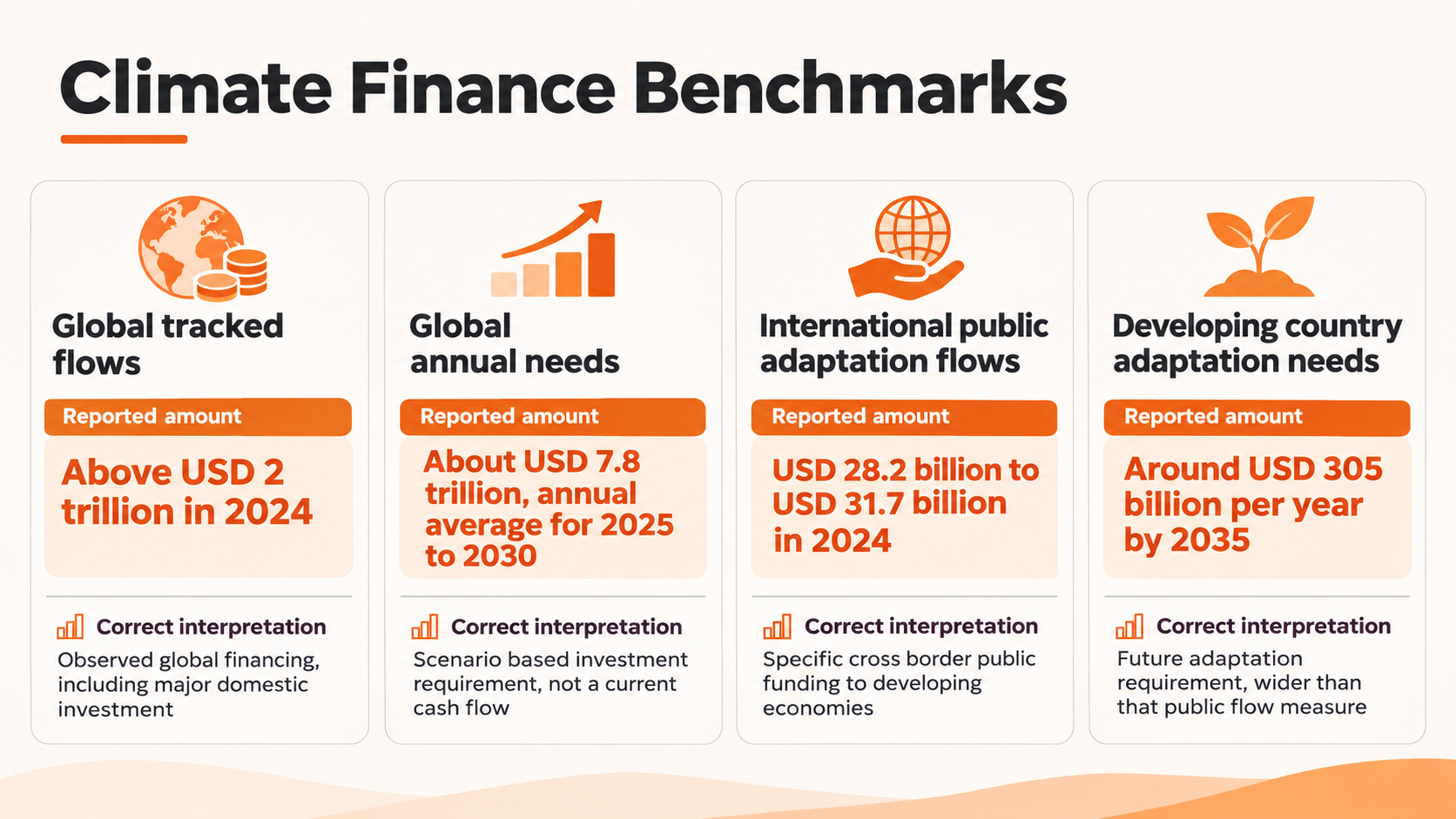
The table illustrates why finance gaps cannot be understood through a single subtraction. An analyst comparing global climate investment with future investment needs is answering a different question from a negotiator assessing international public support for adaptation. Both questions are important, but their answers belong in different accounting frameworks. As technologies become cheaper, investment requirements and the quantity of climate outcomes delivered per dollar can also change.
Why Does the Climate Finance Gap Persist?
Economically valuable projects are not always commercially investable
Some projects avoid damage, improve health, or preserve ecosystems without creating a cash flow that can repay a commercial lender. Their social return may be substantial while their private return is uncertain or absent. More investor outreach will not solve this mismatch on its own. Public budgets, regulation, carefully targeted transfers, or shared payment mechanisms may be required to turn a public benefit into a financeable obligation.
The cost of capital differs sharply across markets
Identical technologies can face very different financing costs depending on interest rates, currency volatility, contract enforcement, political uncertainty, and the availability of domestic lenders. A project may be profitable at one financing rate and unworkable at another. This is why the headline price of solar panels, batteries, or efficient machinery does not reveal whether an investment will proceed in a particular country. The cost of capital can be as decisive as the cost of equipment.
Investment is concentrated where revenues are easier to verify
Commercially established energy technologies receive much of the tracked climate investment because borrowers, lenders, and customers can assess their economics with relatively familiar tools. Other activities, including climate resilient agriculture and industrial transformation, may face longer development periods, uncertain demand, or difficult measurement challenges. The resulting gap is about allocation as much as total funding. Capital may grow globally without reaching the projects that need it most.
Weak project preparation prevents money from being deployed
A government or business may identify an urgent climate need without having feasibility studies, land rights, procurement documents, credible demand forecasts, or an implementable budget. Investors cannot finance a general aspiration as if it were an approved project. Preparation capacity is therefore an economic bottleneck. Technical assistance can be valuable where it helps convert a priority into a proposal with clear costs, accountable management, and realistic delivery milestones.
Policy uncertainty increases perceived risk
Changes in tariffs, permits, energy regulation, procurement rules, or subsidy arrangements can undermine expected returns. Investors may respond by charging more, requiring additional security, or declining to participate. Credible policy, transparent tenders, predictable contracts, and effective dispute resolution can improve financing conditions without necessarily increasing public spending by the same amount as the resulting private investment.
Why Public Climate Pledges Are Not the Same as Finance Delivered
Political finance goals can set direction and establish accountability, but a pledge is not a payment. An announced target may later become an approved budget, a legal commitment, a disbursement, and finally an expenditure by the implementing agency. Each stage has its own risks and delays. An investment gap analysis that counts a pledge and the eventual project expenditure as separate contributions can significantly overstate available resources.
The new collective climate finance goal agreed under the UN climate process includes an annual USD 300 billion goal by 2035, with developed countries taking the lead, alongside a call to scale up financing from all sources for developing countries to at least USD 1.3 trillion per year by 2035. These are distinct goals with different scopes. Neither should be presented as the total estimated global investment requirement, and neither demonstrates that the required capital has already reached projects.
Where Are Financing Shortfalls Most Difficult to Close?
The gap is often acute where climate exposure is high but fiscal capacity, local banking depth, and project preparation resources are limited. It can also be large in sectors with high initial investment costs or uncertain commercial returns. Global totals hide these differences. A country can receive more investment than before and still face a widening gap if its infrastructure needs or physical climate risks are increasing faster.
This geographic dimension does not justify treating every developing economy as the same type of borrower. Some can finance major climate infrastructure through active domestic capital markets, while others depend heavily on grants or concessional assistance. The appropriate response depends on debt capacity, currency risk, institutional capability, project economics, and the distribution of benefits. A more detailed assessment of access barriers belongs to the separate developing country finance discussion.
A Practical Example of Measuring a Funding Gap
Consider a hypothetical national climate programme that requires USD 420 million of eligible investment during the coming year. The finance ministry announces USD 240 million of expected support, but only USD 180 million is contractually committed, and only USD 120 million is likely to reach eligible projects in that same year. The USD 240 million announcement is not the correct figure for assessing implementation capacity.
If the USD 420 million requirement and the USD 120 million expected disbursement are measured over the same year, cover the same eligible activities, and use the same price basis, the illustrative execution gap is USD 300 million. This is different from a commitment gap, and it does not predict whether all planned projects are economically justified. Some spending may be delayed because preparation is inadequate; other activities might be replaced by less costly solutions with equivalent outcomes.
A credible assessment would next identify why the remaining projects are unfunded. Is the problem insufficient budget authority, a financing cost that makes projects unattractive, missing permits, or weak delivery capacity? Each answer implies a different remedy. Asking for more external finance before identifying the constraint can leave the programme with larger pledges but little additional implementation.
How Can the Climate Finance Gap Be Reduced?
Prioritize projects by climate value and financial feasibility
Decision makers should evaluate both expected climate outcomes and the economic conditions required for delivery. Projects with dependable savings or revenues may be suitable for commercial finance, while activities with extensive public benefits may require grants or direct public investment. Choosing the right capital source begins with distinguishing a genuine financing failure from an activity that has not yet been adequately prepared.
Reduce unnecessary financial risk before increasing subsidies
Stronger contracts, reliable regulation, accurate data, local currency financing, and better project preparation may lower financing costs more sustainably than repeated subsidies. Where specific risks remain, targeted public instruments can help. Their effect should be measured through additional investment mobilized and results delivered, rather than the nominal size of the public commitment alone.
Expand public and development finance where markets cannot act alone
Public capital is particularly important for adaptation, basic infrastructure, and other activities where financial returns do not capture the full social benefit. However, governments must also consider debt sustainability and fiscal priorities. The objective should be to direct scarce public resources where they enable outcomes that markets would otherwise underprovide, while establishing transparent implementation and performance requirements.
Build an investable pipeline instead of relying on announcements
Project preparation, credible procurement, effective institutions, and realistic maintenance plans allow committed capital to become completed projects. A pipeline should disclose which investments are ready, which approvals remain outstanding, what cash flows are expected, and which entity will deliver the work. Better pipelines make negotiations more specific and reveal when the immediate barrier is execution rather than lack of available funds.
Measure real progress against a consistent baseline
A financing gap narrows when more eligible investment is deployed relative to a clearly defined need, not when reporting categories expand or multiple institutions claim the same transaction. Progress should be assessed alongside completed projects and measurable climate outcomes. Analysts should also revisit needs estimates when technology costs, policies, or risk exposure change, so that apparent progress reflects economic reality rather than a change in accounting.
Common Mistakes When Interpreting the Climate Finance Gap
The most common error is comparing unlike numbers: worldwide investment with international aid, past flows with future scenarios, or a multi year commitment with annual spending. A second error is treating mitigation and adaptation as interchangeable financing categories. A third is assuming that every missing dollar should come from private investors, even where no practical revenue mechanism exists. These mistakes can produce policies that look ambitious but fail to address the barrier keeping a project unfunded.
Another mistake is to focus exclusively on a financial total while ignoring the cost of the outcome delivered. Lower technology costs, stronger institutions, and improved efficiency can change the investment needed to produce an equivalent result. Conversely, worsening climate risks can increase future adaptation requirements. An honest gap estimate is a decision tool with explicit assumptions, not a timeless score for judging whether climate action is succeeding.
What Policymakers, Investors, and Businesses Should Do Next
Policymakers should begin with a transparent investment needs assessment and a list of the specific obstacles preventing priority projects from moving forward. Investors should distinguish commercial opportunities from projects requiring public support and evaluate policy, currency, and counterparty risks on their merits. Businesses should identify credible climate investments, test the financial assumptions, and disclose how capital will create measurable results rather than relying on labels or headline pledges.
For all three groups, the most useful question is not simply how large the global gap appears. It is which measurable financing constraint prevents the next worthwhile project from proceeding, who is best placed to address it, and what evidence will establish that the intervention worked. That approach turns a global funding debate into a sequence of accountable economic decisions.
FAQ
What is the climate finance gap in simple terms?
It is the shortfall between financing delivered for eligible climate action and the investment required to achieve a specified climate objective, measured over a defined period and scope.
How large is the global climate finance gap?
There is no single universally comparable number. Climate Policy Initiative reported more than USD 2 trillion in tracked 2024 flows and estimated roughly USD 7.8 trillion in average annual needs from 2025 through 2030. Those figures illustrate the scale of the challenge but should not be treated as a precise observed annual shortfall.
Why does the gap persist when climate investment is rising?
Finance concentrates in technologies and markets with predictable returns. Projects that produce public benefits, face expensive capital, or lack preparation and stable policy can remain unfunded even as global totals rise.
Is the adaptation finance gap the same as the total climate finance gap?
No. Adaptation is one part of climate finance. UNEP estimates developing country adaptation needs under a different scope and time period from global mitigation and combined investment assessments.
Can private investment close the climate finance gap on its own?
No. Commercial capital can finance many viable projects, but public support is often necessary where benefits are widely shared and revenues cannot cover the costs of investment.
What is the most important way to measure progress?
Compare eligible finance actually deployed against a consistent investment need, then verify the projects and climate outcomes delivered. Separate pledges, commitments, disbursements, and claimed mobilization.

Masoumeh Jahangard
Markets & Economy Writer at PinerookMasoumeh Jahangard covers markets, economic trends, and business conditions for Pinerook, focusing on how they affect startups and growing companies.
 Seen first.