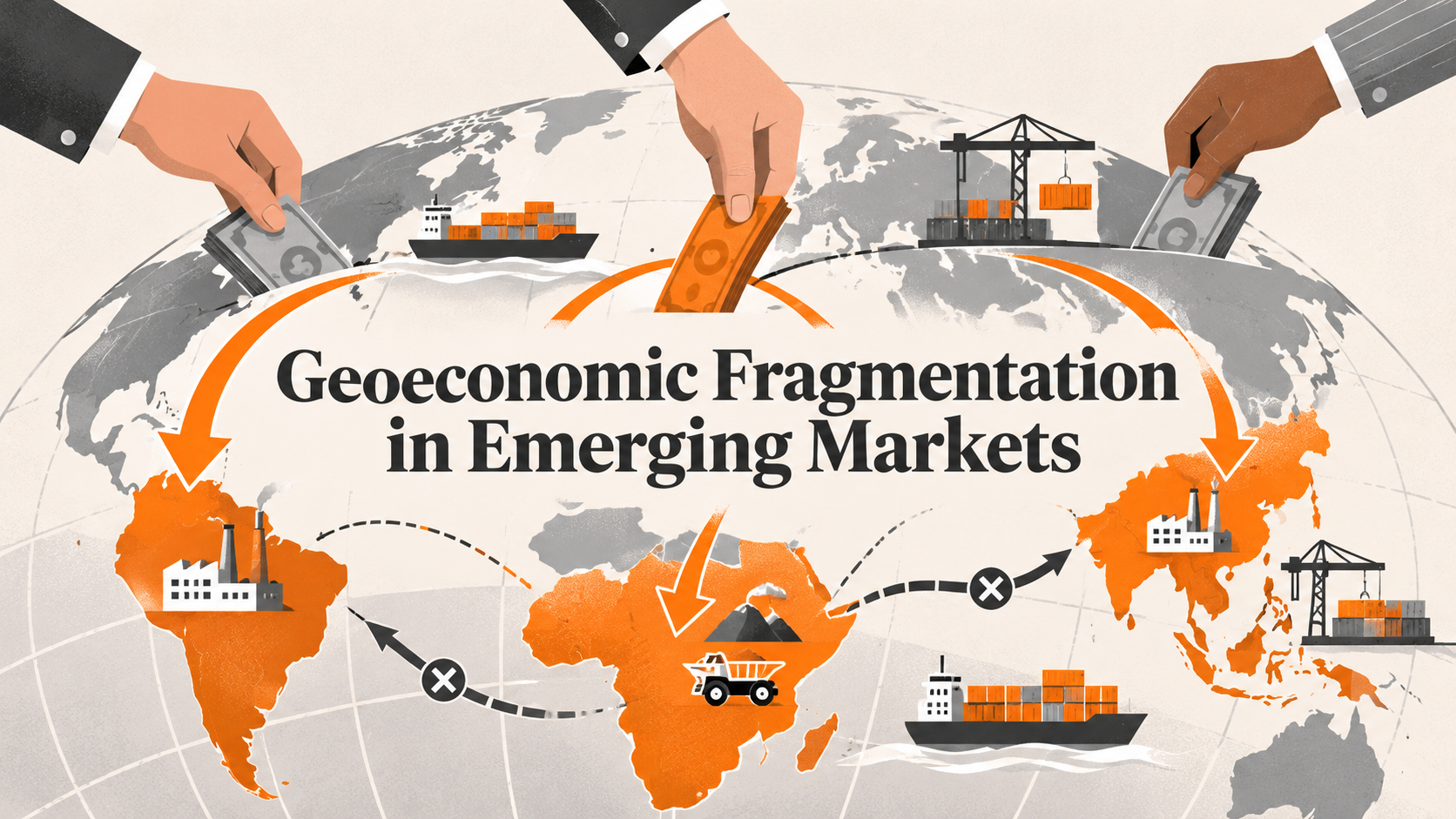
Geoeconomic fragmentation in emerging markets has two very different faces. As major powers change their trading relationships, some developing economies attract factories, new export orders, and investment that once went elsewhere. Others lose access to customers, technology, financing, or inputs that supported their growth. The same geopolitical shift can create an opportunity in one industry and a costly dependency in another.
Understanding these uneven outcomes is an essential part of the broader Geoeconomic Fragmentation debate. For emerging economies, the important question is not simply whether production moves away from a major power. It is whether redirected business creates durable domestic value through employment, productive capacity, skills, and supplier relationships, or merely moves transactions through a different location.
This distinction changes how we interpret the news. A record export figure does not automatically mean a stronger local industrial base, and a new foreign investment announcement is not necessarily evidence of lasting development. To judge the consequences, we need to examine the structure of each economy, what it actually produces, and how dependent it remains on external decisions.
Why Emerging Markets Face Unequal Exposure
Emerging markets are often discussed as a single category, yet their economic structures differ substantially. A diversified manufacturing exporter with strong ports and domestic suppliers can respond to changes in global sourcing very differently from a small economy dependent on fuel imports, a single commodity, or one major overseas buyer. Countries that rely on foreign financing may also feel a trade shock through exchange rates and borrowing conditions even when their direct exports are relatively unaffected.
The IMF has found that the economic exposure of countries to geopolitical trade divisions depends in part on their size, comparative advantages, and political relationships. Its analysis of trade fragmentation indicates that emerging and developing economies can face larger relative income losses than advanced economies under certain simulated scenarios. These estimates describe modeled outcomes, not losses already observed across all developing countries.
An important complication is that the categories used in research do not always match. Emerging markets, developing economies, and least developed countries describe overlapping but distinct groups. An analysis that identifies winners and losers should therefore specify which countries and sectors it is comparing rather than treating the entire developing world as one market.
Trade Diversion Creates Opportunities, Not Guarantees
When tariffs, export controls, or other restrictions change sourcing decisions, importers may look for suppliers in countries that retain access to several markets. That can increase orders for exporters in Southeast Asia, parts of Latin America, and other production locations. Existing industrial infrastructure, trained workers, and established transport networks give some economies a head start.
However, a larger export share can result from several different changes. A manufacturer may move equipment and workers into a country and produce goods there. Alternatively, an existing production chain may continue to depend heavily on imported components, with only final assembly taking place in the new location. Goods may also pass through an intermediary with little productive activity. These paths have very different implications for wages, productivity, tax revenue, and future competitiveness.
The IMF examined this distinction in research published in 2025 on six Asian economies often described as connectors between China and the United States. It found evidence consistent with greater domestic content in selected Vietnamese exports, while the case was less conclusive for the other economies studied. The study also cautioned that the ability to attract redirected trade does not remove exposure to further geopolitical shocks.
The Development Test Is Domestic Value Creation
The strongest evidence of economic progress is not the value of a shipment at the border. It is the additional income, skills, production capability, and commercial activity retained within the country. An economy may export more electronic products but capture a limited share of their value if most components, intellectual property, and specialized services are imported.
Consider two hypothetical electronics exporters. The first assembles imported modules, employs a small workforce, and depends on a foreign parent for purchasing and design. The second develops local component suppliers, trains technicians, and supports businesses that provide testing, logistics, and engineering services. Even if both report similar export growth, the second creates a wider foundation for productivity and future investment.
The relevant evidence includes domestic value added in exports, local procurement, employee earnings, supplier upgrading, and the duration of investment projects. Policymakers should also ask whether foreign firms transfer useful knowledge to local companies or whether production remains an isolated enclave. Strong export performance becomes development only when more of its benefits spread through the domestic economy.
Foreign Investment Is Becoming More Selective
The investment picture is particularly revealing. UNCTAD reported in its World Investment Report 2026 that global foreign direct investment reached about 1.6 trillion dollars in 2025, an increase of 6 percent. Inflows to developing economies rose only 2 percent to about 901 billion dollars. The aggregate recovery therefore concealed a much narrower distribution of new investment opportunities.
According to the same report, the top twenty host economies accounted for more than 80 percent of global foreign direct investment inflows, while strategic sectors represented 44 percent of announced new project values. Investment increasingly favors countries that combine access to large markets with reliable infrastructure, skilled labor, stable rules, and functioning supplier networks. Economies without those foundations may struggle to compete even when their labor costs are low.
This creates a difficult development challenge. Large economies can offer substantial subsidies for semiconductors, energy technologies, and digital infrastructure. Many poorer countries cannot match those incentives without sacrificing resources needed for education, electricity, transport, or public services. An effective response therefore begins with selecting realistic activities where local capabilities can develop rather than attempting to compete for every high profile project.
Different Economic Profiles, Different Outcomes
The table below is a framework for interpreting exposure, not a ranking of individual countries. Real outcomes depend on the sector, policy measures, financing conditions, and the ability of firms to adapt. In particular, a country can belong to more than one category at the same time.
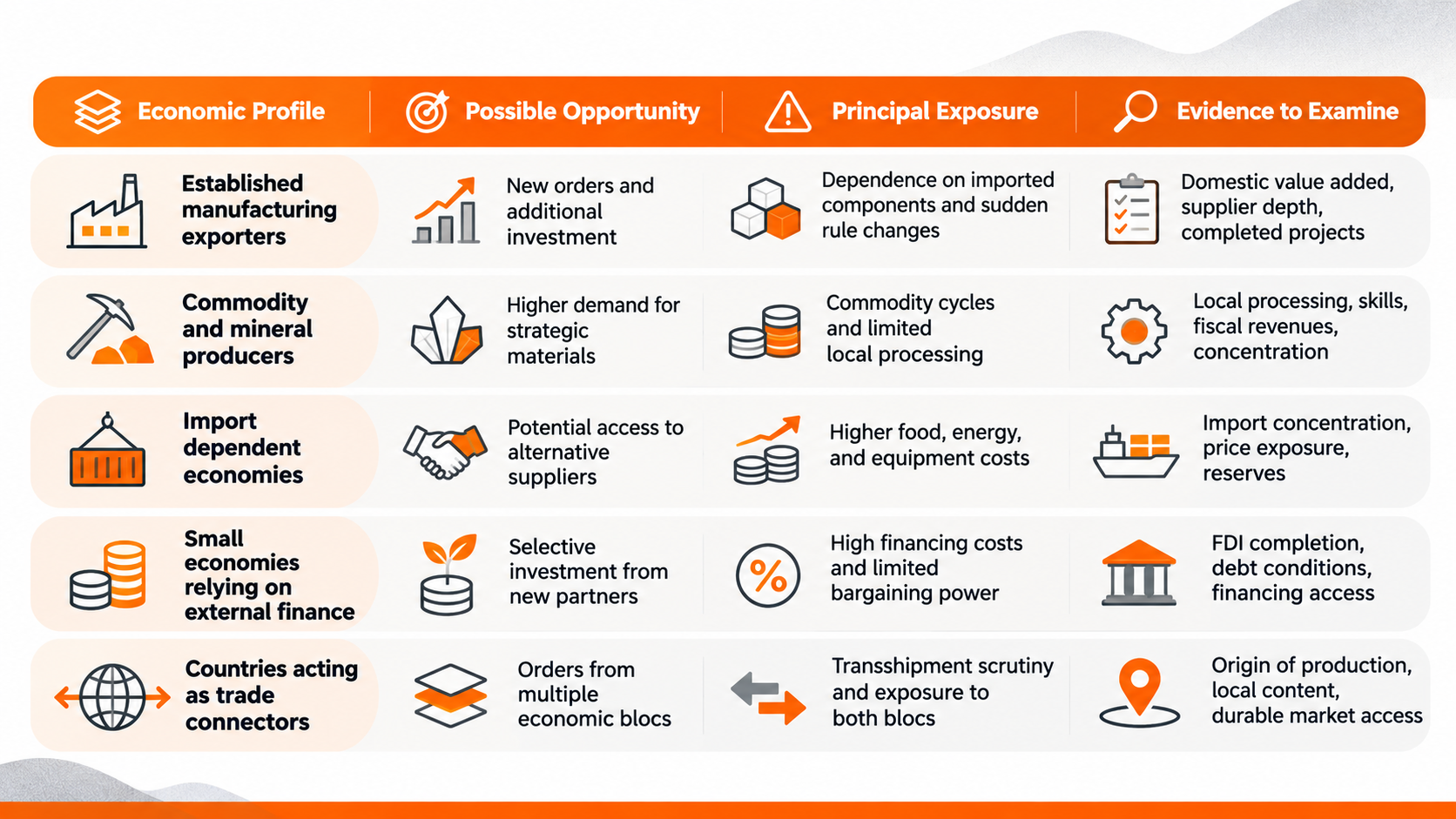
The table shows why an economy can enjoy greater export access while becoming more vulnerable to policy change. No category alone proves whether gains will last. Analysts need evidence of production, local participation, and the ability to retain customers when incentives or trade rules shift.
Beyond Trade: Finance, Food, and Technology
For an export oriented economy, lost market access may be the most visible consequence of fragmentation. Elsewhere, the major effect appears in import costs. Countries that depend on imported energy, fertilizer, food, or machinery can face higher prices and greater supply uncertainty when geopolitical restrictions interrupt established routes. A temporary rise in revenue for commodity exporters does not necessarily offset higher costs elsewhere in the economy.
Financial pressure can amplify these shocks. If investors become more cautious about a region, governments and companies may face higher borrowing costs or reduced access to capital. Currency depreciation can make essential imports and foreign currency debt more expensive. These effects vary greatly with a country’s reserves, debt structure, export earnings, and policy credibility, so they should not be inferred from geopolitical news alone.
Technology access is another dividing line. Rules affecting advanced equipment, software, research partnerships, or specialized components can slow the development of higher value industries. At the same time, new demand for intermediate production and support services may create opportunities for economies with the right capabilities. The challenge is to avoid locking new investment into low productivity activities that are easily relocated again.
The Country Examples Require Careful Interpretation
Vietnam offers a useful illustration of both opportunity and vulnerability. IMF research identified evidence of increased domestic production content in certain strategic exports to the United States following changes in trade patterns. That finding is more meaningful than a simple rise in gross exports, but it does not establish that every part of the Vietnamese economy has gained equally or that future restrictions could not reverse some advantages.
Other economies may attract projects through different strengths. UNCTAD reports investment opportunities in electronics in India and Vietnam, in electric vehicle production in several countries including Brazil, Morocco, and Thailand, and in manufacturing activity connected to the United States in Mexico. These are examples of selective investment interest, not a guarantee that each project will deliver broad national gains.
Commodity exporters face another calculation. Demand for critical minerals can increase their strategic importance, yet extracting raw materials without local processing, engineering capacity, or dependable infrastructure may leave most value creation elsewhere. A country can become more important to global supply chains without becoming substantially more prosperous. The policy challenge is to turn strategic relevance into productive capabilities.
How to Judge Whether a Country Is Benefiting
Assessing the effects of fragmentation requires more than one headline statistic. Gross export growth should be considered alongside domestic value added and the concentration of export destinations. Foreign investment announcements should be compared with projects actually completed, workers hired, and local suppliers contracted. Changes in financing costs also matter because a country can gain manufacturing orders while paying more to finance infrastructure and business expansion.
It is equally important to separate temporary relocation from structural transformation. Some countries may benefit from a policy change that can be reversed or extended to additional trading partners. More durable gains usually depend on capabilities built before the shock, including stable institutions, logistics, technical education, and a competitive domestic business environment.
This approach helps distinguish a genuine change in development prospects from an appealing but incomplete narrative of winners and losers. When exports, investment, and productive capacity improve together, the case for a lasting gain becomes stronger. When only shipments rise, the evidence is much weaker.
The Policy Choices That Matter Most
Governments cannot control the geopolitical decisions of larger trading partners, but they can influence how effectively their economies respond. Investment in reliable infrastructure, workforce skills, customs administration, and transparent regulation makes it easier for businesses to establish real production. Supporting local suppliers can also help foreign investment generate broader benefits, provided assistance is linked to measurable performance rather than permanent protection.
Regional cooperation provides another option. Trade agreements, coordinated standards, and transport connections can give firms access to larger markets without forcing countries to depend on only one major economic bloc. For smaller economies, preserving multiple commercial relationships may be especially valuable, although the benefits depend on actual market access and the credibility of commitments.
Policy also requires discipline. Offering expensive incentives to attract every proposed factory can transfer public resources to projects that would have arrived anyway or that create few local spillovers. The more practical objective is to identify bottlenecks, support credible investment, and preserve the ability to adapt as international rules change. The next stage of analysis is not to predict a permanent winner, but to identify which new economic capabilities can survive a change in geopolitical conditions.
FAQ
Are emerging markets the main losers from geoeconomic fragmentation?
Not all emerging markets experience the same outcome. Many face greater vulnerability because they rely on external trade and finance, while some attract redirected investment or exports. The net result depends on domestic capabilities, industry exposure, and the duration of geopolitical restrictions.
Can an emerging economy benefit from trade diversion?
Yes. A country can gain export orders and investment when international buyers diversify sourcing. The stronger development outcome occurs when the shift increases domestic production, wages, skills, and local supplier activity rather than simply moving goods through the country.
What is a connector economy?
A connector economy maintains commercial links with markets that are becoming less directly connected. Its role may involve genuine new production, assembly, or intermediation. Connector status should not be assumed to provide permanent protection against future restrictions.
Why does foreign investment matter so much?
Foreign direct investment can finance equipment, factories, jobs, and knowledge transfer. However, its development value depends on the type of project, domestic supplier links, and whether benefits extend beyond the investing company.
Which indicators best show lasting gains?
Domestic value added, completed investment projects, local supplier purchases, productivity, skilled employment, and diversified export destinations provide a fuller picture than gross exports or investment announcements alone.
Can regional trade agreements protect developing economies?
Regional agreements can broaden market access and reduce some dependencies, but they do not eliminate geopolitical exposure. Their usefulness depends on practical implementation, trade rules, infrastructure, and the degree to which companies can serve more than one market.

Masoumeh Jahangard
Markets & Economy Writer at PinerookMasoumeh Jahangard covers markets, economic trends, and business conditions for Pinerook, focusing on how they affect startups and growing companies.
 Seen first.