
Venture capital is entering a period in which record investment activity and growing financial pressure exist side by side. Some technology companies are raising extraordinary amounts of money, while smaller venture firms struggle to attract commitments and investors wait longer to recover capital from earlier investments. These developments are changing the relationships between founders, fund managers, and the institutions that finance them.
The future of venture capital will depend on more than the next wave of successful startups. Within the broader context of Investment Trends, changes in fund structures, artificial intelligence, investment concentration, and liquidity are reshaping how venture capital operates. For founders, these developments influence who can finance their companies and what those investors expect. For fund managers, they raise important questions about portfolio construction, investment returns, and access to future capital.
This article examines the forces changing venture capital in 2026 and the possible direction of the industry beyond it. It explains how the traditional venture model is evolving, why exits and investor distributions matter, and what founders and investors should prepare for as the market develops.
What Is the Future of Venture Capital?
The future of venture capital refers to the ways venture investment may evolve as technology, investor expectations, financing structures, and economic conditions change.
Traditionally, venture firms raise money from institutional and private investors, invest in promising companies, support their growth, and eventually seek returns through acquisitions, public listings, or other liquidity events.
That basic model remains important. However, the environment surrounding it is becoming more complex.
Some companies now require billions of dollars to develop infrastructure or advanced technologies. Other businesses can reach customers with considerably less capital. Meanwhile, many startups remain private for extended periods, delaying the returns investors expected when they originally committed capital.
The future of the industry will therefore be influenced by who provides capital, which businesses receive it, how ownership is structured, and when investors can turn estimated investment value into actual financial returns.
Why the Traditional Venture Capital Model Is Under Pressure
Venture capital funds usually operate with a defined investment horizon. Investors commit capital, fund managers deploy it across portfolio companies, and successful exits are expected to produce distributions over time.
These investors are commonly called limited partners, or LPs. They may include pension funds, endowments, family offices, and other institutions. Venture fund managers are generally referred to as general partners, or GPs.
The model depends on more than rising portfolio valuations. LPs eventually need realized proceeds.
A fund can report substantial growth in the estimated value of its portfolio while distributing very little money. When this situation persists, LPs may find it harder to support new venture funds because much of their capital remains committed to earlier investments.
The result is a market in which investment activity can remain high while fundraising conditions become difficult for some fund managers.
This tension is one of the central forces shaping the industry's future.
What the 2026 Venture Market Reveals
Recent figures demonstrate how uneven the venture capital market has become.
According to the PitchBook and National Venture Capital Association Venture Monitor, United States venture investment reached approximately $515.8 billion during the first nine months of 2026.
Artificial intelligence companies accounted for 82.7% of venture deal value during that period.
The same report found that American venture funds raised approximately $108.5 billion through September. Funds with at least $500 million in commitments captured 78.1% of that amount while representing just 6% of funds closed.
These figures describe two different forms of concentration.
Investment dollars are increasingly concentrated in selected companies, while fundraising dollars are also concentrated among larger venture managers.
The global picture shows similar differences. Crunchbase reported approximately $159 billion in venture investment during the third quarter of 2026, with around one third going to 27 companies that each raised at least $1 billion.
These results demonstrate the scale of current investment activity. They do not guarantee that every startup or venture fund has easier access to capital.
The Structural Changes Reshaping Venture Capital
Several developments are influencing how the industry allocates capital and manages investment risk.
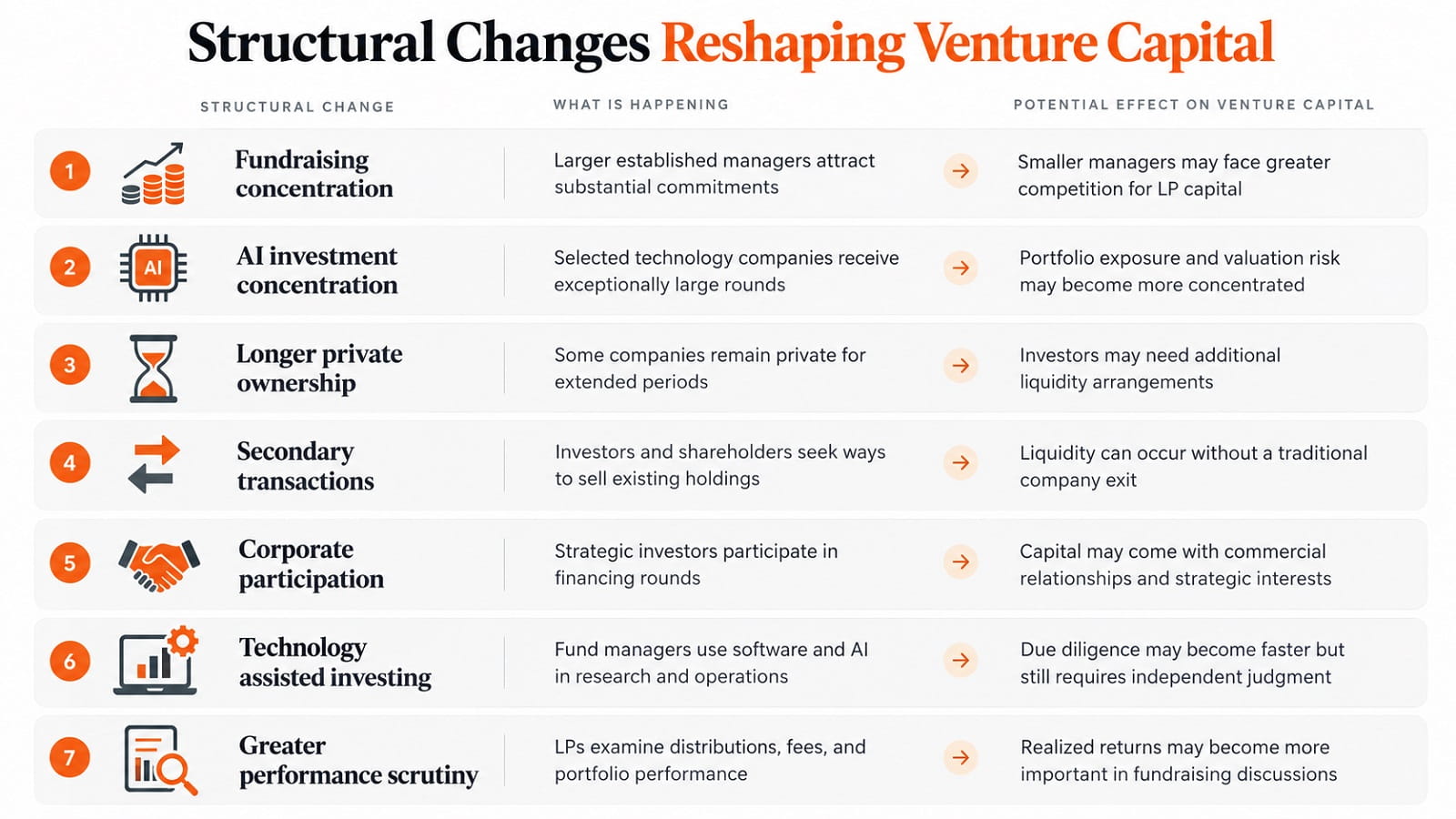
These developments are interconnected.
A company remaining private for longer can increase demand for secondary transactions. Limited distributions can affect LP commitments, which may favor established fund managers. Concentrated investments can generate attractive outcomes but also expose portfolios to similar technologies and economic risks.
Understanding these relationships is more useful than assuming that venture capital will follow one simple direction.
Why Larger Venture Firms May Become More Influential
Fundraising concentration gives established managers several potential advantages.
Large firms may have longstanding institutional relationships, substantial operational resources, and the ability to support companies through multiple financing rounds.
They may also be better positioned to participate in capital intensive technology businesses requiring unusually large commitments.
However, scale does not guarantee superior returns.
A large venture fund needs sufficiently valuable investment outcomes to generate attractive performance relative to the amount of capital it manages. As fund size grows, smaller successful investments may contribute less meaningfully to overall results.
This can encourage large managers to pursue companies capable of producing very substantial outcomes.
Smaller venture firms may respond through specialization, founder relationships, local market expertise, or earlier access to emerging technologies.
The future may therefore include both larger generalist investment platforms and more focused specialists rather than the disappearance of smaller managers.
How Artificial Intelligence Could Change Venture Investing
Artificial intelligence is affecting venture capital in two distinct ways.
First, AI companies are attracting substantial investment because investors see opportunities in software, computing infrastructure, robotics, and industrial applications.
Second, AI tools are changing how venture firms themselves research companies and manage information.
AI as an Investment Opportunity
The extraordinary capital requirements of some advanced AI companies are changing traditional assumptions about startup financing.
Building computing infrastructure, training sophisticated models, and developing specialized hardware can require large amounts of capital before a business reaches financial sustainability.
Venture firms may need to collaborate with strategic investors and other capital providers to finance such businesses.
However, these opportunities also introduce risks involving infrastructure costs, customer concentration, technological change, and valuations.
Investors need to distinguish genuine competitive advantages from temporary access to popular technologies.
AI in Venture Capital Operations
Fund managers can use AI tools to organize research, summarize financial information, compare companies, and identify patterns in large datasets.
These capabilities may reduce administrative work and help teams examine more potential investments.
However, automated analysis cannot establish whether an investment is attractive without reliable information and appropriate interpretation.
AI systems may reproduce errors in source data, overlook contractual details, or generate misleading conclusions.
Sensitive company information also creates confidentiality and data protection obligations.
The likely value of AI in venture investing is improved research and operational efficiency, not the elimination of human judgment.
The Future of Startup Exits and Investor Liquidity
Venture capital ultimately depends on successful investment realizations.
An acquisition or public listing can allow shareholders to sell some or all of their holdings, although the proceeds depend on transaction terms, ownership rights, and market conditions.
When companies remain private for longer, investors may need to wait additional years before receiving substantial distributions.
This delay creates a challenge for LPs, particularly when they are expected to commit capital to new funds while earlier investments remain unrealized.
As a result, liquidity is becoming an increasingly important part of venture fund management.
Secondary Share Sales
A secondary transaction involves selling an existing investment rather than issuing new shares to finance the company.
For example, an early investor may sell part of an ownership position to another investor before the company completes an acquisition or public listing.
Employees and founders may also receive opportunities to sell some shares through structured liquidity programs.
These transactions can provide flexibility without requiring the company itself to exit.
However, secondary prices may differ from the valuation associated with a previous financing round.
Company approval requirements, transfer restrictions, taxes, and shareholder agreements can also affect whether a transaction is possible.
Carta reported that it administered 71 tender offers during the first half of 2026, involving approximately $3 billion in transaction value.
Those figures describe activity on Carta rather than the entire global secondary market, but they illustrate growing demand for liquidity among shareholders of private companies.
Continuation Vehicles
Another developing structure is the continuation vehicle.
In these arrangements, a fund manager may transfer selected assets into a new investment vehicle, potentially allowing existing investors to receive liquidity or retain exposure under revised terms.
These structures have become increasingly important across private markets, particularly private equity. Their future role in venture capital may expand where suitable assets, investors, and transaction structures exist.
However, continuation transactions can create conflicts because the manager may be involved on both sides of the transaction.
The Institutional Limited Partners Association published updated guidance in October 2026 emphasizing transparent pricing, conflicts management, and informed investor decisions.
Continuation vehicles should therefore be evaluated as specialized tools rather than automatic solutions to poor liquidity.
Why Cash Distributions Matter More Than Paper Valuations
Venture fund performance can be measured using several indicators.
Distributions to Paid In Capital, or DPI, compares money distributed to investors with the capital they have contributed.
Total Value to Paid In Capital, or TVPI, combines distributed proceeds and the estimated remaining portfolio value, then divides that total by paid in capital.
The calculations are:
DPI = Cumulative distributions ÷ Paid in capital
TVPI = (Cumulative distributions + Remaining portfolio value) ÷ Paid in capital
These figures explain different aspects of fund performance.
Consider three fictional venture fund scenarios. Each assumes investors have contributed $100 million. The amounts are illustrative and exclude additional complications involving fees, carried interest, and differences in fund accounting.
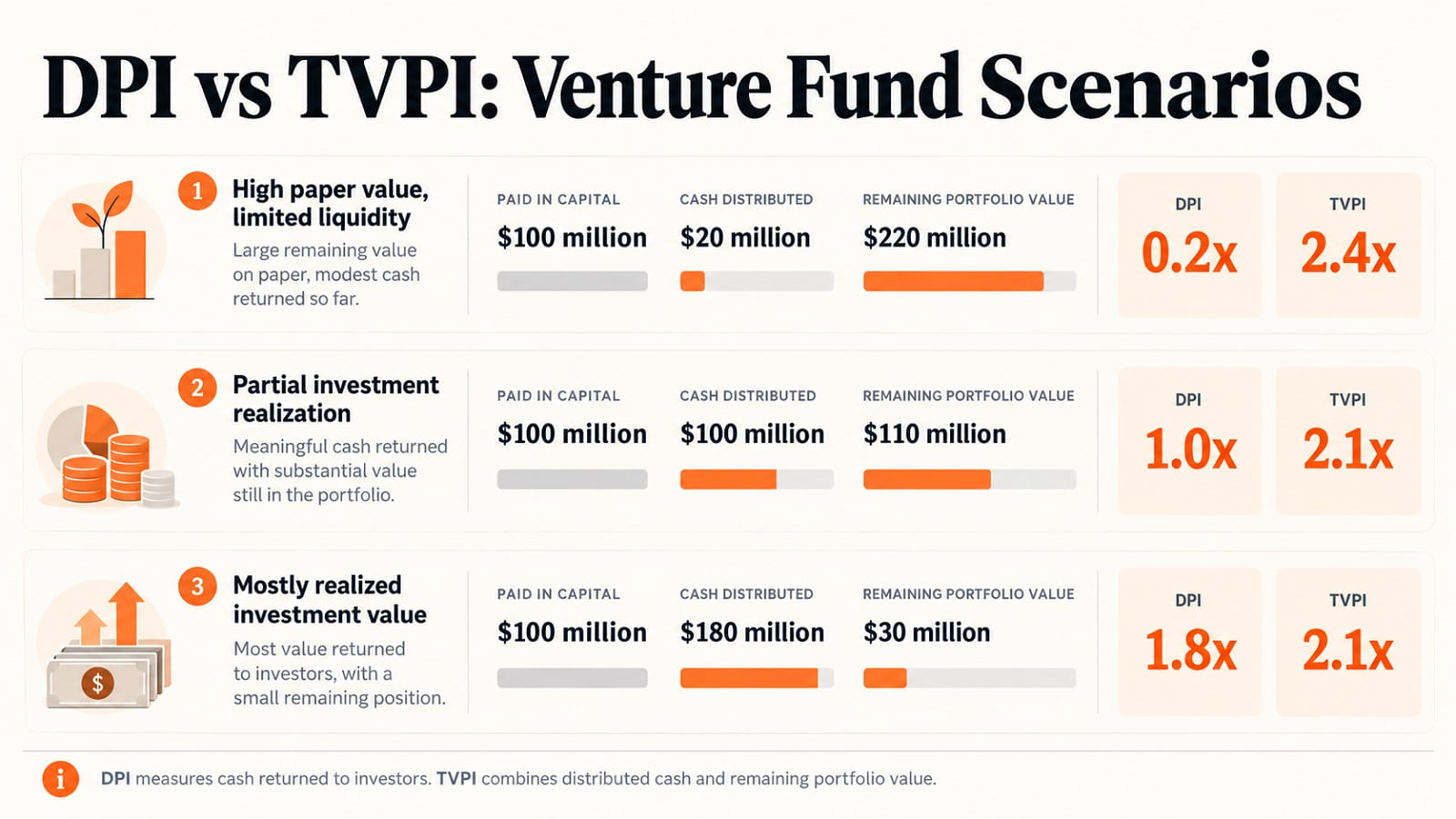
Fund scenarioPaid in capitalCash distributedRemaining portfolio valueDPITVPIHigh paper value, limited liquidity$100 million$20 million$220 million0.2x2.4xPartial investment realization$100 million$100 million$110 million1.0x2.1xMostly realized investment value$100 million$180 million$30 million1.8x2.1x
The first fund appears especially valuable based on TVPI, but investors have recovered only 20% of their contributed capital in distributions.
The third scenario reports a lower TVPI yet has already returned $180 million in cash.
The difference matters because unrealized valuations may change before assets are sold.
It is also important to compare funds of similar maturity. Young funds naturally have less time to generate distributions.
For the future of venture capital, a stronger emphasis on realized performance could influence LP commitments, manager selection, and the timing of investment exits.
Will Venture Capital Fund Structures Change?
Traditional closed fund structures are likely to remain important, but additional approaches may develop alongside them.
Some managers may explore investment vehicles designed for longer holding periods, while others may offer specialized funds focused on particular technologies or development stages.
Corporate investors may provide capital alongside commercial partnerships, access to customers, or technical resources.
Companies with suitable financial characteristics may also use debt or other financing arrangements to complement equity investment.
These alternatives are not interchangeable.
Debt introduces repayment obligations, while equity financing creates ownership dilution and investor rights. Strategic investment can produce commercial benefits but may also create conflicts over information, exclusivity, or future transactions.
The appropriate structure depends on the company's maturity, cash generation, capital requirements, and contractual commitments.
Founders should evaluate the full economic and legal consequences rather than selecting financing solely on the basis of the largest available amount.
What the Future Means for Emerging Venture Managers
Emerging managers face a different challenge from established venture firms.
They must attract LP commitments while demonstrating why their investment strategy deserves capital in a competitive environment.
A new fund may have strong industry knowledge or access to promising founders but limited historical realized performance.
When LPs prioritize experienced managers, emerging funds may need to present clearer differentiation, disciplined fund sizes, and transparent portfolio strategies.
Smaller firms may benefit from specializing in overlooked markets, technical fields, or early company formation.
However, specialization carries its own risks, particularly when a fund becomes heavily exposed to one sector or regulatory environment.
Emerging managers need to demonstrate not only their ability to identify promising businesses but also how they will manage reserves, ownership dilution, governance, and eventual liquidity.
How Corporate Investors May Influence Future Venture Capital
Corporate venture capital can connect startup financing with the strategic objectives of established businesses.
A large company may invest in startups developing technologies relevant to its operations, products, or future markets.
Such relationships can provide access to expertise, distribution channels, and commercial opportunities.
However, corporate investment is not automatically beneficial for every startup.
Founders should consider whether information rights, exclusivity provisions, or strategic priorities could limit future partnerships.
Corporate investment activity can also change when the parent company adjusts its budget or management strategy.
Future venture financing may involve more collaboration between traditional funds and strategic investors, particularly where startups require substantial infrastructure or specialized industry access.
Still, alignment between financial and commercial objectives remains essential.
How the Next Generation of Venture Capital May Develop
Several possible developments could shape venture capital through the remainder of the decade.
Greater Concentration
If substantial investment continues flowing toward selected technology companies and larger fund managers, market concentration could increase.
This might allow well financed businesses to develop quickly while creating greater challenges for competitors and smaller investment firms.
Broader Access to Liquidity
If secondary markets develop further and traditional exits become more accessible, investors may gain greater flexibility in managing portfolios.
However, liquidity depends on willing buyers, acceptable prices, and appropriate transaction structures. It cannot be assumed simply because a market exists.
More Specialized Investment Strategies
Investors may increasingly differentiate through technical knowledge, industry expertise, and access to specific customer markets.
Specialization could create opportunities beyond the largest technology companies, although specialist funds must still manage concentration risk.
Stronger Accountability for Results
LPs may place greater emphasis on realized returns, transparency, and the relationship between fund size and performance.
If this occurs, managers will need to demonstrate that their investment approach produces attractive outcomes rather than relying on rising private valuations.
These developments are possibilities, not guaranteed predictions. Economic conditions, regulation, technology adoption, and exit activity will influence which changes become permanent.
What Startup Founders Should Prepare For
Founders should consider how structural changes in venture capital affect their own financing plans.
The first priority is investor fit.
A startup seeking an initial financing round may benefit more from an investor with strong early stage expertise than from a large firm focused on substantial growth rounds.
Founders should also examine whether potential investors have sufficient capital to participate in future financing and whether their investment horizons align with the business.
Financial preparation remains essential. A credible fundraising plan should explain customer demand, commercial performance, expected spending, and the milestones the proposed capital will support.
Companies with high capital requirements should evaluate the consequences of needing several future financing rounds.
Finally, founders should understand dilution, governance rights, and shareholder liquidity restrictions before entering investment agreements.
A financing structure that appears attractive today can affect the company's flexibility years later.
What Limited Partners Should Watch
For LPs, the future of venture capital raises questions about fund selection, portfolio exposure, and realized investment performance.
Large commitments to established managers may provide access to investment opportunities, but they can also increase concentration.
Smaller specialist firms may offer different exposures, although their strategies require careful evaluation.
LPs should review distributions, remaining portfolio valuations, fund expenses, investment concentration, and the assumptions underlying future liquidity.
The relationship between reported performance and actual cash returned will remain important, especially where companies continue operating privately for extended periods.
Final Thoughts
The future of venture capital is unlikely to be defined by one technology, financing structure, or investment strategy. The industry is adapting to larger funding rounds, concentrated capital, longer periods of private ownership, and growing pressure to deliver realized returns.
Artificial intelligence may transform both the companies receiving investment and the tools venture firms use to evaluate them. Secondary markets and alternative structures may offer additional flexibility, but they also introduce new risks and governance requirements.
For founders, the central objective remains finding investors whose resources and expectations match the company's development needs. For fund managers and LPs, sustainable performance will depend on disciplined investment decisions, transparent valuations, and the ability to turn promising portfolio companies into realized financial returns.
FAQ
What Is the Future of Venture Capital?
The future of venture capital involves changes in how investment funds raise money, select startups, structure investments, manage portfolios, and generate returns. Important developments include AI, fund concentration, secondary liquidity, and evolving investor expectations.
Will Artificial Intelligence Replace Venture Capital Investors?
AI can support research, financial analysis, and investment operations, but it cannot reliably replace the judgment required for evaluating founders, business risks, governance, and complex negotiations. Human oversight remains important.
Why Are Large Venture Funds Attracting More Capital?
Established managers may benefit from institutional relationships, operating resources, and access to major financing rounds. However, large fund size does not automatically produce better returns.
Will Smaller Venture Capital Firms Disappear?
Not necessarily. Smaller firms can differentiate through specialist knowledge, early access to founders, and regional expertise. Their fundraising conditions may nevertheless remain challenging when institutional commitments favor larger managers.
What Are Venture Capital Secondaries?
Secondary transactions involve the sale of existing private investments or shares to another buyer. They may provide liquidity before an acquisition or public listing, subject to pricing and transfer restrictions.
Why Is Venture Capital Liquidity Important?
Venture investors need realized proceeds to return capital to LPs. When exits are delayed, investors may have less flexibility to commit money to new funds even when reported portfolio valuations remain strong.
How Will Venture Capital Change for Startup Founders?
Founders may encounter a wider range of financing structures and investor types, alongside greater expectations around financial reporting, capital requirements, governance, and realistic exit opportunities.
Is Venture Capital Still Relevant for Startups?
Yes. Venture capital remains an important source of financing for businesses pursuing significant growth under uncertainty. However, not every startup requires or benefits from venture funding, and alternative financing approaches may be appropriate.

Mobina Khanki
Venture & Funding Writer at PinerookMobina Khanki covers venture capital, startup funding, fundraising, and startup finance for Pinerook, focusing on founders and investors.
 Seen first.


