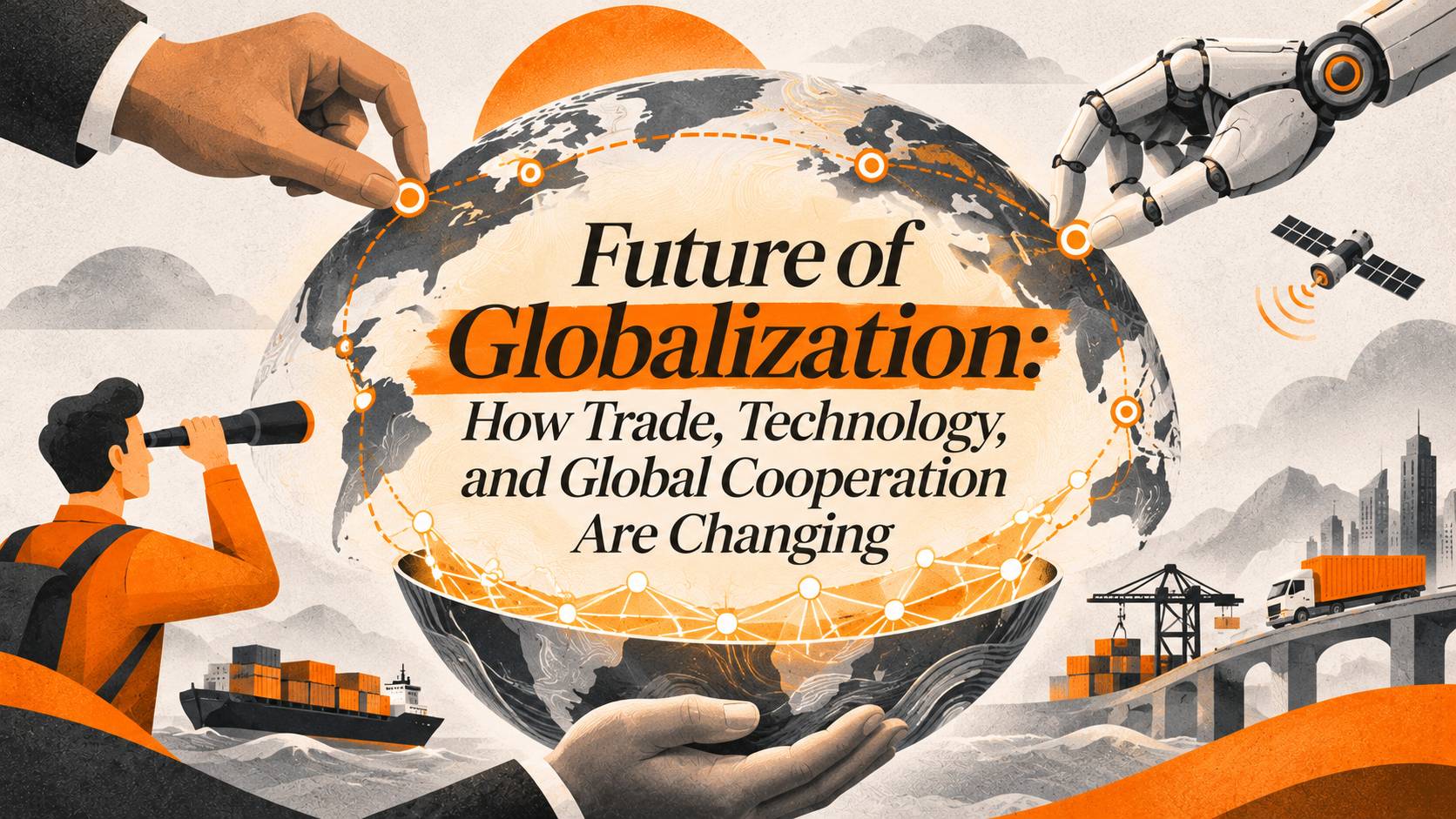
The future of globalization is unlikely to be either an uninterrupted return to open markets or a complete retreat behind national borders. International commerce continues at enormous scale, but the conditions for participating are changing. Governments are attaching more importance to security, technology, and trusted partnerships, while companies still need global customers, specialized inputs, and access to innovation. The most plausible near term outcome is a more selective form of integration, not the disappearance of globalization.
This debate is closely connected to Geoeconomic Fragmentation, which describes how political and security priorities can redirect economic relationships. The narrower question here is what comes next: whether common trade rules can evolve, whether new forms of digital exchange can offset barriers in physical commerce, and whether countries will remain connected across political divisions. An answer requires separating what has already changed from what is still an uncertain scenario.
The 2026 evidence does not support a simple story of global trade collapsing. UN Trade and Development reported that worldwide trade reached roughly $35 trillion in 2025, even as access to markets became more selective. The World Trade Organization also reported that approximately 72 percent of merchandise trade still operates under the core nondiscriminatory tariff commitments of its members. Globalization is therefore resilient in aggregate, but the terms and distribution of its benefits are being renegotiated.
Is Globalization Ending or Entering a Different Phase?
Deglobalization describes a sustained reduction in international economic integration. It could appear through falling trade intensity, declining investment connections, restrictions on cross border technology exchange, or the replacement of common rules with national controls. Yet a change in where commerce occurs is not the same as a decline in commerce itself. Trade can expand even as countries buy less from particular partners, and production can remain international despite political pressure to concentrate it closer to home.
A more useful description for the present moment is selective globalization. Governments seek wider integration where it supports growth and more control where dependence is judged strategic. A semiconductor supply chain can link several economies while sensitive chip designs face export controls. A company can serve customers worldwide while storing certain data locally. These choices create uneven patterns of openness rather than a uniform retreat from international exchange.
The distinction matters for economic forecasts. One year of trade growth does not prove that openness is strengthening, just as one bilateral trade decline does not prove global commerce is shrinking. Analysts need to examine goods, services, investment, and technology connections over multiple years before labeling a structural change.
Why the Previous Model of Globalization Faces Pressure
The globalization model associated with lower tariffs, expanding production networks, and predictable international rules assumed that economic efficiency would often outweigh security considerations. That assumption is weaker today. Governments view access to advanced technology, energy, minerals, pharmaceuticals, and infrastructure as questions of national resilience. Industrial subsidies, investment screening, and technology restrictions can change commercial decisions even when consumers still prefer affordable imported goods.
Domestic politics also shape the future. The benefits of lower prices and greater product choice were not shared evenly among industries, workers, or regions. Pressure to protect employment and strategic capacity is not merely an objection to international trade; it reflects unresolved questions about adjustment costs and who receives the gains from integration. A sustainable model of globalization needs policies that help communities adapt rather than assuming aggregate growth automatically answers distributional concerns.
Finally, the global economy is more diverse than the institutions originally built to govern it. The WTO noted in its 2026 report that low and middle income economies accounted for about 45 percent of world merchandise trade in 2024, compared with 23 percent in 1995. New economic weight makes negotiation both more inclusive and more complex. Rules negotiated decades ago now confront digital commerce, artificial intelligence, different industrial models, and environmental priorities.
Global Trade Is Being Reorganized Rather Than Replaced
Companies are changing the composition of their international relationships, not uniformly abandoning them. McKinsey Global Institute reported in March 2026 that merchandise trade continued growing in 2025 while major economies shifted some flows toward more politically aligned partners. Its analysis also found limited broad evidence of a wholesale move back to domestic production. That combination explains why headlines about decoupling can coexist with busy ports and expanding international shipments.
An important feature of the emerging system is that political distance and physical distance are different measures. A firm may source from a politically trusted economy thousands of kilometers away rather than from a nearer supplier. Companies may diversify final assembly while relying on established regional networks for intermediate components. The geography of a finished product can change faster than the location of the expertise and inputs needed to make it.
The practical implication is not that each country will become economically self sufficient. Specialized manufacturing, the distribution of natural resources, research networks, and economies of scale continue to reward international cooperation. The emerging contest is about which connections remain open by default, which require additional safeguards, and which are restricted by policy.
Digital Trade Could Extend Globalization Beyond Goods
The next phase of international integration will not be measured only by containers and factory output. Digitally delivered services, software, research, design, professional advice, and some AI enabled work can cross borders without the physical movement of merchandise. These exchanges can offer new opportunities to smaller firms that could not economically build a presence in every market they serve.
However, digital globalization is not automatically borderless. Privacy requirements, data transfer rules, cloud infrastructure location, taxation, intellectual property protection, and access to advanced computing can create separate digital environments. A software product may be available globally while facing different compliance obligations in each jurisdiction. Global reach on a technical level does not remove the legal or commercial costs of market access.
The WTO argues in its 2026 World Trade Report that digitalization and artificial intelligence increase the importance of international rules precisely because the new forms of trade generate policy effects across borders. Future globalization may therefore depend as much on compatible standards and trusted systems as on tariff reductions.
The Choice Between Regional Agreements and Global Rules
Regional trade agreements can help governments move forward when universal negotiations stall. Countries may coordinate standards, simplify customs procedures, and establish common requirements for selected industries. For some businesses, this makes the rules of serving nearby markets clearer. Regional arrangements can also provide an environment for testing agreements on digital services or other emerging forms of trade.
The risk appears when many arrangements create incompatible requirements or discriminate against countries outside their membership. Firms that sell into several markets can face overlapping origin rules, documentation, and technical standards. Smaller exporters often find this complexity harder to absorb than large multinational companies. Regional agreements can complement global integration, but they are not a complete substitute for a shared international foundation.
The WTO framework still matters because it supports transparency, dispute procedures, and baseline commitments that allow trading relationships to continue beyond preferred political partners. The challenge is updating cooperation without losing the predictability that made long international production relationships possible. For a useful overview, see the World Trade Report 2026 executive summary. Its central argument is that reform and continued openness need not be opposing choices.
Three Plausible Futures for Globalization
No single forecast can determine how governments will respond to conflict, technological change, or domestic pressure. It is more informative to compare conditional scenarios and identify what evidence would distinguish them. The scenarios below are analytical possibilities rather than probabilities, official forecasts, or predictions of specific policy decisions.
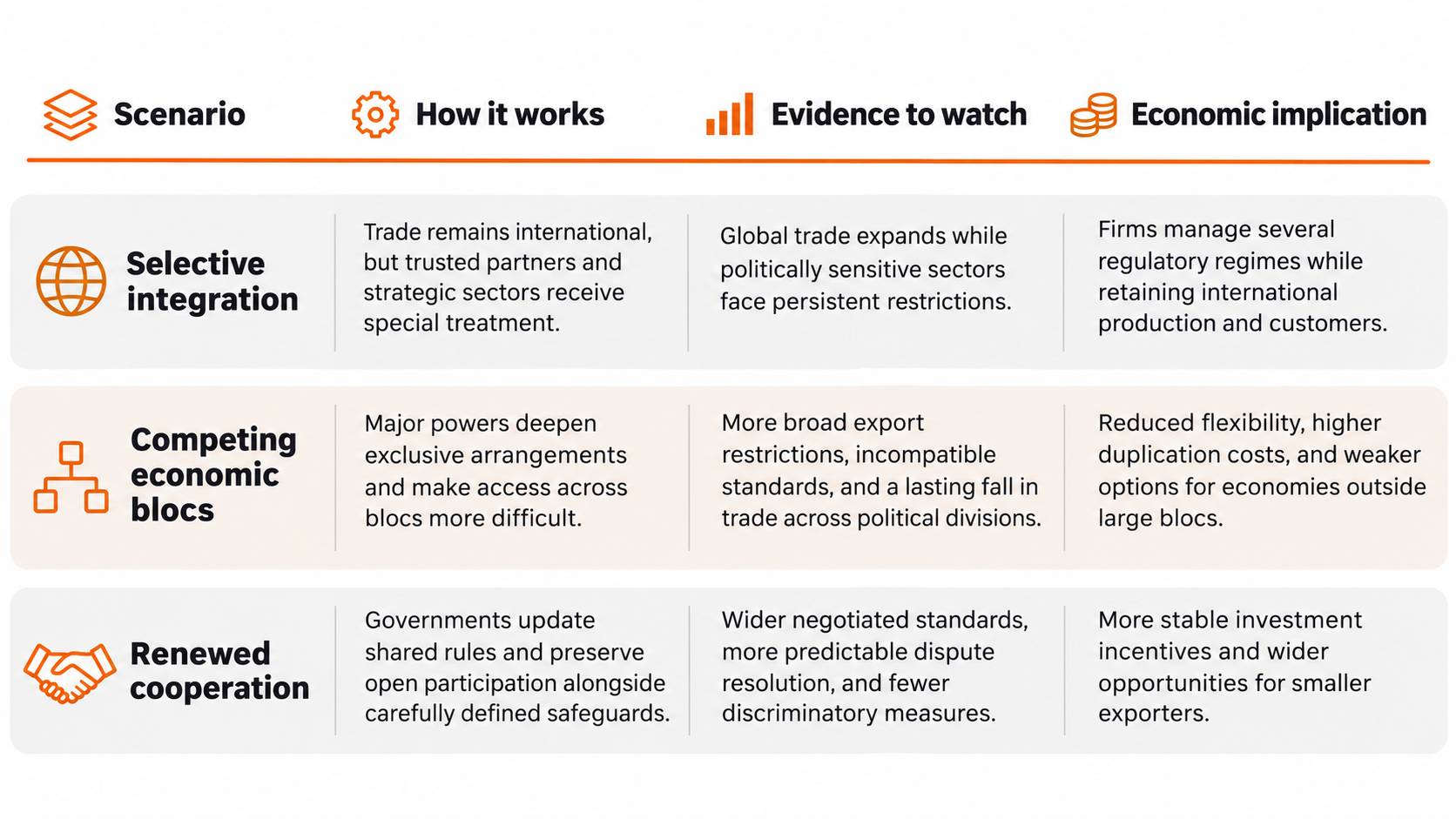
These scenarios can overlap across sectors. A country may support common rules for food trade while restricting sensitive technologies. A company may operate globally in services but regionally in manufactured goods. The question is which pattern becomes dominant and whether cooperation remains broad enough to prevent targeted restrictions from spreading into general exclusion.
What the Next Phase Means for Emerging Economies
Emerging economies will help determine the future of globalization rather than simply reacting to decisions made elsewhere. Their growing share of trade increases their influence over demand, production choices, and negotiations. Countries that maintain access to diverse markets may become important commercial connectors, while those that cannot meet evolving standards may find participation more difficult.
The main uncertainty is whether a more selective trade system leaves room for new entrants. Stronger global rules can lower the disadvantage of being small, while competing blocs can make preferential relationships more important than efficiency. This is especially consequential for economies that rely on a limited range of exports or lack the bargaining power to negotiate favorable bilateral terms.
UNCTAD warned in its October 2026 Trade and Development Report that the geography of global trade is changing and access is becoming more conditional. The long term outcome will depend on investment in skills, logistics, institutions, and digital capability, as well as whether larger economies preserve transparent and accessible trade arrangements. The central test is whether new international connections offer durable development opportunities rather than merely redirecting existing transactions.
The Signals That Will Reveal the Direction of Globalization
Observers should start with the gap between world trade growth and changes in bilateral trade relationships. Expanding global flows alongside persistent shifts toward a narrower set of partners would support the selective integration scenario. A sustained fall in overall trade and greater barriers between several major economic groups would suggest a more serious retreat from openness.
A second signal is whether rules become more compatible or more fragmented. Trade agreements that reduce paperwork or establish interoperable digital standards can deepen integration. A rising number of conflicting product, data, or investment requirements may have the opposite effect even without dramatic tariff increases.
Third, consider whether services and digital exchanges continue to broaden participation. More cross border services exports, viable digital access for smaller firms, and clear data transfer mechanisms would point to forms of globalization that conventional goods statistics alone cannot capture. These indicators should be read alongside investment trends rather than in isolation.
Finally, monitor the behavior of institutions and governments during disputes. Temporary restrictions followed by negotiation produce a different long term environment from repeated unilateral measures without effective avenues for resolution. The number of trade agreements matters less than whether businesses can rely on their provisions.
Why Predictions of a Fully Global or Fully Divided Economy Fall Short
The strongest evidence against an immediate end to globalization is continued economic dependence across borders. Modern production relies on knowledge, capital, logistics, and inputs distributed among many economies. Separating those connections completely would require extensive duplication that businesses and consumers would ultimately finance. Continued integration therefore remains economically attractive, even as states place limits on selected relationships.
The strongest evidence against an uncomplicated return to the past is the lasting political value attached to control over critical technologies and infrastructure. Even after particular trade disputes ease, governments may preserve investment screening, cybersecurity requirements, and incentives for selected domestic capabilities. A future with lower average tariffs would not necessarily restore the earlier model of unrestricted cross border production.
This tension is why the relevant question is not simply whether globalization survives. It is whether international rules and domestic policies can keep the benefits of exchange available while addressing legitimate vulnerabilities and unequal outcomes.
Globalization is changing more than it is disappearing. Trade volumes, production networks, and digital exchanges demonstrate the continuing appeal of international integration, while political competition is altering where firms invest and which relationships governments permit. The next phase may combine wider digital participation with narrower access in sensitive industries.
The future of globalization will be decided less by any single headline than by the rules countries build, the compatibility of their standards, and the choices that allow smaller economies to participate. The most credible outlook remains conditional: selective integration is visible today, deeper division is possible, and stronger cooperation remains a policy choice. Treating those outcomes as alternatives to evaluate is more useful than predicting that the world will either become completely open or completely divided.
FAQ
Is globalization coming to an end?
Current trade evidence does not show a complete end to globalization. Global commerce remains extensive, but trade relationships and market access are increasingly influenced by political and strategic considerations.
What is the most likely future of globalization?
The available evidence supports selective integration as a current pattern, but it cannot establish a certain future. Outcomes depend on trade rules, technology policies, security decisions, and the willingness of governments to cooperate.
How is deglobalization different from regionalization?
Deglobalization means a sustained reduction in overall international integration. Regionalization means greater concentration of connections within geographic areas. Trade can become more regional without necessarily declining worldwide.
Will artificial intelligence strengthen globalization?
AI could support cross border services, productivity, and new commercial connections. Its effects also depend on access to computing resources, data transfer rules, and restrictions on advanced technology. The net outcome is not guaranteed.
Can regional trade agreements replace the WTO?
Regional agreements can deepen cooperation among participating economies, but they cannot fully replace the common rules and predictability that support trade across many different partners. Fragmented arrangements can create extra compliance costs.
What should economists monitor to understand the future of globalization?
They should examine the scale and composition of trade, the diversity of trading partners, changes in policy restrictions, compatibility of standards, investment connections, and the development of digitally delivered services over time.

Masoumeh Jahangard
Markets & Economy Writer at PinerookMasoumeh Jahangard covers markets, economic trends, and business conditions for Pinerook, focusing on how they affect startups and growing companies.
 Seen first.