
Building a successful startup can create substantial wealth for its founders without providing them with immediate access to that wealth. A founder may own shares worth millions of dollars while receiving a relatively modest salary and having limited personal savings. As the company grows and remains privately owned, this concentration of wealth can become increasingly difficult to manage. Selling a portion of existing shares offers a potential solution without requiring the founder to leave the business.
Within Startup Exit and M&A, partial founder liquidity represents an alternative to a complete departure or company sale. It allows entrepreneurs to realize some of the value they have created while maintaining an ownership interest and continuing to contribute to the business. However, the decision can influence investor confidence, future financing opportunities, governance arrangements, and the founder's financial incentives.
A founder secondary is a transaction in which a startup founder sells existing shares to an eligible purchaser and receives the proceeds personally. The challenge is determining how much ownership to sell, when to pursue the transaction, and how to maintain alignment with investors. This guide examines these decisions, explains the financial implications of partial liquidity, and provides a practical example of founder ownership before and after a sale.
What Is a Founder Secondary?
A founder secondary allows an entrepreneur to convert part of an existing ownership interest into cash while the startup continues operating. The purchaser may be an existing investor, a new investor participating in a funding round, or another eligible buyer approved under the applicable transaction requirements.
The founder does not necessarily resign or surrender control of the company. Leadership responsibilities and governance rights depend on the remaining ownership structure and relevant agreements. A founder may continue serving as chief executive while holding fewer shares than before the transaction.
In a conventional sale to another investor, the company does not issue additional securities for the secondary component. The purchase proceeds belong to the founder, and the company's outstanding share count remains unchanged by that transfer.
The transaction should therefore be understood as a personal liquidity decision with corporate consequences. Although the founder receives the money, other shareholders may have legitimate interests in how the sale is structured.
Why Founders Seek Personal Liquidity
Startup founders often accumulate financial value through equity rather than immediate income. This creates a distinction between the estimated value of their ownership and the resources available for personal use.
A founder may spend several years accepting compensation below the level available elsewhere. During that period, personal expenses continue even when the startup's valuation increases. Housing costs, financial commitments, family responsibilities, and limited savings can create pressure that equity ownership alone does not resolve.
Partial liquidity can also reduce concentration risk. When most of a founder's wealth depends on one private business, financial security becomes closely tied to the company's future performance. Selling some shares can provide diversification while preserving exposure to further growth.
For certain founders, improved financial stability may support a longer commitment to the business. It can reduce pressure to pursue an immediate acquisition solely for personal financial reasons. Nevertheless, this benefit depends on the founder's circumstances and the amount of ownership retained.
When Should Founders Consider Selling Shares?
There is no universal stage at which a founder should pursue liquidity. The appropriate timing depends on company performance, investor demand, financing requirements, and the founder's personal financial position.
During the earliest stages, a secondary sale can be difficult to justify if the company has limited operating evidence and requires substantial capital to survive. Investors may question why existing owners are selling when the business still depends heavily on external funding.
As the startup develops a more predictable commercial model, personal liquidity may become easier to discuss. Established revenue, stronger customer retention, experienced management, and credible growth opportunities can provide a clearer context for the transaction.
Founders should also evaluate their negotiating position. A company attracting meaningful investor interest may have more flexibility than one seeking emergency financing. Attempting to negotiate substantial personal proceeds during a financially difficult period can create unnecessary tension with investors.
The decision should follow business and personal circumstances rather than a predetermined funding stage or company valuation.
Founder Secondary During a Funding Round
A financing round can provide an opportunity to combine new investment in the company with a purchase of existing founder shares.
Under this arrangement, an investor allocates one portion of its investment to newly issued shares and another portion to shares already owned by the founder. The primary component provides operating capital, while the secondary component provides personal liquidity.
Founders should establish the company's financing requirements before negotiating their individual proceeds. If the startup needs a particular amount of capital to execute its operating plan, diverting investor demand toward existing shares could leave the business with insufficient resources.
The pricing of the two components may also differ. Investors purchasing newly issued preferred shares may receive contractual protections that are not attached to existing founder shares. A difference in price can therefore reflect differences in economic rights rather than simply a lower assessment of the company's value.
A properly structured financing should distinguish corporate funding requirements from personal liquidity objectives and explain how both are supported by the available investment.
How Much Ownership Should a Founder Sell?
Determining an appropriate sale amount requires more than selecting a percentage of existing shares. Founders should begin by identifying the personal financial objective behind the transaction and assessing how much equity must be transferred to achieve it.
An entrepreneur seeking to establish financial security may need considerably less liquidity than one planning a gradual transition away from the company. Selling more shares than necessary can reduce participation in future value creation without delivering a proportionate improvement in financial stability.
The founder must also consider remaining ownership after the transaction. Future financing rounds, employee incentive plans, and other equity commitments may further reduce the founder's percentage interest.
A useful assessment compares the percentage of the founder's existing holding being sold with the percentage of the entire company being transferred. These are different measures. Selling 10% of a founder's holding does not mean selling 10% of the startup.
There is no universally appropriate sale percentage. The decision should reflect personal objectives, retained economic incentives, future dilution, and the expectations of other shareholders.
Evaluating Founder Liquidity Before a Sale
A founder considering a secondary transaction should examine financial objectives alongside company requirements and investor expectations. An ownership decision that appears attractive in isolation may produce undesirable consequences when evaluated within the broader financing strategy.
The following table presents a practical framework for assessing whether a proposed founder share sale is appropriate.
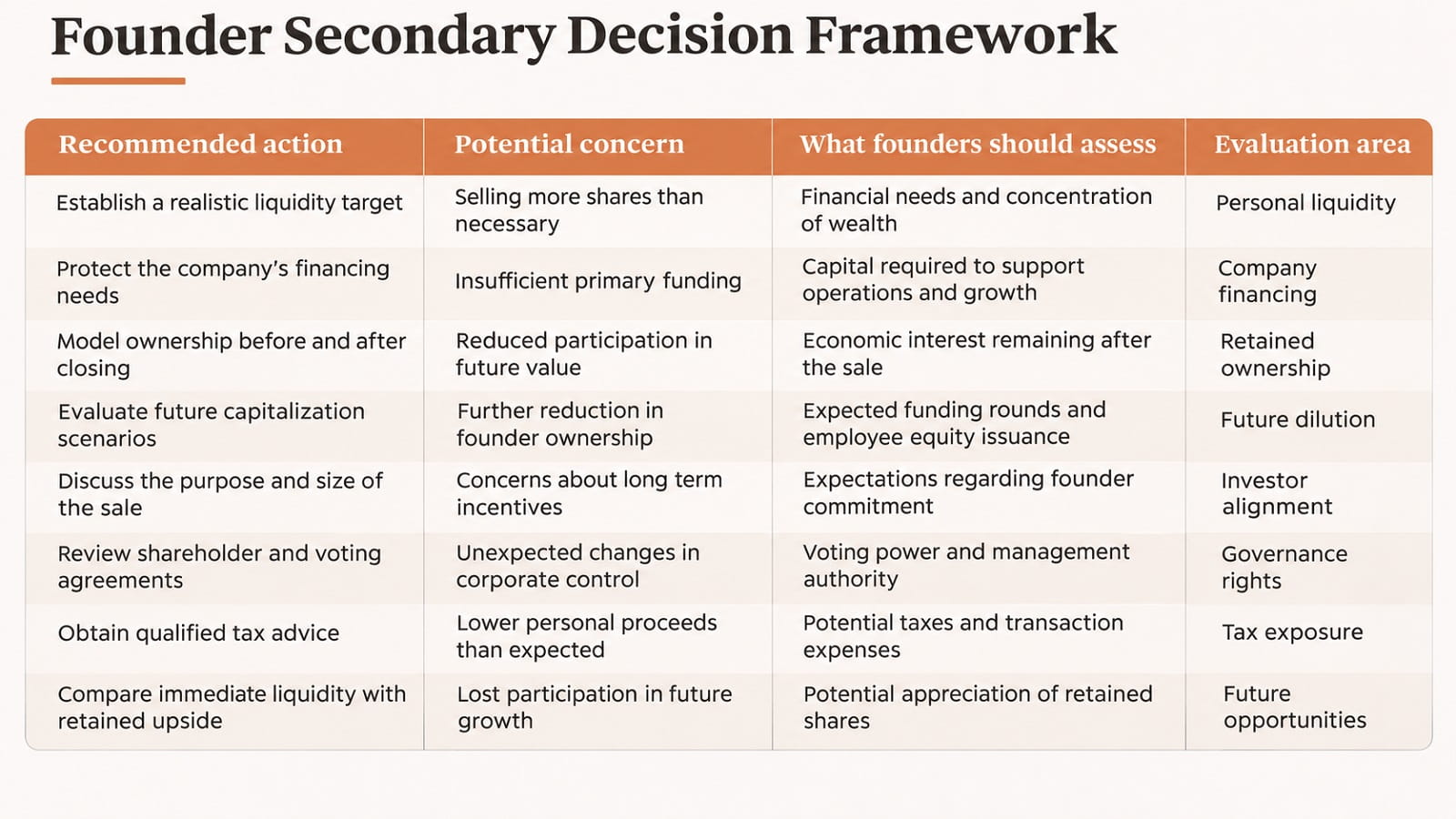
This framework helps founders distinguish a reasonable reduction in personal financial risk from a transaction that could weaken their position unnecessarily. The analysis should also consider whether future financing is likely to change the ownership balance. A sale that appears modest today may have greater consequences after additional investment rounds. Reviewing these scenarios before negotiations allows founders to make decisions with a clearer understanding of their financial and governance position.
How Investors Evaluate Founder Share Sales
Investors generally assess founder liquidity in the context of the company's future rather than treating every sale as a negative signal. A limited transaction can be acceptable when the founder remains committed and the company has sufficient capital to pursue its strategy.
The size and purpose of the sale are important. Investors may respond differently to a founder seeking reasonable financial stability than to one attempting to sell most of an ownership interest while expecting others to finance the next stage of growth.
They may also examine operating performance. A transaction supported by reliable revenue, commercial progress, and a credible business plan presents a different investment context from one involving a company with unresolved financing problems.
Transparency can help address these concerns. Founders should explain the financial purpose of the transaction, their remaining ownership, and their intended responsibilities after closing. Existing documents and the proposed capitalization should support those explanations.
Maintaining Founder and Investor Alignment
Alignment depends on more than the founder's ownership percentage. Leadership responsibilities, voting rights, compensation, and future financial incentives also influence how the founder participates in the company's development.
A founder who retains meaningful economic exposure and continues managing important business functions may remain aligned with investors after a partial sale. Conversely, a substantial ownership interest does not automatically resolve concerns about leadership commitment or succession.
Investors should evaluate the founder's actual role and incentives rather than rely exclusively on a numerical ownership threshold.
A Practical Founder Secondary Example
Consider HorizonStack Technologies, a fictional enterprise software startup preparing for a growth financing round. The company has 10 million ordinary shares outstanding, and its founder owns 3 million shares, representing 30% of the existing equity.
The founder has accumulated substantial equity value but wants to reduce personal financial concentration. Management also needs additional capital to support product development and international expansion.
An investor agrees to purchase 2 million newly issued shares at $10 per share. Separately, the investor agrees to purchase 300,000 existing founder shares at $8 per share.
For simplicity, assume all outstanding and newly issued shares carry identical economic and voting rights, the investor has no previous holding, and no additional securities are issued or exercised. The different negotiated purchase prices are illustrative.
Calculating Founder Liquidity and Remaining Ownership
The primary investment provides $20 million in gross financing to HorizonStack. The secondary sale generates $2.4 million in gross personal proceeds for the founder.
After both transactions, the company has 12 million shares outstanding, while the founder retains 2.7 million shares. The founder's ownership therefore decreases from 30% to 22.5%.
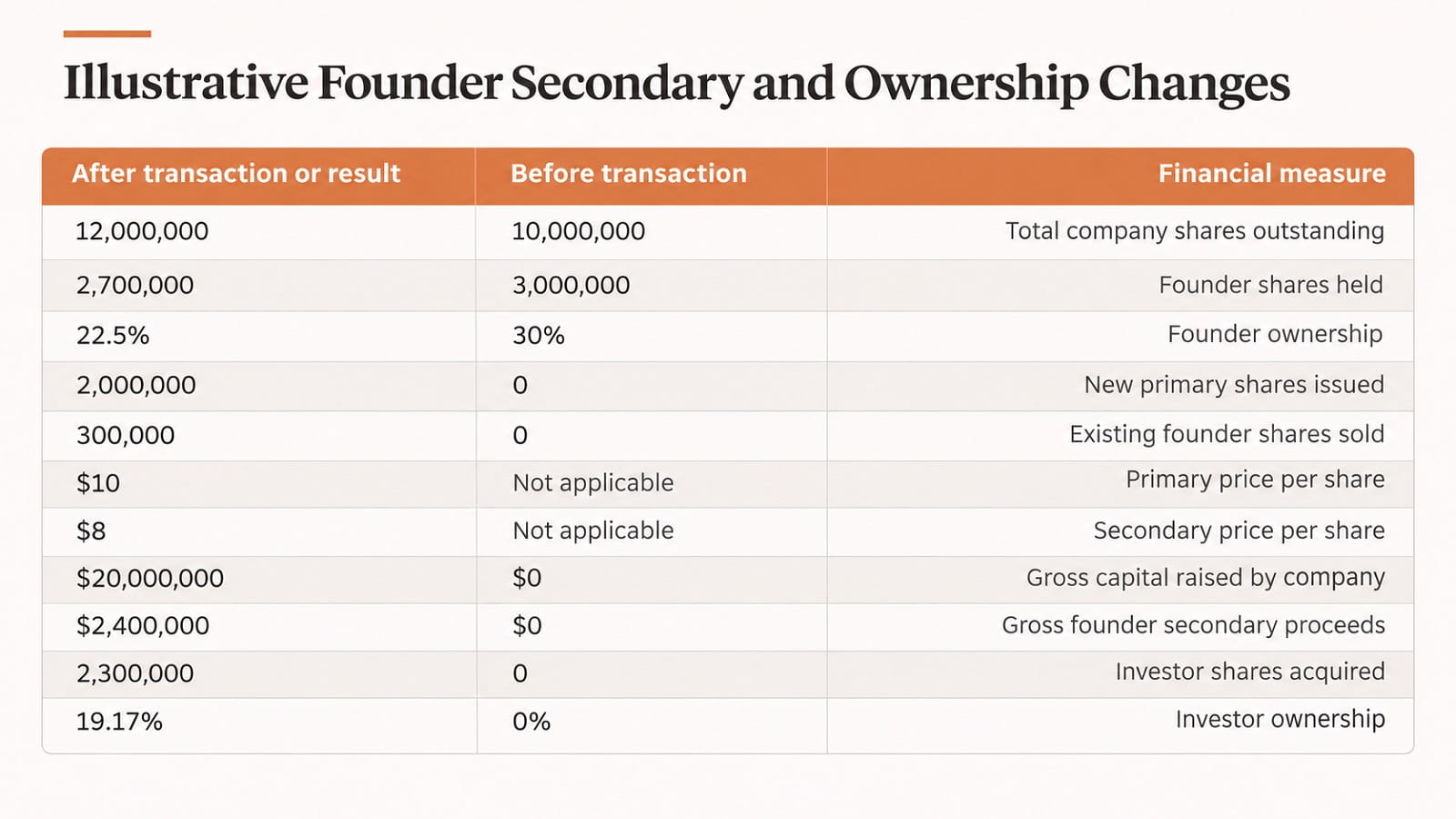
This example separates the effects of new share issuance from those of the founder's personal sale. Without the secondary component, the founder would retain 3 million shares and own 25% of the company after the primary investment. Selling 300,000 existing shares reduces that interest further to 22.5%. The company receives $20 million in gross primary financing, while the founder receives $2.4 million before taxes and personal transaction expenses. The secondary component does not itself increase the total number of outstanding shares.
Evaluating the Long Term Financial Outcome
The founder has sold 10% of the original personal shareholding while retaining 90% of those shares. This provides immediate liquidity but eliminates exposure to future changes in value for the 300,000 shares transferred.
Suppose the shares could eventually be sold for $20 each. Under that hypothetical scenario, the transferred shares would have a future gross value of $6 million, compared with the $2.4 million received today.
Alternatively, if the future share price falls to $4, the transferred shares would have a value of $1.2 million. The earlier sale would have provided greater gross proceeds than that hypothetical future outcome.
Neither scenario represents a forecast. The comparison illustrates the financial tradeoff between obtaining certainty today and retaining exposure to uncertain future appreciation.
Ownership, Voting Rights and Founder Control
A founder may retain a leadership position after selling shares, but continued employment should not be confused with corporate control. Ownership percentages, voting arrangements, board composition, and contractual rights determine different aspects of authority.
Some companies issue securities with different voting rights. A reduction in economic ownership may therefore have a different effect on voting power. Other companies rely on board appointment rights or shareholder agreements to establish influence over important decisions.
Founders should examine whether the proposed sale affects approval thresholds, board representation, or rights established in financing documents. Future dilution should also be included in this assessment.
A transaction that provides attractive personal liquidity may still be unsuitable if it creates an unexpected loss of influence over decisions that are important to the founder's continuing role.
Negotiating a Founder Secondary With Investors
Negotiations should begin with a clear explanation of the proposed transaction rather than a demand for a particular percentage of investment.
Founders can present their personal liquidity objectives alongside the company's financing requirements and operating plans. They should establish the number of shares they intend to sell, the ownership they will retain, and whether the transaction will change any leadership responsibilities.
The discussion should also address the price of existing shares. Investors may evaluate the security's rights, transfer limitations, and expected liquidity differently from those of newly issued preferred securities. Founders should understand the reason for any difference in pricing before accepting the proposal.
Where other shareholders have participation or consent rights, these requirements should be identified early. A proposed arrangement may need to accommodate existing contractual obligations before it can proceed.
The objective is to establish a transaction that provides reasonable liquidity without creating unresolved conflicts regarding company funding, ownership, or future commitment.
Tax and Legal Considerations for Founders
A founder's gross sale proceeds do not necessarily represent the amount available for personal use after closing. Taxes, professional fees, and other expenses may reduce the financial benefit.
Tax treatment depends on the jurisdiction, the founder's tax residence, the acquisition history of the shares, and the structure of the transaction. The length of time the shares have been held and their eligibility for particular tax provisions may also matter.
In the United States, certain founder shares may qualify for favorable treatment under applicable qualified small business stock rules. However, eligibility is subject to specific statutory requirements and should not be assumed.
Founders must also establish whether the shares are vested and transferable. Existing purchase agreements, equity arrangements, and financing documents may impose restrictions that affect which shares can be sold.
Legal and tax advisers should review these issues before the founder enters a binding agreement. Addressing them after negotiating a sale price can limit the available options.
When Founder Liquidity May Be a Poor Decision
A secondary transaction may be inappropriate when the company urgently needs capital and the proposed share sale competes with essential financing. Personal proceeds should not obscure the business's ability to fund its operating plan.
Selling may also be unsuitable when the founder would retain insufficient economic exposure relative to the responsibilities expected by investors. This concern becomes particularly important when additional dilution is likely.
Founders should exercise caution when the offered price does not adequately reflect the risks and potential value of the securities being transferred. At the same time, a higher future valuation is never guaranteed, and rejecting liquidity solely because the company might become more valuable can leave substantial personal risk unresolved.
The appropriate decision balances financial security, future participation, company requirements, and the founder's continuing responsibilities.
Final Thoughts
Founder liquidity can provide financial flexibility without requiring an entrepreneur to abandon a growing business. Selling a portion of existing shares may reduce personal concentration risk while preserving meaningful ownership and participation in future company growth.
The decision should begin with realistic personal financial objectives and a clear understanding of the company's capital requirements. Retained ownership, future dilution, governance rights, investor expectations, and tax consequences all deserve careful consideration.
A successful founder secondary balances immediate financial security with continued commitment to the company. The goal is not simply to maximize personal proceeds today, but to preserve a financial and ownership position that remains appropriate throughout the next stage of business development.
FAQ
What Is a Founder Secondary Sale?
It is a transaction in which a startup founder sells existing shares to an eligible purchaser and receives personal proceeds without necessarily leaving the company.
Is Founder Secondary the Same as a Startup Exit?
No. A partial founder share sale provides individual liquidity while the company can remain independent. A complete exit generally involves a broader ownership or business transaction.
How Much Equity Can a Founder Sell?
There is no universal percentage. The amount depends on transfer restrictions, investor consent where required, personal financial objectives, retained ownership, and company circumstances.
Does Founder Secondary Dilute Other Shareholders?
A conventional transfer of existing shares does not itself dilute other shareholders. Additional shares issued during a separate primary financing component can create percentage dilution.
Why Do Investors Allow Founders to Sell Shares?
Investors may support reasonable personal liquidity when it reduces financial pressure and helps preserve the founder's commitment. They also consider the company's financing needs and remaining founder incentives.
Can a Founder Sell Unvested Shares?
Unvested shares frequently carry transfer restrictions or company repurchase rights. Whether they can be sold depends on applicable agreements, approvals, and legal requirements.
Can Founders Remain CEO After Selling Shares?
Yes. Selling part of an ownership interest does not automatically terminate a leadership role. Management responsibilities and corporate authority depend on governance arrangements and relevant agreements.
Is Founder Secondary Income Taxable?
The sale may create tax obligations, but the treatment depends on the jurisdiction, share history, and eligibility for applicable tax provisions. Founders should obtain professional advice before completing a transaction.

Mobina Khanki
Venture & Funding Writer at PinerookMobina Khanki covers venture capital, startup funding, fundraising, and startup finance for Pinerook, focusing on founders and investors.
 Seen first.