Finding startup investors can be one of the most challenging parts of building a company. Many founders assume the difficult part is convincing someone to invest, but an earlier problem often receives less attention: identifying investors who are actually suitable for the business. A startup may have a promising product, growing customer interest, and a clear need for capital, yet spend months approaching investors whose priorities have little connection to its industry or development stage.
The problem is rarely a shortage of investor names. Venture capital databases, startup communities, professional networks, and investment announcements make it possible to discover thousands of potential contacts. The challenge is determining which of those contacts represent credible opportunities. An investor may have experience in a relevant industry but focus on later stage companies, invest only in particular countries, or prefer commitments that are larger than the startup requires.
Finding startup investors therefore requires research, qualification, and an understanding of how investment relationships develop. Founders need to identify appropriate sources of capital, examine investor preferences, establish credible contact paths, and decide which relationships deserve attention.
A clear Fundraising Strategy provides the financial objectives behind raising capital. Investor discovery builds on those objectives by identifying potential funding partners whose investment approach matches the company's needs.
This guide explains where to find startup investors, how to evaluate their suitability, which tools can simplify research, and how to establish contact without relying on generic outreach.
What Does Finding Startup Investors Actually Involve?
Finding startup investors is the process of identifying individuals and organizations that may be interested in financing a particular company. It involves understanding the startup's needs, researching investment preferences, evaluating potential matches, and establishing appropriate communication channels.
This differs from simply collecting contact information. A directory may show that an investor has previously supported software companies, but that information alone does not establish whether they invest at the startup's current stage, operate in its geographic market, or have the capacity to participate in the proposed financing.
The process begins with understanding the business itself. The company's industry, commercial maturity, financing needs, operating location, and development plans determine which investors are likely to be relevant. A startup developing specialized medical technology may need investors comfortable with lengthy development periods and regulatory uncertainty. A subscription software company may attract investors more familiar with recurring revenue and customer acquisition economics.
Investor discovery should produce a qualified list, not merely a large database. Every investor included in that list should have a documented reason for being considered. Founders can then concentrate their attention on realistic opportunities rather than spending time approaching people who are unlikely to participate.
Understand the Different Types of Startup Investors
Startups can receive capital from several categories of investors, but each category has different characteristics. Understanding those differences helps founders identify which sources are relevant before beginning detailed research.
Angel investors are individuals who invest their own capital. Some are former founders or experienced business operators who can provide industry knowledge alongside financing. Their investment amounts, preferred sectors, and level of involvement vary considerably, making individual research important.
Venture capital firms invest capital managed through investment funds. They typically operate according to defined investment mandates that influence company stage, industry preferences, geographic coverage, and expected returns. Their investment decisions may involve several professionals and internal approval processes, particularly for larger commitments.
Corporate venture capital investors are connected to established businesses. Some prioritize financial returns, while others also consider strategic relationships, technologies, or markets relevant to their parent companies. Founders should understand how those interests may affect commercial independence, information sharing, and future decisions.
Family offices may also invest in private companies, although their approaches differ significantly. Some maintain dedicated venture investment teams, while others primarily focus on established businesses or conventional investment assets.
Accelerators and certain startup programs provide another potential source of investment. Some invest directly in participating companies, while others primarily offer mentorship, networking opportunities, and introductions to investors. Founders should examine each program's eligibility requirements, services, and financial terms rather than assuming all accelerators operate in the same way.
The most appropriate category depends on the company's circumstances. A very early startup seeking a modest amount of capital may find certain angels or seed investors more relevant than large institutional funds. A company pursuing substantial expansion may need investors with greater financing capacity and experience supporting businesses at a comparable stage.
Define the Ideal Investor Before Starting Your Search
A more effective investor search begins with a description of the type of investor the company needs. This profile should reflect the startup's actual position, not the business it hopes to become several years later.
Development stage is one of the most important considerations. Investors who support companies with prototypes may evaluate risk differently from those who expect established revenue and repeatable customer acquisition. Founders should identify where their company stands and look for investors whose history suggests they are comfortable financing that stage.
Industry focus provides another useful filter. An investor familiar with enterprise software may understand recurring revenue and business purchasing decisions, while a specialist in biotechnology may be better equipped to evaluate research milestones and clinical development risks. Relevant expertise can improve the quality of the discussion, although it does not guarantee investment.
The proposed funding amount also matters. A firm whose typical initial investments are far larger than the company's financing requirement may not be a realistic target. Similarly, an individual investor may be unable to provide the amount required to lead a substantial round.
Geographic restrictions should be evaluated carefully. Some investors focus on companies incorporated or operating in particular countries. Others invest internationally but have preferences related to legal structure, location, or industry regulation.
Founders should also consider the type of relationship they want. An investor who expects active governance involvement may be suitable for one company but less appropriate for another. The objective is to identify investors whose capital and expectations align with the business.
How to Research and Qualify Potential Investors
Investor qualification is the process of determining whether a potential investor deserves further attention. A useful qualification system evaluates compatibility using information that can be verified, rather than relying entirely on reputation or assumptions.
Public investor profiles provide an initial source of information, but they should be interpreted carefully. A firm's website may describe the sectors it has historically supported without confirming its current investment activity. Investment mandates can change, and individual partners may have different interests within the same firm.
Recent portfolio investments, official announcements, and statements from investment professionals can provide additional context. Founders should also examine whether the investor has backed companies with similar business models or customer groups.
Startup Investor Fit Evaluation Framework
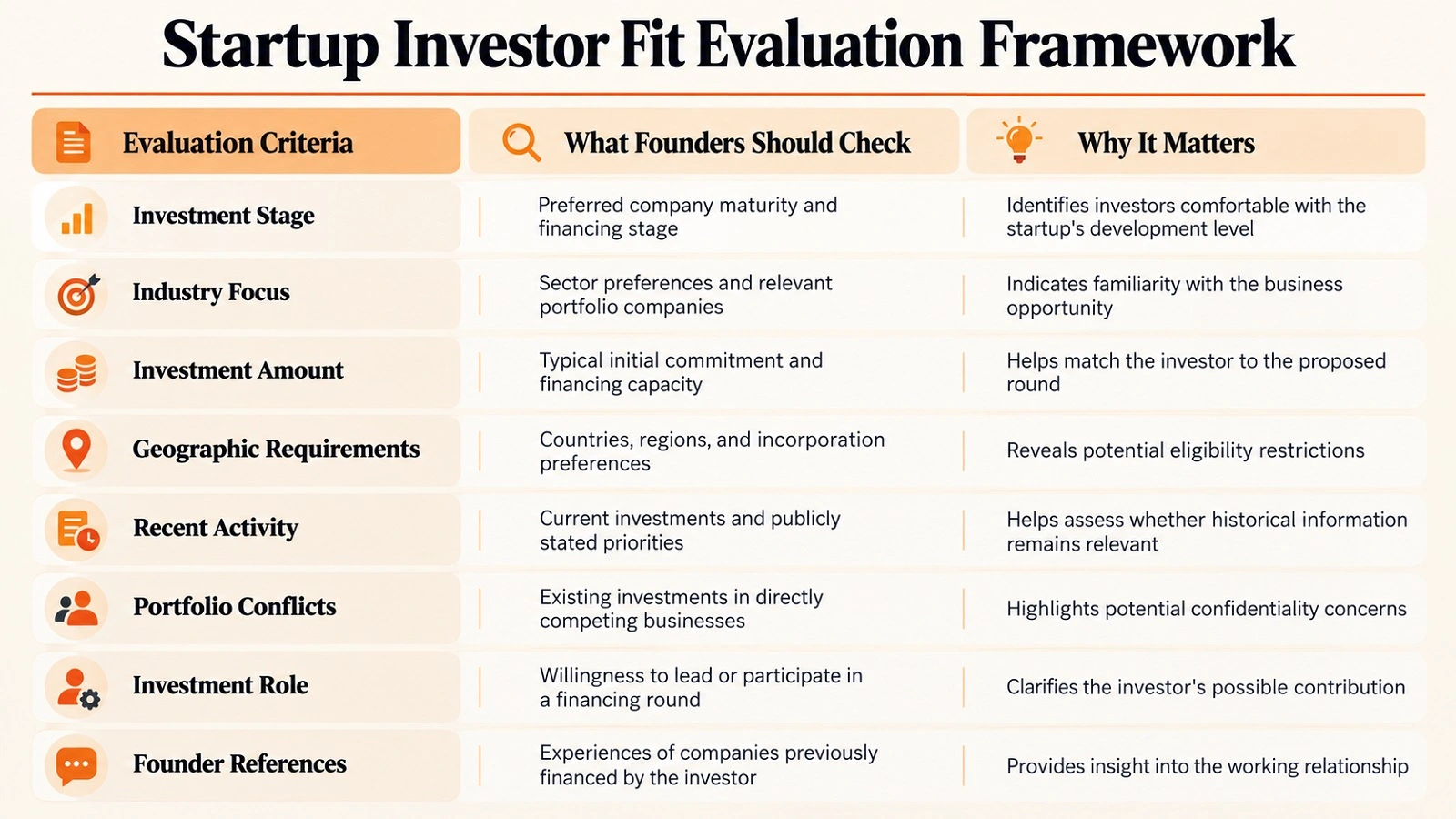
No single characteristic guarantees investor suitability. A firm may have relevant portfolio companies but operate at the wrong investment stage. Another may invest suitable amounts but have geographic restrictions that prevent participation.
Founders should distinguish confirmed information from details that still require investigation. When an investor's typical investment amount or current priorities are unclear, the list should identify those uncertainties rather than treating assumptions as verified facts.
Where to Find Startup Investors Online
Online investor platforms can significantly reduce the time required to identify potential funding sources. Their main advantage is the ability to narrow a broad investor universe using characteristics such as industry, financing stage, geography, and investment amount.
OpenVC provides an investor database designed for startup fundraising research. Founders can search using criteria such as company stage, geographic focus, funding requirements, and investor category. The platform also provides information about preferred outreach methods for certain investors, helping founders identify how an initial approach may be made.
Signal by NFX is another investor discovery resource. It organizes investors using sector and stage information and offers features related to professional connections and fundraising organization. This can help founders identify both potential investors and relevant relationships that may support introductions.
These tools can be valuable starting points, but neither should be treated as a guarantee of current investor availability. Profiles may contain incomplete information, and being included in a database does not mean an investor will consider every company that meets the listed criteria.
Official investor websites remain important. Many venture capital firms describe their investment philosophy, sector preferences, team members, and existing portfolio. Some also explain whether they accept direct submissions and how prospective companies should contact them.
Professional networking platforms provide additional context about individual investment professionals. Founders can research current responsibilities, previous experience, and relevant public discussions to identify who may be responsible for a particular industry or development stage.
The most useful research process combines several sources. A database can identify a possible match, an official website can help establish the firm's investment approach, and recent investment activity can provide additional evidence of relevance.
Find Investors Through Similar Startup Portfolios
One of the most practical ways to discover relevant investors is to research companies operating in related markets. Businesses with comparable customers, technologies, or revenue models may provide clues about which investors understand a particular commercial opportunity.
Founders can identify startups that operate in the same industry and examine their publicly announced financing rounds. The investors involved in those transactions may be worth researching, particularly when they have supported companies at a similar development stage.
This method can uncover investors whose experience is more relevant than a broad industry label suggests. A firm may not describe itself as a specialist in retail software, for example, but could have invested in several subscription businesses selling operational tools to smaller companies.
However, portfolio similarity requires careful interpretation. A previous investment does not guarantee that the investor is seeking more opportunities in the same sector. Some firms also avoid financing companies that compete directly with their existing portfolio businesses.
Founders should investigate potential conflicts before sharing sensitive information. Customer lists, proprietary technology, and detailed commercial plans may require additional precautions when an investor has relationships with competing companies.
Portfolio research can also help identify the appropriate contact within an investment firm. A partner who led a relevant transaction may be more suitable than a general contact address, provided the founder respects the firm's stated communication preferences.
The purpose is to use investment history as evidence for further research, not as proof that an investor is ready to fund a similar startup.
Use Founder Networks and Warm Introductions
Professional relationships can provide valuable information about potential investors. Other founders, advisors, former colleagues, customers, and industry specialists may know which investors have relevant experience and whether they are likely to consider a particular opportunity.
A warm introduction is especially useful when the person making it understands both parties. Rather than simply forwarding contact details, they can provide context about the startup and explain why the business may be relevant to the investor.
Founders should therefore request introductions selectively. Asking a professional contact to introduce the company to every investor they know can create unnecessary work and lead to conversations with limited potential.
A more effective request identifies a specific investor, explains why the investor appears relevant, and provides a concise introduction that the contact can assess before forwarding.
For example, a founder developing software for retailers might approach an entrepreneur who has previously raised capital from investors specializing in business software. The founder could explain the company's customer segment, current progress, and financing objective, then ask whether an introduction would be appropriate.
The intermediary should be free to decline if the match is weak or the relationship is not suitable for an introduction.
Founder networks can also provide information that public databases rarely capture. Entrepreneurs who have worked with an investor may understand their communication style, expectations, decision process, and behavior when a portfolio company encounters difficulties.
These insights can be useful even when no introduction results from the conversation.
Can Founders Contact Investors Directly?
Not every founder has access to an extensive network of investors, and a personal introduction is not always necessary. Some investment firms openly accept direct submissions, while individual investors may publish preferred contact methods for relevant opportunities.
Direct outreach is most useful when it follows careful research. The founder should understand why the investor is suitable and communicate that reason clearly.
A message sent to a specialist investor should demonstrate familiarity with the investor's actual interests rather than simply mentioning that the firm invests in startups. The company description should be specific, the evidence should be accurate, and the request should be appropriate for an initial conversation.
Founders should also respect investor communication preferences. Some firms use submission forms to organize opportunities, while others welcome direct emails. Ignoring published instructions can make the company appear poorly prepared.
The legal context of investor outreach matters as well. In the United States, certain private securities offerings restrict general solicitation and advertising, while other exemptions permit broader solicitation subject to specific requirements. Rules vary by jurisdiction and financing structure, so founders should obtain appropriate legal advice before publicly promoting an investment offering.
Researching investors and contacting suitable individuals should therefore be distinguished from advertising a securities offering broadly to the public.
A direct introduction can create an opportunity, but it should never be treated as evidence that an investor has committed capital.
How to Write an Initial Email to a Startup Investor
The first investor email should provide enough information for the recipient to decide whether the company is relevant. It should not attempt to reproduce an entire business plan or overwhelm the reader with financial projections.
A practical message identifies the startup, explains its product and customers, presents one meaningful piece of evidence, and communicates why the investor was selected. It then makes a clear request for further discussion.
Consider a hypothetical startup called ShelfPilot, which develops inventory planning software for independent retailers. The following example assumes the company has confirmed pilot activity and is preparing to discuss financing. Any founder using this structure should replace those details with verified facts from their own business.
Example Investor Introduction Email
Subject: ShelfPilot | Inventory Software for Independent Retailers
Hi Sarah,
I'm the founder of ShelfPilot, a software company helping independent retailers improve inventory planning and purchasing decisions.
We've developed a working product and are running pilot programs with retail businesses to validate demand and understand how the software fits their operations.
I noticed your firm's interest in business software and technology serving smaller companies. Given that focus, I thought ShelfPilot might be relevant to your investment interests.
We're exploring financing to support product development and further customer validation. Would you be open to a brief introductory conversation?
Best,
Alex
Founder, ShelfPilot
This message establishes the business, its current progress, the reason for contacting the investor, and the proposed next action. It avoids exaggerated claims about market size or future revenue.
In an actual financing campaign, founders should consider including a specific verified commercial achievement if one is available. A paying customer milestone or clearly defined usage result can provide more useful context than a general statement about promising traction.
The email should be tailored to the recipient rather than copied unchanged across a large contact list. A personalized message does not need excessive detail, but the reason for approaching the investor should be genuine.
The appropriate supporting materials depend on the investor's preferences. Some recipients expect a short deck with the initial contact, while others request information through a formal submission process.
Build and Organize Your Startup Investor List
Investor research becomes more valuable when the findings are organized consistently. A founder may identify dozens of relevant individuals through databases, portfolio research, and professional introductions, but those discoveries become difficult to manage if important information remains scattered across emails and personal notes.
A useful investor list should contain the investor's name, organization, investment focus, preferred stage, geographic requirements, potential investment amount, and source of information. It should also record the strongest available contact path and any details that still need verification.
Founders can organize the list in a spreadsheet or dedicated research platform. The tool itself matters less than the quality of the information and the ability to update it.
Startup Investor Discovery Channels and Research Priorities
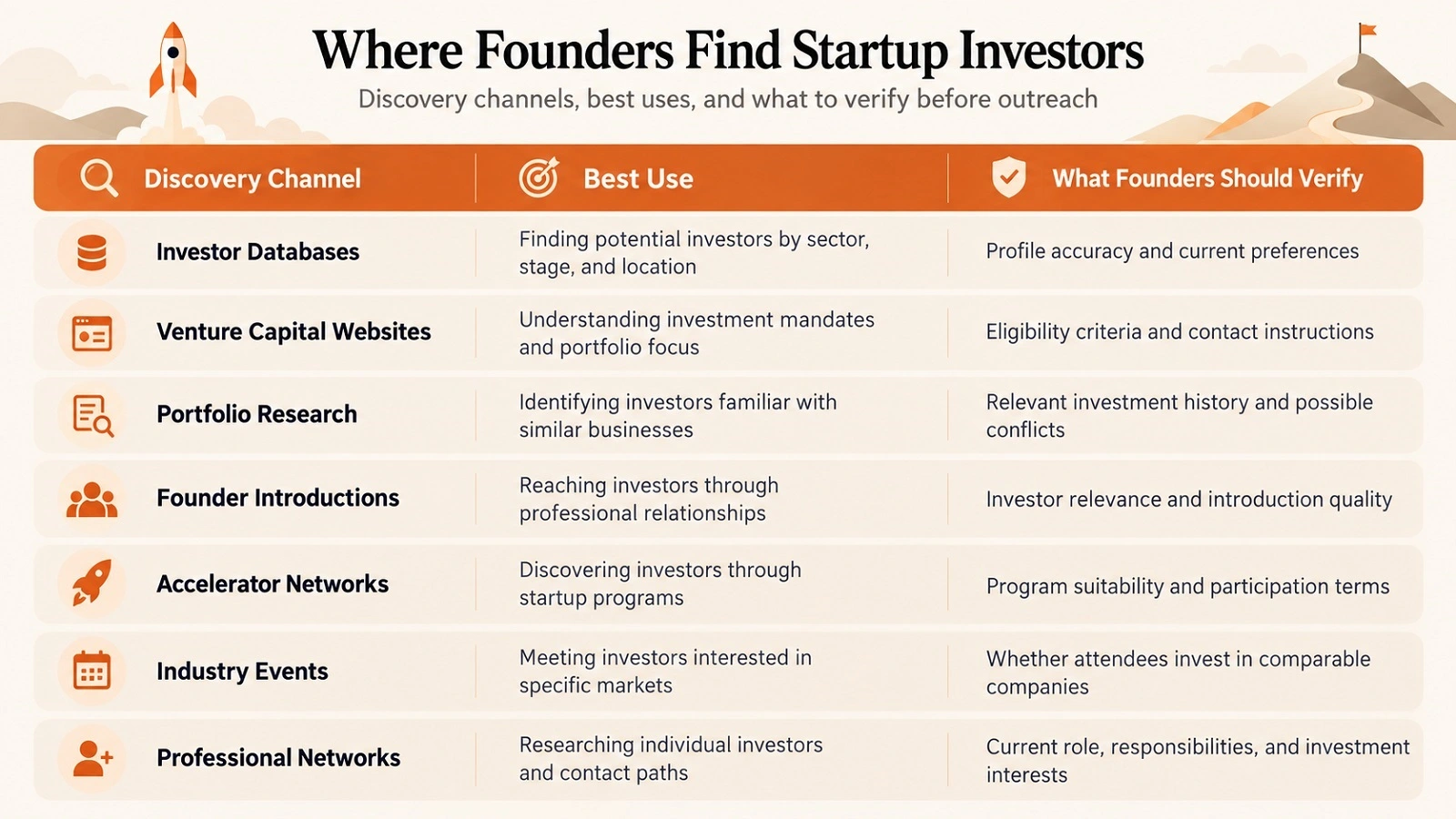
This structure helps founders identify where each opportunity originated and which sources are producing the most relevant matches. It also reduces the chance of contacting the same investor through several channels without coordination.
An investor list should be updated as new information becomes available. If a firm changes its investment focus or confirms that it does not support the company's stage, the record should reflect that decision.
The objective is to develop a reliable research resource that supports informed communication rather than accumulate names indefinitely.
How to Prioritize the Most Promising Investors
After creating an investor list, founders need to decide which potential relationships deserve attention first. A useful approach is to separate essential requirements from preferences.
Essential requirements might include investment stage, geographic eligibility, and financing capacity. If an investor does not support companies at the startup's stage, other positive characteristics may not overcome that mismatch.
Preferences can include specialized industry knowledge, a strong professional introduction, relevant portfolio experience, or a working style compatible with the founding team.
Founders can categorize investors according to the strength of their overall fit. Those with confirmed alignment across the most important criteria deserve deeper research, while investors with uncertain compatibility may require additional verification.
This approach is more useful than assigning numerical scores without understanding the reasons behind them. An investor might rank highly for industry expertise but remain unsuitable because of an existing conflict or geographic restriction.
Contact accessibility should also influence planning, although it should not replace investment suitability. A strong investor match with a credible introduction may be easier to approach than an equally relevant firm with no established contact path.
The priority list should remain flexible. As the startup develops and the financing requirements become clearer, some investors may become more suitable while others become less relevant.
Finding Startup Investors: A Practical Example
Consider ShelfPilot, the hypothetical company introduced earlier. It provides inventory planning software for independent retailers and has developed an early product that is being tested with potential customers.
The founding team wants to identify investors who understand software businesses serving smaller commercial organizations. Rather than approaching every venture capital firm, it begins by researching investors with experience in business software, retail technology, and early product development.
An investor database produces several possible matches. The founders review each firm's official website to determine whether its current investment preferences include businesses at ShelfPilot's stage.
They then examine relevant portfolio companies. A firm that has supported subscription software businesses may have useful industry familiarity, but the founders still need to confirm its typical investment amount and geographic requirements.
Another investor may have financed a company offering directly competing inventory software. ShelfPilot would need to consider possible conflicts before sharing sensitive commercial information.
The founders also speak with entrepreneurs who have raised capital in related markets. These conversations help identify investors who may not appear prominently in database searches and provide insight into how potential investment relationships work.
After combining their findings, the team creates a qualified list and identifies which opportunities have credible introduction paths. Investors with confirmed alignment receive priority, while uncertain matches remain under investigation.
This example demonstrates that investor discovery works best when each contact is supported by a reasoned assessment. The objective is not to secure a predetermined number of names. It is to identify a manageable group of investors who may realistically consider the business.
Verify Investor Credibility Before Sharing Sensitive Information
Finding potential investors also requires appropriate caution. Founders should verify important claims about an investor's identity, organization, and investment activities before entering into sensitive discussions.
Professional profiles and company websites are useful starting points, but they should not be accepted as conclusive evidence on their own. Founders may need to confirm an individual's affiliation through official organizational channels, examine verifiable investment history, and seek references from companies that have previously worked with the investor.
Unusual requests for upfront payments deserve particular scrutiny. A person claiming that a guaranteed investment will be released only after the startup pays an unexplained administrative or processing fee may present a serious warning sign.
Pressure to make immediate commitments, unclear contractual arrangements, and inconsistent descriptions of an investor's organization can also justify further investigation.
Founders should be cautious when sharing confidential customer information, proprietary product details, ownership documents, or financial records with unverified parties.
Not every private investor is subject to identical registration or disclosure requirements. The appropriate checks depend on the person's role, the transaction, and the applicable jurisdiction.
The purpose of verification is to establish a reasonable basis for trust before exposing the company to unnecessary financial, operational, or legal risk.
Evaluate Investors as Long Term Business Partners
An investor may remain involved in the startup long after the initial financing round. Choosing an investor therefore involves more than determining whether they can provide capital.
Founders should understand what the investor expects from the relationship. Some investors prefer to participate actively through board responsibilities, strategic introductions, and ongoing advice. Others maintain a less involved position and primarily monitor financial progress.
Neither approach is automatically preferable. The important consideration is whether the expectations align with the company's needs and governance arrangements.
References from existing portfolio founders can provide useful information. Founders may ask how the investor communicates during difficult periods, whether expectations are realistic, and how disagreements are handled.
It is also useful to understand whether an investor commonly supports existing portfolio companies in later financing rounds. Some funds reserve capital for additional investments, while others concentrate primarily on making initial commitments. The existence of reserves does not guarantee future support, but it can help founders understand the investor's approach.
Potential conflicts of interest should also be considered. A firm that backs directly competing businesses may create additional questions about information handling and strategic confidentiality.
The best investor is not necessarily the one with the most recognizable name or the largest possible commitment. A suitable partner should offer capital on appropriate terms while maintaining expectations that the founders can reasonably work with.
Common Mistakes When Finding Startup Investors
One of the most common mistakes is approaching investors before verifying their investment preferences. A firm may have a strong reputation but little interest in the company's sector, development stage, or location. Sending generic messages to such firms can consume substantial time without creating realistic opportunities.
Another mistake is relying on outdated information. Investor websites and public profiles may not reflect recent changes in investment priorities, individual responsibilities, or available capital. Founders should verify important details rather than assuming that previous investments establish current availability.
Some companies focus too heavily on famous investors while overlooking smaller firms and individuals with more relevant experience. Investor recognition does not automatically indicate compatibility with the startup's financing needs.
Poorly targeted introduction requests can create problems as well. Asking professional contacts to connect the company with any available investor makes it difficult for those contacts to judge whether an introduction is appropriate. A specific request supported by a clear explanation of investor fit is generally more useful.
Founders may also share confidential information too early or fail to investigate potential conflicts. The search for investment should not require unrestricted disclosure of sensitive company material to people whose identity and interests remain uncertain.
Finally, discovering interested investors should not be confused with completing a financing round. An investor may express enthusiasm, request a meeting, or review company information without committing capital. Finding suitable investors creates opportunities for future discussion, but investment remains dependent on further evaluation and agreement.
Building an Investor Network That Supports Startup Growth
Finding startup investors is most effective when founders treat it as a focused research and relationship building activity. A clear understanding of the company's financing requirements makes it easier to identify investors whose industry experience, stage preferences, geographic interests, and financial capacity align with the business.
Investor databases, portfolio research, professional relationships, and direct introductions can all contribute to that search. Their value depends on how carefully founders evaluate the information they discover and whether they use it to develop meaningful relationships.
A qualified investor list should explain why each potential investor is relevant, identify a credible contact path, and remain current as the company and investment market develop.
The objective is not to build the largest list or secure meetings with the most recognizable firms. It is to find appropriate investors who understand the opportunity and may become constructive financing partners as the startup grows.
FAQ
How do I find investors for my startup?
Begin by identifying investors whose preferred industry, company stage, geography, and investment amount match your business. Use investor databases, venture capital websites, portfolio research, accelerator networks, and professional relationships to discover potential matches. Verify each investor's current preferences before deciding whether to make contact.
Where can I find angel investors for a startup?
Angel investors can be found through professional networks, founder communities, angel investment groups, startup accelerators, industry events, and specialized investor platforms. Since individual angels have different investment interests and financial capacities, founders should evaluate each potential investor separately rather than assume all angels finance similar businesses.
Can I contact startup investors without a warm introduction?
Yes. Some investment firms and individual investors accept direct submissions through official websites, email, or other published contact channels. A carefully researched message that explains the company, relevant evidence, and the reason for approaching that investor can be useful without a mutual connection. Founders should also respect investor contact preferences and applicable securities regulations.
How do I know whether an investor is right for my startup?
Evaluate the investor's preferred financing stage, sector experience, typical investment amount, geographic requirements, portfolio relationships, and expectations about involvement. Recent investment activity and references from portfolio founders can provide additional context. A suitable investor should align with the company's actual financing requirements and development plans.
What is the biggest mistake founders make when searching for investors?
A common mistake is contacting investors without confirming whether they support companies in the relevant industry or development stage. This creates unnecessary outreach and makes it difficult to identify genuine financing opportunities. A carefully qualified investor list provides a stronger foundation than a large collection of contacts selected without meaningful research.

Mobina Khanki
Venture & Funding Writer at PinerookMobina Khanki covers venture capital, startup funding, fundraising, and startup finance for Pinerook, focusing on founders and investors.
 Seen first.


