A large customer population, a rising number of new companies, or a prominent funding announcement can make a market look attractive. None of these indicators, however, establishes that a startup can acquire paying customers and expand profitably. For founders considering a new country and investors assessing companies outside familiar markets, the more useful questions concern demand, distribution, payment collection, and the resources needed to operate locally.
Emerging startup markets offer opportunities to solve problems that established providers may serve poorly, particularly in financial services, business software, logistics, and essential infrastructure. Within the wider context of Investment Trends, their appeal lies in the relationship between commercial demand and the capital available to support it. A market with active investors can still be difficult to enter, while a location receiving relatively little venture funding can support a viable business with dependable customers.
This guide examines opportunities across Southeast Asia, Africa, Latin America, the Middle East, and developing European technology markets. Rather than ranking startup ecosystems, it explains how to assess real purchasing behavior, test a market before expanding, account for currency and collection risks, and decide whether additional investment is justified. The financial example compares three fictional market entry pilots using actual customer contribution and the cash required to operate them.
What Makes an Emerging Startup Market Attractive?
An emerging startup market can offer sophisticated customers and a growing technology sector while still presenting gaps in distribution, local financing, or specialized services. For an investor, the opportunity also depends on how efficiently the startup can reach those buyers, retain them, and eventually turn commercial success into a financial return. Rankings of cities and innovation activity can be useful background, but measuring the development of an ecosystem is a separate task from judging whether a specific business should enter it.
What Regional Funding Data Can and Cannot Tell You
Recent financing reports demonstrate why regional headline figures require care. DealStreetAsia reported that startups in Southeast Asia raised $7.25 billion across 217 equity transactions during the first half of 2026. One $4.5 billion financing accounted for much of that total, while the number of transactions was the lowest since at least 2018. A large reported increase in investment therefore did not mean funding became broadly accessible to young companies across the region.
Partech reported approximately $4.1 billion in combined equity and debt financing for African technology companies during 2025, including around $2.4 billion in equity and $1.6 billion in debt. LAVCA reported that Latin American venture investment remained selective in 2025, with $2.2 billion invested in early stage rounds. MAGNiTT found that AI businesses in the Middle East and North Africa raised $678 million during the first half of 2026 across 53 deals, with financing concentrated heavily in particular markets. These reports cover different regions, periods, instruments, and classifications, so their totals are not a valid regional ranking. The practical lesson is to use funding figures to understand the availability and structure of capital, not to forecast demand for an individual product.
Commercial Opportunities Across Emerging Regions
Southeast Asia: Distribution and Payment Habits Matter
Southeast Asia contains distinct markets rather than a single customer base. Indonesia, Vietnam, Malaysia, and the Philippines differ in language, purchasing habits, regulatory requirements, and the commercial relationships needed to reach businesses or consumers. Singapore plays an important role in regional financing and company operations, but a startup headquartered there may serve customers across several other countries.
Opportunities can arise in merchant services, logistics software, business automation, and tools that help companies manage fragmented operations. The main challenge is often the practical route to customers. Founders need to know whether they can sell directly, require local distributors, or must integrate with established platforms.
Africa: Essential Services and Financing Structure
Across Africa, businesses are developing products for payments, energy access, transportation, and enterprise operations, but the conditions facing a company in Kenya can differ substantially from those in Nigeria, Egypt, or South Africa. Some business models address gaps in essential services, while others improve efficiency for established companies.
Financing structure deserves particular attention. Partech's 2025 figures show that debt formed a material part of reported African technology funding. Debt may fit companies with suitable assets or cash flows, but it introduces repayment obligations that ordinary equity does not. Founders also need to consider collection methods, access to foreign currency for imported services, and whether money can be moved when suppliers or investors are located abroad.
Latin America: Local Demand Before Regional Expansion
Brazil, Mexico, Colombia, and Chile offer different opportunities in financial services, retail technology, business software, and industry specific products. A startup that establishes strong demand in one country may still need to redesign onboarding, payments, pricing, and support before entering another. Regional expansion is therefore a new commercial experiment, not merely a larger addressable market in a presentation.
LAVCA's research points to selective venture deployment and the significance of local investors in early financing. That context can help founders identify suitable capital partners, but commercial readiness remains the decisive issue. Before spending on expansion, companies should examine how comparable customers purchase products, what they pay for, and whether local delivery and compliance costs leave sufficient financial contribution.
Middle East and North Africa: Verify the Commercial Buyer
The United Arab Emirates, Saudi Arabia, and Egypt present different combinations of corporate demand, public initiatives, infrastructure development, and consumer needs. Opportunities may exist in enterprise software, financial infrastructure, automation, and services supporting large organizations. However, an announcement about regional technology spending does not necessarily represent an accessible budget for a new startup.
Enterprise sales can depend on procurement approval, integration with existing systems, or a local commercial relationship. Those steps may extend the period between an encouraging meeting and a paid contract. Founders should distinguish approved spending, signed customer agreements, completed delivery, and cash collected. Investors should apply the same distinction when assessing the apparent strength of a startup's sales pipeline.
Developing European Markets: International Sales From a Local Base
Cities across Turkey, the Baltic region, and Southern Europe can support businesses building for local or international customers. These markets may provide specialized talent, sector expertise, or a suitable base for exporting software and services. Yet access to customers and access to investors do not necessarily develop at the same pace, particularly when the company sells internationally while operating locally. It is more useful to prove that the company can win and retain a specific international customer segment than to rely on a city ranking as evidence that its business model will succeed.
Comparing Market Entry Opportunities
The following comparison focuses on commercial questions rather than ecosystem rankings. Its examples are starting hypotheses that require validation in each specific country and customer segment.
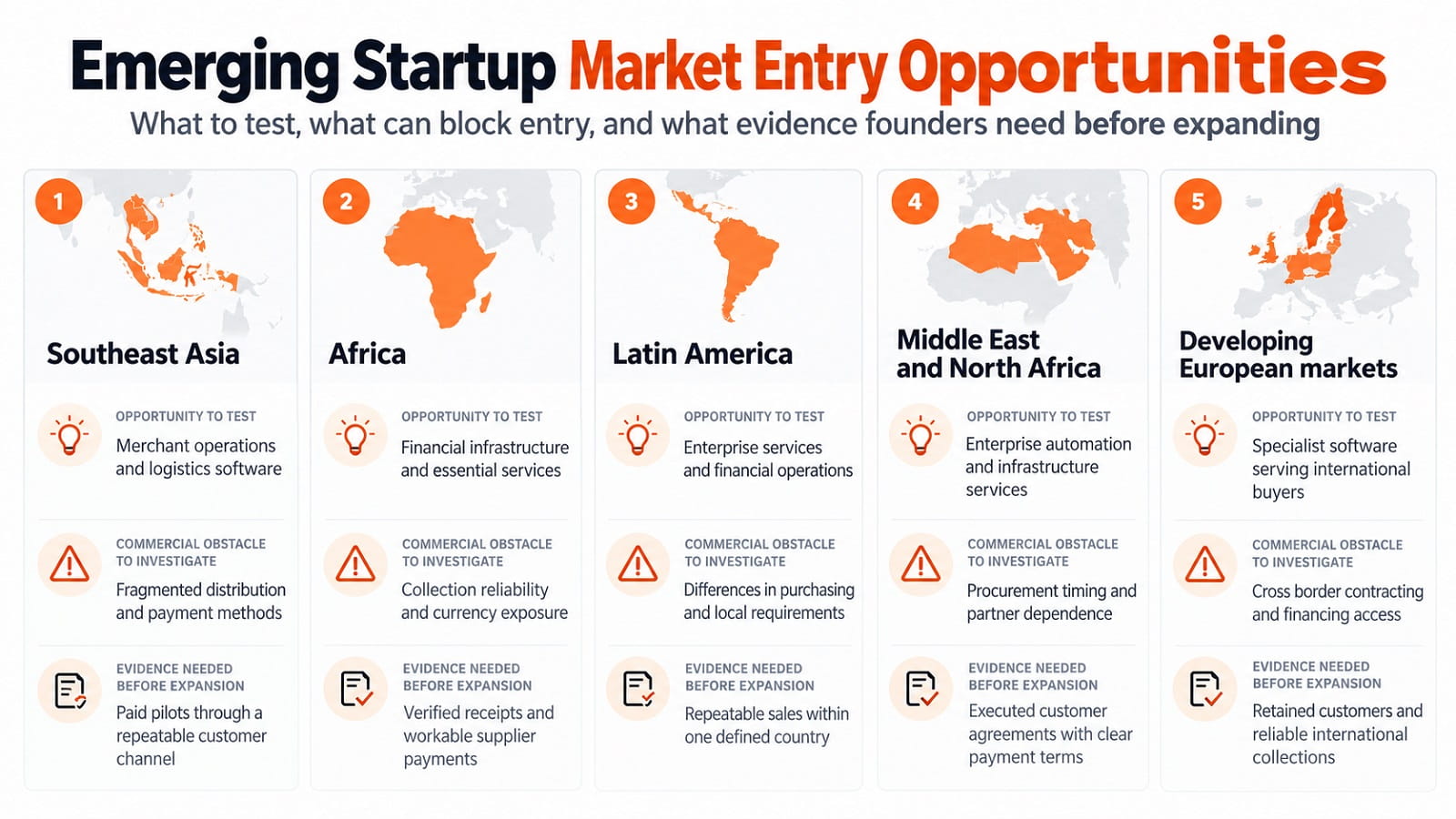
No row identifies a universally superior region. A company may find an attractive customer niche in a market that appears difficult for another business. The value of the comparison lies in selecting the uncertainty a founder should test before committing more money.
How to Validate a Market Before Committing Capital
Define the Buyer and the Problem
Start with a narrow customer segment, not the entire population of a country. A startup selling inventory software might initially target independent distributors handling a particular product category. It should investigate the existing tools those distributors use, who authorizes purchases, and the measurable costs of their current process. Interviews are useful for discovering problems, but a real paid commitment provides stronger evidence of willingness to buy.
The first pilot should test an offer customers understand, including what is delivered, the price, and any onboarding requirements. Founders should also record the cost and responsibilities of local sales partners. Otherwise an apparently successful sales test may conceal a distribution model that cannot be repeated economically.
Test the Full Path From Sale to Cash
A signed contract is not the same as money in the bank. In unfamiliar markets, invoicing conventions, settlement systems, customer approval processes, and currency conversion can affect when revenue becomes usable cash. Before scaling, founders should document the entire sequence from customer acquisition to service delivery, invoice approval, payment receipt, and any onward transfer to suppliers.
A pilot should therefore measure both revenue and collection behavior. Late invoices may be manageable at small scale but become serious when payroll and infrastructure payments must be made every month. The finance team should maintain separate assumptions for recognized revenue, amounts invoiced, cash received, and balances that remain outstanding.
Establish the Local Cost of Serving Customers
A customer acquired in a new market may require different support, payment processing, integration, and distribution expenses. Founders should calculate the revenue retained after direct delivery costs and then compare it with the local fixed expenses needed to maintain operations. Low employee or office costs do not guarantee attractive economics if customer acquisition is slow or service delivery requires extensive manual work.
Distributors, remote sales, and selected partnerships may reduce initial commitments, but they can create dependencies and fees of their own. The preferred route should follow measured customer outcomes rather than assumptions about how startups usually expand internationally.
A Practical Market Entry Investment Example
Consider NorthBridge Analytics, a fictional business software startup choosing where to run its next six month commercial pilot. Management identifies 100 qualified prospects in each of three hypothetical markets. By the beginning of the pilot, 20 customers in Market A, 14 in Market B, and 24 in Market C have become paying accounts. The company assumes those customers remain active for all six months, with no further additions or cancellations.
Monthly revenue per account is $180 in Market A, $250 in Market B, and $130 in Market C. Direct delivery payments are $60, $75, and $45 per account respectively. Monthly local operating expenses are $8,000, $9,000, and $6,000, while initial setup payments are $16,000, $22,000, and $12,000. Unless stated otherwise, customers pay and the company meets its expenses within the same month. All amounts are illustrative US dollar equivalents and exclude taxes, financing, and currency changes.
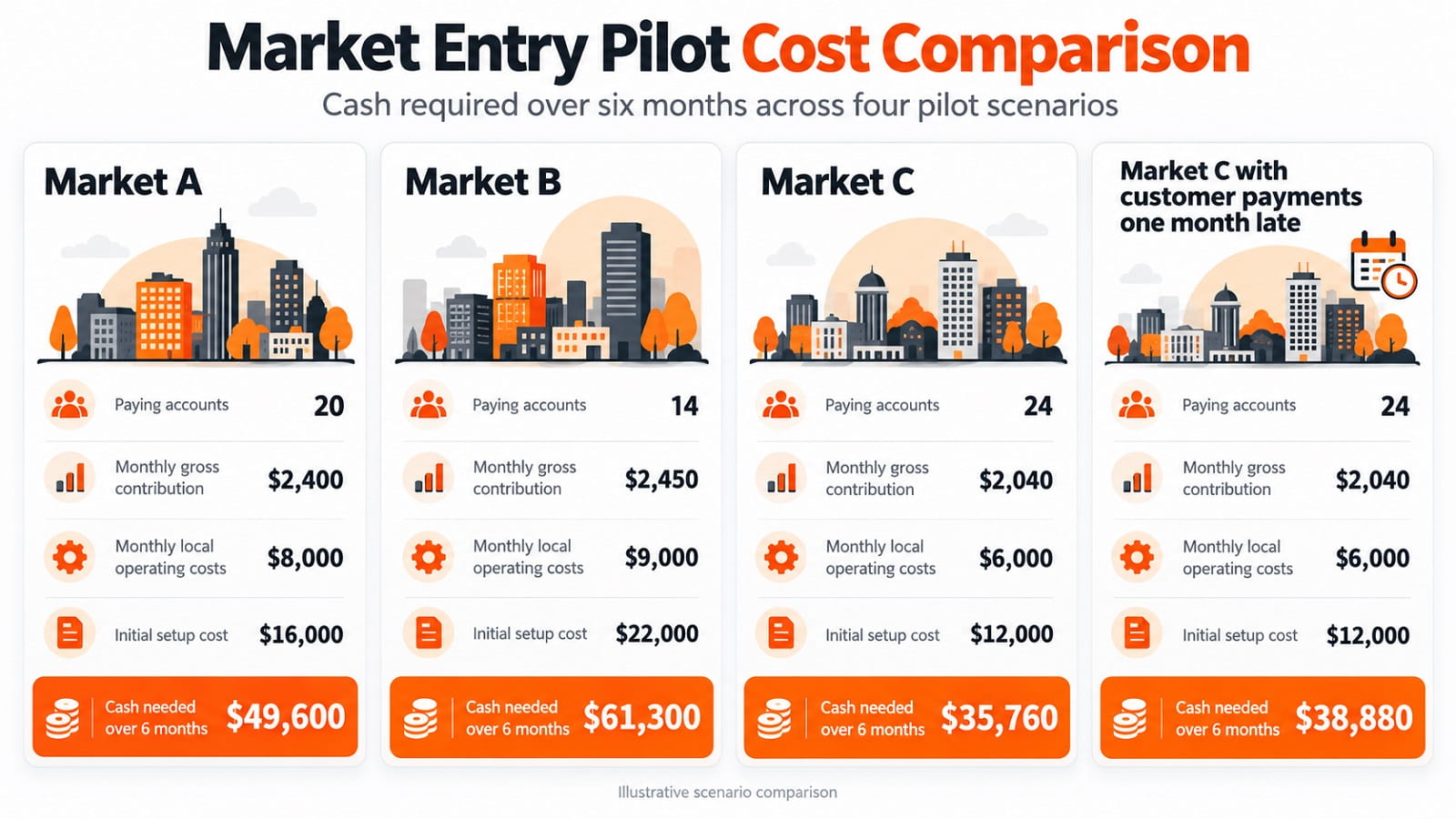
Monthly gross contribution equals monthly customer revenue less direct delivery payments. For Market A, 20 customers generate $3,600 in revenue and $1,200 in delivery payments, leaving $2,400. The six month cash requirement is the $16,000 setup cost plus six months of $8,000 operating expenses, less six months of $2,400 contribution, or $49,600. The same calculation produces $61,300 for Market B and $35,760 for Market C.
The final scenario demonstrates the effect of collection timing. If Market C customers pay one month after receiving service, the company collects only five months of revenue during the six month pilot, although all six months of direct delivery expenses still require payment. The resulting funding requirement rises by $3,120, which is one month of customer revenue, to $38,880. That additional cash requirement is not a decline in recognized revenue; it reflects a collection delay.
Market C requires the least initial cash under these assumptions, but this does not prove it is the best investment. Management still needs to compare retention, customer growth after the pilot, contract quality, and the opportunity for future expansion. The purpose of the model is to make the cash cost of learning about each market visible before a larger commitment is approved.
Currency, Legal Structure, and Access to Capital
International expansion can expose a startup to mismatches between the currency it earns and the currency it spends. A company receiving local payments while purchasing cloud infrastructure in dollars may face pressure if the local currency weakens. Conversely, changes in exchange rates can alter reported growth without changing the number of customers served. Management should examine whether cash can be converted and transferred when required, not only how it appears in accounting reports.
Legal and operational arrangements need to be understood before a pilot begins. Depending on the product, activities may require local registration, tax treatment, data protection procedures, licensing, or agreements with regulated partners. Founders should seek appropriate local advice and reflect the resulting costs and timing in their forecasts. A market is not ready for commercial entry merely because customers express interest.
Access to follow on funding should also influence how an expansion is financed. The cash forecast should include a case in which a later round is delayed. Investors should examine whether the pilot creates evidence that suitable future funders will recognize, while founders should avoid assuming that an international expansion automatically increases valuation or investor interest.
What Investors Should Verify Before Financing Expansion
Once a startup has produced a credible pilot, investment diligence should focus on whether the results can be replicated. Investors should request records showing the actual paying customer cohort, contractual prices, invoices, receipts, direct costs, and local operating commitments. They should also examine which results depended on the founders' personal relationships or a one time promotional arrangement and which came from a process the business can repeat.
The next investment decision should be tied to a clear milestone. That might involve retaining a defined cohort, reaching a contribution target, shortening collection times, or proving that a distribution partner can generate additional paying customers. A downside forecast should show what happens if expansion costs increase or customer purchases develop more slowly than expected.
Common Mistakes When Choosing Emerging Markets
A frequent mistake is selecting a country because of a large population or a prominent funding announcement without identifying the paying customer. Another is assuming that success in one country will transfer to its neighbors without changes in purchasing habits, regulation, or distribution. Founders may also count signed contracts as immediate cash or underestimate the cost of supporting customers in a new location.
Investors can make a similar error by comparing regional fundraising totals without checking whether they include equity, debt, or exceptional transactions. Pilot results, contract terms, contribution after delivery costs, and actual collections provide a more dependable basis for committing additional capital.
Final Thoughts
Emerging startup markets can offer opportunities to serve customers that established products overlook, but geography alone does not make a business investable. A useful market entry decision rests on evidence that people will pay, customers can be served economically, and the company can collect and use the resulting cash.
The NorthBridge example illustrates why customer volume or monthly revenue alone can lead to the wrong conclusion. Local commitments and collection timing can substantially change the money needed to test an opportunity. Founders and investors are better served by disciplined pilots and explicit financing decisions than by broad claims about which region will produce the next generation of successful startups.
FAQ
What Are Emerging Startup Markets?
They are places where entrepreneurial opportunities and investment capabilities are developing, often with customer needs that established providers do not fully serve. The label does not mean every location is a developing country or that all businesses face identical risks.
Which Emerging Markets Are Worth Considering in 2026?
Opportunities exist across Southeast Asia, Africa, Latin America, the Middle East, and developing European business centers. The most suitable choice depends on a startup's customers, product, legal requirements, sales channels, and ability to collect payments.
How Should a Startup Select Its First Foreign Market?
Begin with one clearly defined buyer segment and test a paid offer. Measure acquisition, delivery costs, customer retention, payment timing, and the cash required to operate the pilot before committing to wider expansion.
Does More Venture Funding Mean a Better Market?
Not necessarily. Regional totals can be dominated by a few large investments or include debt alongside equity. They say relatively little about the profitability of a specific product or the funding available to an early company.
What Is the Biggest Financial Risk of Market Entry?
The most material risk depends on the business, but delayed collections, unexpectedly high local costs, currency exposure, and an inability to finance the next stage can all create serious problems. A realistic cash forecast should test these possibilities before launch.
Should Investors Prefer Markets With Lower Operating Costs?
Customer purchasing behavior, contribution after delivery costs, and access to reliable sales channels determine whether operating in a market creates economic value. Cheap operations offer little advantage if customers are expensive to win or slow to pay.
Can a Startup Expand Without Opening a Local Office?
Sometimes. Direct remote sales, distributors, and commercial partners may support an initial test, depending on the product and legal requirements. Their actual cost and effectiveness should be measured instead of assumed.

Mobina Khanki
Venture & Funding Writer at PinerookMobina Khanki covers venture capital, startup funding, fundraising, and startup finance for Pinerook, focusing on founders and investors.
 Seen first.