Economic costs of geoeconomic fragmentation arise when political divisions make international exchange, investment, and production less efficient. Barriers can limit competition, force businesses to use costlier suppliers, reduce access to technology, and lower the purchasing power of households. The important issue is not simply whether trade routes change, but whether the world produces less value than it could under a more open and predictable set of economic relationships.
Within the broader debate about Geoeconomic Fragmentation, the cost question asks what countries, companies, and consumers give up when commercial decisions are increasingly shaped by geopolitical boundaries. A cost estimate must identify the policy shock, the economic baseline, the time horizon, and the measure of welfare or output being compared. Without those details, a dramatic percentage can tell readers very little about the real consequences of fragmentation.
This distinction matters because some diversification may improve resilience, while indiscriminate restrictions can impose persistent costs. Economic studies therefore do not all arrive at the same number. Their estimates represent different assumptions about how far relationships break down and how quickly firms and workers can adapt.
What Economists Mean by the Cost of Fragmentation
An economic cost is the difference between an outcome under a fragmentation scenario and the outcome under a specified alternative. That alternative might be continued current policies, unchanged trade costs, or stronger international cooperation. A forecast of output being lower than a reference scenario does not necessarily mean that actual global GDP will fall in absolute terms. The global economy may still grow, but grow by less than it otherwise could.
Economists also distinguish real GDP, real income, and welfare. Real GDP measures production adjusted for prices. Real income asks what economic resources can purchase. Welfare models can capture the value of more variety, better allocation, or consumption possibilities. These measures are related, but they cannot be substituted for each other. A decline in export volumes, for example, is not automatically a decline of the same size in national income.
Opportunity cost is another important part of the calculation. A country may build a domestic production line for strategic reasons and gain insurance against disruption. The economic cost is not just its budgetary expense. It also includes resources that could have supported other productive activities if alternative suppliers had remained available.
How Trade Barriers Reduce Real Income
International trade allows producers to specialize, spread fixed costs across larger markets, and obtain inputs that would be expensive or unavailable locally. Tariffs, export controls, and discriminatory market access rules can weaken these benefits. A firm that loses a reliable input supplier may pay more, accept lower quality, or redesign its production process. Households can ultimately face higher prices or fewer choices as these changes move through the economy.
The consequences extend beyond the directly restricted product. If a manufactured component becomes more costly, every downstream activity that relies on it may face pressure. Employers can respond by raising prices, reducing margins, investing in substitutes, or delaying production. The final effect depends on how easily workers, machines, and purchasing relationships can shift. That is why a simple sum of tariff rates is not a credible measure of total economic loss.
Trade diversion may soften the immediate damage. A country excluded from one supply relationship may sell to another buyer, while intermediary economies acquire new business. These adjustments change who gains and who loses, but they do not eliminate the underlying question of whether production has moved toward or away from the most efficient available options.
Why Prices and Living Standards Can Suffer
Fragmentation can make a basket of goods more expensive without producing a permanent acceleration in inflation. A one time increase in import costs can raise the price level, while sustained inflation depends on additional factors including monetary policy, expectations, wages, and repeated supply shocks. Treating all price increases caused by restrictions as permanent inflation would overstate what the evidence proves.
For households, the distribution of these changes matters as much as the average. Lower income consumers spend a larger proportion of their budgets on essentials such as food, energy, and transport. When restrictions raise the cost of essential imports or their inputs, the loss in purchasing power can be particularly painful. Governments can offset part of the burden through targeted support, but those measures require funding and may introduce other distortions.
The gains of protection can also be uneven. Domestic producers that compete with imports may receive a temporary advantage, while exporters using imported materials lose competitiveness. National welfare depends on the combined changes in consumer purchasing power, production efficiency, public revenue, and the cost of adjustment.
Investment, Technology, and Productivity Losses
The larger long term cost can arise slowly. Companies invest less when the rules governing market access are unpredictable, while restrictions on foreign investment can reduce access to capital and management expertise. A manufacturer may hesitate to expand capacity if its export destinations or technology suppliers are uncertain. Projects delayed across many firms can weaken the future capital stock and productivity growth.
Technology restrictions create a separate channel. Research collaboration, access to specialized equipment, licensing, and knowledge transfer can all become harder across political divides. Less diffusion of productive ideas can reduce the rate at which countries close income gaps. The IMF has warned that technological decoupling may amplify the losses associated with trade fragmentation, particularly where domestic substitutes are costly to develop.
These effects are difficult to quantify because innovation responds over long periods and is influenced by many other conditions. Models that include technology transfer can therefore produce results very different from models limited to tariffs or goods trade. The difference is a reason for caution, not proof that one estimate must be wrong.
How Large Could the Economic Losses Be?
The most widely cited figures are conditional results from economic models. In its 2023 assessment, the International Monetary Fund described trade fragmentation scenarios with estimated losses ranging from about 0.2 percent to as much as 7 percent of global output, depending on the severity of the split and the difficulty of adjustment. The upper end refers to an extreme case. It is not a measurement of losses already experienced.
The World Trade Organization offered a more recent reference in its 2026 World Trade Report. In a modeled world divided into geopolitical trade blocs, global GDP would be 5.1 percent lower and exports 18.6 percent lower by 2050 than in its reference scenario. A separate scenario in which multilateral disciplines give way to a network of preferential agreements produces different results. None of these numbers should be presented as a prediction of what will necessarily happen.
It is also important to recognize results that complicate a one direction narrative. An IMF working paper published in December 2025 found that the actual trade cost changes it studied between 2015 and 2023 were associated with modest modeled real income gains for the median country. Falling trade costs within some groups partly offset rising costs between groups. That result does not erase the risks of more severe fragmentation; it shows that the outcome depends on the exact configuration of trade relationships.
Why Cost Estimates Vary So Widely
Two studies can use the same phrase, economic fragmentation, while describing very different shocks. One may impose higher tariffs only on trade between rival blocs. Another may assume the near elimination of such trade, a loss of foreign investment, or reduced technology flows. As the disruption becomes broader and more difficult to reverse, the estimated losses generally rise.
Baseline choices matter too. A comparison with present economic policies will not be numerically identical to a comparison with enhanced cooperation. Likewise, a change in annual output by 2050 should not be interpreted as a percentage of output lost every year before 2050. Readers should check whether the published figure refers to the level of output, the growth rate, consumption, or welfare.
Adjustment assumptions are equally important. Workers may move between industries, firms can establish new supplier relationships, and technology may lower the cost of substitution. Yet adjustment can be slow or expensive, particularly when production relies on specialized machinery or a narrow supply of raw materials. A useful range of scenarios should make those constraints explicit rather than hide them behind a single headline number.
Comparing Selected Estimates of Fragmentation Costs
The following estimates describe different scenarios, reference periods, and economic measures. They are not interchangeable or additive.
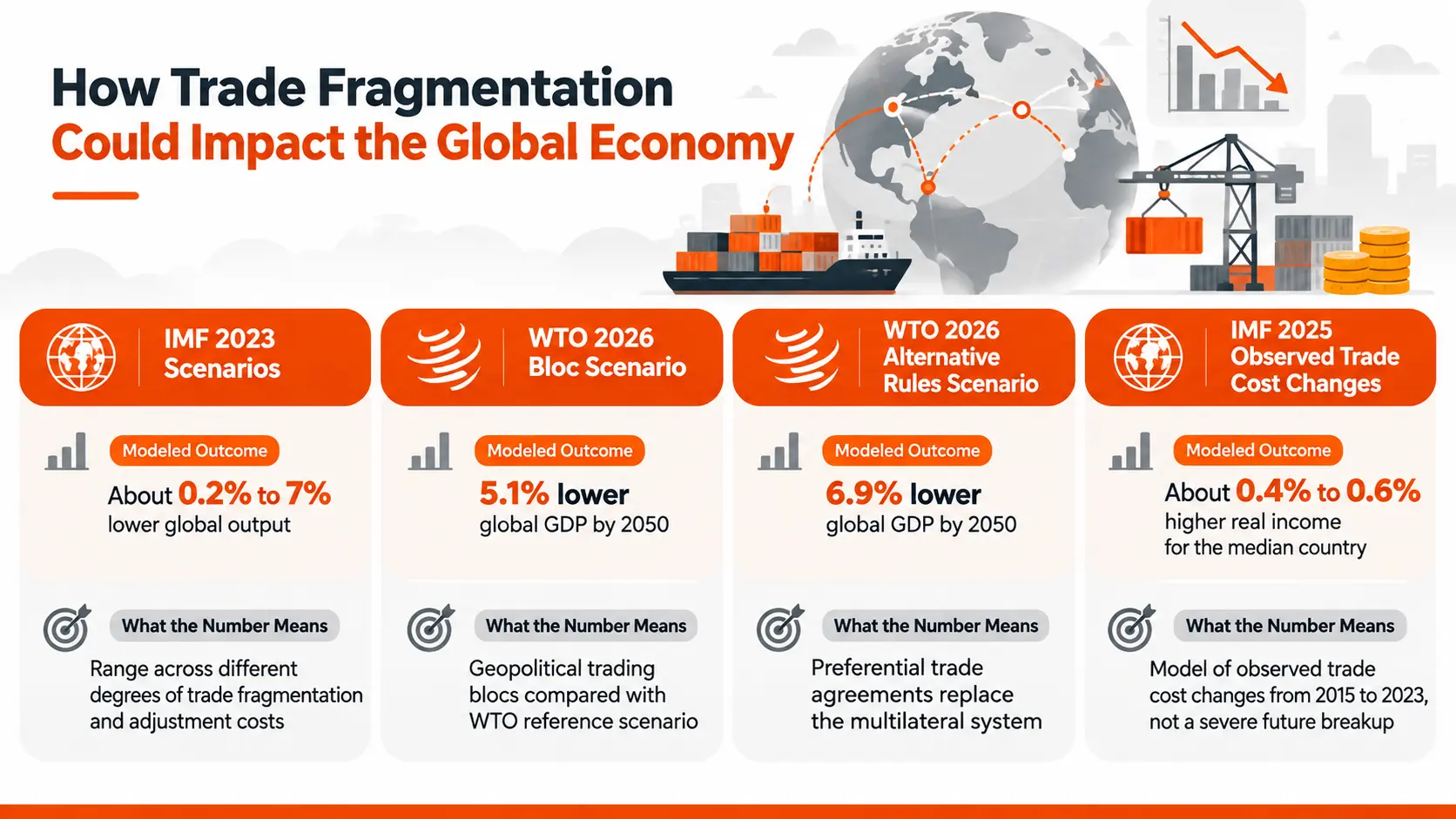
The comparisons are most useful when read as alternative illustrations of the cost of reduced economic integration. The IMF range summarizes multiple severities of trade disruption, while the WTO results depend on distinct institutional scenarios through 2050. The 2025 IMF study examines an observed historical reshuffling of trade costs rather than a hypothetical collapse in cross bloc trade.
Who Bears the Greatest Burden?
Costs are distributed unevenly across countries, sectors, and households. Larger economies often have more domestic alternatives and stronger bargaining power, although they still sacrifice potential benefits of international specialization. Smaller, trade dependent economies may face steeper losses when market access becomes conditional on political alignment or when suppliers are concentrated in a few jurisdictions.
An IMF study on differential exposure to geopolitical fragmentation found that, in its modeled trade shock, median real income losses for emerging and developing economies in Asia and Africa were respectively about 80 percent and 120 percent larger than those for the median advanced economy. Those figures compare modeled relative losses under specified assumptions. They do not mean that incomes in those regions had fallen by those percentages.
At the same time, some economies can benefit from redirected investment, processing activity, or new production capacity. The essential question is whether those gains represent lasting productivity improvements or mainly more expensive routes for goods that continue to depend on the same upstream inputs. Short term winners do not invalidate aggregate losses, and aggregate losses do not imply every country is worse off.
The Difference Between Short Term Disruption and Lasting Loss
In the first stages of a policy shock, businesses may face contract changes, shipping delays, inventory accumulation, and compliance costs. These are adjustment expenses that can fade as alternative suppliers or payment arrangements become established. They can nevertheless be economically significant when production stops or financing becomes unavailable during the transition.
Permanent losses have a different mechanism. If restrictions prevent producers from using more productive inputs, reaching larger markets, or sharing ideas across borders, economic output can remain below an otherwise achievable path after the initial disruption ends. A temporary factory relocation bill should not be counted in the same way as a lasting reduction in productive efficiency.
The timing of policy matters as well. A sudden and broad restriction creates more disruption than a predictable transition with narrowly targeted measures. A resilient strategy can limit the probability of catastrophic supply interruption, but policymakers still need to consider whether its recurring cost is proportionate to the reduction in risk.
When Resilience Spending Is Economically Rational
Not every departure from the cheapest supplier is an economic mistake. Businesses and governments sometimes underestimate the cost of disruption because failures are infrequent and difficult to price. Maintaining a backup source for a critical medicine or an essential industrial input may be worth paying for even if the alternative is more expensive in normal conditions.
The appropriate comparison is the expected cost of remaining exposed versus the total cost of reducing that exposure. Expected disruption cost combines the likelihood of a failure with its consequences. Resilience spending includes new capacity, inventory, ongoing operating costs, and the possibility that the backup source will never be used. A decision becomes more defensible when these elements are compared transparently.
Diversification across genuinely independent suppliers can often reduce vulnerability without requiring a complete political division of markets. By contrast, broad restrictions that apply to ordinary commerce may transfer large costs to consumers without providing an equivalent improvement in security. The boundary between prudent insurance and costly discrimination depends on the specific risk.
How Policymakers Can Reduce the Costs
Governments cannot eliminate all geopolitical risk, but they can limit unnecessary damage by keeping restrictions proportionate, transparent, and targeted to clearly defined concerns. Predictable licensing procedures, transition periods, and cooperation on technical standards can reduce uncertainty for businesses without abandoning legitimate security objectives.
Multilateral institutions and trade agreements also help preserve common rules where political consensus is limited. The WTO argues that stronger cooperation can improve economic outcomes relative to scenarios in which common disciplines erode. For smaller economies, reliable rules may be especially valuable because they reduce the influence of bargaining power in market access decisions.
Domestic policy matters just as much. Investment in infrastructure, workforce skills, and institutional capacity can help firms adapt to new trade patterns. Such measures are most effective when they increase productivity rather than permanently subsidize activities that remain uncompetitive. Careful evaluation should ask who receives the benefit, who pays the bill, and whether an alternative policy could manage the same risk at lower cost.
A Better Way to Read Future Cost Estimates
Before using a fragmentation estimate in an investment memo or policy discussion, identify the source, publication year, and scenario. Find out what changes in tariffs, market access, investment, or technology the study assumes. Confirm whether the result concerns global GDP, individual country income, exports, or welfare, and whether it compares a future outcome with current policy or a more cooperative benchmark.
Next, examine whether the model allows suppliers, capital, and workers to move, and whether it captures persistent productivity effects. Look for ranges or sensitivity tests instead of quoting only the largest possible loss. Finally, separate observations about existing trade patterns from simulations of hypothetical restrictions. A scenario can illuminate a serious risk without establishing that the scenario will occur.
This discipline is essential for interpreting claims about the economic costs of a divided world. More restrictive policies can produce substantial costs, but the magnitude cannot be understood without a defined counterfactual, measurable transmission channels, and an honest account of uncertainty.
Geoeconomic fragmentation can make the world economy less productive by weakening specialization, raising costs, obstructing investment, and slowing the diffusion of technology. The losses are not fixed, immediate, or evenly distributed. They depend on which links are restricted, how economies adjust, and whether security benefits justify the resources devoted to reducing exposure.
The most useful lesson from IMF and WTO research is not that one headline percentage settles the debate. It is that the economic stakes rise as restrictions become broader, harder to reverse, and more damaging to cooperation. Evaluating costs requires comparing realistic alternatives, not treating every change in trade patterns as proof of economic decline.
FAQ
What are the economic costs of geoeconomic fragmentation?
They include higher production costs, weaker competition, reduced market access, lower investment, slower productivity growth, and potential losses in real income. The scale depends on the restrictions and the alternatives used for comparison.
How much GDP could the world lose from fragmentation?
Published models give different conditional results. The IMF has described trade fragmentation scenarios with global output losses ranging from about 0.2 percent to 7 percent. The WTO modeled a 5.1 percent GDP loss by 2050 under a specific geopolitical bloc scenario. These are not observed losses.
Does fragmentation always make prices rise?
Restrictions can raise particular prices or the overall price level, but persistent inflation depends on broader economic conditions. Some prices may fall if diverted goods create excess supply elsewhere.
Why are developing economies more exposed?
Many have narrower export markets, greater dependence on imported inputs, and fewer financing or substitution options. The effect is not uniform, and some economies may attract redirected production and capital.
Can countries benefit from fragmentation?
Yes. Selected producers, intermediary economies, and destinations for redirected investment may gain. These gains must be considered alongside costs borne by other countries, consumers, and downstream firms.
Is reducing dependence on foreign suppliers always inefficient?
No. Diversification and redundancy can be worthwhile insurance against severe disruptions. The question is whether the expected security benefit exceeds the full economic cost of the chosen policy.

Masoumeh Jahangard
Markets & Economy Writer at PinerookMasoumeh Jahangard covers markets, economic trends, and business conditions for Pinerook, focusing on how they affect startups and growing companies.
 Seen first.