
Corporate venture capital gives startups access to investment from established companies, often alongside opportunities for commercial partnerships, technical expertise, and industry connections. Unlike traditional investment firms, corporate investors may consider both financial returns and the strategic value a startup could bring to their wider business.
For founders, this creates an opportunity that goes beyond raising capital. A corporate investor might introduce a startup to major customers, support product development, or help it enter a difficult market. However, the relationship can also introduce conflicts of interest, restrictions on future partnerships, and expectations that do not always align with the startup's independent growth strategy.
Understanding corporate venture capital (CVC) helps founders evaluate whether a strategic investor is the right choice. As a specialized form of Venture Capital, CVC requires careful consideration of funding terms, commercial relationships, and the long term interests of both parties.
What Is Corporate Venture Capital?
Corporate venture capital is the practice of established companies investing in external startups, usually through dedicated investment teams, investment subsidiaries, or affiliated venture funds. The corporation provides capital in exchange for an ownership interest or through another financing arrangement that may later convert into equity.
These investments may support businesses developing technology relevant to the corporation's existing operations, entering adjacent markets, or exploring emerging industries. A financial services company, for example, might invest in a startup developing payment infrastructure, while an automotive manufacturer may support businesses working on advanced materials or industrial automation.
The defining characteristic of CVC is the connection between an operating corporation and a startup investment. The parent company may want financial returns, access to innovation, future partnership opportunities, or some combination of these benefits.
However, corporate investment does not automatically give the parent company control of the startup. It also does not necessarily mean the corporation intends to acquire the business. Many corporate venture programs invest as minority shareholders and allow portfolio companies to operate independently.
The relationship depends on the investor's strategy, organizational structure, and the terms negotiated with the startup.
How Corporate Venture Capital Works
Corporate venture capital programs can operate in different ways. Some companies maintain dedicated investment divisions with professional investors responsible for identifying opportunities, evaluating startups, and managing investments. Others establish separate investment entities designed to operate with greater independence from the parent corporation.
A corporate venture team typically begins by identifying startups that fit its investment priorities. These priorities may include artificial intelligence, cybersecurity, healthcare technology, energy systems, manufacturing, or industries connected to the corporation's existing business.
Once a promising startup is identified, the investment team evaluates its founders, market opportunity, product, customers, financial position, and growth potential. The team may also consider whether the startup's technology or commercial capabilities could create strategic value for the parent company.
Investment approval varies between organizations. Some corporate venture teams can make decisions independently, while others require approval from corporate executives, finance departments, or relevant business units. These additional stakeholders can influence the timeline and the conditions under which an investment proceeds.
After financing, the startup may receive support through industry introductions, technical resources, partnerships, or potential customer relationships. However, these benefits are not guaranteed simply because the investment has closed.
Founders should distinguish between the equity investment itself and any separate commercial agreement. A corporation may invest without committing to purchase the startup's product, and a startup may establish a commercial partnership without receiving corporate investment.
Corporate Venture Capital vs Traditional Venture Capital
Corporate venture capital and traditional venture capital share several characteristics. Both provide investment to private companies, evaluate growth opportunities, and generally seek financial returns. They may participate in the same funding rounds and negotiate similar ownership and investor rights.
The difference lies primarily in the source of capital and the potential influence of broader corporate objectives. Traditional venture firms generally invest funds raised from limited partners and seek returns according to their fund strategies. Corporate venture investors use capital associated with an established operating business and may consider how investments support its long term direction.
Corporate Venture Capital vs Traditional Venture Capital
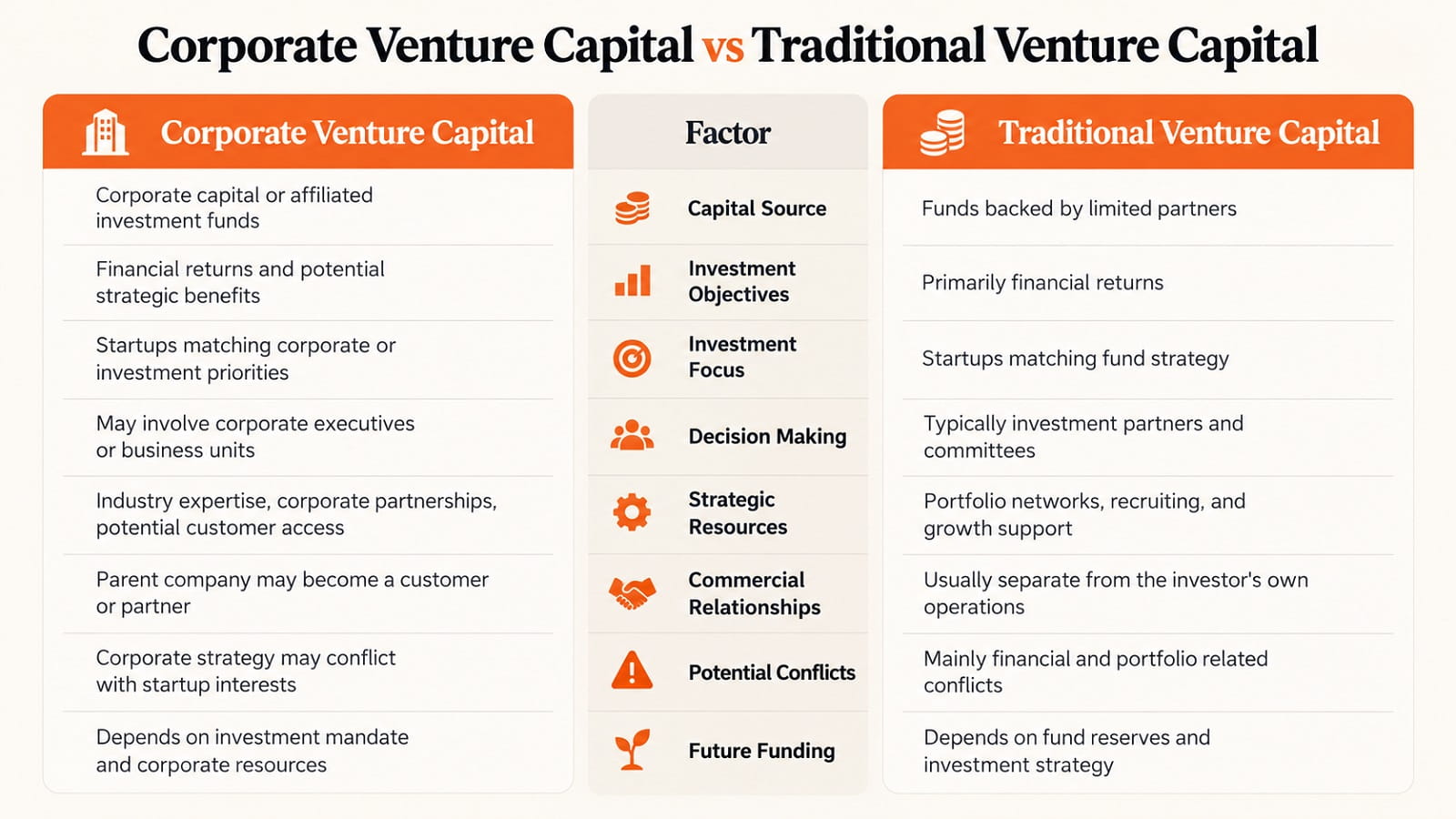
These distinctions are useful, but they should not be treated as universal rules. Some corporate venture firms operate independently and focus heavily on financial returns. Others work closely with their parent company's business units and prioritize investments with a clear strategic connection.
For founders, the relevant question is not simply whether the investor is corporate or independent. It is how the investor makes decisions, what support it can realistically provide, and whether its priorities are compatible with the startup's business model.
Why Corporations Invest in Startups
Corporations establish venture investment programs for several reasons. One is to gain visibility into emerging technologies and business models that could influence their industries. Rather than developing every new solution internally, established companies can invest in startups exploring technologies outside their existing capabilities.
Another motivation is access to innovation. A corporation operating in a mature industry may recognize that smaller companies can experiment with new products and business models more quickly. Investment offers a way to establish relationships with these businesses while allowing them to develop independently.
Corporate venture programs can also support ecosystem development. A technology company might invest in startups building products that complement its platform. An industrial company may support businesses creating technologies that improve manufacturing efficiency or supply chain resilience.
Financial performance remains important. Some corporate venture teams are evaluated primarily on investment returns, while others must demonstrate both financial value and strategic relevance. The balance depends on the parent company's objectives and the investment program's structure.
This combination of priorities can benefit founders when the corporation's commercial interests support the startup's growth. Problems are more likely to emerge when those priorities change or when the corporation expects the startup to serve its specific needs at the expense of broader market opportunities.
Real Examples of Corporate Venture Capital
Corporate venture capital operates across many industries, and established investment programs illustrate how corporations can combine funding with specialized networks and market knowledge.
Salesforce Ventures
Salesforce Ventures is the investment arm associated with Salesforce, focusing on enterprise technology companies. Its investment interests include areas such as artificial intelligence, data infrastructure, cybersecurity, and business applications.
The program illustrates how a corporate investor can connect financial investment with an established technology ecosystem. Salesforce Ventures describes its ability to provide portfolio companies with access to enterprise relationships, industry knowledge, and commercial networks.
For a startup selling enterprise software, these relationships may be particularly valuable. Understanding large customer requirements, building credibility, and developing partnerships can be difficult without industry experience.
However, an investment from Salesforce Ventures does not automatically guarantee that Salesforce will purchase, distribute, or integrate a portfolio company's product. Founders should evaluate each proposed commercial relationship separately.
BMW i Ventures
BMW i Ventures is another example of corporate venture capital. Backed by BMW Group, the investment firm supports startups operating in areas such as artificial intelligence, advanced manufacturing, mobility, and technologies relevant to the broader automotive ecosystem.
In April 2026, BMW i Ventures announced its third investment fund, with $300 million dedicated to opportunities connected to artificial intelligence and the transformation of automotive and industrial technology.
The firm emphasizes financial investment discipline alongside access to BMW Group's technical expertise and potential commercial relationships. Its approach demonstrates that a corporate venture investor can operate with investment independence while maintaining connections to a major industrial organization.
For founders developing complex technology, access to industry expertise or opportunities to validate products in commercial environments may be as important as the funding itself.
These examples also highlight an important distinction: corporate venture capital is not one standardized investment model. Individual programs differ in their financial objectives, strategic involvement, independence, and support for portfolio companies.
Benefits of Corporate Venture Capital for Startups
The main advantage of corporate venture capital is the possibility of combining financial resources with capabilities developed by an established business. These capabilities can be valuable when startups face barriers that are difficult to overcome through capital alone.
Access to Customers and Distribution
A corporate investor may help a startup reach potential customers through existing commercial relationships. This can be valuable for enterprise companies, where sales processes involve multiple decision-makers, security requirements, procurement procedures, and extended evaluation periods.
An established corporation may also become a customer or distribution partner. Such relationships can help a startup test its product in real business environments and demonstrate commercial demand.
However, founders should avoid treating introductions as confirmed revenue. The corporation's investment team and purchasing departments may operate independently, and a commercial agreement may require its own negotiations and approvals.
Technical Expertise and Industry Knowledge
Startups operating in regulated or technically complex industries may benefit from the knowledge available within a corporation. Experienced professionals can provide insight into technical standards, product requirements, industry practices, and customer expectations.
For example, a startup developing industrial software may need access to manufacturing expertise to understand how its technology performs in production environments. A corporate relationship could help identify technical limitations earlier and improve the product's commercial readiness.
The actual value depends on whether the corporation makes relevant expertise accessible. A broad promise of strategic support is less useful than a relationship with identified specialists who are willing and authorized to assist.
Credibility and Future Opportunities
Investment from a recognized corporation may increase a startup's visibility among customers, commercial partners, and other investors. It can indicate that an established industry participant considers the startup's market or technology worth exploring.
Nevertheless, corporate backing should not replace independent evidence of product quality and customer demand. Investors and customers will still examine the company's performance, competitive position, and ability to operate beyond its corporate relationships.
The strongest benefit emerges when corporate resources help the startup develop a more competitive business rather than making it dependent on one strategic partner.
Risks and Disadvantages of Corporate Venture Capital
Corporate funding introduces risks that founders should evaluate before accepting an investment. These risks often arise from the possibility that the corporation's commercial interests may differ from the startup's long term objectives.
A corporate investor may be interested in a particular technology because it supports the parent company's operations. The startup, however, may want to sell that technology across an entire industry, including to the corporation's competitors.
Changes in corporate priorities can create additional uncertainty. Leadership changes, budget reductions, restructuring, or a shift in strategy may reduce the attention and resources available to portfolio companies.
Founders should also consider how other market participants will view the relationship. Potential customers may hesitate to share information with a startup if they believe a competing corporation has privileged access to its operations or product strategy.
Corporate Venture Capital Benefits and Risks
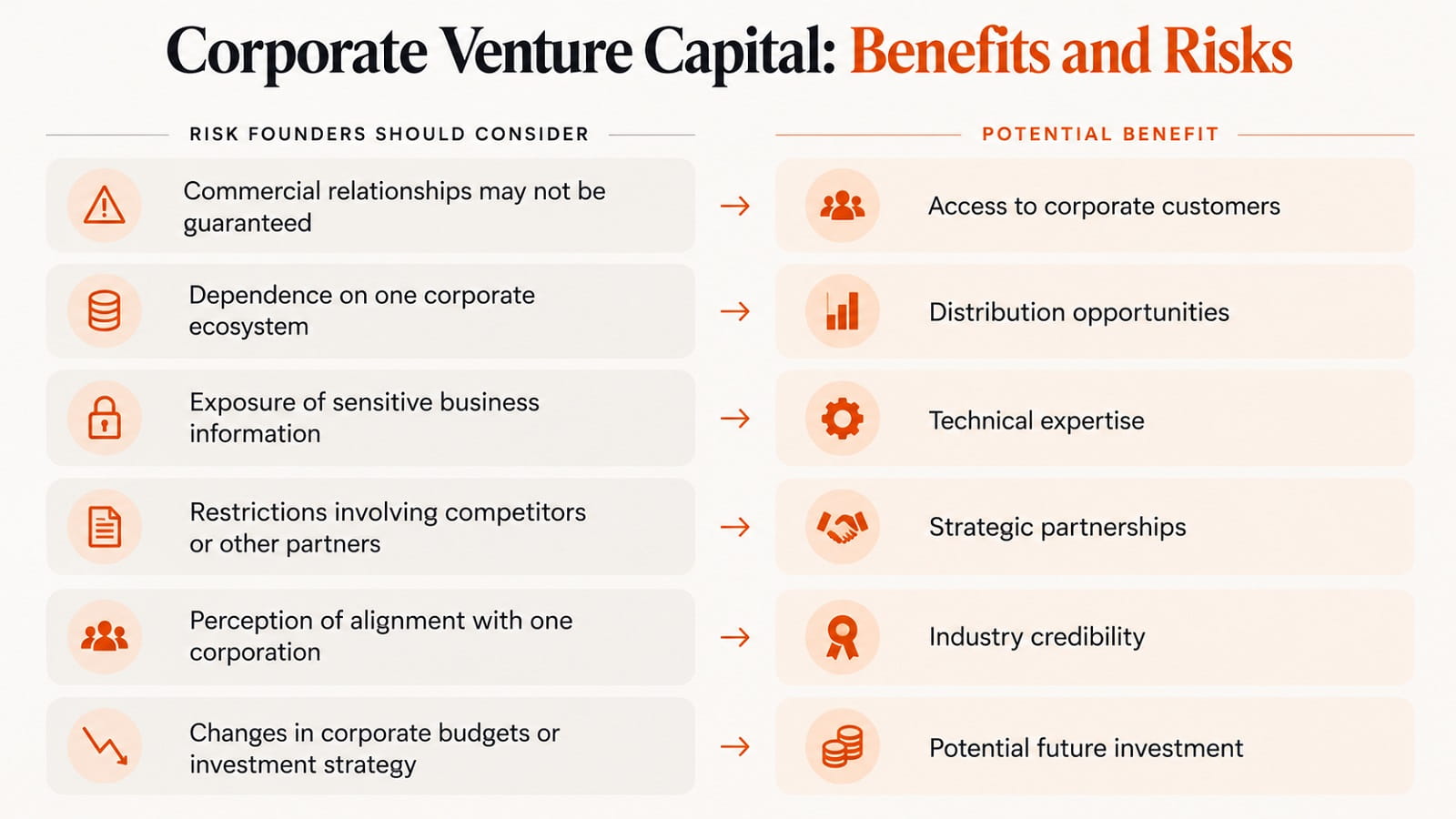
These concerns do not make CVC unsuitable. They demonstrate why the investment relationship must be carefully structured. A startup can benefit from corporate capital while preserving its ability to develop products, serve competing customers, and pursue independent business opportunities.
Corporate Venture Capital Investment Terms and Founder Control
Investment terms are particularly important when the investor has commercial interests connected to the startup's market. Corporate financing may include conventional venture investment provisions, but founders should also examine any strategic rights requested by the parent company.
Exclusivity provisions can restrict a startup's ability to work with other businesses. A corporation may request exclusive access to a product, technology, market, or commercial arrangement. These restrictions can reduce the startup's addressable market and should be evaluated against any concrete commercial benefit being offered.
Rights of first refusal, first offer, or negotiation involving a future acquisition deserve similar attention. Depending on their wording, such provisions may complicate conversations with other potential buyers or reduce flexibility during an eventual exit process.
Information rights also require careful review. Investors commonly receive financial reports and company updates, but sensitive customer information, intellectual property, pricing strategies, and product development plans may require additional protection when the investor operates in a related market.
Board representation can create further complications if the startup discusses matters involving the corporate investor or its competitors. Appropriate governance arrangements can help manage conflicts and protect confidential information.
Not every corporate investor requests these rights, and similar provisions can appear in traditional venture financing. Founders should evaluate the specific documents rather than assuming corporate financing always includes additional restrictions.
Legal advice is important before signing investment or commercial agreements, particularly when the proposed relationship includes exclusivity, intellectual property licensing, acquisition rights, or access to competitively sensitive information.
How to Choose the Right Corporate Venture Investor
Selecting a corporate venture investor begins with understanding the startup's own needs. Founders should identify whether they primarily require capital, technical expertise, customer access, distribution support, or a combination of these resources.
The next step is evaluating the investor's strategic relevance. A corporation familiar with the startup's industry may be able to provide meaningful assistance, but relevance alone is not enough. Founders should determine whether the corporate venture team has the authority, relationships, and resources needed to deliver that support.
Investment independence matters as well. Founders should understand who approves financing, whether the venture team operates separately from corporate business units, and how disagreements between financial and strategic objectives are resolved.
A useful evaluation also examines the investor's existing portfolio. Speaking with founders who have received investment can reveal whether the corporation provides meaningful introductions, respects confidentiality, and remains supportive when business performance is weaker than expected.
Founders should distinguish between promises and commitments. An investor may describe potential access to thousands of customers, but the practical value depends on whether those introductions can actually happen. Specific commercial opportunities, identified contacts, and clearly defined partnership processes provide stronger evidence than general claims.
Finally, the startup should consider whether the relationship could affect future fundraising, commercial partnerships, or acquisition opportunities. The right investor should strengthen the company's competitive position without unnecessarily limiting its independence.
When Corporate Venture Capital Makes Sense
Corporate venture capital can be particularly attractive for startups operating in industries where commercial access, technical validation, or specialized knowledge creates significant barriers to growth.
Enterprise software companies may benefit from introductions to major customers and guidance on procurement requirements. Industrial technology startups may gain valuable opportunities to test products in manufacturing environments. Healthcare and financial technology businesses may benefit from industry expertise that helps them understand complex operational requirements.
Corporate investment may also be useful when a startup has already established product demand and wants to expand distribution through relevant business relationships. In these circumstances, access to an established corporation's ecosystem can complement the financial investment.
However, CVC may be less suitable when independence from industry participants is essential to the business model. A startup that serves several competing corporations may face difficulties if one customer or potential partner believes another has privileged access to its technology or commercial information.
The decision should therefore reflect the startup's long term market position. Founders need to consider not only what the corporate investor can provide today, but also which future opportunities the relationship might support or restrict.
Corporate Venture Capital and Future Funding Rounds
Corporate venture investors can participate alongside traditional venture firms, angel investors, and other financial backers. A startup might attract a corporate investor during an early financing round or add strategic capital after establishing commercial traction.
Combining corporate and financial investors can create a useful balance. Traditional venture firms may contribute fundraising experience, portfolio relationships, and financial discipline, while corporate investors offer industry access and potential commercial opportunities.
However, future investors will evaluate the rights granted to existing shareholders. Broad exclusivity provisions, complicated acquisition rights, or unusual information-sharing arrangements may raise concerns during later financing.
Founders should also understand that corporate investors are not automatically committed to future rounds. Their investment capacity may depend on parent company budgets, internal priorities, and the continued operation of the venture program.
Maintaining a clear ownership structure, independent customer relationships, and flexible investment terms can make it easier to attract additional capital as the business develops.
Final Thoughts
Corporate venture capital offers startups an opportunity to secure funding while building relationships with established companies. Its potential value extends beyond capital to include customer access, technical expertise, industry knowledge, and commercial partnerships.
Those advantages must be weighed against possible conflicts of interest, restrictive contractual provisions, and dependence on a corporation whose priorities may change. The relationship works best when strategic collaboration supports the startup's broader business objectives rather than narrowing them.
Founders should evaluate corporate investors based on the actual resources they can provide, their investment terms, organizational independence, and compatibility with the company's future plans. A carefully structured investment can support growth while allowing the startup to remain commercially independent.
FAQ
What is corporate venture capital?
Corporate venture capital is investment in external startups by established companies, often through dedicated investment teams or affiliated venture funds. Corporations may seek financial returns, strategic benefits, or a combination of both.
How is corporate venture capital different from traditional venture capital?
Traditional venture firms generally invest capital raised from limited partners and focus primarily on financial returns. Corporate venture investors are connected to operating companies and may also consider commercial partnerships, technology development, or other strategic objectives.
What are some examples of corporate venture capital firms?
Salesforce Ventures and BMW i Ventures are examples of corporate venture investment programs. They invest in startups while offering potential access to specialized industry expertise, commercial relationships, and broader business networks.
What are the main risks of corporate venture capital?
The main risks include conflicts of interest, excessive dependence on a corporate partner, restrictions on working with competitors, access to confidential information, and contractual provisions that may complicate future fundraising or acquisitions.
Can corporate venture capital investors participate in later funding rounds?
Yes. Corporate venture investors may participate in subsequent financing rounds, sometimes alongside traditional venture firms. However, future investment depends on the investor's available capital, strategy, internal approvals, and the startup's performance.

Mobina Khanki
Venture & Funding Writer at PinerookMobina Khanki covers venture capital, startup funding, fundraising, and startup finance for Pinerook, focusing on founders and investors.
 Seen first.