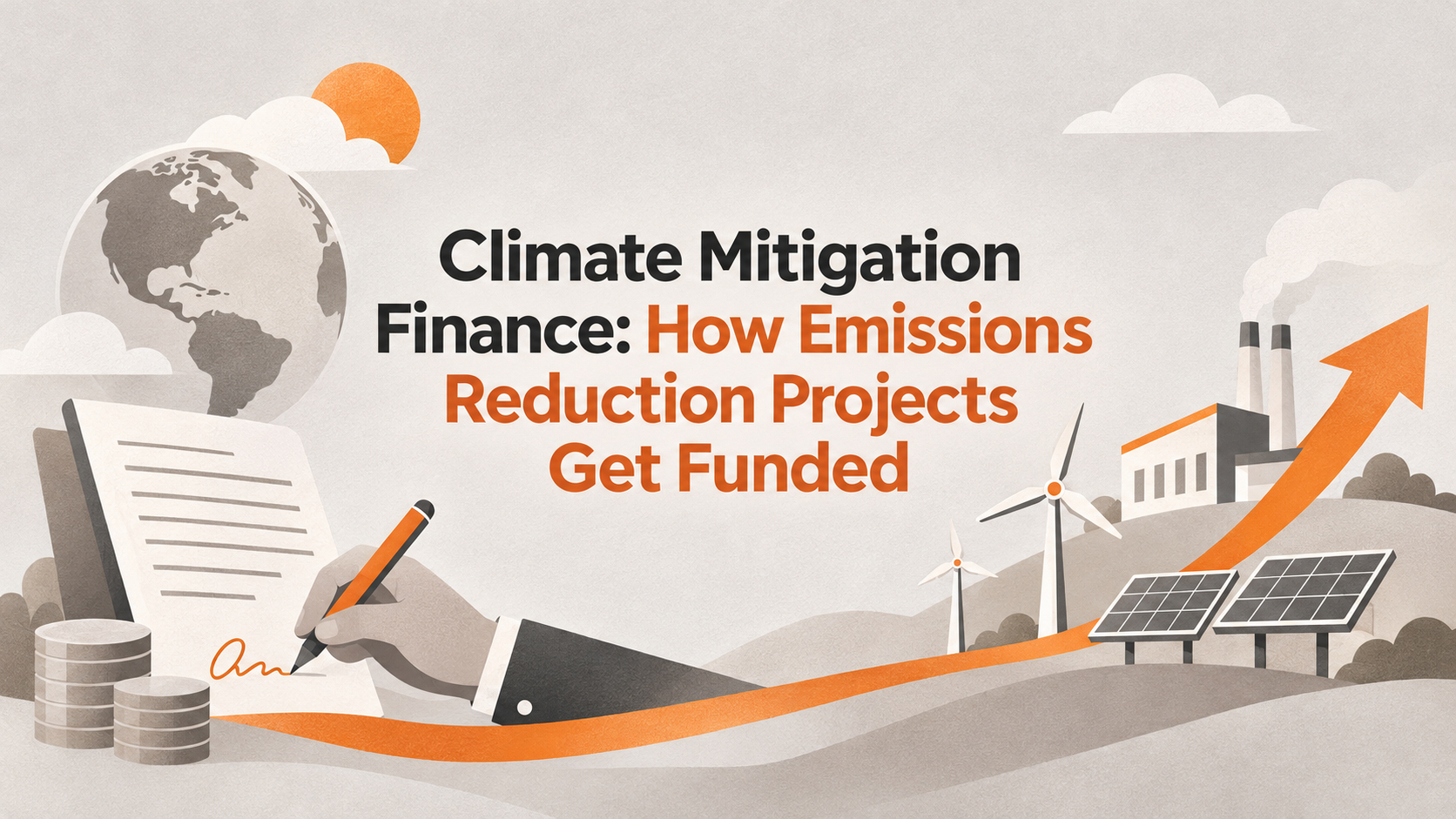
Climate mitigation finance is funding used to prevent, reduce, or remove greenhouse gas emissions. It supports activities such as renewable electricity, industrial efficiency upgrades, cleaner transport, methane control, and other investments that can change the emissions produced by economic activity. A financing arrangement becomes meaningful when the project has a credible emissions objective, a workable source of capital, and a realistic plan for delivery. Climate value alone does not guarantee that a lender or investor can recover the money committed.
For businesses and investors, understanding mitigation funding is an essential part of the broader Climate Finance landscape, but the immediate question is more specific: how can a project that cuts emissions attract capital on terms that its revenues, risks, and expected results can support? The answer begins with project economics rather than the environmental label placed on a loan or fund.
What Counts as Climate Mitigation Finance?
Climate mitigation refers to actions that limit the release of greenhouse gases or increase their removal from the atmosphere. The United Nations climate process identifies emissions reduction and the enhancement of carbon sinks as central elements of mitigation. Funding can qualify when it is demonstrably directed toward an eligible activity, although the exact tracking rules vary among development banks, national programs, and independent datasets. A general corporate loan does not become mitigation finance simply because its borrower has announced a climate ambition.
The important distinction is between an intended climate outcome and a financial instrument. A solar project can be funded through equity, commercial debt, public grants, or a combination of sources. None of these instruments is inherently a mitigation project on its own. Eligibility depends on what the funds support, the methodology used to classify the activity, and whether the resulting emissions benefit can be assessed against a reasonable reference point.
Mitigation finance is also distinct from money directed primarily toward resilience. Flood barriers and drought protection ordinarily address the physical consequences of climate change rather than the causes of warming. Some investments deliver both types of benefit, but their financial and environmental reporting should distinguish the results instead of counting a single expense twice.
Which Projects Receive Mitigation Finance?
Commercially mature technologies tend to receive financing more readily because lenders can estimate construction costs, operating performance, and revenue. A utility scale solar installation can sell electricity under a contract. An efficient industrial motor may save enough energy to justify its initial cost. Charging networks and lower emissions transport systems can generate service revenue, although utilization and infrastructure constraints complicate the picture.
Other projects face a harder financing problem. Industrial process changes can require unfamiliar technology and unusually long investment cycles. Methane abatement may deliver large climate benefits without a dependable revenue stream. Forestry and land management projects can involve land rights, measurement uncertainty, and long periods before outcomes are verified. The climate case may be compelling even when the commercial case needs public support or a different financing structure.
A reliable assessment therefore starts by describing the exact asset, activity, and emissions pathway. The phrase clean industry is not specific enough for a credit committee. A proposal should explain which production process changes, what energy or material use is displaced, how much capital is required, and why the project would continue to operate after the initial funding is spent.
Why Mitigation Attracts More Capital Than Some Other Climate Needs
Many mitigation investments produce revenue or measurable cost savings. Electricity can be sold, fuel spending can fall, and efficient equipment can improve operating margins. These financial benefits make it possible for banks and investors to price risk with familiar tools. Some adaptation projects, by comparison, mainly prevent future public losses whose value cannot readily be collected through user charges. This difference helps explain why commercially mature mitigation technologies have attracted a greater share of tracked climate investment.
The concentration should not be mistaken for complete success. The Climate Policy Initiative reported that global mitigation finance reached approximately $1.9 trillion in 2024, with investment heavily concentrated in the energy sector. The same report identifies sectors such as industry, agriculture, and waste as areas that have not attracted comparable financing. This is a tracked flow for a defined year and methodology, not the amount that every country or sector needs to meet its climate goals.
The International Energy Agency separately projects around $2.2 trillion in clean energy investment for 2026. That figure follows an energy investment methodology and includes categories that should not automatically be treated as identical to the mitigation finance total. Comparing the two headlines without their definitions would produce a misleading picture of both markets.
How a Mitigation Project Becomes Financeable
Project developers first establish the financial purpose of the investment. A proposed manufacturing upgrade needs a capital expenditure budget, implementation schedule, expected output, energy costs, maintenance requirements, and the operational disruption associated with installation. In parallel, the project needs an emissions baseline and a defensible explanation of how the proposed technology changes that baseline.
The developer then identifies which party can absorb each major risk. Construction delays may remain with a contractor under enforceable terms. A corporate borrower may carry energy price exposure. A utility may be expected to purchase electricity, creating counterparty risk. Foreign currency debt can become expensive if project revenues are earned in a weaker local currency. Financing becomes more likely when those risks are visible, allocated, and mitigated rather than dismissed as secondary to the climate objective.
For lenders, the central question is whether expected cash flows can meet contractual obligations under credible downside scenarios. For equity investors, it is whether the remaining returns justify the uncertainty. Public institutions may evaluate additional economic benefits, market failures, and the amount of private investment their contribution can genuinely unlock. Each provider is looking at the same asset through a different financial lens.
Matching Mitigation Projects to Financing Structures
The financing structure should follow the project rather than precede it. The following comparison shows why a single funding product cannot solve the capital needs of every emissions reduction activity.
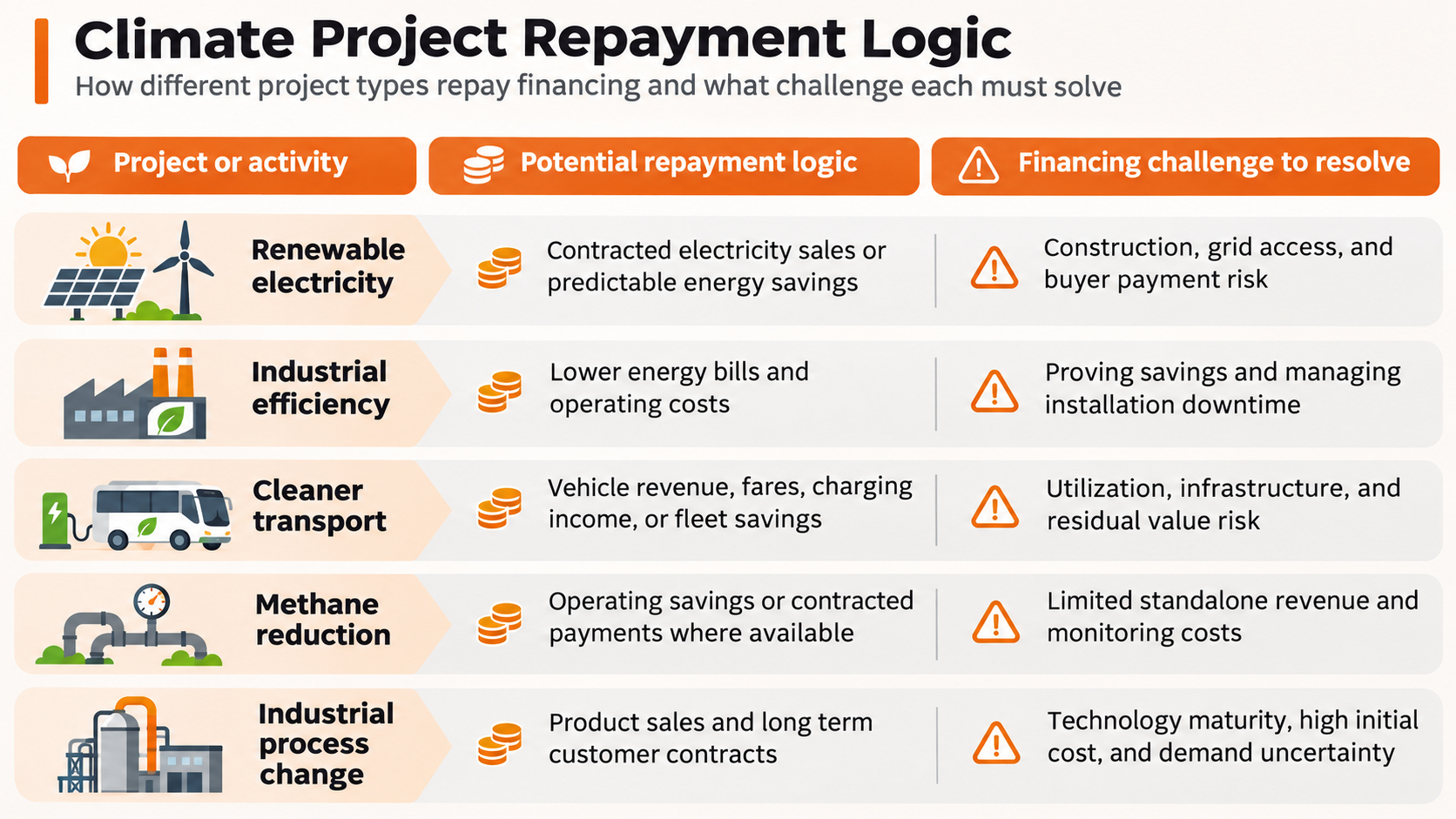
These are financing considerations, not fixed eligibility rules. A project may qualify for more than one form of capital and may face risks that do not appear in a short comparison. The purpose of the table is to connect each mitigation activity to the source of repayment and the barrier that must be addressed before capital can be committed.
Where the Capital Comes From
Private corporations often finance upgrades through retained earnings or borrowing because the benefits accrue directly to the business. Banks finance projects with sufficiently predictable repayment. Institutional investors may participate through debt or equity vehicles that match their risk tolerance and investment horizon. Governments support projects through budgets, incentives, procurement commitments, or infrastructure investment when market prices do not reflect the full public value of reducing emissions.
Development institutions can help where a strong project faces financing conditions that commercial lenders cannot yet accept. They may support project preparation, offer longer maturities, provide guarantees, or share selected risks. These interventions are most useful when they address a specific obstacle, such as unfamiliar technology, limited local currency lending, or uncertain public payment obligations, rather than broadly subsidizing every project labeled green.
Some issuers raise money through bonds whose proceeds are assigned to eligible environmental activities. Others blend public and commercial sources. These structures require dedicated assessment of issuance rules, borrower credit quality, risk sharing, and reporting. What matters in this article is their underlying function: the structure must lower a real financing barrier without obscuring who ultimately bears the loss if the project underperforms.
A Financing Example for an Industrial Efficiency Project
Consider a hypothetical food processor that plans to replace outdated heating equipment with a more efficient system. The total investment is $12 million, including installation, engineering, and contingency costs. Management expects meaningful fuel savings, but the installation could disrupt operations and the savings estimate relies on future production volumes. The figures in this example are illustrative and do not describe an actual company.
Suppose the business contributes $4 million in equity and seeks an $8 million loan. The lender evaluates the company’s existing obligations, the reliability of the equipment supplier, projected energy savings, operating margins, and debt service under lower production or higher maintenance costs. The borrower documents the energy baseline before construction and commits to measuring actual fuel consumption after commissioning. A forecast of avoided emissions is useful, but it does not replace cash flow evidence or a credible plan to verify results.
If the project fails normal credit tests, lowering the borrowing rate might not be enough. The company may need phased construction, an equipment performance guarantee, a longer repayment schedule, or a smaller project. If public support is considered, decision makers should explain what risk it addresses and whether the investment would otherwise proceed without it. A sound financial package is one that works even when optimistic assumptions are removed.
The Difference Between Emissions Claims and Verified Results
A project proposal usually estimates future emissions avoided relative to an alternative. That alternative is called the baseline. For electricity generation, the baseline may depend on what source of power is displaced. For efficiency projects, it may depend on expected production activity and prior energy consumption. A credible baseline needs transparent boundaries, assumptions, and a way to update measurements when operating conditions change.
Projected emissions reductions, installed capacity, and money spent are three different indicators. A developer may complete a renewable energy facility yet generate less power than planned. A factory can buy efficient equipment yet operate it incorrectly. Reported reductions should reflect observed activity and an appropriate method, with uncertainty and relevant indirect effects disclosed. Credibility is lost when financed project capacity is reported as though it were automatically an achieved climate outcome.
Avoiding double counting matters financially as well as environmentally. If several investors or intermediaries participate in one project, each may describe involvement in the transaction, but their claims must not create the impression that the same investment happened multiple times. Emissions reductions should also be attributed and reported consistently rather than multiplied by the number of financial actors involved.
Why Funding Remains Uneven Across Sectors and Countries
The most accessible projects often combine established technology, clear policy signals, manageable construction risk, and paying customers. Difficult industrial projects may lack one or more of those conditions. Emerging markets can face additional obstacles including higher interest rates, local currency volatility, weaker grid infrastructure, or limited project preparation capacity. A technology with strong emissions benefits may therefore remain unaffordable in places where its deployment could have significant value.
The solution is not simply to direct more international capital toward every eligible project. Regulatory stability, reliable procurement, legal enforcement, domestic financial institutions, and practical engineering expertise all affect financing outcomes. A project pipeline with completed feasibility work may be more valuable than a much larger list of investment ideas that cannot withstand a lender’s due diligence.
For policy makers, funding priorities also involve tradeoffs. Public resources used to support a commercially mature solar project cannot simultaneously support every unprofitable methane or industrial technology intervention. A targeted approach considers the extra emissions benefit or financial additionality that public assistance can produce, alongside distributional effects and the risk of supporting assets that could lock in emissions for decades.
A Practical Due Diligence Framework
A credible mitigation proposal should answer four linked questions. First, what physical change reduces emissions and how is its eligibility established? Second, what economic activity generates cash or public value and who is expected to pay? Third, which construction, market, regulatory, currency, and technology risks remain after contracts and guarantees? Fourth, which measurements will show whether the money was disbursed and the intended emissions outcome was achieved?
Businesses should insist on downside scenarios that reflect realistic changes in energy prices, output, equipment performance, and financing cost. Investors should review covenant protection, counterparties, independent technical assessment, and the difference between estimated and realized emissions. Public institutions should explain why their support is necessary and how they will evaluate whether it mobilizes additional investment rather than replacing money that was already available.
This discipline is what turns climate mitigation finance from a promise into a capital allocation process. It allows decision makers to recognize projects that offer both credible environmental benefits and financial durability, while identifying those that require a different design or more patient sources of funding.
FAQ
What is climate mitigation finance in simple terms?
It is money used to support projects or activities that reduce, avoid, or remove greenhouse gas emissions. Examples include renewable energy, efficient equipment, cleaner transport, and some industrial improvements.
How is mitigation finance different from adaptation finance?
Mitigation finance addresses emissions that contribute to climate change. Adaptation finance supports responses to the impacts of climate change, such as flood protection and drought resilience. A project can deliver both, but the benefits should be measured separately.
Who provides climate mitigation finance?
Businesses, households, commercial banks, institutional investors, governments, and development finance institutions can all provide capital. Their roles differ according to the project’s revenue, risk, and public benefits.
Are all renewable energy investments eligible as mitigation finance?
Many qualify, but eligibility depends on the financing framework and the characteristics of the project. Relevant rules may examine technology, emissions performance, project boundaries, and the purpose of the expenditure.
Can a project receive financing without earning carbon credits?
Yes. Many mitigation projects are financed through electricity sales, energy savings, public procurement, or ordinary business income. Carbon credit revenue is not required and should not be assumed when building a financial case.
How can an investor assess whether mitigation finance is credible?
Review the use of funds, economic assumptions, emissions baseline, independent technical evidence, material risks, reporting method, and actual disbursements. A projected reduction should not be presented as verified performance.

Masoumeh Jahangard
Markets & Economy Writer at PinerookMasoumeh Jahangard covers markets, economic trends, and business conditions for Pinerook, focusing on how they affect startups and growing companies.
 Seen first.