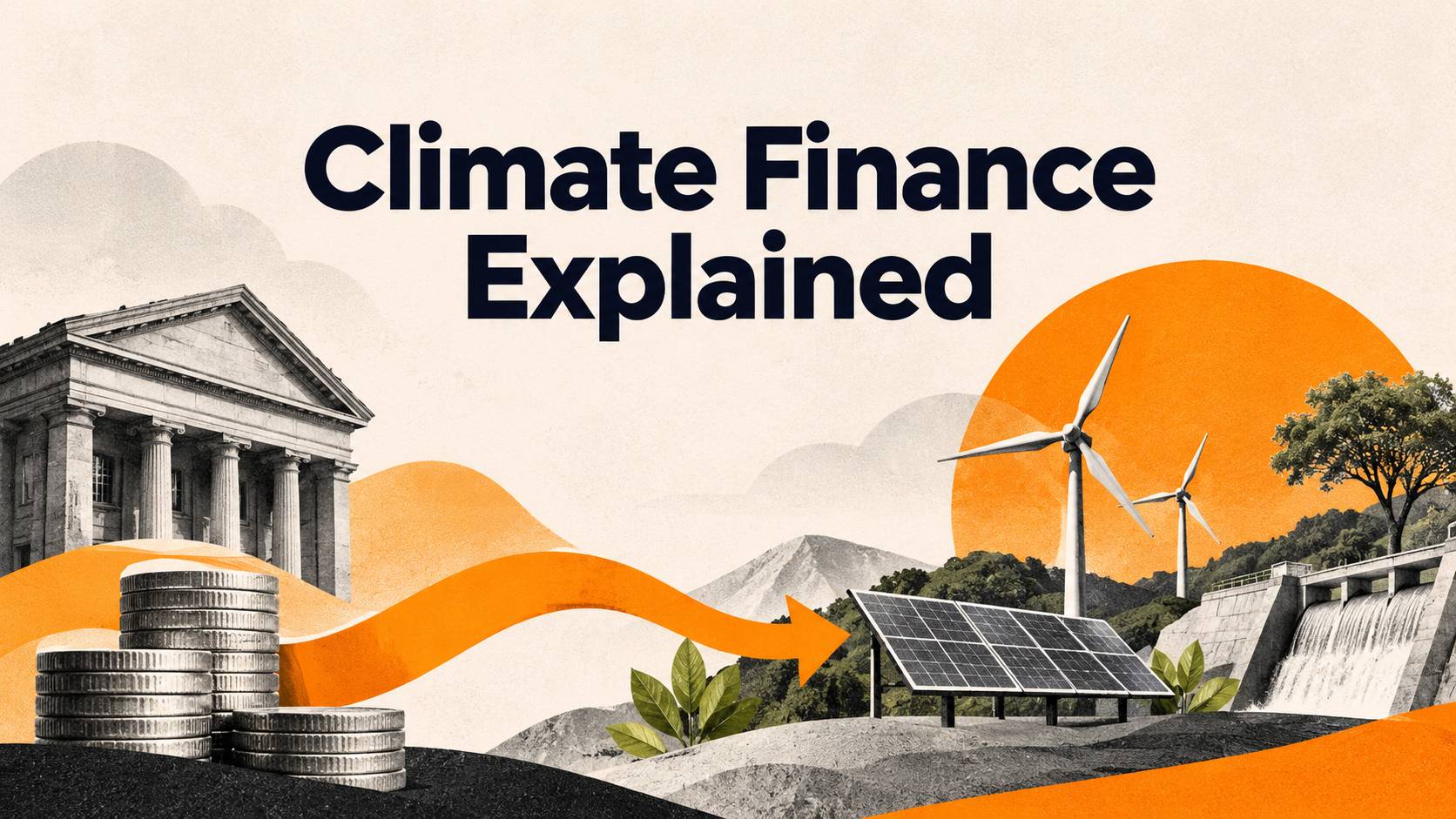
Climate finance is money directed toward reducing greenhouse gas emissions or helping people, businesses, and infrastructure adapt to climate change. It can come from public budgets, development banks, private investors, companies, and households, and can take the form of grants, loans, equity, guarantees, and other financial arrangements. The crucial question is not simply how much money is announced, but whether funding reaches a credible project, on workable terms, and produces a measurable climate outcome.
A solar installation, a more resilient water system, and an industrial efficiency upgrade can all qualify for climate related funding, but they do not require the same financial structure. Some projects generate predictable revenues that can repay investors. Others primarily protect public health or prevent losses and need grants or public support. Understanding that difference is the starting point for evaluating climate finance as an economic system rather than a collection of headline commitments.
What Climate Finance Means and What It Does Not
The United Nations climate convention describes climate finance as funding from public, private, and alternative sources that supports mitigation and adaptation. In practice, the definition is broad, but accounting rules differ across institutions. One tracker may count investment in clean transport by households while another measures only international finance provided to developing countries. Both are legitimate measures of different activities, not interchangeable answers to a single question.
Climate finance is not identical to environmental spending or sustainable finance. A general corporate loan is not automatically climate finance because the borrower publishes a sustainability target. Likewise, a project can be environmentally valuable without fitting a specific climate finance reporting methodology. Analysts should ask what climate result is being financed, what evidence establishes eligibility, and which party is responsible for measuring it.
Carbon markets are related but distinct. The sale of verified emissions credits can create revenue for some projects, yet buying a credit does not by itself describe the source, terms, or additionality of the underlying capital investment. Treating carbon credit turnover as equivalent to funding for construction, operations, or adaptation would overstate the role of financial flows.
Why Climate Finance Matters to the Real Economy
Climate finance affects the cost and availability of capital for energy, transport, agriculture, housing, manufacturing, and public infrastructure. When investment becomes affordable, projects that reduce future losses or operating costs can proceed sooner. When the financing structure is weak, even an economically valuable project can remain unfunded because its benefits arrive slowly, cannot be captured as revenue, or are shared across the wider community.
The problem is especially visible in adaptation. A factory may justify energy efficiency equipment through lower electricity bills, but a city protecting a low income neighborhood from flooding may have no direct commercial cash flow. Both investments can create large economic benefits. Only one is likely to attract ordinary private lending without additional public financing or a mechanism that converts some benefits into reliable payments
The Two Main Purposes: Mitigation and Adaptation
Projects that prevent or reduce emissions fall under climate mitigation finance. Examples include renewable electricity, cleaner transport, efficient buildings, methane reduction, and industrial improvements. Their financing depends on project costs, the price of energy or services sold, regulatory incentives, technological performance, and expected operating savings. The existence of a climate benefit does not eliminate conventional credit risk or construction risk.
By contrast, climate adaptation finance supports investments that help systems function under changing weather and climate conditions. Flood defenses, drought resilient crops, early warning services, drainage upgrades, and protection of essential infrastructure can reduce future economic damage. Their returns may be distributed across households, businesses, and public budgets, making grants, concessional finance, or pooled insurance arrangements more relevant than simple project debt.
Some investments deliver both benefits. Restoring a coastal mangrove can protect communities from storm surges while supporting carbon storage. A credible financing plan should distinguish the mitigation and adaptation outcomes rather than count the entire project twice without a transparent allocation method.
Who Pays and Who Receives the Capital?
At the source, climate finance includes tax revenue, development bank lending, institutional portfolios, commercial bank credit, corporate spending, and household purchases. At the receiving end are municipalities, utilities, infrastructure developers, manufacturers, farms, communities, and individual consumers. Capital can also pass through national funds, intermediaries, investment vehicles, and specialized facilities before reaching the project.
The debate over public vs private climate finance is less about choosing a winner than understanding their different roles. Public finance can pay for projects whose social benefits exceed their commercial revenues and can absorb risks that markets cannot price efficiently. Private finance can supply large amounts of capital when revenue, regulation, contracts, and investor protections are sufficiently predictable. Public guarantees and grants can help connect the two, but they must be designed to avoid subsidizing investments that would have happened anyway.
Funding sources also differ geographically. A solar rooftop purchased by a household with domestic credit belongs to a different category from a concessional loan made by a development institution to a foreign government. These distinctions matter when a headline says climate finance has increased: the next question is which kind of finance grew, who received it, and under what conditions.
How Climate Finance Reaches a Project
A practical climate investment follows several linked decisions. A public agency or business first identifies a problem and estimates the investment required to address it. The project then establishes eligibility through an emissions baseline, a resilience objective, or other defensible climate rationale. Financial advisers assess the future cash flows, operating obligations, construction risks, local currency exposure, and who bears losses if the project fails.
Only after these fundamentals are clear can the funding package be matched to the project. A revenue generating facility may rely on ordinary loans and equity, perhaps with a guarantee. A program delivering broad public benefits may require grants or government budget support. Funding must then be contracted, disbursed, monitored, and evaluated against the outcomes promised. The announcement of a financing amount is therefore only one stage, not proof of completed investment.
The Instruments That Change the Cost of Capital
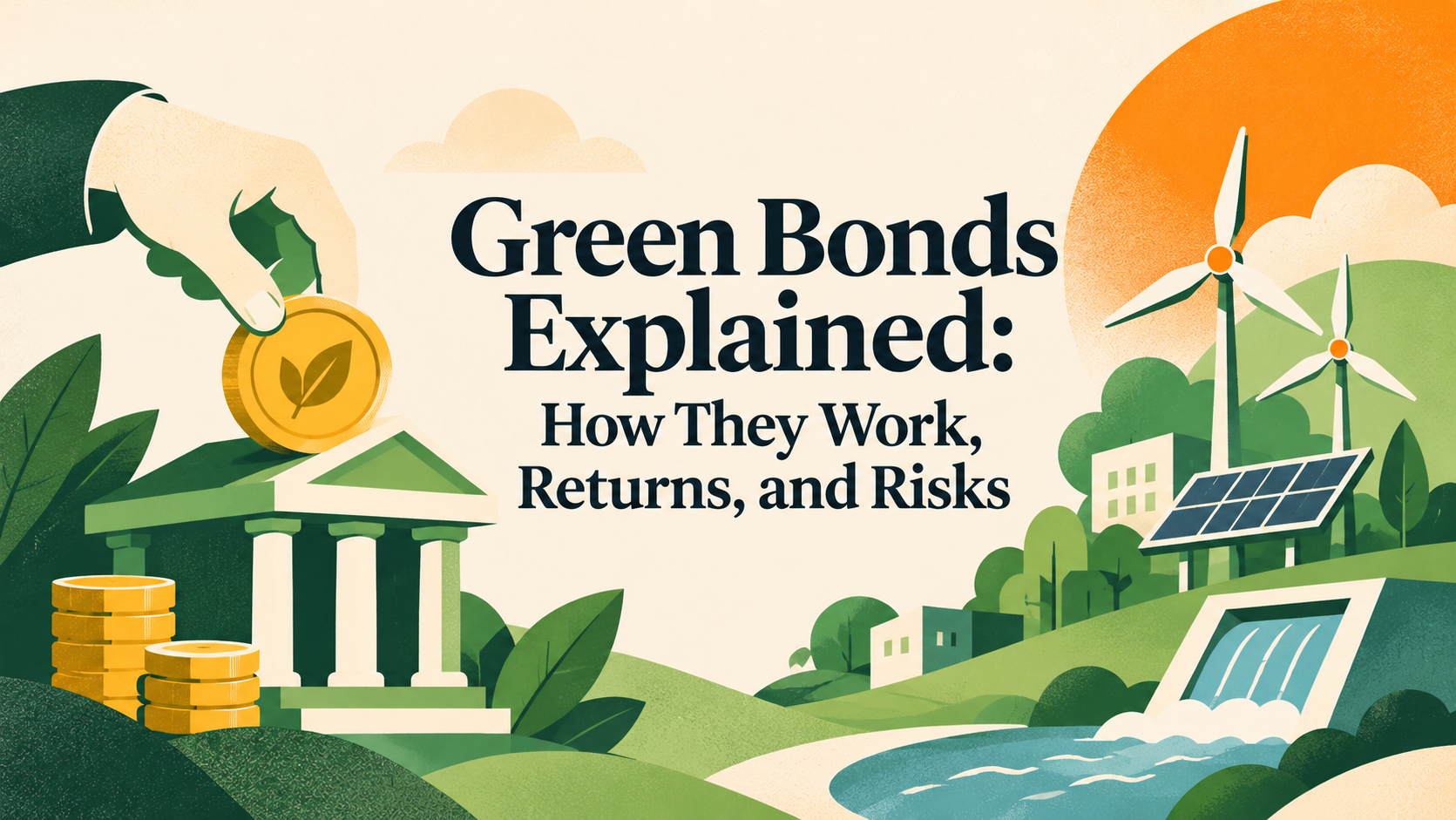
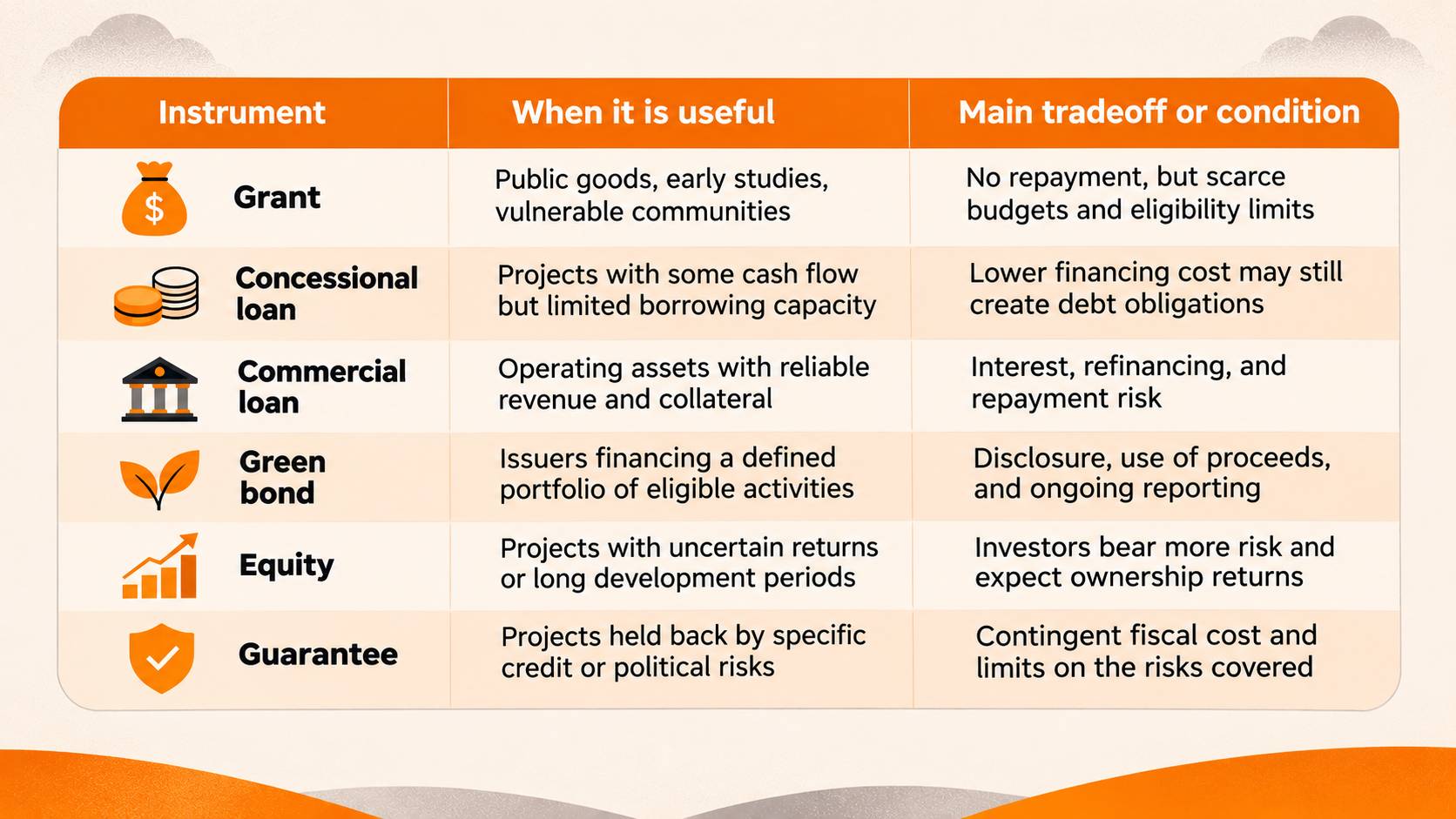
An instrument is valuable because of the risk it transfers and the project it allows to proceed. A green bond is still a borrowing instrument. For readers who want green bonds explained in practical terms, the essential distinction is between the label attached to a security and the issuer’s capacity to repay. Investors should evaluate creditworthiness, eligible use of proceeds, external review where applicable, and reporting quality. An environmental label cannot substitute for financial due diligence.
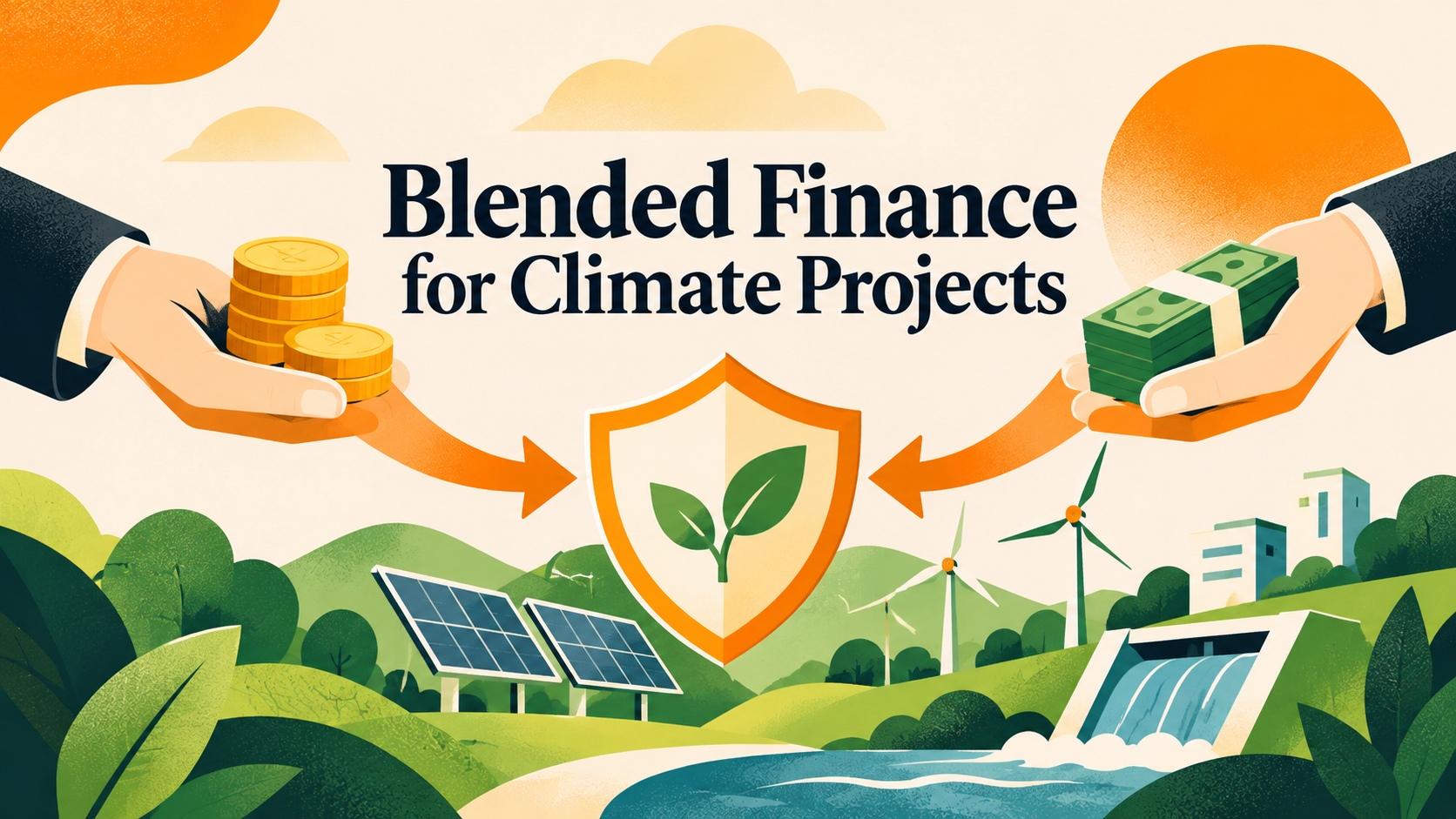
Other structures combine public support with commercial capital. blended finance for climate projects uses concessional resources, guarantees, or junior capital to improve an investment’s risk and return profile for private investors. For example, a development bank may accept some initial losses or provide a partial guarantee so that lenders can finance a project they would otherwise avoid. This can expand investment, but only when the amount of subsidy is proportionate to the additional finance mobilized and the development results delivered.
Risk transfer also has limits. Foreign exchange volatility can make a foreign currency loan unaffordable even when the project operates successfully in local currency. Weak contracts can make revenue uncertain. Climate hazards can damage the asset itself. Good project design considers these exposures separately rather than applying a single discount rate and assuming every risk has been solved.
A Worked Financing Example for a Resilient Water System
Consider an illustrative city project with a total cost of $100 million to improve flood drainage and water resilience. Suppose preliminary analysis shows that expected user charges cover maintenance but cannot support enough debt to pay the full construction cost. One possible capital structure is a $25 million public grant, a $40 million concessional loan, a $25 million commercial loan, and $10 million of local equity or budget contribution. The figures are hypothetical and are not a benchmark for real projects.
A guarantee could protect lenders against a narrowly defined payment risk, but it would not add another $20 million of capital to the project. Counting both the loan and the full guaranteed amount as separate financing would exaggerate resources mobilized. The city would still need a credible operations plan, procurement controls, debt service capacity, and a way to measure whether flood exposure actually falls.
If the same project produced no dependable revenue, the package would have to change. Greater reliance on grants or public budget support might be economically rational if the avoided damages and social benefits were substantial. The lesson is that climate importance and bankability are related, but they are not the same thing.
What the Latest Climate Finance Numbers Actually Show
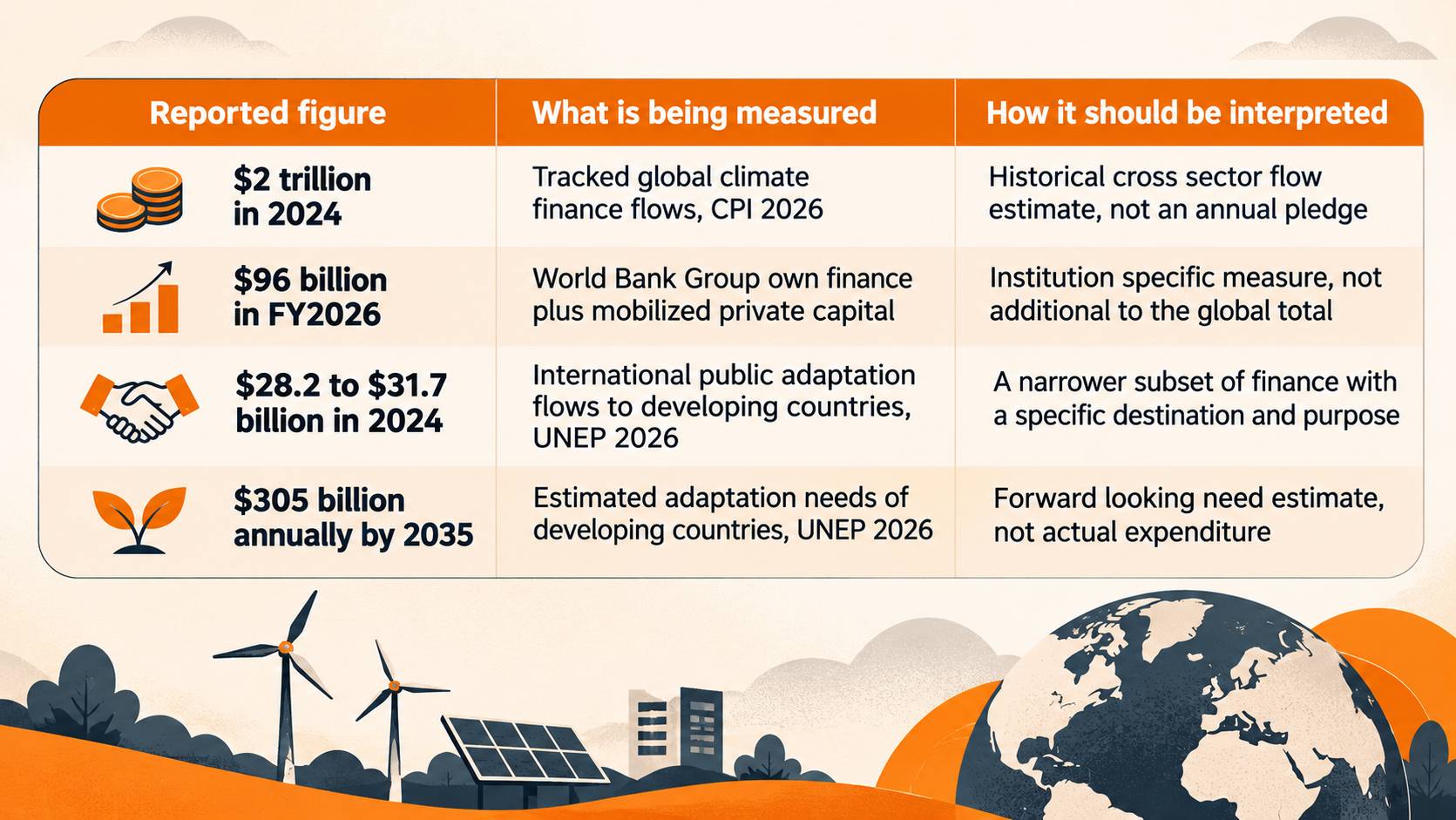
Climate Policy Initiative reported in June 2026 that global climate finance surpassed $2 trillion in 2024. Its estimate for 2025 was about $2.1 trillion, a projection rather than a finalized observation. Much of the expansion was associated with mitigation investment, particularly in energy, and with domestic spending by private actors. The 2026 figures show a large market, but the composition matters as much as the total.
In a separate measurement, the World Bank Group reported $48 billion in own account climate co benefits and $48 billion in mobilized private capital with climate co benefits in fiscal 2026, for $96 billion in combined climate related financing under its reporting framework. UNEP, meanwhile, reported international public adaptation finance to developing countries of approximately $28.2 billion to $31.7 billion in 2024 and estimated adaptation needs of $305 billion a year by 2035. These amounts describe different populations, time periods, and accounting approaches. They must not be added together as if they were independent slices of one single global total.
Why the Financing Gap Is Still Large
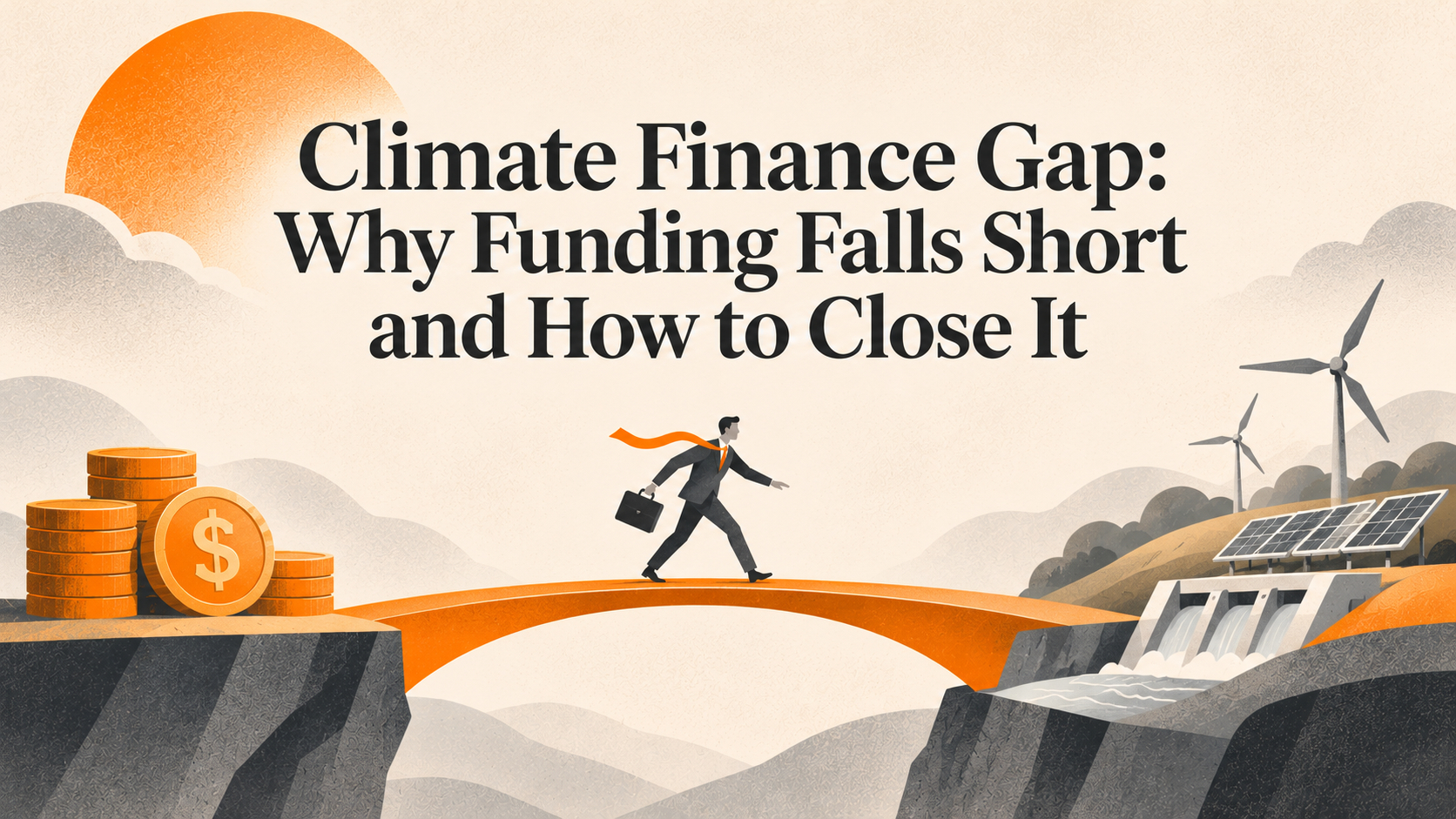
The climate finance gap is the distance between climate related funding available or deployed and the investment needed to meet a defined goal. That gap changes depending on whether the analysis covers mitigation, adaptation, a region, a period, or a particular scenario. A multi trillion dollar global investment figure can coexist with severe underfunding of flood protection in a vulnerable country because capital is not evenly distributed and cannot freely move from one purpose to another.
The gap persists for several reasons. Some projects generate returns that are difficult for private investors to capture. Many countries face high borrowing costs, limited fiscal space, and shallow domestic capital markets. Financial institutions may lack standardized data to assess physical climate risk or the revenues of emerging technologies. Policy reversals and unstable contracts can reduce bankability even where technical solutions are available.
Closing a gap therefore requires more than announcing a larger target. It means making projects investable where feasible, using public funds efficiently, lowering avoidable risks, expanding local capacity, and checking whether funds are disbursed rather than merely pledged.
Why Developing Economies Face Different Financing Conditions
A practical discussion of climate finance in developing countries must start with access to capital and debt capacity. A project with similar technical benefits can have different financing costs in two countries because lenders assess currency risk, political risk, legal enforcement, construction capacity, and the ability of customers or governments to pay. A low cost technology does not automatically translate into a low cost investment.
Adaptation makes the inequality more visible. The benefits of protecting homes, public hospitals, and agricultural livelihoods are often greatest where fiscal resources and insurance markets are weakest. International grants, concessional loans, and well designed guarantees can be important, but access procedures and the burden of meeting reporting standards can prevent eligible projects from moving forward. Financing decisions should also consider whether new borrowing worsens debt vulnerability.
The right aim is not simply to move more money across borders. It is to finance projects that match country priorities, develop local skills, create measurable results, and do not leave recipients with unaffordable long term obligations.
What Businesses and Investors Should Examine Before Committing
For a business, climate finance can reduce the cost of upgrading equipment, improving energy performance, or making facilities more resilient. Yet a company should evaluate the same questions it would for any major capital project: what is the cash requirement, how predictable are returns, what happens if energy prices or exchange rates change, and who covers maintenance and unforeseen costs? An incentive that reduces the initial price may still be unattractive if conditions or reporting burdens are unrealistic.
For an investor, the existence of a climate objective is not a substitute for project underwriting. A credible proposal identifies a measurable baseline, documents the project’s additional contribution, describes assumptions behind climate outcomes, and discloses material operating and financial risks. Greenwashing risk becomes most serious when the environmental claim is more specific than the evidence that supports it.
For public agencies, a further question matters: would the project have happened without public support? Concessional capital should ideally help finance activities that markets would not fund on reasonable terms, rather than create a windfall for a borrower already able to raise ordinary commercial money.
How to Track Finance and Climate Results
Strong climate finance tracking and reporting distinguishes between promised funding, legally committed amounts, actual disbursements, investment mobilized from other actors, and realized outcomes. A project may have a large announced facility but receive only a fraction of the money during the current year. A public guarantee may mobilize a commercial loan without becoming a cash outlay itself. These details are necessary for honest accounting.
Financial reporting also needs climate reporting. A mitigation project might track verified emissions reductions against a defensible baseline. An adaptation project might track people protected, service disruptions avoided, or the resilience of infrastructure during extreme weather. Results should be appropriate to the project and disclose uncertainty. A number such as anticipated beneficiaries is not the same as the number of people who have already become more resilient.
Comparing reports requires attention to scope and potential double counting. The same private investment may appear in a development bank mobilization figure and in a global project finance dataset. The same activity may generate both mitigation and adaptation benefits. Transparency about methodology is the foundation for interpreting progress rather than rewarding the largest headline.
How Climate Finance Could Change After 2026
The next phase of climate finance will probably be defined less by the novelty of green labels and more by the availability of dependable financing at the project level. Investment in commercially mature technologies can continue to expand, while adaptation, agricultural resilience, and difficult industrial sectors may require stronger public institutions and creative approaches to risk allocation. Continued growth in global totals is possible without solving access problems in vulnerable regions.
Current policy discussions also place greater emphasis on implementation. During COP31 in November 2026, governments and international organizations are debating how commitments translate into available finance and measurable adaptation. Outcomes from ongoing negotiations should be treated as unresolved until final decisions are published, rather than built into projections as established policy.
Three practical trends are worth monitoring: the use of guarantees and local currency finance to address genuine market failures, greater scrutiny of project level climate outcomes, and improving public data on the difference between commitments and disbursements. Any lasting improvement will depend on the interaction between policy stability, credible measurement, and affordable capital.
A Practical Way to Evaluate a Climate Finance Proposal
Start by stating exactly which climate problem the project addresses and whether its primary result is mitigation, adaptation, or both. Identify who benefits and who pays. Determine whether there is a dependable revenue stream, what resources are available for construction and operation, and which risks prevent private finance from entering. Match the financial instrument to those constraints rather than choosing a fashionable label first.
Then define three measurements: the funding actually received, the economic performance of the project, and the climate outcome it produces. A finance package is credible when each measure can be verified independently. It is stronger still when the project remains useful if expected carbon revenues are delayed, subsidies change, or climate conditions are worse than originally assumed.
Climate finance is the process of directing capital toward lower emissions and greater resilience. Its importance cannot be captured by a single global total. Governments, investors, and businesses need to understand who provides the money, who receives it, how risk is shared, and which outcomes can be verified. The central challenge in 2026 is turning growing financial flows into projects that work in the places where the need is greatest.
FAQ
What is climate finance in simple terms?
Climate finance is funding used to reduce greenhouse gas emissions or help people and economic systems adapt to climate change. It may come from public institutions, businesses, investors, banks, and households.
What is the difference between mitigation and adaptation finance?
Mitigation finance supports activities that reduce or avoid emissions, such as cleaner energy. Adaptation finance supports resilience, such as flood protection or drought management. Some projects deliver both benefits.
Does climate finance always come from governments?
No. Private banks, institutional investors, businesses, and households finance many projects. Governments and development institutions often provide grants, concessional lending, or guarantees when commercial financing alone is insufficient.
Are green bonds the same as climate finance?
No. Green bonds are one possible borrowing instrument used to fund eligible environmental activities. The broader climate finance system also includes loans, grants, equity, guarantees, and direct public expenditure.
Why is there a climate finance gap if investment exceeds $2 trillion?
The global total includes many countries and sectors, particularly mitigation investment. Funding is unevenly distributed and does not necessarily reach vulnerable communities or adaptation projects with limited commercial revenues.
How can a business tell if a climate finance offer is credible?
Review the financing terms, repayment requirements, climate eligibility rules, reporting duties, and the project risks that remain with the company. Verify the provider and the methodology used to claim climate results.

Masoumeh Jahangard
Markets & Economy Writer at PinerookMasoumeh Jahangard covers markets, economic trends, and business conditions for Pinerook, focusing on how they affect startups and growing companies.
 Seen first.