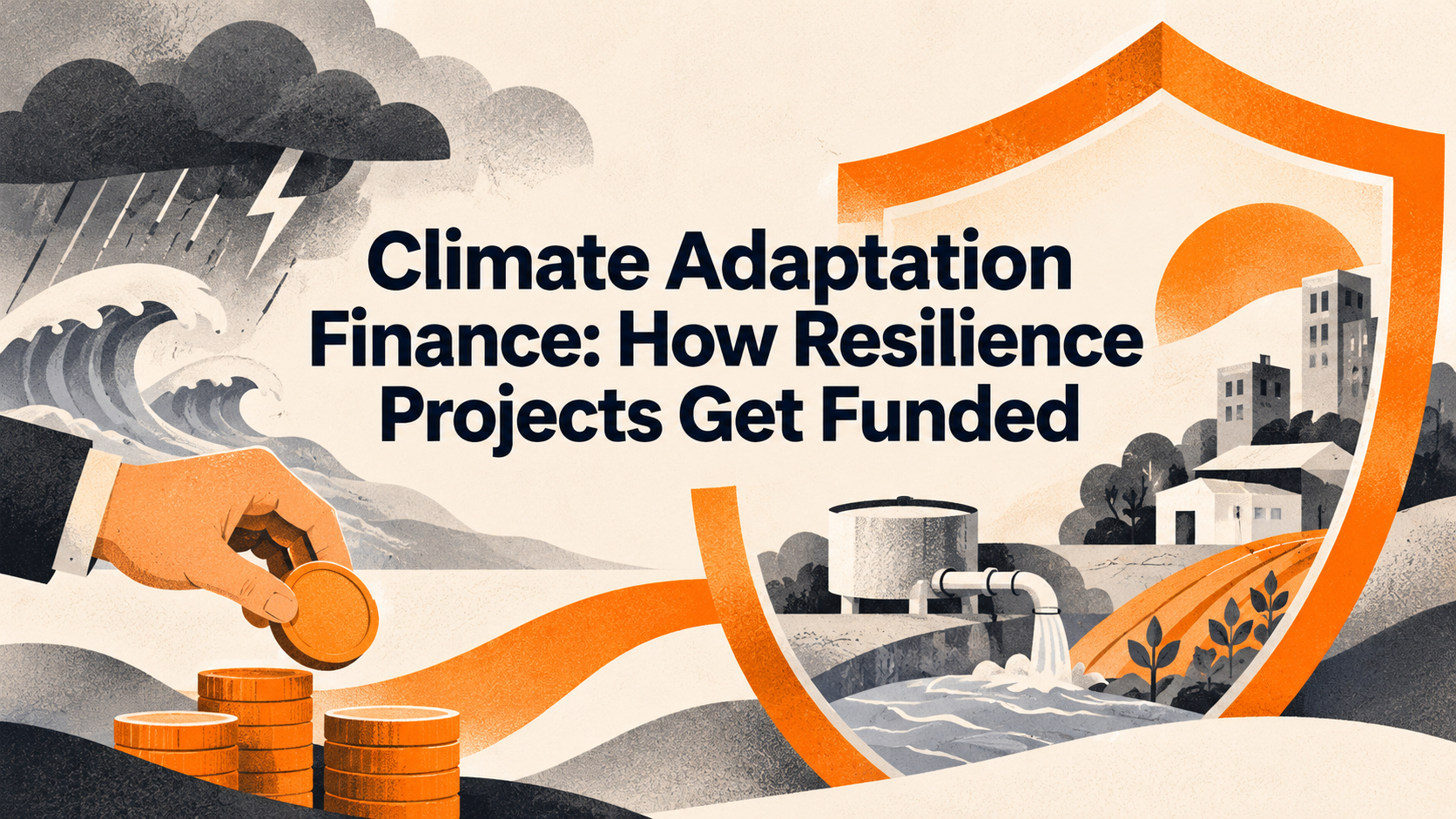
Climate adaptation finance is capital used to reduce the harm that rising temperatures, flooding, drought, severe storms, coastal erosion, and other climate hazards can cause to people and economic systems. It pays for measures such as stronger drainage, climate resilient water infrastructure, early warning systems, and farming practices that can withstand changing rainfall. The goal is not simply to spend more on infrastructure. It is to prevent or reduce future losses and keep essential services operating when conditions become more dangerous.
Understanding adaptation investment is an important part of the wider Climate Finance system, but its financing logic deserves separate attention. A renewable power project may repay a loan by selling electricity. A flood barrier protecting homes and local businesses can deliver enormous economic value without generating an income stream of its own. That difference explains why adaptation finance so often depends on public budgets, development institutions, and carefully designed agreements about who pays and who benefits.
What Counts as Climate Adaptation Finance?
Adaptation finance supports a specific response to an identifiable climate risk. A municipality reinforcing a bridge against projected flooding, a farmer adopting water efficient irrigation because of worsening drought, or a hospital upgrading backup water and cooling systems during extreme heat may all be pursuing adaptation. The investment must connect a changing climate hazard to the exposure of people, assets, or services and explain how a proposed intervention will reduce the consequences.
Ordinary maintenance should not automatically receive an adaptation label. Repairing a damaged road to its former standard may restore service without addressing the additional risk that future weather creates. An upgrade designed against a credible future hazard could qualify, but the assessment needs to document why the extra measures are necessary. The baseline, the climate rationale, and the incremental resilience outcome all matter.
Adaptation also differs from mitigation and disaster relief. Mitigation reduces emissions or increases carbon removals. Disaster relief responds to immediate harm after an event. Adaptation prepares systems to absorb, avoid, or recover from expected climate impacts before the next event occurs. Insurance can help finance recovery, but a policy alone does not necessarily make the insured asset more resilient.
Why Adaptation Is an Economic Investment Rather Than Just a Cost
The financial case for adaptation begins with risk reduction. Better flood protection can mean fewer business closures, less damage to public infrastructure, lower emergency expenditure, and fewer days of disrupted transport. An improved water network may help factories and households maintain supply through drought. These benefits can strengthen productivity and household security even when they never appear as revenue in the project operator’s accounts.
This creates a crucial distinction between economic value and bankable cash flow. Avoided flood damage benefits households, insurers, local firms, and the public sector, but no single beneficiary may pay the project owner for that benefit. A conventional lender still needs a dependable source of repayment. Governments can sometimes use taxes, utility charges, or budget appropriations to support debt. If those sources are absent, grants or other forms of public support may be more appropriate than commercial borrowing.
The World Resources Institute has documented substantial potential benefits from adaptation investments, but expected public benefits should not be confused with guaranteed investor returns. Benefits depend on the risks actually faced, implementation quality, the life of the asset, and what would have happened without the project. A credible appraisal makes those assumptions visible rather than treating every avoided loss as certain.
Which Projects Can Receive Adaptation Funding?
The range of potential investments extends well beyond flood walls. Water storage, efficient irrigation, resilient crop varieties, urban cooling, stronger health facilities, restored wetlands, coastal protection, climate information services, and transport infrastructure can all respond to physical climate hazards. Their financing characteristics vary considerably, even when their public value is clear.
A water utility may recover part of its costs through regulated tariffs. A warehouse operator may find a commercial reason to protect assets against flooding. By contrast, a public early warning system benefits an entire region and may not have a viable charging model. These projects belong in different parts of the financing system. Grouping them under one climate label does not remove differences in ownership, operating costs, maintenance duties, or repayment capacity.
Project eligibility is also contextual. The same drainage upgrade may address an urgent increase in storm intensity in one city but be routine replacement in another. Financial reviewers need hazard information, evidence of exposure, expected service improvements, and a clear justification for the portion of expenditure attributed to adaptation.
Where the Money Comes From
National and local government budgets remain important because many adaptation benefits are public goods. Development banks, bilateral partners, climate funds, philanthropic organizations, and private investors can provide additional resources. Support may reach a project through a ministry, municipal authority, utility, financial intermediary, local organization, or private developer. The route matters because each institution has different approval procedures and obligations.
The Green Climate Fund supports planning and project preparation as well as investment. Its readiness and preparation facilities recognize a practical problem: communities may know which hazards they face but lack the studies, technical designs, procurement capacity, or financial projections required for a credible funding proposal. Financing preparation can therefore be as consequential as increasing the amount available for construction.
Private capital is most likely to participate where the project has a commercially recognizable benefit, stable payments, or arrangements that reduce uncertainty. A manufacturer may fund resilience improvements to protect output. A water company may borrow against tariff revenues if regulation permits. Public support can also reduce particular barriers, but it should not be assumed that all adaptation projects can be converted into attractive private investments.
Matching Resilience Projects to the Right Financial Instrument
The correct instrument follows the financial structure of the project, not the other way around. An intervention that protects the public without generating user payments may need grants or tax funded investment. A utility with predictable revenues may be able to service concessional or commercial debt. Guarantees and insurance can address specific risks but are not substitutes for a viable operating model.
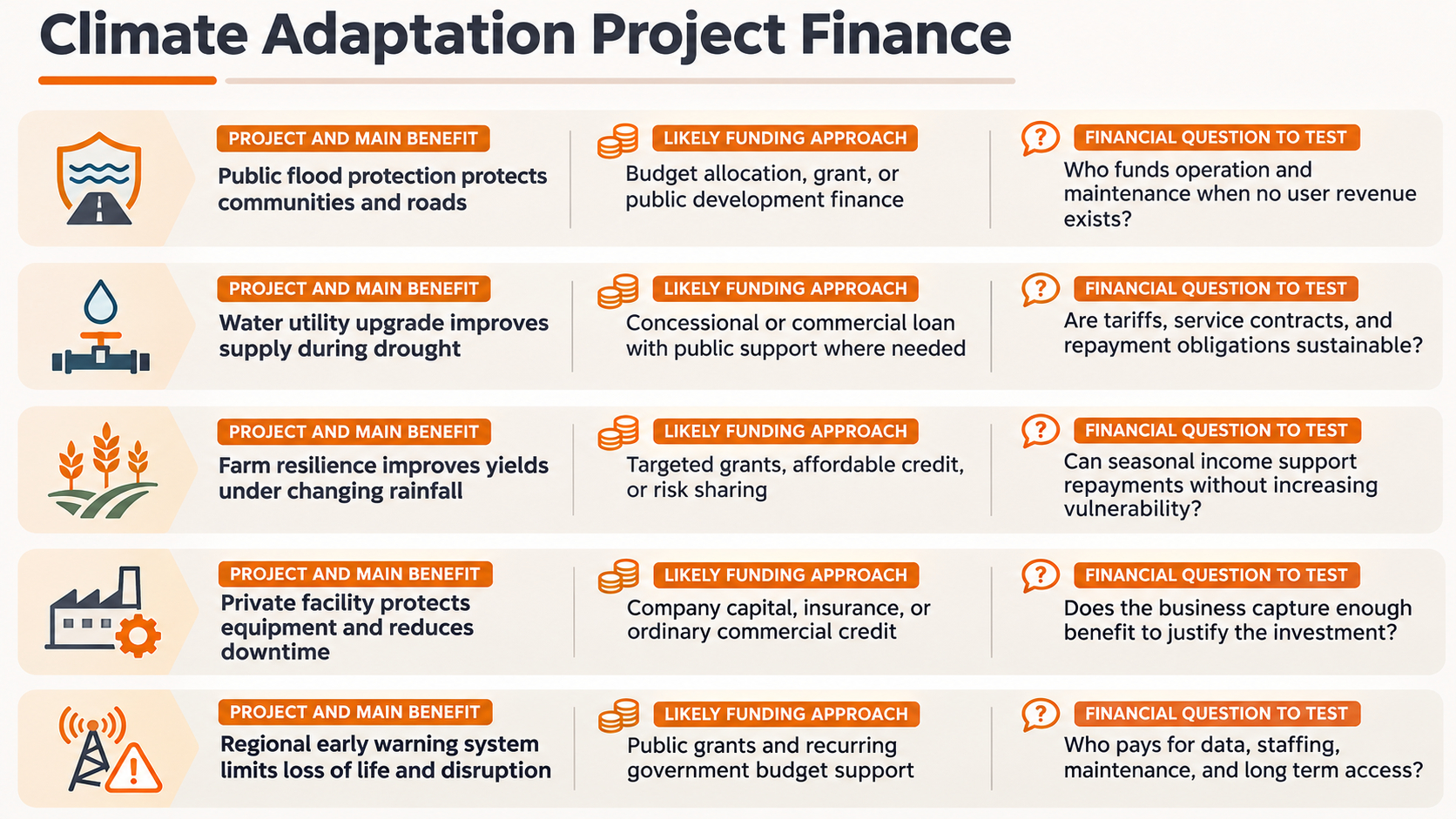
These are indicative structures, not universal prescriptions. A flood protection project may also be financed with public borrowing if a government has fiscal capacity, while a water utility could require grant support if tariffs are unaffordable. The key test is whether the arrangement allocates costs, benefits, and risks to parties able to carry them without undermining the very resilience the project is supposed to build.
How an Adaptation Project Becomes Ready for Finance
Preparation starts with a location specific assessment of climate hazards and the people, services, and assets exposed. A developer should identify what is at risk, how that risk may change over the life of the project, and what would happen without the intervention. Where climate data are uncertain, the appraisal should examine plausible scenarios rather than rely on a single precise forecast.
Next comes a comparison of practical responses. Engineering a new embankment may be one option, while restoring wetlands, changing land use rules, improving drainage maintenance, or relocating particularly exposed assets may be others. The lowest construction cost is not always the lowest cost over the life of the system. Project design should account for maintenance, environmental and social effects, service continuity, and the risk of creating new vulnerabilities elsewhere.
Financial structuring follows that analysis. The proposal identifies the capital expenditure, implementation timeline, public or commercial revenue, operating obligations, and risks of delay. The sponsor then selects a financing package, defines procurement and governance responsibilities, and explains how outcomes will be monitored. If no institution is able to maintain the asset after installation, a technically sound project can still be an ineffective investment.
A Worked Example: Financing Urban Flood Resilience
Consider a hypothetical city that wants to invest $10 million in improved drainage and flood management. Its appraisal estimates expected annual flood damage of $1.9 million under a clearly specified baseline. With the proposed investment, estimated annual damage falls to $500,000. This produces an illustrative annual avoided loss of $1.4 million. Additional maintenance and operating costs are estimated at $250,000 annually, leaving a simple annual net economic benefit of about $1.15 million before discounting, uncertainty, and other project effects.
These figures are an illustration, not evidence from an actual municipality. They reveal an important financing problem: residents and businesses would benefit from lower expected losses, but the city would not automatically collect $1.15 million in cash each year. A lender therefore cannot treat avoided damage as a contractual repayment source. The city might combine a capital grant with government budget support, or use public borrowing backed by lawful and sustainable fiscal revenues.
The final decision also depends on who receives the protection. If the scheme mainly benefits a commercial district but leaves a vulnerable neighborhood exposed, its aggregate economic return may conceal a serious distributional weakness. A credible proposal should show how protection is shared, which alternatives were considered, and how residents can hold implementing agencies accountable for delivery and upkeep.
What the Latest Data Say About the Adaptation Funding Gap
The UNEP Adaptation Gap Report 2026 estimates that international public adaptation finance from developed to developing countries reached approximately $28.2 billion to $31.7 billion in 2024, only about $1 billion more than the previous year. The same report estimates adaptation financing needs in developing countries at around $305 billion a year by 2035. The annual 2035 estimate is a forward looking need measure, while the 2024 range describes a narrower category of observed international public flows. They are useful together for identifying the scale of the challenge, but they are not interchangeable totals.
Global adaptation expenditure also includes domestic public finance and private activity that international public flow statistics do not fully capture. Climate Policy Initiative tracking illustrates why measurement boundaries matter. Countries can spend significant amounts from their own budgets on resilient infrastructure and services without those outlays appearing in a measure limited to international support. Likewise, a company protecting its assets may not be visible in public climate finance reporting.
The funding gap is therefore more than a headline subtraction. Analysts should distinguish economic needs, planned costs, committed amounts, money actually disbursed, and investment completed. They should also ask whether funding terms create debt pressure for highly vulnerable countries, whether resources reach local priorities, and whether reported commitments turn into functioning protection.
Why Adaptation Projects Still Struggle to Attract Investment
Several barriers reinforce one another. Physical climate risks are uncertain and difficult to price. Project developers may lack the climate and financial data needed for reliable appraisal. Many benefits accrue to the wider public, making it difficult to charge beneficiaries. Governments face constrained budgets and high borrowing costs, while private investors may prefer projects with clearer revenue streams and shorter time horizons.
Institutional capacity matters as much as headline funding. Agencies need staff who can prepare plans, secure land and permits, manage procurement, and oversee monitoring. Smaller jurisdictions can face high preparation costs relative to project size. International funding applications may involve complex compliance rules, and loans denominated in foreign currency can create further financial risk when local currency revenues are weak.
The OECD has emphasized that scaling adaptation requires better data, stronger policy frameworks, access to affordable capital, and coordination among institutions. Simply expanding private finance targets will not solve the problem where repayment sources are absent. Nor is adding more debt always a sound outcome for countries already dealing with limited fiscal space and repeated climate shocks.
How to Tell Whether Funded Adaptation Is Working
A credible adaptation project needs evidence at three levels. First, the sponsor should establish a baseline: what climate hazard exists, which people and assets are vulnerable, and how often essential services are interrupted. Second, it should monitor whether the planned infrastructure or service was actually delivered, maintained, and used. Third, it should test whether exposure, vulnerability, or expected damage has changed compared with a reasonable alternative scenario.
Completion figures alone are insufficient. A drainage channel can be built on schedule and still fail during the next severe storm because maintenance was underfunded. An early warning system may have excellent technical coverage but exclude residents who cannot receive or act on alerts. An irrigation project may improve average yields while disadvantaging households without access to credit or land. Resilience outcomes must account for reach, durability, and unequal effects.
Financial accountability is equally important. Reports should separate grants from repayable loans, commitments from disbursements, and project level investment from wider climate expenditure. When project costs serve ordinary development and adaptation together, funders should explain how they allocate the climate relevant portion. Transparent methods are especially valuable because adaptation results are shaped by location, time, and climate uncertainty.
What Adaptation Finance Needs Next
The most promising direction is not one financial instrument or one class of investor. It is better alignment between climate risk evidence, projects that communities need, and the institutions able to pay for them. Public funding remains essential for protection that benefits everyone. Development institutions can support planning, technical capacity, and affordable finance. Private investment can expand where returns and risk allocation are credible, without making resilience depend on unrealistic revenue assumptions.
The 2026 UNEP findings underline how far international public flows remain from projected needs. Future progress should be measured not only by the amount pledged but also by improved access, faster preparation, sustainable funding terms, and reductions in physical vulnerability. A city that builds a durable warning system or protects essential water supply may achieve more meaningful resilience than one that simply announces a larger financing package.
FAQ
What is climate adaptation finance in simple terms?
It is funding for measures that reduce the damage climate hazards can cause to people, infrastructure, businesses, and ecosystems. Examples include flood protection, resilient water systems, early warning services, and drought preparation.
What is the difference between adaptation and mitigation finance?
Mitigation finance supports activities that reduce emissions or increase carbon removals. Adaptation finance supports measures that reduce vulnerability to climate impacts. Some projects have both purposes, but their outcomes should be measured separately.
Who provides climate adaptation finance?
National and local governments, development banks, international climate funds, philanthropic providers, businesses, and private investors can all contribute. The mix depends on project risks, expected benefits, and whether reliable revenue exists.
Can private investors fund adaptation projects?
Yes, especially where a business can capture financial benefits or where service contracts and public arrangements make payments dependable. Many public protection projects still need grants or government funding because they do not generate direct revenue.
Why does adaptation finance remain insufficient?
The need is large, while many projects offer social returns without a straightforward commercial income stream. Limited budgets, high financing costs, weak project preparation, data gaps, and complicated funding procedures add to the shortfall.
How can adaptation results be measured?
Sponsors can establish a risk baseline, track delivery and maintenance, and assess whether exposure, vulnerability, disruptions, or expected losses decline. Results should also show who benefits and whether the improvements last.

Masoumeh Jahangard
Markets & Economy Writer at PinerookMasoumeh Jahangard covers markets, economic trends, and business conditions for Pinerook, focusing on how they affect startups and growing companies.
 Seen first.