
A cap table example makes startup ownership easier to understand because it connects share counts, ownership percentages, and financing transactions in one place. Founders often begin with a simple division of shares, but that record becomes more complicated as employees receive equity awards and new investors purchase shares. Without a consistent method for recording these changes, a company can miscalculate ownership or present conflicting information during fundraising.
A capitalization table is an essential part of Cap Table and Startup Equity because it shows who holds the company's securities and how those holdings may change. An accurate table distinguishes existing shareholders from people who hold rights to acquire shares in the future. It also separates the shares that have already been issued from the broader capitalization used to estimate potential ownership after options and other securities are considered.
This guide walks through a fictional startup's capitalization table, beginning with two founders and ending with a completed seed financing round. It explains the calculations behind each row, shows how to organize the information in a spreadsheet, and identifies the records needed to keep the table accurate as the business grows.
Understanding the Structure of a Cap Table
A capitalization table records the equity securities associated with a company and the people or entities entitled to them. Its simplest form lists shareholders, share classes, the number of shares held, and each shareholder's percentage ownership.
As a startup develops, the record may also include outstanding employee options, unallocated shares under an equity incentive plan, preferred stock, warrants, and convertible financing arrangements. These items do not always represent issued shares, so their treatment depends on the type of calculation being performed.
A useful capitalization table should distinguish between outstanding ownership and fully diluted ownership. Outstanding ownership is calculated using shares already issued and outstanding, while fully diluted capitalization includes the potential shares specified by the company's model or transaction agreements.
For example, a startup can have 9 million shares outstanding while maintaining another 1 million shares in an employee equity reserve. Its founders may own 100% of the outstanding shares while representing only 90% of the simplified fully diluted capitalization.
Both percentages can be correct. The important requirement is to identify which denominator is being used and apply that definition consistently.
Introducing the Startup Ownership Example
Consider ClearBridge, a fictional software company founded by two entrepreneurs. Founder A receives 5.4 million common shares, while Founder B receives 3.6 million common shares. The company therefore begins with 9 million issued and outstanding shares.
As ClearBridge prepares to recruit employees, it establishes an equity incentive reserve covering 1 million additional shares. Of that amount, the company grants options covering 400,000 shares to eligible employees and leaves 600,000 shares available for future awards.
At this stage, the company has 9 million outstanding common shares and 400,000 outstanding options. The remaining 600,000 shares are unallocated capacity under the equity incentive plan.
For this simplified example, fully diluted capitalization includes all outstanding common shares, the granted options, and the remaining unallocated reserve. The total is therefore 10 million shares on a fully diluted basis.
ClearBridge subsequently negotiates a seed financing round. The investor agrees to contribute $3 million at a $12 million pre investment valuation, with the price based on the existing 10 million fully diluted shares.
The example assumes there are no SAFEs, convertible notes, warrants, prior preferred investors, or additional changes to the employee reserve. It also assumes that the new preferred shares are counted on a one for one common share equivalent basis.
These assumptions are important because actual financing documents can define capitalization differently and may include adjustments that change the final share counts.
Cap Table Example Before and After Seed Funding
The following table shows ClearBridge's fully diluted ownership immediately before and after its seed financing. Each row identifies a shareholder or potential equity allocation, while the columns show the number of shares included in the model and the corresponding percentage.
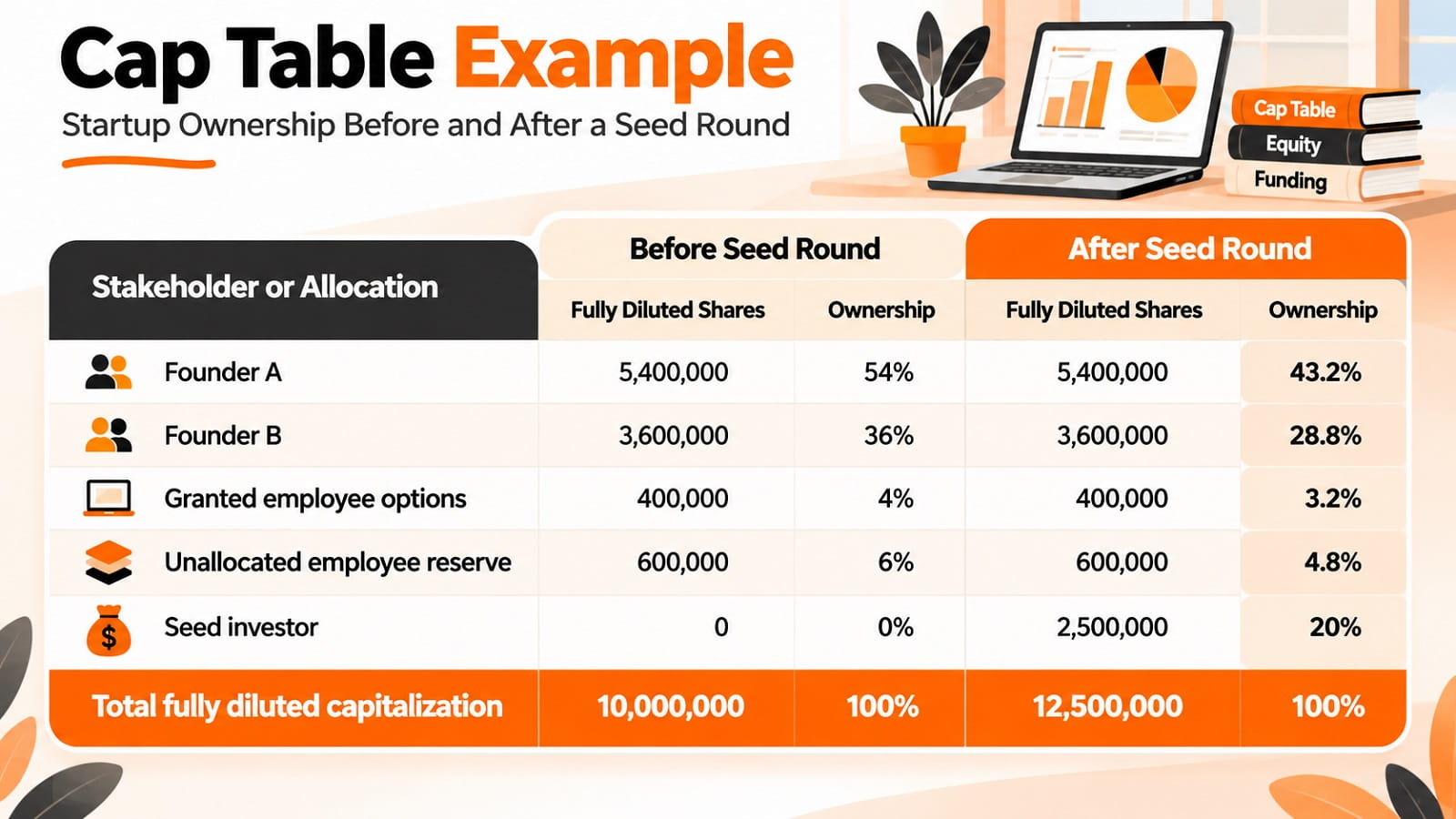
The table illustrates three important changes. First, the investor receives 2.5 million newly issued shares, increasing total fully diluted capitalization to 12.5 million shares. Second, the founders retain their original share counts, but their combined ownership falls from 90% to 72% on the fully diluted basis used in the example.
Third, the granted employee options and unallocated reserve remain unchanged in absolute share count. Their percentages decrease because the financing increases the denominator. The reserve does not disappear, and the company has not issued the unallocated shares merely because they appear in the fully diluted table.
The seed investor's 20% ownership reflects the agreed financing terms under the stated assumptions. This percentage represents ownership on the relevant common equivalent basis and does not by itself describe the investor's voting rights or potential liquidation preference.
A real capitalization table should identify the actual class and series of each issued security. The illustrative table combines the relevant amounts to make the calculation easier to follow, but the company's detailed securities ledger must preserve those distinctions.
Calculating the Price Per Share in the Seed Round
The first financing calculation establishes the price at which the new investor will purchase shares.
ClearBridge has a negotiated pre investment valuation of $12 million and 10 million fully diluted shares before financing. Dividing the valuation by that share count produces an illustrative financing price of $1.20 per share.
Price per share = $12,000,000 ÷ 10,000,000 = $1.20
The investor contributes $3 million. Dividing that amount by the price per share determines the number of new shares issued in the financing.
New investor shares = $3,000,000 ÷ $1.20 = 2,500,000
After the investment, the fully diluted share count increases from 10 million to 12.5 million.
The post investment valuation is calculated by adding the new primary investment to the pre investment valuation.
Post investment valuation = $12,000,000 + $3,000,000 = $15,000,000
The resulting investor ownership percentage is:
Investor ownership = 2,500,000 ÷ 12,500,000 × 100 = 20%
The same result can be calculated using the investment amount and post investment valuation.
Investor ownership = $3,000,000 ÷ $15,000,000 × 100 = 20%
These calculations agree because the example uses a straightforward priced primary investment with no additional adjustments. In more complicated transactions, outstanding convertible securities, changes to employee reserves, and negotiated capitalization definitions may affect the pricing calculation.
A Spreadsheet Calculation Worksheet
The ownership table becomes more reliable when the underlying calculations are separated from the final percentages. Founders can use a worksheet that records the starting share count, financing assumptions, and resulting capitalization.
The following table summarizes the calculations for ClearBridge. Each result can be reproduced in Excel or Google Sheets using the appropriate input cells rather than manually entering a percentage.
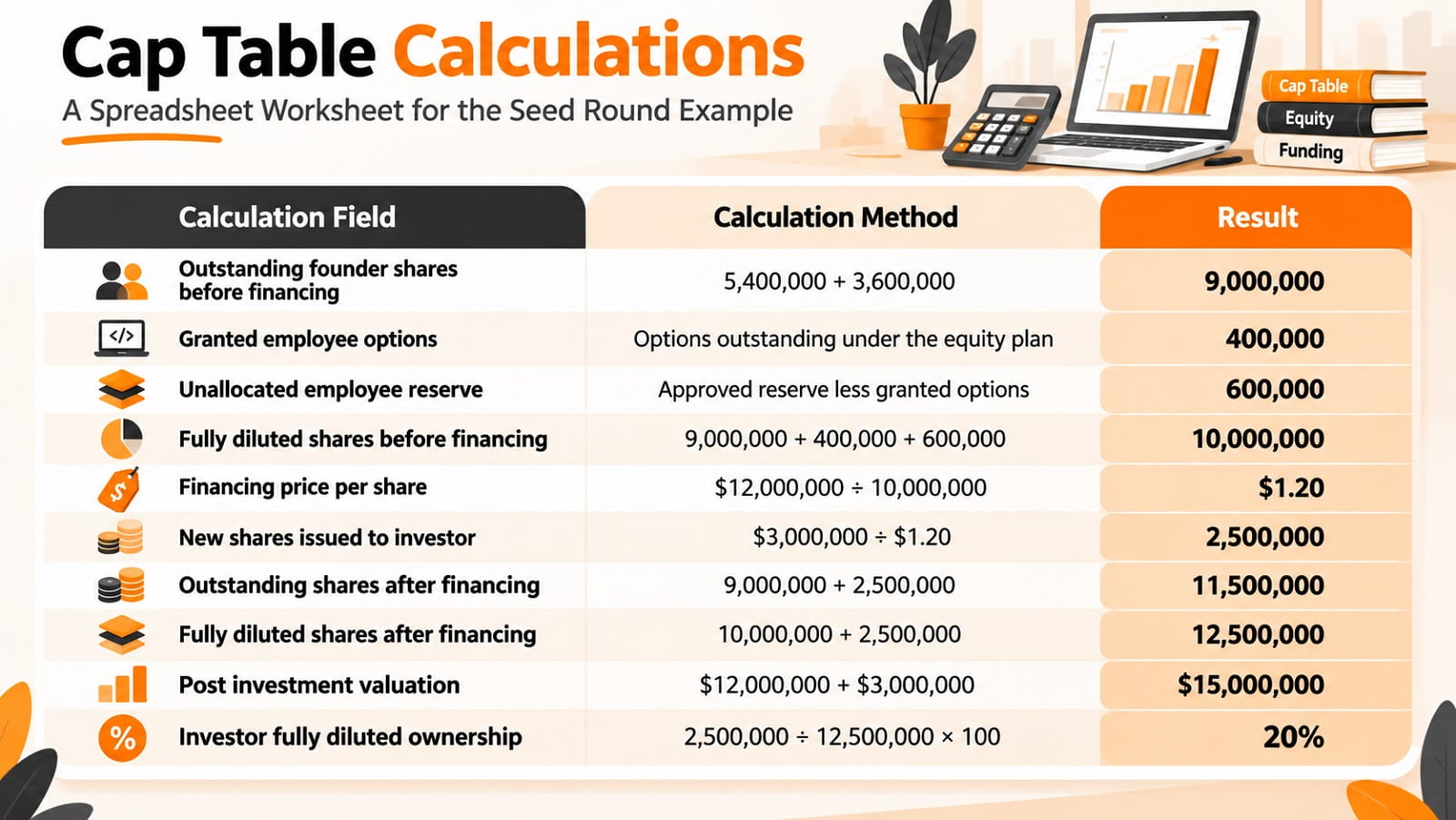
The distinction between the two post financing share totals deserves attention. ClearBridge has 11.5 million issued and outstanding shares after the investment, assuming the employee options remain unexercised. The fully diluted capitalization is 12.5 million because the model also includes the granted options and the remaining unallocated reserve.
The calculations should reference cells containing the underlying values. For example, an ownership percentage formula can divide the shares associated with a specific holder by the total fully diluted share count.
Using linked formulas reduces the risk of inconsistent calculations when investment amounts, share counts, or financing assumptions change. However, the formulas are only as reliable as the information entered into the spreadsheet.
Building a Cap Table in Excel or Google Sheets
A practical spreadsheet begins with a shareholder and securities ledger. The ledger should record each relevant holder, security class, share quantity, issuance date, and supporting document reference. An employee equity schedule should separately track options and other awards that have not yet resulted in issued shares.
The next step is to create a summary of outstanding capitalization. This summary includes the shares that have actually been issued and remain outstanding, allowing the company to calculate existing ownership percentages.
A separate fully diluted calculation can then incorporate the potential shares specified by the model. Outstanding employee options and the remaining unallocated reserve should be included according to the applicable assumptions without counting the same underlying shares twice.
The financing worksheet should contain editable inputs for the pre investment valuation, investment amount, and any required capitalization changes. The new shares issued to investors and the resulting ownership percentages should be calculated automatically from those inputs.
Finally, the spreadsheet should include a summary comparing ownership before and after the proposed transaction. This allows founders and investors to examine the expected outcome without changing the company's official historical records.
Spreadsheets are useful for simple companies, but they require disciplined maintenance. As securities become more complicated, companies may need specialized software and professional support to manage the underlying records reliably.
Outstanding Ownership Versus Fully Diluted Ownership
The ClearBridge example illustrates why ownership percentages can change depending on the share count used in the denominator.
Before financing, the founders collectively hold all 9 million issued and outstanding shares. Founder A therefore owns 60% of outstanding shares, and Founder B owns 40%.
On a fully diluted basis, the same founders represent 54% and 36% because the calculation also includes 1 million potential employee shares.
After financing, the company has 11.5 million outstanding shares. Founder A's 5.4 million shares represent approximately 46.96% of outstanding ownership, while Founder B's 3.6 million shares represent approximately 31.30%. The seed investor holds approximately 21.74% of outstanding shares.
However, the fully diluted percentages are lower for these issued shareholdings because the calculation uses 12.5 million shares. Founder A holds 43.2%, Founder B holds 28.8%, and the new investor holds 20% on that basis.
These differences are not accounting errors. They result from using different capitalization definitions. Any table intended for a financing decision should clearly identify whether the percentages describe outstanding ownership, fully diluted ownership, or another agreed measure.
Recording Employee Options Without Double Counting
Employee equity awards are a common source of spreadsheet errors. When a company establishes an incentive reserve, the total number of potential shares available under the plan may be included in its fully diluted capitalization.
Once options are granted from that reserve, the unallocated amount decreases. The underlying shares should not be added to the fully diluted denominator a second time merely because the company has assigned them to an employee.
In ClearBridge, the equity plan contains 1 million potential shares. The granted portion is 400,000, leaving 600,000 available for future awards.
Together, these two amounts still represent 1 million potential shares. The distinction is operational: 400,000 shares are associated with existing option awards, while the remaining 600,000 have not yet been allocated to recipients.
If the company later grants another 200,000 options from the remaining reserve, it would have 600,000 granted options and 400,000 unallocated reserve shares, assuming no other changes.
Its total modeled fully diluted capitalization would remain unchanged because the grant reallocates shares already included in the reserve.
If the company instead increases the approved reserve by an additional 200,000 shares, the fully diluted share count may increase. That transaction must be modeled separately from granting options out of existing capacity.
Adding Preferred Shares to the Cap Table
A financing round may introduce preferred stock with rights that differ from the common shares held by founders. The capitalization table should preserve those distinctions, even when the company presents a simplified ownership summary using a common share equivalent basis.
Preferred shares may carry liquidation preferences, conversion provisions, voting rights, or approval rights established in the financing documents. As a result, the ownership percentage shown in the summary does not necessarily determine how sale proceeds would be distributed.
In the ClearBridge example, the seed investor's 2.5 million shares are assumed to represent 2.5 million common equivalents for the purposes of calculating fully diluted ownership.
That assumption does not mean the preferred shares have identical economic rights to founder common shares. A detailed capitalization record should identify their series and relevant conversion terms.
An exit calculation may also be needed to estimate how proceeds would be distributed between shareholders with different rights. The capitalization table and an exit distribution model answer related but distinct questions.
Including SAFEs and Convertible Notes
Some startups raise financing before their first priced equity round through SAFEs or convertible notes. These agreements can affect future share ownership without immediately increasing the number of issued shares.
A SAFE may provide a right to receive shares when a specified financing or other contractual event occurs. Convertible notes are debt instruments that may convert under agreed terms, potentially including a valuation cap, discount, interest, and other provisions.
A company should maintain separate records of outstanding instruments and their contractual conditions. Simply entering the original financing amounts into a shareholder percentage column does not produce a meaningful ownership calculation.
When a priced round is proposed, the company should determine how many shares each instrument would receive under the relevant conversion provisions. Those shares can then be incorporated into the pro forma capitalization model according to the financing assumptions.
Different SAFE forms, convertible note agreements, and employee reserve provisions can interact in ways that materially change the final ownership structure. The conversion calculations should therefore be based on the actual documents rather than a generic percentage estimate.
Tracking Changes Through a Transaction History
A capitalization table is more reliable when every change can be traced to an approved transaction. Founders should be able to identify when shares were issued, who received them, what consideration was provided, and which documents authorize the transaction.
Employee grants require similar records. The company should distinguish the award date, number of options, exercise price, applicable restrictions, and any subsequent exercise or cancellation.
When options are exercised, the underlying shares may become issued and outstanding. The capitalization summary should reflect the resulting change without incorrectly adding shares that were already accounted for on a fully diluted basis.
Share transfers also require careful recording. If one founder sells or transfers existing shares to another shareholder, ownership changes between holders, but the company does not ordinarily issue additional shares through that transfer.
Maintaining a transaction history allows management to reconstruct the capitalization at earlier dates and explain the effect of subsequent events. It also helps reconcile the spreadsheet with legal records when investors conduct due diligence.
Common Cap Table Mistakes
One frequent mistake is using authorized shares as the ownership denominator. Authorized shares represent the maximum number of shares a company may issue under its governing documents, not the number currently outstanding or included in a fully diluted model.
Another mistake is combining granted employee options with the entire original reserve without reducing the unallocated portion. This double counts potential shares and can make existing shareholders appear to own less than they actually do under the intended model.
Companies may also overlook convertible financing arrangements because they have not yet resulted in share issuance. A simple outstanding ownership table can be accurate while still failing to disclose important potential future changes.
Incorrect financing calculations create additional problems. If the company divides an investment amount by a pre investment valuation instead of the appropriate post investment valuation when calculating the investor's final percentage, the ownership result may be wrong.
Finally, founders sometimes treat a spreadsheet as the legal record of share ownership. The spreadsheet summarizes transactions, but corporate approvals, securities registers, issuance documents, and contractual rights determine what has actually occurred.
A capitalization table should be checked against those records before the company relies on it for financing or other significant decisions.
Reviewing a Cap Table Before Fundraising
Before approaching investors, a startup should confirm that its capitalization table matches the company's underlying securities records. Every issued shareholding should have a clear legal basis, and outstanding employee awards should be supported by the relevant agreements.
Management should also confirm the status of its employee equity reserve. The number of granted awards, unallocated shares, and shares already issued through option exercises must be reconciled so that the fully diluted capitalization is not overstated.
Any outstanding SAFEs, convertible notes, or warrants should be identified and modeled using their actual terms. If the proposed financing includes an increase in employee equity capacity, that increase should be included in the appropriate stage of the pricing calculation.
The final review should compare outstanding and fully diluted capitalization before and after the financing. Percentage totals should reconcile, share quantities should match the assumptions, and the ownership consequences of the proposed transaction should be understood.
Professional legal and accounting review may be necessary, particularly when the company has multiple security classes or instruments that convert under different conditions.
Final Thoughts
A cap table example becomes useful when founders can follow the calculations from initial share issuance through employee equity awards and investor financing. The individual percentages matter, but the underlying share counts and transaction records are what make the ownership structure understandable and verifiable.
The ClearBridge example demonstrates how a startup can move from 10 million fully diluted shares to 12.5 million after raising $3 million. It also shows why the company has 11.5 million outstanding shares after financing even though its fully diluted capitalization is higher.
A reliable capitalization table should distinguish issued shares from potential shares, preserve the rights attached to different securities, and connect every change to supporting documents. With those foundations in place, founders can use the table to understand current ownership and prepare more accurately for future financing decisions.
FAQ
What Does a Cap Table Example Show?
It shows how a company's equity is allocated among shareholders and other relevant security holders. A useful example includes share quantities, security types, ownership percentages, and the effects of financing transactions.
How Do You Calculate Ownership in a Cap Table?
Divide the number of shares associated with the holder by the total shares included in the chosen capitalization definition, then multiply by 100. The company must state whether the denominator represents outstanding or fully diluted shares.
What Is the Difference Between a Cap Table and a Shareholder Register?
A shareholder register records legally recognized share ownership under the applicable corporate requirements. A capitalization table provides a broader financial view that may also include options, convertible securities, reserves, and scenario calculations.
Do Unallocated Employee Shares Belong in a Cap Table?
They can be included in the fully diluted capitalization when the model or financing terms require it. However, unallocated reserve shares are not the same as shares already issued to employees.
How Does a Cap Table Change After a Seed Round?
The company generally adds the newly issued investor shares and recalculates ownership using the expanded capitalization. Any conversion of existing instruments or changes to employee reserves must also be reflected.
Can a Cap Table Be Created in Excel?
Yes. A straightforward startup capitalization table can be built using separate sections for issued shares, equity awards, convertible instruments, and financing calculations. The spreadsheet should be maintained and reconciled with legal records.
Are Fully Diluted Shares the Same as Outstanding Shares?
No. Outstanding shares have already been issued, while fully diluted capitalization includes additional potential shares specified by the model. The totals and resulting ownership percentages may therefore differ.
Should SAFEs Appear in a Startup Cap Table?
Outstanding SAFEs should be recorded and considered in relevant financing models. Their future share quantities depend on the specific agreements and conversion terms rather than a universal formula.
How Often Should a Startup Update Its Cap Table?
The record should be updated whenever a transaction changes issued shares, equity awards, convertible rights, or other relevant capitalization information. Regular reconciliation helps prevent discrepancies before financing and corporate transactions.

Mobina Khanki
Venture & Funding Writer at PinerookMobina Khanki covers venture capital, startup funding, fundraising, and startup finance for Pinerook, focusing on founders and investors.
 Seen first.


