A startup can lose months building software that already exists. It can also lose control of a critical customer experience by relying on a tool that cannot evolve with the product. The build vs buy software decision is not a contest between engineering and subscriptions. It is a choice about where a young company should invest scarce time, cash, and attention. A sound technology strategy for startups starts with the business capability that matters, then asks how much of that capability the company actually needs to own.
Define the Capability Before Comparing Vendors
Start by describing the job the software must do. Who uses it? What outcome should improve? Which data, integrations, permissions, and failure cases are essential? This prevents a founder from comparing an ambitious custom specification with the lowest tier of a product that solves a different problem.
Separate the requirements into two groups. Essential requirements are necessary for customers to receive value or for the business to operate safely. Preferences are conveniences the team can change or postpone. A purchased tool that misses one essential workflow may be a worse fit than a simpler tool that handles the whole workflow reliably.
When Buying Software Makes More Sense
Buying is usually the stronger starting point for established functions such as accounting, email delivery, payroll, scheduling, and standard customer support. A mature provider can spread security work, maintenance, and product development across many customers. For a small startup, reproducing that capability can consume engineering capacity without improving the reason customers choose the business.
The purchase still needs scrutiny. Test the actual workflow, including exceptions. Check pricing at expected usage, export options, integration limits, support quality, and what happens if the vendor changes its terms. A low monthly price is not a bargain if employees spend hours correcting records or working around missing functionality.
When Building Custom Software Is Worth It
Building becomes more defensible when the capability directly shapes the customer experience or unit economics, and available products cannot support it without damaging compromises. A marketplace might need distinctive matching logic. A logistics startup might compete through its routing and allocation system. In those cases, owning the core workflow can make the product more adaptable.
But strategic importance alone is not enough. The startup also needs evidence that the capability matters, engineers who can maintain it, and sufficient runway to support testing, monitoring, security, and future changes. Code ownership without an operating owner is not independence.
Consider a Third Option: Buy and Extend
The decision is often not binary. A startup can purchase a reliable base system, configure its supported features, and develop a small custom layer for the part that differentiates the business. For example, a company may use an established billing service while building the pricing logic and customer workflow that make its product distinctive.
This hybrid approach can preserve launch speed, but it is not automatically simple. Every integration introduces a dependency. If the custom layer becomes difficult to test, monitor, or replace, the team may have recreated the complexity it was trying to avoid. Keep the boundary between vendor functionality and proprietary logic explicit.
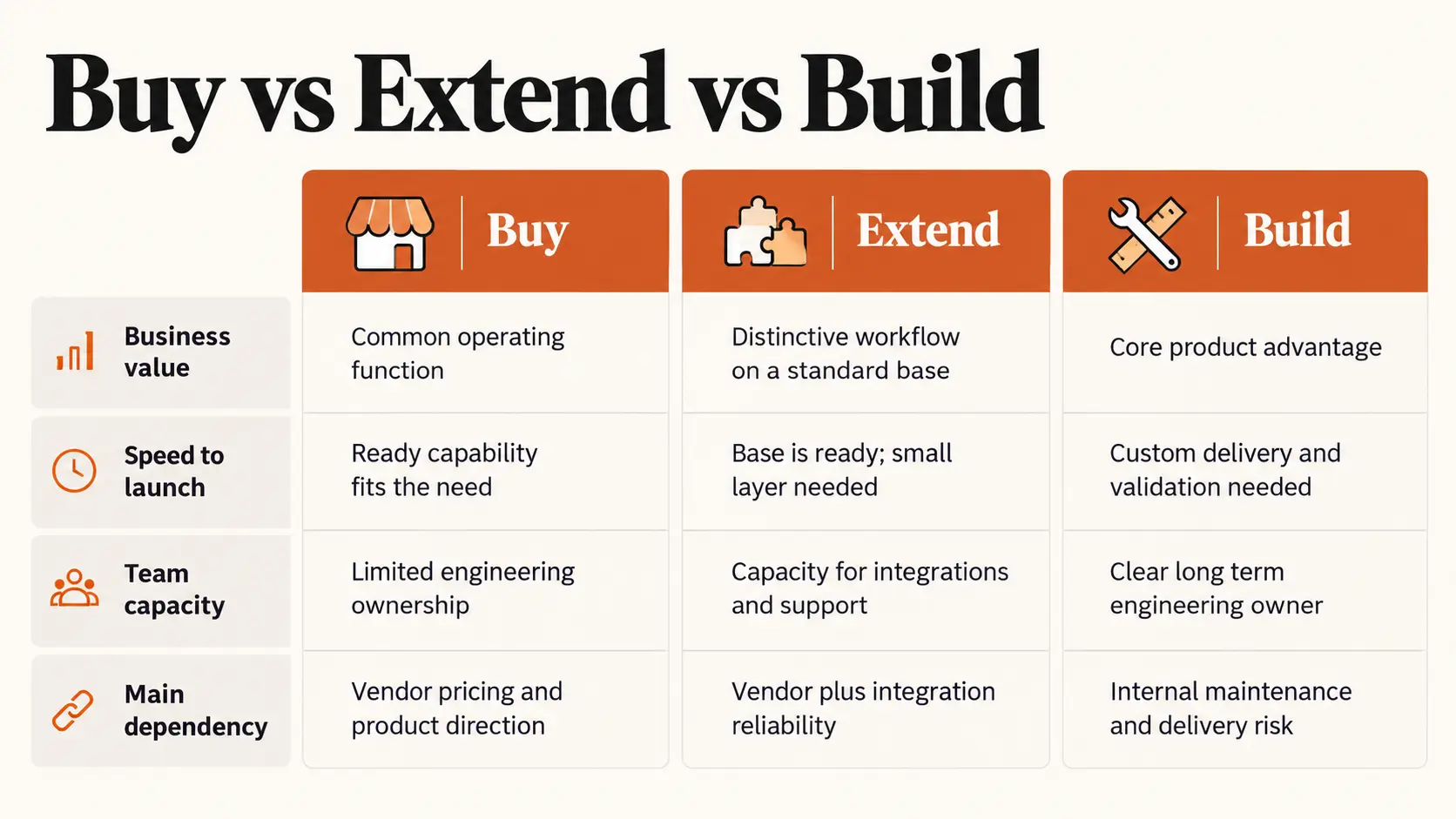
Use a Simple Decision Matrix
The table below is a starting point, not an automatic scoring system. A serious security requirement or an unavailable critical feature can outweigh several smaller advantages.
Compare Total Cost, Not the First Invoice
For purchased software, include subscription fees at realistic usage, setup, integration, training, administration, workarounds, and possible migration. For custom software, include discovery, development, testing, hosting, maintenance, incident response, and the engineering work that must be delayed to deliver it. Compare the options over the same period and with the same required outcome.
Consider a narrow internal workflow as an illustrative example. A purchased service costs $400 a month and needs about $200 a month of administration and integration support. Its estimated two year operating cost is $14,400. A custom version costs $22,000 to develop and $350 a month to maintain, or $30,400 over two years. Under these assumptions, buying is less expensive. The result could change if usage fees rise sharply or the vendor blocks a capability that matters to revenue. These are scenario figures, not market price benchmarks.
A founder should also ask what the engineering team will not build while working on the custom system. That opportunity cost may matter more than the cash comparison, particularly before product market fit.
A Five Question Test for Founders
1. Does this capability help us win? If customers would not notice whether the company built or bought it, purchasing deserves the first look. If the capability defines the product experience, custom development deserves serious consideration.
2. Can an existing product handle the critical workflow? Test the hardest realistic use case, not only the vendor demonstration. Identify gaps that can be configured, integrated, or cannot be accepted.
3. What is the full cost over the next two years? Include implementation, recurring work, and the cost of switching later. Use ranges when demand and usage remain uncertain.
4. Who owns reliability and change? A vendor handles part of the product lifecycle, but the startup still owns configuration and integration. A custom build requires a named technical owner and a support budget.
5. What evidence would make us change the decision? Define a trigger before committing. Rising integration hours, repeated workflow failures, a vendor policy change, or proven customer demand may justify revisiting the choice.
Example: A Startup Choosing Its Onboarding System
Imagine a business software startup with a small engineering team. Its customers need account setup, document collection, and an unusual approval process. Standard identity verification and document storage are already available through established services, but the approval sequence is central to how the company serves its market.
A sensible first decision may be to buy identity and storage capabilities, then build the approval logic and customer experience around them. This lets the team test the distinctive workflow without becoming responsible for every underlying service. If the approval process changes with customer evidence, the startup can improve the part it controls. If the external providers become too restrictive, it can reconsider that boundary with actual usage data rather than predictions.
Review the Decision as the Startup Changes
A good decision at five customers may not remain good at five thousand. Revisit the choice when usage pricing changes materially, essential product work is blocked, integration maintenance consumes significant capacity, or the custom system becomes difficult to operate. Do not replace software merely because the team has grown. Replace it when evidence shows that the current arrangement is limiting value, reliability, or flexibility.
Build What Makes the Business Different
For most early stage startups, the goal is not to own every line of code. It is to protect the few capabilities that create customer value while avoiding unnecessary operating burdens. Buy what is already solved, extend when a small custom layer creates leverage, and build when the evidence justifies owning the capability for the long term.
FAQ
Is it cheaper for a startup to build or buy software?
It depends on the scope and time horizon. Buying often reduces upfront cost and speeds deployment. Building can become attractive when a capability is central to the product and purchased tools create expensive limitations. Compare full operating costs rather than subscription price against a development quote.
Should a startup build its own software before product market fit?
It should build the smallest part needed to test its distinctive customer value. Standard supporting functions can often be purchased until the team has stronger evidence about demand and requirements.
When should a startup replace a SaaS tool with custom software?
Consider replacement when essential customer needs are repeatedly blocked, total costs become unfavorable, or vendor constraints prevent meaningful differentiation. Confirm that the team can fund migration and long term maintenance before starting the rebuild.

Mohsen Avid
Founder & Editor, PinerookMohsen Avid is the founder of Pinerook, covering entrepreneurship, startup strategy, digital business, and the decisions behind building new ventures.
 Seen first.