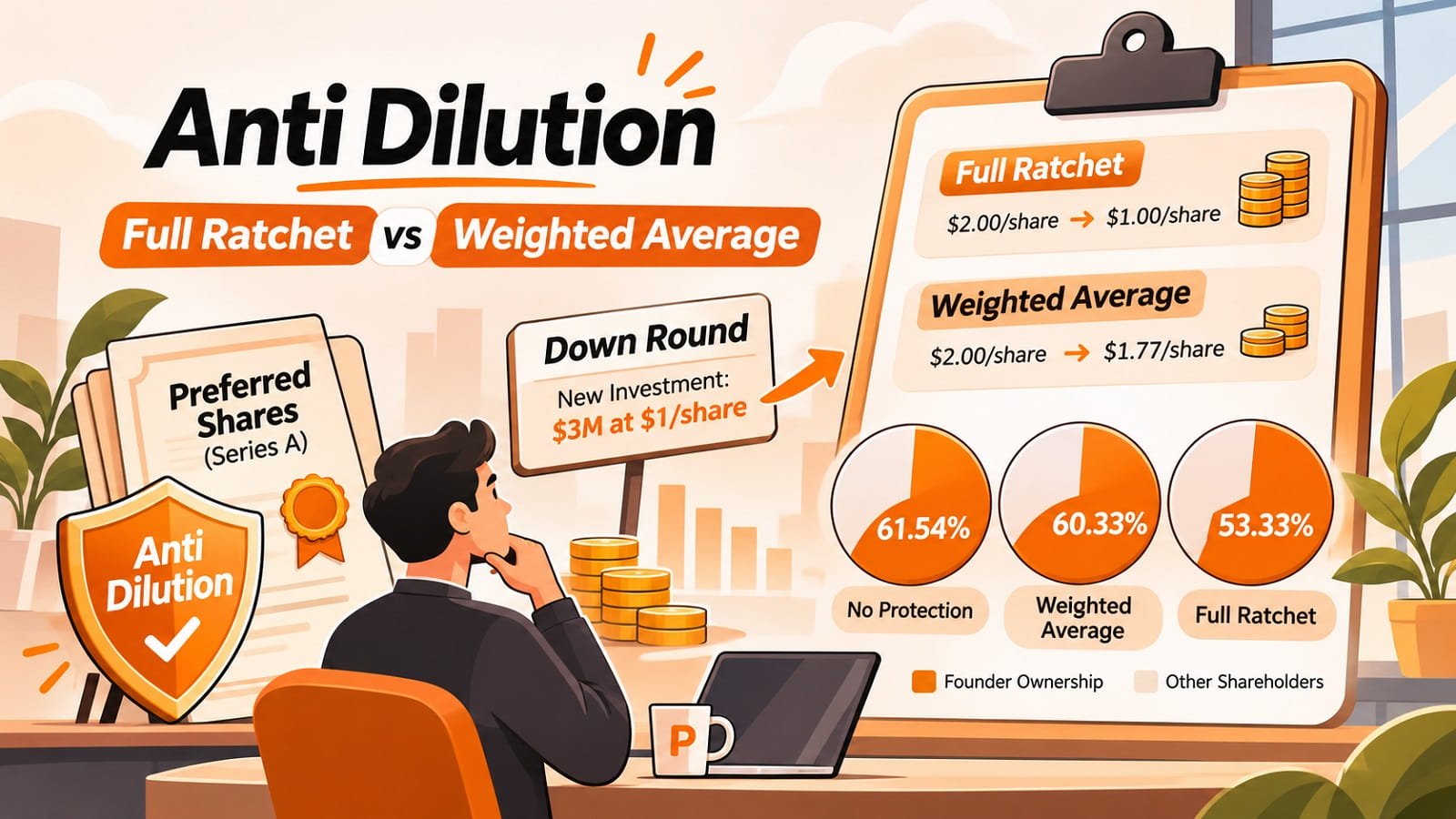
A startup may raise capital at a lower share price than investors paid in an earlier financing round. When this happens, the new shares can reduce the ownership percentages of existing shareholders and weaken the economic position of earlier investors. Some preferred shareholders negotiate contractual protections that change how their securities convert into common stock following a qualifying lower priced issuance. These provisions can significantly influence the final capitalization of a startup, particularly when the new financing occurs under difficult financial conditions.
Anti dilution protection is an important economic provision within Term Sheets and Investment Deals because it determines how certain investors are treated when subsequent financing occurs at a lower price. Unlike ordinary rights to participate in future funding rounds, these protections can adjust the conversion terms of existing preferred shares without requiring investors to contribute additional capital. The resulting benefit to protected investors can increase the ownership dilution experienced by founders, employees, and other shareholders.
The practical consequences depend on the adjustment method, the price of the new financing, and the number of shares issued. A full ratchet provision can produce a substantial change even when a company raises a relatively small amount of money, while a weighted average formula considers the size of the financing in relation to the company's existing capitalization. This guide explains both approaches, compares their economic consequences, and provides a worked example showing how they affect startup ownership.
Understanding Anti Dilution Protection
Anti dilution protection is a contractual mechanism that can adjust the conversion terms of certain preferred securities when a company issues additional shares at a price below a specified reference price. In a typical US venture financing, this protection is established through provisions in the company's certificate of incorporation governing the relevant preferred stock.
The mechanism generally begins with a conversion price. When preferred shares are issued, their original conversion price commonly equals the original purchase price, allowing each preferred share to convert into one common share. If a qualifying lower priced issuance subsequently occurs, the agreement may reduce that conversion price.
A lower conversion price increases the number of common shares into which the existing preferred shares can convert. The investor therefore receives a larger common equivalent ownership position than would otherwise result from the new financing.
This adjustment does not normally mean that the company immediately issues additional preferred shares to the protected investor. Instead, the calculation changes the conversion ratio applicable to the investor's existing securities.
The protection also does not guarantee the value of the investment. If the company's economic prospects deteriorate, a more favorable conversion ratio cannot ensure that the investor will recover the original capital or receive a profitable return.
Why Anti Dilution Matters During a Down Round
A down round occurs when a startup issues shares in a financing at a lower price per share than in a preceding relevant financing round. This may happen because revenue growth falls below expectations, capital markets weaken, the company needs additional liquidity, or investors reassess its prospects.
The lower financing price affects the capitalization because new investors receive more shares for a given amount of capital than they would have received at the earlier, higher price.
For existing shareholders, the new issuance generally reduces their percentage ownership unless they acquire additional shares or other adjustments apply. For preferred shareholders with price protection, the financing may also trigger an adjustment to their conversion ratio.
The combined effect can be especially important for founders. They experience the ordinary dilution associated with issuing shares to the new investors, while the conversion adjustment can further reduce their percentage ownership on a fully converted basis.
However, not every financing described informally as a down round necessarily triggers every existing investor's protection. The contractual reference price, excluded issuances, conditions, and definitions must be examined to determine whether an adjustment is required.
Full Ratchet Anti Dilution Protection
Full ratchet protection is a price based adjustment mechanism that generally reduces an earlier preferred investor's conversion price to the price of a subsequent qualifying lower priced issuance.
Suppose an investor originally purchases preferred shares at $2 per share. If the company later issues qualifying new shares at $1 per share, a full ratchet provision may reduce the conversion price of the earlier preferred shares from $2 to $1.
The conversion ratio is calculated by dividing the applicable original issue price by the adjusted conversion price.
Conversion ratio = Original issue price ÷ Adjusted conversion price
Under these assumptions, a preferred share that originally converted into one common share would become convertible into two common shares.
The distinctive feature of full ratchet protection is that the adjustment generally depends on the lower issuance price rather than the number of shares sold in the financing. A relatively small qualifying issuance can therefore produce the same conversion price adjustment as a much larger financing completed at that price.
This makes full ratchet a particularly strong form of investor protection. It can materially increase the common equivalent ownership of protected investors and reduce the percentages attributable to founders and other shareholders.
Although the method provides significant protection against lower priced issuances, it can complicate later financing negotiations. New investors may be concerned about how existing conversion adjustments affect the ownership structure they are purchasing into.
Weighted Average Anti Dilution Protection
Weighted average protection uses a different approach. Instead of automatically reducing the existing investor's conversion price to the new financing price, it calculates an adjusted conversion price using the size and price of the qualifying issuance.
The calculation considers how many shares the company has before the financing, how much consideration it receives, and how many new shares are issued.
A smaller financing generally produces a more limited adjustment than a larger financing at the same lower price, assuming the other relevant inputs remain unchanged.
This characteristic makes weighted average protection less severe than full ratchet protection in many comparable transactions. The adjustment still benefits the protected preferred shareholder, but its magnitude reflects the scale of the new issuance relative to the existing capitalization.
There are two principal variations: broad based weighted average and narrow based weighted average. Their distinction lies primarily in which shares are included in the capitalization figure used in the formula.
Broad Based and Narrow Based Weighted Average
Broad based weighted average protection uses a relatively comprehensive capitalization definition. Depending on the agreement, this may include outstanding common shares, preferred shares on an as converted basis, outstanding options, warrants, and other specified potential shares.
Some formulations also include shares reserved for future equity awards, while others exclude some or all unallocated capacity. The precise definition in the governing agreement controls the calculation.
A broader share count generally reduces the magnitude of the conversion price adjustment for a given financing. This means that broad based protection is typically less dilutive to founders than a corresponding narrow based formula.
Narrow based weighted average protection uses a smaller capitalization figure. For example, the calculation may exclude outstanding options or unallocated employee share reserves that would have been counted under a broader definition.
Because the starting capitalization is smaller, the same lower priced issuance generally produces a more substantial adjustment.
Founders should not rely on the phrase weighted average alone when reviewing a financing proposal. Two agreements using that description can create different outcomes if their capitalization definitions are not identical.
Contractual Terms That Determine Anti Dilution Outcomes
The adjustment formula is only one part of the protection. Founders must also understand which events activate the mechanism, which securities receive protection, and whether specific transactions are excluded.
The following table identifies important contractual elements and explains how they influence the financial outcome.
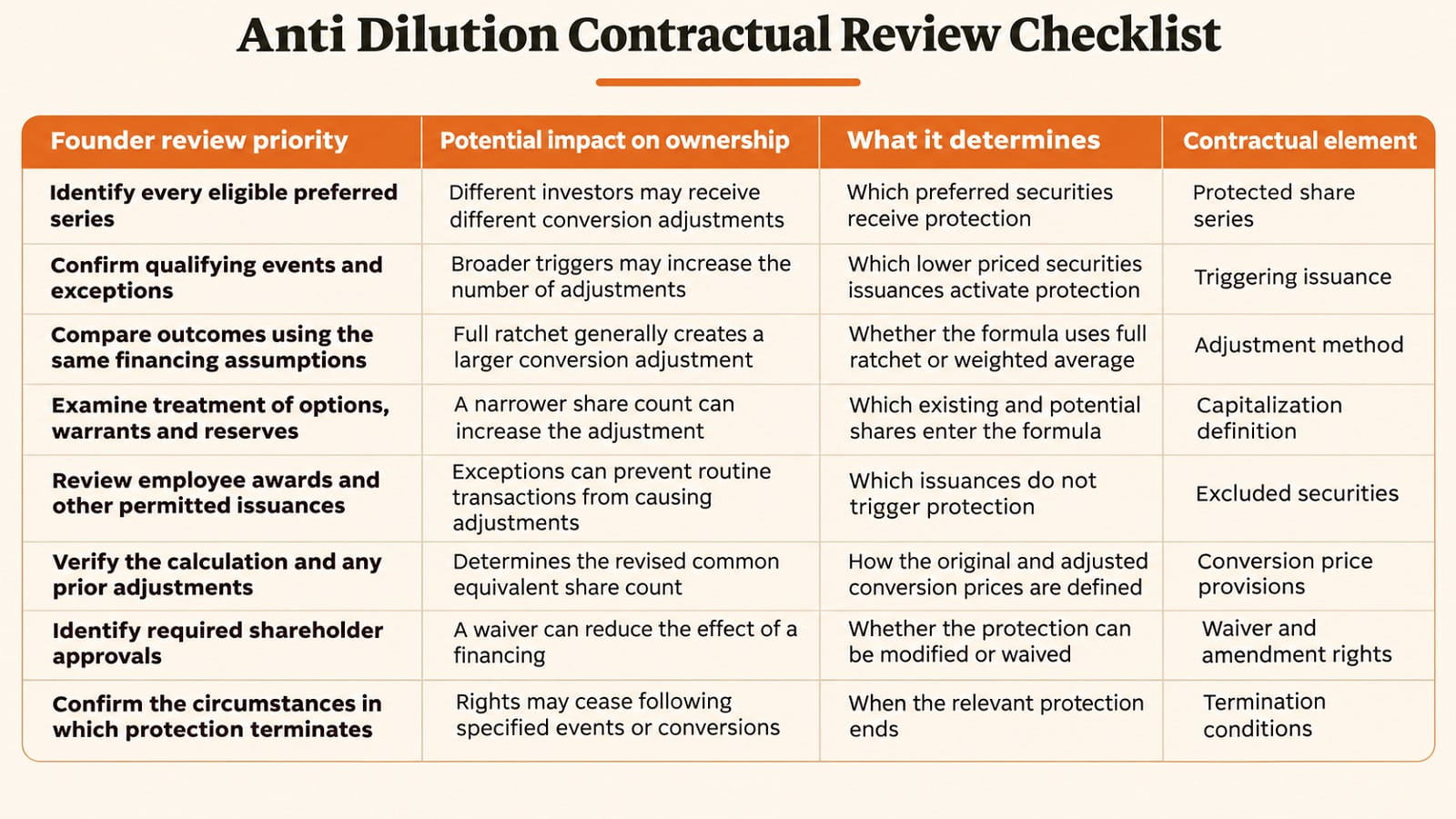
The table demonstrates why a contractual label is not sufficient to determine the consequences of a financing. An apparently standard weighted average provision can produce different results depending on its denominator, exclusions, and prior adjustments.
The provisions should be reviewed together with the proposed capitalization table. This allows founders to understand which securities benefit from the protection and which existing shareholders bear the associated ownership reduction.
Calculating Broad Based Weighted Average Protection
A commonly used formula for broad based weighted average protection adjusts the conversion price as follows:
New conversion price = Old conversion price × (A + B) ÷ (A + C)
In this expression, A represents the company's capitalization immediately before the qualifying issuance, measured using the definition specified in the relevant agreement.
B represents the number of shares that the new financing proceeds would have purchased at the existing conversion price. It is calculated by dividing the consideration received in the new financing by that existing conversion price.
C represents the number of new shares actually issued in the qualifying financing.
The formula compares the hypothetical share issuance at the earlier conversion price with the number of shares actually sold at the lower price. When the company issues more shares than would have been issued at the old price, the formula generally reduces the conversion price.
The adjusted conversion price then determines the new common equivalent share count for the protected preferred securities.
To calculate that share count, the company divides the applicable original issue price by the adjusted conversion price and multiplies the result by the number of protected preferred shares.
The calculation must use the precise definitions in the governing documents. In particular, the treatment of employee reserves, outstanding convertible instruments, and multiple protected preferred series can affect the result.
A Practical Anti Dilution Calculation
Consider Redwood Analytics, a fictional software startup with 10 million common equivalent shares before a new financing.
The company's founders hold 8 million common shares. An earlier Series A investor owns 2 million preferred shares purchased at $2 each, representing an original investment of $4 million.
Initially, each Series A preferred share converts into one common share. The Series A investor therefore represents 20% of the company's capitalization on the simplified as converted basis.
Redwood Analytics now needs additional capital. The company negotiates a $3 million Series B investment at a share price of $1, issuing 3 million new preferred shares that initially convert into common shares on a one for one basis.
The new financing price is below the earlier Series A conversion price of $2. Assume this issuance triggers the Series A protection and that the company has no other securities, employee reserves, or contractual adjustments that affect the calculation.
Under a full ratchet provision, the Series A conversion price would decrease to $1. The 2 million existing preferred shares would then represent 4 million common equivalent shares because each preferred share would convert into two common shares.
Under broad based weighted average protection, the conversion price is calculated differently.
The inputs are:
A = 10,000,000 existing common equivalent shares
B = $3,000,000 ÷ $2 = 1,500,000 shares
C = $3,000,000 ÷ $1 = 3,000,000 shares
Substituting these inputs into the formula gives:
New conversion price = $2 × (10,000,000 + 1,500,000) ÷ (10,000,000 + 3,000,000)
New conversion price = approximately $1.76923
The revised common equivalent share count for the Series A investor becomes:
Series A common equivalents = 2,000,000 × ($2 ÷ $1.76923)
Series A common equivalents = approximately 2,260,870
This is a much smaller adjustment than the 4 million common equivalent shares produced by full ratchet protection.
Comparing Founder Ownership Under Three Scenarios
The economic difference becomes clearer when all shareholders are included in the capitalization calculation.
Before Series B, the founders hold 8 million common shares, and the Series A investor holds 2 million common equivalent shares. The new Series B investors receive 3 million common equivalent shares under each scenario.
The following table compares the original capitalization with three possible outcomes: financing without an additional conversion adjustment, financing with broad based weighted average protection, and financing with full ratchet protection.
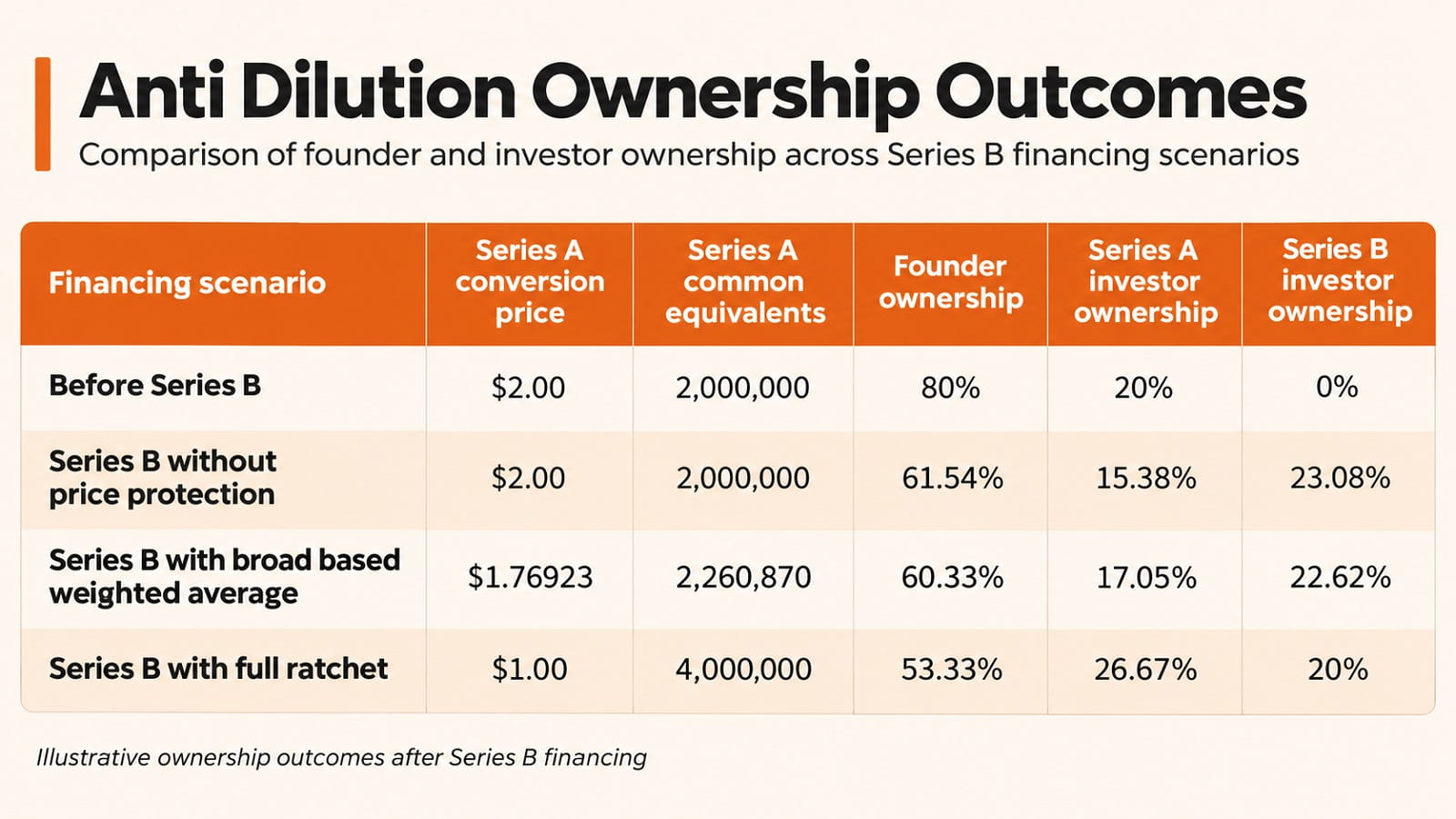
Without an adjustment, total common equivalent capitalization after Series B is 13 million shares. The founders' 8 million shares represent approximately 61.54%, while the Series A investor retains approximately 15.38%.
With weighted average protection, the Series A investor's conversion adjustment increases its common equivalent position to approximately 2.261 million shares. The resulting capitalization is approximately 13.261 million shares, and the founders hold 60.33%.
Under full ratchet protection, the Series A investor represents 4 million common equivalent shares. Adding the founders' 8 million shares and the 3 million new Series B shares produces 15 million common equivalent shares.
The founders now represent only 53.33% of the company, while the protected Series A investor represents 26.67%.
The founders have not sold any of their original shares in these scenarios. Their ownership percentages change because the company issues new securities and because the protected investor's existing preferred shares become convertible into a larger number of common shares.
The calculated conversion adjustment does not itself represent a new investment by the Series A investor. It changes the economic allocation among shareholders under the assumed contractual terms.
The figures are rounded for presentation. The example excludes different liquidation preferences, voting rights, transaction costs, and other securities that could affect the financial outcome of an actual financing.
Why the Size of a Down Round Matters
The Redwood Analytics example uses a $3 million financing to demonstrate the difference between the adjustment methods. However, the amount raised is particularly important when comparing full ratchet and weighted average protection.
Suppose the company instead raises only $500,000 at the same new price of $1 per share. The price reduction from $2 to $1 remains unchanged, but the number of new shares issued would be 500,000 rather than 3 million.
Under a standard full ratchet provision, the earlier Series A conversion price may still decrease to $1. The investor's existing 2 million preferred shares would continue to represent 4 million common equivalent shares.
With weighted average protection, the calculation would account for the smaller issuance. The conversion price adjustment would consequently be less substantial than in the $3 million example.
This distinction matters when a startup raises a small emergency financing or bridge round. A full ratchet provision can create a disproportionate ownership shift relative to the amount of new capital received.
Founders should therefore consider the possibility of future financing at lower prices when negotiating the original protection. A clause that appears unlikely to matter during a strong fundraising environment can become significant when the company needs additional capital quickly.
Excluded Issuances and Other Exceptions
Not every issuance of shares at a low price should automatically activate investor protection. Venture financing documents frequently identify categories of securities that are excluded from the adjustment.
Employee equity awards are an important example. A startup may grant options with an exercise price based on the fair market value of common stock, which can differ from the price investors paid for preferred shares.
Without appropriate exclusions, routine compensation arrangements could create unintended consequences under a broadly worded price protection provision.
Financing documents may also address shares issued through the exercise or conversion of previously authorized securities, stock splits, specified strategic transactions, and other agreed circumstances.
The treatment of these events depends on the governing documents. A share split, for example, often requires a separate proportional adjustment to preserve conversion mechanics rather than the same calculation used for a new financing priced below an earlier round.
Founders should carefully identify the distinction between ordinary capitalization adjustments and price based protection triggered by qualifying financing transactions.
Anti Dilution Protection and Pro Rata Rights
Anti dilution protection should not be confused with the contractual right to invest in future financing rounds.
Pro rata participation rights may allow an existing investor to purchase additional shares in a new round to maintain some or all of its ownership percentage. Exercising those rights generally requires the investor to contribute additional capital.
Price based anti dilution protection operates differently. The investor may receive an adjustment to the conversion terms of existing preferred shares without purchasing additional securities.
The two mechanisms can apply to the same investor. A protected investor may benefit from a conversion adjustment and also have an opportunity to participate in the new financing.
This interaction can influence how much ownership remains available to new investors and existing common shareholders. The cap table should therefore model both rights separately rather than treating them as a single form of protection.
Managing Multiple Preferred Share Classes
An adjustment becomes more complicated when a company has several outstanding preferred share series with different purchase prices and protection provisions.
For example, a Series A investor may hold shares originally purchased at $2, while a Series B investor holds shares issued later at $4. A subsequent financing at $1 may trigger different adjustments for the two series.
The governing documents may use distinct conversion prices, capitalization definitions, and excluded issuance provisions for each group. A formula appropriate for one class cannot necessarily be applied unchanged to another.
Conversion adjustments may also interact with an employee equity reserve increase or outstanding convertible securities. Those changes can affect the capitalization that enters the calculation and the resulting distribution of ownership.
The company should use a coordinated capitalization model that applies the relevant provisions in the correct sequence. This is particularly important when several instruments convert or adjust during the same transaction.
Professional legal and financial review may be necessary to ensure that the model reflects the actual rights of each class.
Negotiating Anti Dilution Terms Before Investment
Founders should evaluate a proposed price protection clause before accepting a term sheet, even when they do not expect to raise money at a lower valuation.
The first question concerns the adjustment method. A broad based weighted average provision generally produces a less severe adjustment than full ratchet protection under comparable circumstances.
The second question concerns the capitalization definition. A broad formula may benefit founders by reducing the adjustment, but the agreement must specify exactly which securities are included.
Founders should also examine excluded issuances, the duration of protection, and the conditions required to amend or waive it.
The importance of waiver rights can become clear during a difficult financing. Existing investors may agree to waive or modify their protection when the adjustment would leave management with insufficient incentives or complicate the company's ability to raise necessary capital.
Such changes can require specified investor approvals and must comply with the governing documents. Founders should not assume that protection can be ignored simply because the new financing is commercially necessary.
The objective is to establish reasonable investor protection without creating a capitalization structure that makes future financing unnecessarily difficult.
Pay to Play Provisions and Investor Participation
Some financing arrangements include provisions commonly described as pay to play requirements. These provisions can condition the retention of certain preferred shareholder rights on participation in a subsequent financing.
Under particular structures, an investor that declines to participate in a qualifying round may lose some preferred rights or face conversion into a different class of securities.
The consequences depend on the agreement and can be significant. A pay to play arrangement may encourage existing investors to provide additional capital when the company needs financing.
However, such provisions are not identical to anti dilution formulas. A weighted average calculation determines a conversion price adjustment, while a pay to play requirement establishes conditions associated with investor participation.
Founders should examine whether the transaction combines the two mechanisms and whether different investors face different obligations.
Common Mistakes in Anti Dilution Calculations
A frequent mistake is assuming that a protected investor cannot experience any ownership dilution. Price based protection usually adjusts conversion economics after qualifying lower priced issuances; it does not necessarily preserve a fixed ownership percentage in every transaction.
Another mistake is treating the adjustment as an immediate issuance of new preferred shares. In the common US venture structure, the mechanism normally changes the number of common shares represented by existing preferred stock.
Founders may also apply the weighted average formula using an incorrect capitalization figure. Omitting securities that should be included or counting the same securities twice can materially change the adjusted conversion price.
A further problem is ignoring the size of the new financing when comparing protection methods. Full ratchet and weighted average can produce different outcomes even when the new share price is identical.
Finally, companies sometimes model only the effect on the protected investor while failing to recalculate the percentages of founders, employees, other investors, and the new financing participants.
A complete analysis should reconcile all relevant share equivalents and ensure that ownership percentages total 100% under each defined scenario.
Reviewing the Financial Impact Before a Down Round
Before completing a lower priced financing, founders should obtain an updated capitalization model showing the rights of every outstanding security class.
The model should identify the conversion price currently applicable to each protected series, the price of the proposed new issuance, and the specific adjustments required by the governing documents.
Any applicable exclusions, waivers, and investor participation conditions should also be reflected. A transaction involving several investor groups may require more than one calculation.
Management should then compare ownership before and after financing and identify which shareholders experience the greatest proportional change.
It is also useful to consider the business consequences. A financing that provides essential operating capital may still be necessary despite its ownership impact, but founders and investors should understand whether the resulting incentives support the company's continuing development.
Final Thoughts
Anti dilution protection can materially change how startup ownership is distributed after a lower priced financing round. Although the mechanism is intended to protect specified investors, the resulting conversion adjustments can increase the dilution experienced by founders and other shareholders.
The Redwood Analytics example demonstrates the difference between no conversion adjustment, broad based weighted average protection, and full ratchet protection. Under the same $3 million financing, founders retain approximately 61.54%, 60.33%, or 53.33%, depending on the applicable structure.
The most important consideration is not whether the company provides any investor protection, but how that protection operates when financial conditions change. Founders who understand conversion prices, contractual exclusions, and capitalization assumptions can negotiate more effectively and evaluate future financing proposals with greater precision.
FAQ
What Is Anti Dilution Protection?
Anti dilution protection is a contractual mechanism that can adjust the conversion terms of certain preferred securities when a company issues qualifying shares at a lower price. Its purpose is generally to provide additional economic protection to specified investors.
What Is the Difference Between Full Ratchet and Weighted Average?
Full ratchet generally resets the protected conversion price to the qualifying lower issuance price. Weighted average uses a formula that considers both the financing price and the size of the issuance relative to the company's capitalization.
Does Anti Dilution Prevent All Ownership Dilution?
No. Ordinary share issuances can still reduce the percentages held by existing investors. Price based protection generally operates only under the events and conditions specified in the governing documents.
How Does Broad Based Weighted Average Work?
Broad based weighted average uses a relatively comprehensive capitalization figure when calculating a conversion price adjustment. This generally produces a smaller adjustment than a narrower formula under otherwise comparable assumptions.
Why Is Full Ratchet Less Favorable to Founders?
Full ratchet can significantly increase the number of common shares represented by protected preferred securities after a lower priced issuance. The resulting adjustment may reduce the ownership percentages attributable to founders and other shareholders.
Does Anti Dilution Require Investors to Invest More Money?
Not ordinarily for the conversion adjustment itself. The mechanism can change the terms of securities investors already hold. Participation in a separate financing round is a different transaction that generally requires additional investment.
Can Employee Stock Options Trigger Anti Dilution?
The answer depends on the contractual definitions and exclusions. Venture financing agreements commonly exclude specified employee equity awards from price based adjustments, but the exact treatment must be confirmed in the documents.
Can Investors Waive Anti Dilution Rights?
Depending on the governing documents and required approvals, protected investors may agree to waive or modify their rights. Such arrangements can be considered during a lower priced financing or restructuring.
Is Anti Dilution the Same as Pro Rata Rights?
No. Pro rata rights generally concern an investor's ability to purchase additional securities in later financing rounds. Price based protection adjusts existing preferred share conversion terms after specified qualifying events.
What Should Founders Check Before Accepting Anti Dilution Terms?
Founders should review the adjustment method, conversion price definition, capitalization formula, excluded issuances, waiver provisions, and applicable termination conditions. A numerical financing model can show the potential impact on founder ownership.

Mobina Khanki
Venture & Funding Writer at PinerookMobina Khanki covers venture capital, startup funding, fundraising, and startup finance for Pinerook, focusing on founders and investors.
 Seen first.


