The biggest changes in artificial intelligence are no longer only about creating better models or releasing new tools. The real shift is happening in how people and companies use AI to build products, make decisions and complete everyday work.
When I look at the current AI landscape, one thing is clear: the value of AI is moving from simple assistance toward systems that can understand goals, handle processes and become part of how businesses operate.
For founders and business leaders, following AI trends is not about chasing every new announcement. It is about understanding which developments can create real advantages and which ones are only temporary attention.
AI is moving from tools to systems that can take action
The first wave of AI adoption was built around individual tasks.
People used AI to write content, summarize documents, generate images or answer questions. These use cases made AI accessible, but the next stage is focused on something bigger.
AI is becoming less like a tool people open when they need help and more like a system that can support ongoing workflows.
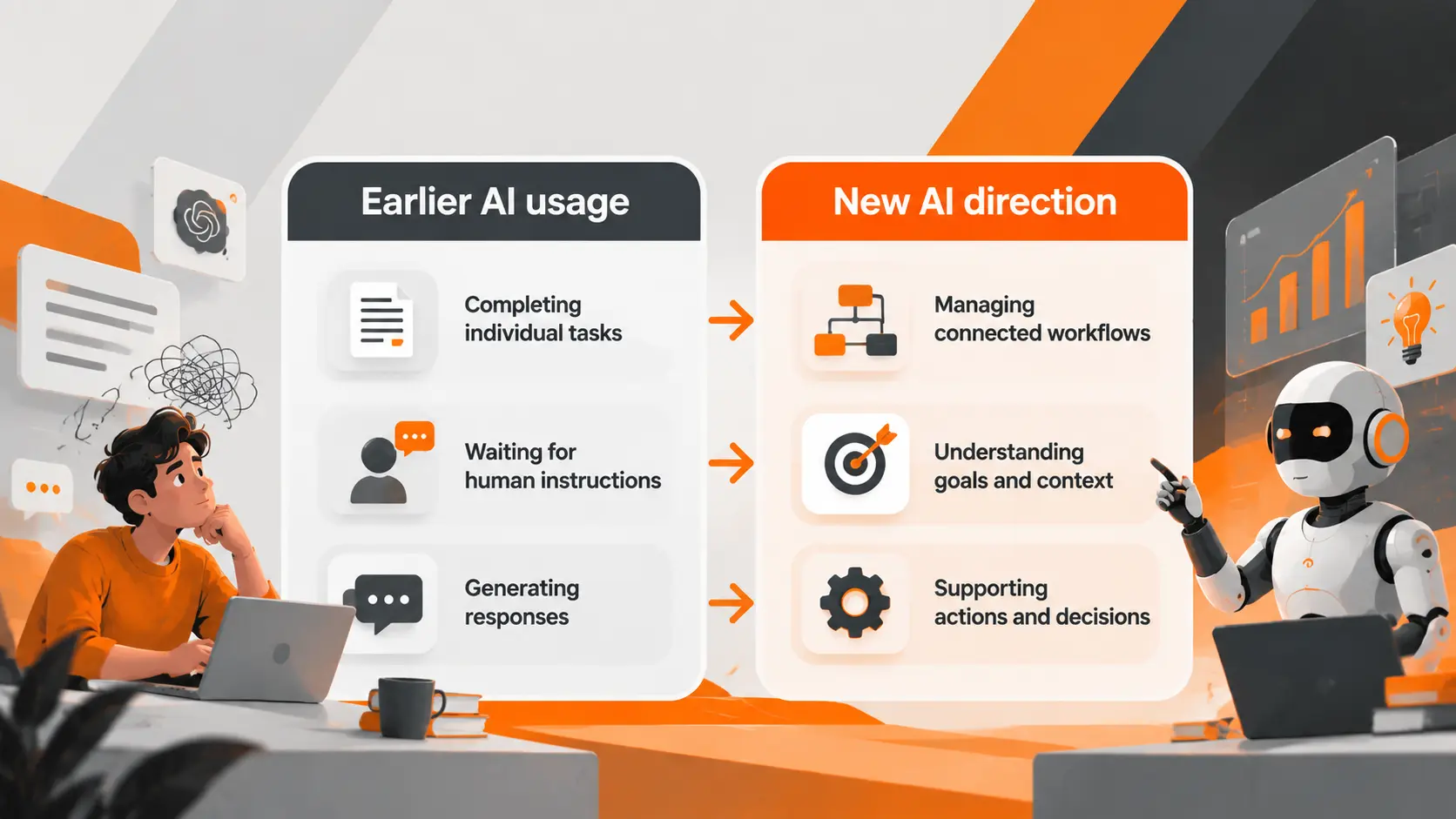
This shift is one of the main reasons AI trends have become such an important topic for businesses. The question is no longer only "What can AI create?" but "What parts of work can be redesigned with AI?"
Understanding this change is also important for anyone exploring the broader development of artificial intelligence and how it is affecting different industries.
AI agents are changing how companies use automation
AI agents are one of the most important developments shaping the next stage of AI.
Traditional automation works well when a process follows fixed rules. A system receives an input, follows predefined steps and produces an expected result.
AI agents work differently. They can analyze information, decide on the next step and use different tools to complete a goal.
For startups, this creates a major opportunity.
A small team can now handle tasks that previously required more time and resources. Research, customer communication, internal operations and product workflows can become faster when AI supports the process.
The important point is that successful companies will not use AI agents simply because they exist. They will identify areas where AI can remove unnecessary complexity while keeping important decisions under human control.
Specialized AI is creating new opportunities for startups
One pattern I keep seeing in the AI market is the move from general tools toward specialized solutions.
Early AI products focused on being useful for everyone. The next generation is focused on solving specific problems for specific groups.
A healthcare company, a legal firm and a marketing team do not need exactly the same AI solution. They need systems that understand their environment, data and workflow.
This creates an opportunity for startups.
The advantage will not only come from building another AI interface. It will come from understanding a problem deeply and creating a solution that uses AI to solve it better.
A startup with strong industry knowledge and a clear customer problem can often create more value than a company simply adding AI features without a real purpose.
AI is changing how startups are built
One of the biggest effects of AI is happening behind the scenes.
AI is changing the process of building companies.
Founders can test ideas faster, create early product versions more quickly and analyze information without spending as much time on repetitive tasks.
This does not mean building a successful company has become easy. Finding product market fit, understanding customers and making strategic decisions still require human experience.
The difference is the speed of execution.
A founder today can move from an idea to an early experiment much faster than before. This changes how startups validate opportunities and compete in early markets.
AI search is changing the relationship between users and information
Search is another area where AI is creating a major shift.
For years, businesses focused on ranking pages and attracting clicks. AI powered search is changing this behavior by creating more direct answers from information across multiple sources.
This does not make useful content less important. It makes quality and clarity more important.
Businesses that understand what users actually need and create valuable information will have a stronger position as search continues to evolve.
The focus is moving from simply creating content around keywords toward becoming a reliable source of information.
Multimodal AI is making technology easier to interact with
Another important trend is the expansion of multimodal AI.
AI systems are no longer limited to text. They can understand and combine different types of information, including images, audio and video.
This changes how people interact with technology.
Instead of learning complicated commands, users can communicate with software in more natural ways. They can describe a problem, show an example and receive assistance based on multiple inputs.
For businesses, this opens opportunities in areas such as education, customer experience, design and productivity.
The biggest impact of multimodal AI may come from making advanced technology easier for more people to use.
AI infrastructure is becoming a competitive advantage
Behind every AI application is a large infrastructure system.
Powerful models require computing resources, quality data and reliable technology infrastructure.
As AI adoption grows, the competition is not only between companies creating AI products. It is also between companies building the foundation that allows those products to work.
For startups, this creates opportunities beyond consumer facing applications. Infrastructure, data management and specialized AI systems are becoming important areas for innovation.
AI is changing the future of work
The conversation around AI and work is often focused on automation, but the bigger change is how people and technology collaborate.
AI is becoming better at handling information processing, repetitive tasks and pattern recognition.
Human skills such as judgment, creativity, communication and strategic thinking remain important because businesses still need people who can decide what should be built and why.
The future of work will likely belong to people who understand how to combine their own expertise with AI capabilities.
Trust and responsible AI are becoming business priorities
As AI becomes more involved in business processes, companies need to think more carefully about reliability, privacy and decision making.
A business cannot simply adopt AI because a tool is popular. It needs to understand how the system works, what information it uses and where human review is necessary.
Trust will become an important factor in AI adoption.
Companies that build reliable AI processes will have a stronger foundation as the technology becomes more integrated into everyday operations.
The AI trends that will shape the next stage of technology
Looking at the current direction of artificial intelligence, the biggest changes are connected to practical impact.
The important lesson is that AI trends are not only about new technology releases. They are about understanding where technology creates real changes in how businesses operate and how people work.
For founders and businesses, the goal is not to follow every AI announcement. The goal is to recognize the developments that can create meaningful advantages.
FAQ
Is following AI trends useful for someone who is not working in technology?
Yes. AI is affecting many industries, not only software companies. Understanding major developments helps professionals recognize how their work and industry may change.
How can a founder decide if an AI opportunity is worth building around?
A strong AI opportunity usually starts with a clear customer problem. The technology should improve a process or solve a real limitation instead of being added only because AI is popular.
Are AI agents the same as automation tools?
No. Traditional automation follows predefined rules, while AI agents can analyze situations, choose steps and work toward a goal using different resources.
What skills will become more valuable as AI improves?
Skills related to problem solving, communication, decision making and understanding business needs become increasingly important because they help people use AI effectively.
How should companies prepare for more AI adoption?
Companies can start by identifying repetitive processes, improving data quality and creating clear guidelines for where AI can support employees and where human review is required.

Fatemeh Jahangard
Technology & AI Writer at PinerookFatemeh Jahangard covers AI, emerging technologies, and digital innovation for Pinerook, focusing on how technology shapes startups and industries.
 Seen first.