AI becomes useful to a business when it solves a real problem, not when it simply adds another tool to the stack.
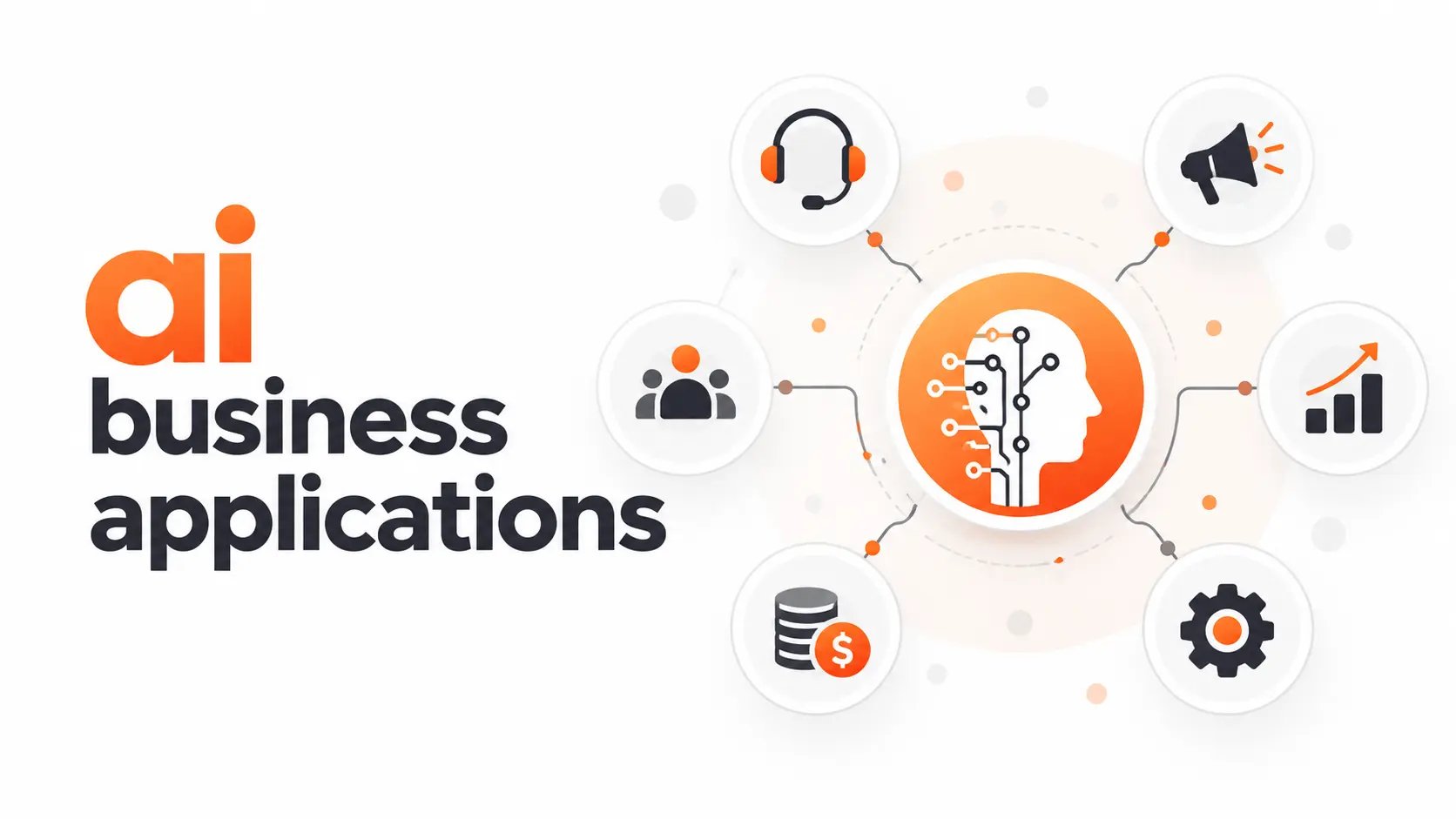
The strongest AI business applications I see today are in customer service, marketing, sales, operations, finance and product teams. In each case, the value comes from reducing repetitive work, making information easier to use or helping people make faster decisions.
The important part is knowing where AI actually fits.
AI Applications Across a Business
I find it easier to look at AI by business function rather than by technology.
A founder does not need to start by choosing between machine learning, generative AI or AI agents. Start with the part of the business that is slow, repetitive or difficult to manage.
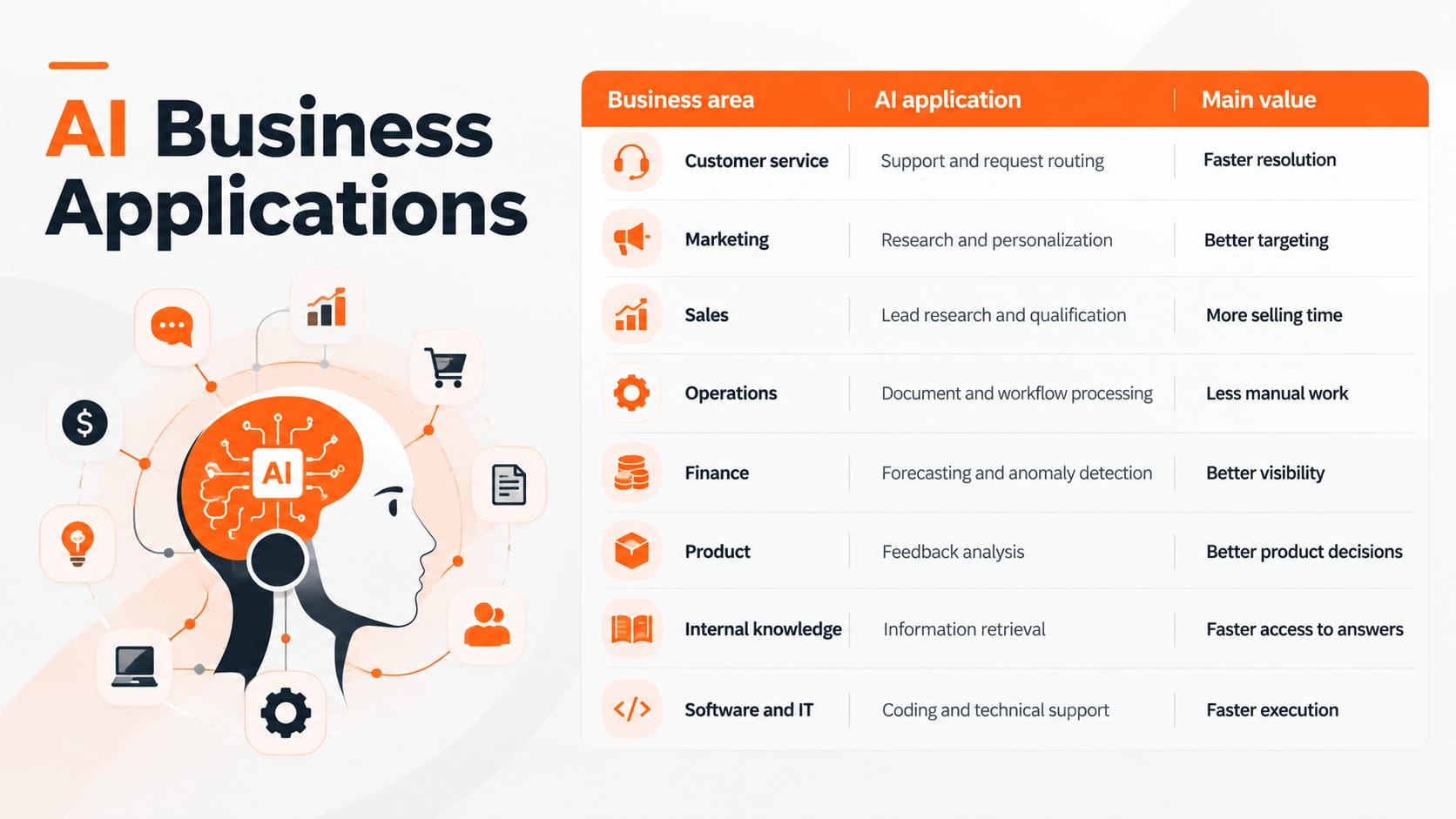
This is the practical side of artificial intelligence that matters most to a business. The technology becomes valuable when it improves a process people already depend on.
AI in Customer Service
Customer service is one of the clearest business applications of AI.
A support system can read a customer request, find relevant information, prepare an answer and route complex cases to a person.
It can also help support employees by summarizing previous conversations and retrieving account information before they respond.
The value is not having a chatbot.
The value is reducing the time between a customer asking for help and getting the correct answer.
AI in Marketing
I would not limit AI marketing to content generation.
The more useful applications start with customer information.
AI can analyze reviews, survey responses, campaign results and customer behavior to identify patterns that would take a team much longer to find manually.
That helps marketers:
understand customer segments
find repeated objections
personalize campaigns
compare campaign performance
organize market research
create content variations
Writing faster is useful. Understanding what should be written and for whom creates more value.
AI in Sales
Sales teams spend a large amount of time preparing to sell.
They research companies, review CRM records, prepare for meetings and write follow ups.
AI can handle much of that preparation.
Before a call, it can summarize the account and previous interactions. It can help rank incoming leads based on available customer and company data. After the call, it can organize notes and prepare the next action.
That leaves salespeople with more time for the work that still depends heavily on people: conversations, negotiation and relationship building.
AI in Business Operations
Operations is one of the first places I would look for valuable AI use cases.
A large amount of operational work involves moving information.
Someone reads a form, copies information, checks a document, updates a system or sends a request to another team.
AI can:
extract information from documents
classify incoming requests
summarize records
identify the next step
transfer information between workflows
This matters because repeated administrative work adds up quickly.
Saving two minutes on one task means little. Removing two minutes from a process that happens thousands of times changes operating capacity.
AI in Finance
Finance teams work with large amounts of structured information, which gives AI several practical roles.
It can support:
invoice processing
cash flow analysis
expense classification
forecasting
transaction monitoring
anomaly detection
I see the strongest role here as helping people find what deserves attention.
Instead of manually checking a large volume of transactions, AI can surface unusual activity for a finance professional to review.
The system handles scale. The finance team keeps responsibility for the decision.
AI in Product Development
Product teams collect feedback from support tickets, reviews, surveys, analytics and sales conversations.
The difficult part is turning all of that information into something useful.
AI can group related feedback, identify repeated complaints and show which issues appear across different customer segments.
That gives product teams a clearer view of what users are experiencing.
It should not decide the roadmap.
Its role is to organize evidence so the people making product decisions have better information.
AI in Internal Knowledge
Growing companies create a lot of information.
The problem is finding it again.
Employees lose time searching through documentation, previous projects, internal messages and company systems.
AI knowledge tools can let employees search company information using natural language and retrieve answers from approved internal sources.
This becomes particularly useful for:
onboarding
company policies
product information
operating procedures
sales documentation
technical knowledge
For this application, the source matters as much as the answer. Employees need to know where the information came from.
AI in Software and IT
AI has become a practical part of software and IT work.
Developers use it to explain code, prepare tests, create documentation and investigate errors.
IT teams can use it to classify requests, retrieve technical information and summarize incidents.
The value comes from reducing time spent searching and preparing.
Verification still stays with the technical team. Faster output does not remove the need to test code or review security related changes.
Choosing the Right AI Application
The biggest mistake I see is starting with the AI tool.
I would start with the workflow.
Look for work that has these characteristics:
Repeated
The process happens frequently enough that an improvement creates meaningful value.
Clear
The business knows what information enters the process and what a successful result looks like.
Measurable
You can compare performance before and after introducing AI.
Reviewable
A person can verify whether the output is correct.
Data Ready
The information AI needs actually exists and can be accessed safely.
These five conditions narrow a huge list of possible AI ideas into a smaller group of applications worth testing.
Measuring AI Business Value
AI usage itself is not a useful business metric.
I care more about what changed after AI entered the workflow.
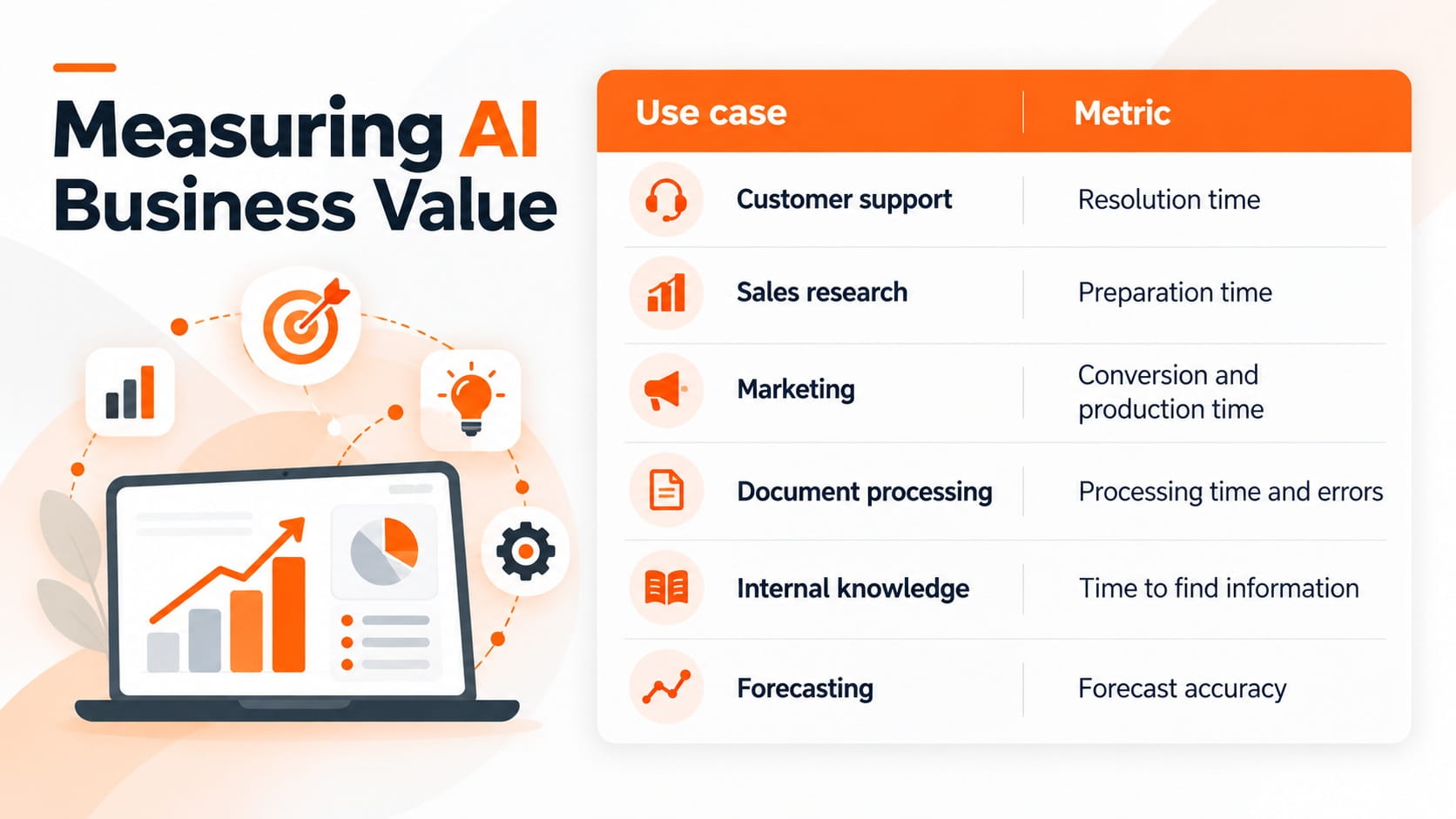
Then introduce AI and measure the same process again.
That makes it much easier to tell whether AI created real value or simply added another tool employees now have to manage.
Human Oversight
AI should have less freedom as the cost of being wrong increases.
Generating an internal summary and making an employment decision are not comparable tasks.
Businesses need stronger human control when AI touches areas such as:
employment
financial decisions
legal work
security
sensitive customer data
Human oversight also needs to be meaningful.
A person should understand the output well enough to reject it when it is wrong.
From AI Tools to Better Workflows
I think this is where business AI becomes most interesting.
The first stage is using AI for individual tasks:
writing an email, summarizing a document or researching a customer.
The next stage is connecting those tasks into a better workflow.
Sales research becomes an account briefing.
Customer support becomes request resolution.
Document summarization becomes document processing.
Marketing content becomes a system built around customer research and personalization.
That is the shift businesses should pay attention to.
The goal is not to use AI everywhere.
The goal is to find the places where AI makes the business noticeably better at something it already needs to do.
FAQ
Is AI worth using if my company only has a few employees?
Yes. Company size does not determine whether an AI application is useful. A small team can benefit significantly when AI removes work that would otherwise consume a large share of limited employee time.
Can I connect AI directly to all my company data?
No. Access should be limited to the information required for the specific application. Sensitive, confidential and personal data require appropriate security, permissions and governance before an AI system receives access.
Should customers know when they are talking to AI?
Customer facing systems should provide appropriate transparency and a clear route to human support when the interaction requires escalation or human judgment.
Is buying an AI tool better than building our own system?
It depends on the workflow. Existing software is more efficient when the business need is standard. Custom development becomes relevant when the process, integrations or company data create requirements that existing products cannot meet.
How long should I test an AI use case before deciding if it works?
The correct test period depends on how often the workflow runs. The business needs enough completed cases to compare the new process with its previous baseline using the metric selected before the test.

Fatemeh Jahangard
Technology & AI Writer at PinerookFatemeh Jahangard covers AI, emerging technologies, and digital innovation for Pinerook, focusing on how technology shapes startups and industries.
 Seen first.