An AI adoption strategy is not a plan for buying more AI tools. It is a way to decide where AI deserves a place inside your business, prove that it improves real work, and expand it only when the results justify the decision.
When I look at AI adoption, I start with the work itself. I look for time being wasted, repetitive tasks consuming skilled people, slow decisions, growing backlogs and processes that struggle to keep up with demand. That is where the business value of Artificial Intelligence starts to become useful rather than theoretical.
The goal is simple. Find one valuable workflow, understand how it performs today, introduce AI into a controlled part of it, measure what changes and decide whether the result deserves to scale.
Start With One Workflow That Has a Real Business Cost
The first decision is not which AI tool to buy.
It is which piece of work deserves attention.
I look for workflows where the business is already paying a visible price. That price might be employee time, slow delivery, repetitive manual work, inconsistent output or a process that cannot handle more volume without adding more people.
A broad idea such as using AI in marketing is not useful enough.
Reducing the time required to turn customer interviews into structured research notes is.
The difference is important because one describes a technology ambition while the other describes a business problem that can actually be tested.
I would not start with the AI project that looks most impressive in a demonstration. I would start with a workflow where better performance creates a clear benefit for the business.
That first project becomes the reference point for everything that follows.
Define the Business Result Before Introducing AI
Once I have selected a workflow, I record how it performs before AI enters the process.
Without a baseline, it is impossible to judge the result properly.
If account research takes 35 minutes per company, write that down.
If a support team handles 25 requests per shift, record it.
If a document goes through three rounds of correction before approval, measure that.
Then define what should improve.
The objective should not be to use AI more.
The objective should describe what changes in the business.
That could mean reducing research time, increasing the number of cases processed per employee, shortening response time, reducing manual review or improving consistency.
Usage alone does not prove value.
A team can use an AI tool every day and still fail to improve the process that justified the investment.
Choose the First Use Case by Value, Feasibility and Risk
Once teams start discussing AI, ideas appear quickly.
The problem is not finding possible use cases. The problem is deciding which one deserves resources first.
I reduce the list using three criteria.
Business value tells me whether solving the problem matters.
Feasibility tells me whether the required workflow, data and technology are ready.
Risk tells me what happens if the AI produces the wrong result.
For a first adoption project, I prefer a use case with meaningful value, strong feasibility and controlled risk.
Internal knowledge search, sales research preparation, support drafting with human approval and structured document preparation can fit this profile.
Fully autonomous customer communication, automatic financial approval or high impact decision making require a much higher level of evidence and control.
The first pilot does not need to attack the biggest problem in the company.
It needs to create enough value to matter while remaining controlled enough to learn from.
Define the Exact Role of AI Inside the Workflow
After selecting the use case, I define the role of AI in one sentence.
This keeps the project from turning into a vague request for an AI assistant or AI agent.
AI might retrieve information.
It might summarize documents.
It might classify incoming requests.
It might produce a first draft.
It might detect an exception.
It might recommend a next action.
These are very different roles.
If the problem is slow information retrieval, I do not need to build an autonomous system that controls several applications.
If the problem is repetitive drafting, I do not need AI to make final business decisions.
The role should match the problem.
This decision makes everything else easier because it becomes clear what data the system needs, what employees need to review and where human responsibility remains.
Check Whether the Workflow Is Ready
Before spending more time or money, I check whether the selected workflow is ready for AI.
I do not assess the entire organization. I only look at the process we are preparing to change.
The workflow needs a clear beginning and end.
Someone needs to own it.
The information required to complete the task needs to be accessible and reliable.
Employees need to understand what AI will do and what they remain responsible for.
There also needs to be a clear rule for what happens when the AI output is wrong.
A disorganized process does not become a strong process because AI is added to it.
If five people complete the same task in five different ways, I would standardize the workflow before attempting to automate part of it.
The same applies to data.
The important question is not whether the company has a lot of data. The important question is whether the selected AI system has access to the right information for this specific job.
Run a Narrow Pilot on Real Work
A useful pilot tests a business workflow.
It does not test whether an AI model can produce an impressive answer.
I keep the first pilot narrow.
One workflow.
One group of users.
One clear owner.
One primary business outcome.
One defined review process.
Take sales research as an example.
Asking an AI tool to research a few random companies and judging whether the output looks good tells me very little.
Instead, I would take a real set of accounts, measure how long research takes today, define the information sales representatives actually need and introduce AI into that process.
Then I compare the result with the baseline.
The real test is not whether AI creates a polished brief.
The test is whether the sales team reaches the required research standard faster without creating more verification work.
That is a business experiment.
Keep Human Approval Where Errors Carry Real Cost
I separate assistance from authority early.
AI can prepare a customer response without being allowed to send it.
It can identify an unusual invoice without approving a payment.
It can rank potential leads without deciding which customers receive different commercial terms.
It can prepare an internal summary without becoming the final source of truth.
The greater the impact on customers, employees, money, legal obligations or important business decisions, the stronger the human control should be.
This does not reduce the usefulness of AI.
It simply defines where accountability remains.
As the company collects evidence about reliability, more parts of the workflow can be reconsidered.
That decision should be based on performance, not excitement.
Make AI Part of the Work People Already Do
A strong AI model can still become a weak adoption project.
I have seen the problem appear when employees need to leave their normal tools, copy information into a separate AI application, write a prompt, inspect the answer and then move everything back into the original system.
AI has now created additional work.
I look at adoption as a behavior inside the workflow.
For a support team, that might mean reviewing a prepared response before answering a specific type of ticket.
For sales, it could mean opening a prepared account brief before first outreach.
For an operations team, it might mean reviewing flagged exceptions instead of checking every case manually.
The closer AI sits to the moment work happens, the easier it becomes to use and evaluate.
Training should follow the same principle.
I would rather show an employee how AI supports three real tasks from their job than give them a broad presentation about everything AI can do.
People adopt a better way of working.
They do not adopt a technology category.
Measure Adoption and Business Value Separately
I do not use a single metric to judge an AI project.
Three things need to work.
People need to use the AI in the intended workflow.
The output needs to meet the required quality standard.
The underlying business process needs to improve.
This is the one table I would keep in the article because it lets the reader evaluate a pilot quickly.
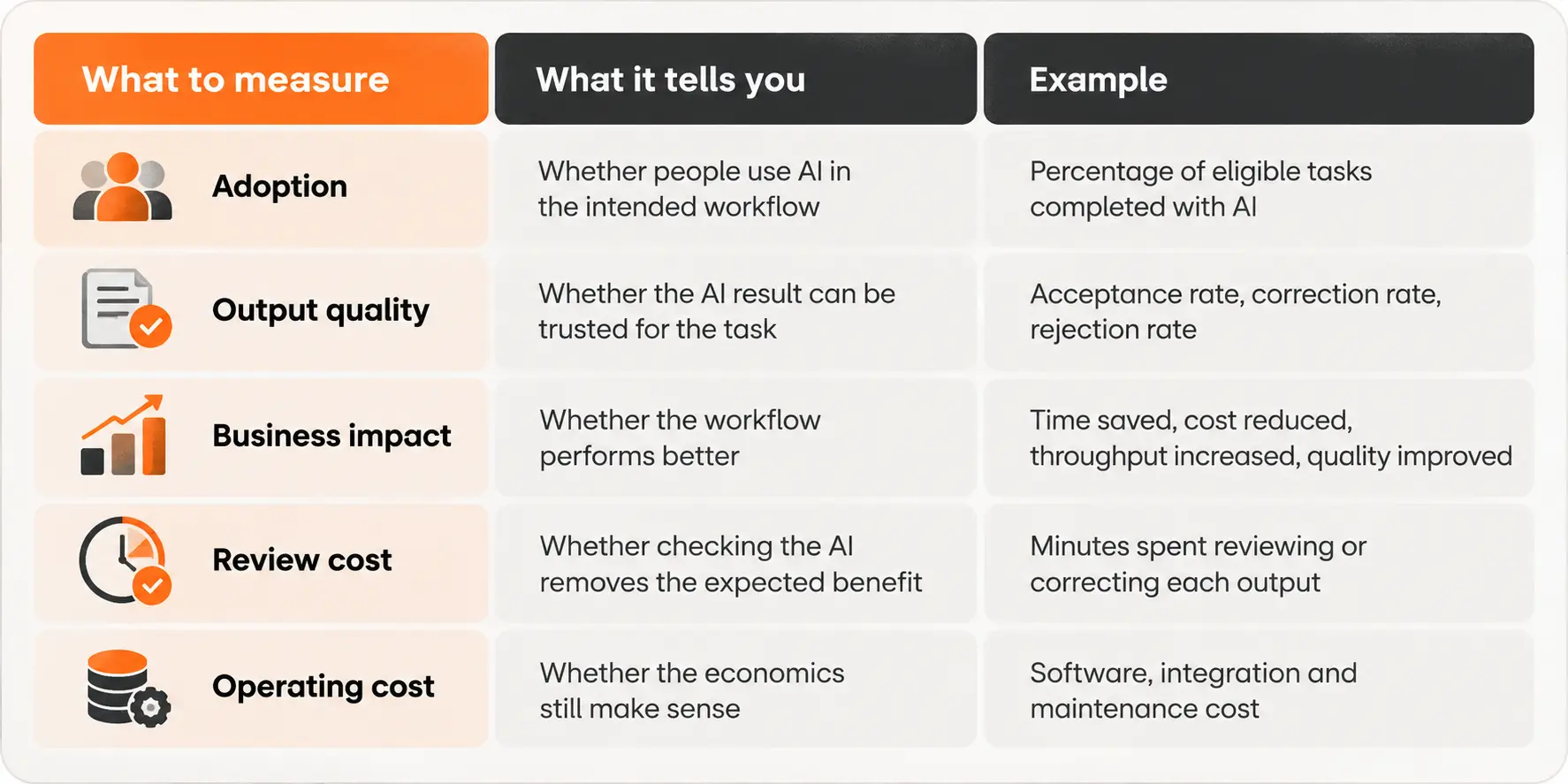
These measurements need to be read together.
High usage with poor output quality means the team adopted a weak system.
Strong output with low usage means the technology works but the workflow does not.
High usage and strong output with no improvement in the business metric means the project is not creating enough value.
The goal is not adoption by itself.
The goal is better business performance.
Count Human Review as Part of the Cost
One number can completely change the result of an AI pilot.
Review time.
If AI saves fifteen minutes of drafting but creates twelve minutes of checking and correction, the gross productivity claim is misleading.
I compare the total time before AI with the full time after AI.
That includes the AI assisted task, human review, corrections and any additional operational work.
The same logic applies outside productivity.
If AI increases support volume but also increases escalations, both need to be counted.
If it creates more sales leads but lowers their quality, both sides of the result matter.
AI adoption needs to improve the whole workflow, not one isolated step.
End Every Pilot With a Scale, Redesign or Stop Decision
A pilot should end with a decision.
I would not leave an AI experiment running for months because the team finds it interesting.
If the business metric improves, users adopt the workflow and the output meets the required standard, there is a case for scaling.
If value is visible but employees struggle with the workflow, redesign the process.
If human review removes most of the expected benefit, redesign or stop.
If unreliable data prevents consistent performance, fix the data foundation first.
If the risk of failure is greater than the value created, stop.
Stopping a weak pilot is not a failed AI strategy.
Scaling a weak pilot is.
Scale the Pattern That Worked
Scaling AI does not mean deploying the tool across the whole company.
I scale the proven workflow pattern.
That might mean adding more users to the same process.
It might mean moving the same solution into another market.
It might mean finding another workflow with similar inputs, controls and business economics.
The first pilot has already taught the company how employees respond, where data breaks, what needs human approval and which metric actually reflects value.
The next implementation should use those lessons.
This is where AI adoption starts to become repeatable instead of experimental.
Keep AI Strategy, Adoption Strategy and Implementation Separate
I treat these as three connected but different decisions.
AI strategy defines where AI supports the broader direction of the business.
AI adoption strategy defines where AI enters real work, how the company proves value and how successful use expands.
AI implementation covers the tools, systems, integrations and technical work required to deliver the use case.
The distinction matters because buying software is implementation.
It is not adoption strategy.
A company might decide that customer service needs to scale without increasing headcount at the same rate.
That is a business direction.
The adoption strategy identifies which support workflow AI can improve and how that improvement will be measured.
Implementation then determines which technology can deliver it.
Keeping these layers separate makes the decision much clearer.
Build the First Adoption Cycle in 60 Days
For a startup or growing company, I would not start with a year long AI transformation plan.
A focused 60 day cycle is enough to determine whether one use case deserves further investment.
The first part should be spent finding workflow friction and establishing current performance.
Then select one use case based on value, feasibility and risk.
Define the role of AI and prepare the data, controls and users.
Run the pilot on real work.
Use the final part of the cycle to compare results with the original baseline.
At the end, make one decision.
Scale.
Redesign.
Or stop.
I would rather finish one measurable project in that cycle than launch ten disconnected AI experiments.
The first project is not only testing AI.
It is testing how your company makes decisions about AI.
The Strategy Becomes Real When the Workflow Improves
A useful AI adoption strategy does not end with a document.
It ends with a piece of work being done better.
I start with business friction, choose one valuable and controlled workflow, establish how it performs today, define the exact role of AI and test it against a measurable outcome.
Then I look at the evidence.
If AI improves the workflow enough to justify its cost and risk, scale what worked.
If it does not, change the approach or stop.
That is a much stronger foundation than trying to predict every way AI might transform the company.
Prove one valuable use case.
Learn from it.
Then make the next decision with better evidence.
FAQ
Do I need to hire an AI person before we start?
No. The first project needs a clear business owner who understands the workflow and is responsible for the outcome. Dedicated AI or technical specialists become necessary when the selected use case requires custom integration, advanced data preparation, security work or model development.
What if most of our company knowledge is stuck in Google Drive, Slack and documents?
Define which information the selected workflow actually needs. Create an approved source set, establish access permissions and assign responsibility for keeping those sources current. Connecting every document and communication channel creates more complexity than value.
Should we build our own AI system or use an existing tool?
Use an existing product when it can perform the required job, meet your data and control requirements and fit the workflow at an acceptable cost. Custom development makes sense when the workflow creates strategic value that available products cannot deliver with the required control or integration.
How much money should I budget for the first AI project?
Base the budget on the value of the workflow you are trying to improve. Include software, integration, employee time, data preparation, review and ongoing operating costs. A pilot should prove enough business value to justify the larger investment that would follow.
What if the first AI pilot completely fails?
Separate the reason for failure. The problem may be the AI capability, the available data, the workflow design, user adoption or the original business assumption. Close the project when the economics remain weak after those factors are understood. A controlled failed pilot costs far less than scaling an unproven system.

Fatemeh Jahangard
Technology & AI Writer at PinerookFatemeh Jahangard covers AI, emerging technologies, and digital innovation for Pinerook, focusing on how technology shapes startups and industries.
 Seen first.